Showing posts with label Hovhaness. Show all posts

May 30, 2025

Keith Jarrett: A Tribute

by Karl Nehring

Earlier this month, American pianist and composer Keith Jarrett celebrated his 80th birthday. Although best known as a jazz pianist, his body of work extends far beyond jazz – and beyond the piano. We have reviewed a few of his recordings in the past; you can find those reviews here (Budapest Concert)here, (Bourdeaux Concert), and here (C.P.E. Bach Sonatas). Like many people, my first encounter with his playing was from listening to Forest Flower, on which Jarrett played piano as a member of the Charles Lloyd Quartet in a live set at the 1966 Monterey Jazz Festival that was released on Atlantic Records in 1967. In 1971, Jarrett, who was then touring with Miles Davis, had a fateful meeting with producer Manfred Eicher that resulted in Jarrett recording a solo piano album, Facing You, which was released in 1972 on Eicher’s ECM label. In 1973, had released Solo Concerts: Bremen/Lausanne, the first of what would become a series of concert recordings during which Jarrett played improvised music. Popular music critic Rick Beato has posted a YouTube video (which you can see here) describing a segment of this recording as “two of the most beautiful minutes in music.” 

While in the Army in 1974, I picked up both of his “American” quartet albums – Fort Yawuh and Treasure Island – on the Impulse! label, the latter of which featured Jarrett picking up the soprano saxophone on one of the cuts. As a side note, his “American” quartet included the late Dewey Redman, father of Joshua Redman (whose recent performance we mentioned here), on tenor saxophone, along with Charlie Haden on bass and Paul Motian on drums). 1974 also saw the release of the album Belonging on the ECM label, this by Jarrett’s “European” quartet, with Jan Garbarek on tenor saxophone, Palle Danielsson on bass, and Jon Christensen on drums. It’s a beautiful recording, highlighting Jarrett’s skill as a composer as well as a pianist. Then in 1975, ECM released what would become the best-selling piano recording in history, Jarrett’s The Köln Concert. It’s a spellbinding album that still sounds fresh and new 50 years after its initial release.

In 1976, Jarrett received a commission from the Deutsche Grammophon to compose a piece for the Boston Symphony Orchestra. It was to be conducted by Seiji Ozawa and feature Jarrett on piano. Jarrett completed his 200-page, 40-minute score for The Celestial Hawk in 1978. The BSO had been expecting a jazzy piece with Jarrett doing a lot of improvising, apparently thinking that would guarantee box-office success; when they saw it was a serious classical composition, they lost interest, and the project was dropped. Instead, Eicher decided to record the work for his ECM label, with Jarrett on piano accompanied by the Syracuse Symphony Orchestra conducted by Christopher Keene. It was released in 1980.


In 1984, Eicher decided to expand ECM into the classical realm and brought a new sound into the musical world with the release of Arvo Pärt’s Tabula rasa, the first album on the label’s New Series imprint. This recording also marked the intersection of some of the most longstanding, significant musical collaborators in the label’s history: Arvo Pärt, Gidon Kremer, and Keith Jarrett. I was quite familiar with Jarrett, somewhat familiar with Kremer, but my familiarity with Pärt extended only as far as having heard his name but not his music when, late at night in 1984 while sitting in my car having just finished a shift as a security guard while I was still in grad school, over the radio came music that immediately held me under its spell. The late-night host on WOSU-FM announced that he was playing some tracks from a new album of music by the Estonian composer Arvo Pärt, and that we had just heard his composition Fratres, performed by violinist Gidon Kremer and pianist Keith Jarrett. Keith Jarrett?! Although the music sold itself, Jarrett’s endorsement made me even more eager to run out and purchase the CD just as soon as I could find it; I have been an enthusiastic Arvo Pärt fan ever since.

Jarrett went on to release many, many recordings over the ensuing decades, both as a soloist and as part of an ensemble. Many of these were jazz, of course, but there were also many classical efforts, in music of Bach Handel, Mozart, Shostakovich, Bartók, Barber, Harrison, and Hovhaness. (If I may be permitted another personal aside, it was Jarrett who introduced me to the 24 Preludes and Fugues for Piano by Shostakovich – I had many recordings of DSCH’s symphonies and was somewhat familiar with his concertos and chamber music but had no idea this marvelous piano music even existed until ECM released Jarrett’s recording in 1992. I now own several versions and continue to delight in this music that Jarrett first revealed to me.) 


In 1994, Jarrett’s Bridge of Light album appeared on the ECM New Series label, containing four classical compositions by Jarrett: Elegy for Violin and String OrchestraAdagio for Oboe and String OrchestraSonata for Violin and Piano, and Bridge of Light for Viola and Orchestra. Jarrett said of these works, “Actually, all of these pieces are born of a desire to praise and contemplate rather than a desire to "make" or "show" or "demonstrate" something unique. They are, in a certain way, prayers that beauty may remain perceptible despite fashions, intellect, analysis, progress, technology, distractions, "burning issues" of the day, the un-hipness of belief or faith, concert programming, and the unnatural "scene" of "art", the market, lifestyles, etc., etc., etc. I am not attempting to be "clever" in these pieces (or in these notes), I am not attempting to be a composer. I am trying to reveal a state I think is missing in today's world (except, perhaps, in private): a certain state of surrender: surrender to an ongoing harmony in the universe that exists with or without us. Let us let it in.” It is a charming album, pastoral and serene. If you were to listen to it today without being told who the composer is, your guess might well be a British composer such as, say. Butterworth. 

Tragically enough, in 2018 Jarrett suffered the first of several strokes that robbed him of the use of his left hand, thus leaving him unable to continue his career at the piano. However, ECM has since released several albums of past concert performances; in fact, there is a release of a recording he made in Vienna that we will be reviewing in a forthcoming post. For more insight into this fascinating musician, whose music blurred the boundaries between classical and jazz, between composed and improvised, there is a an in-depth interview that the notoriously press-shy Jarrett granted to Rick Beato; that fascinating video can be seen here.

Aug 16, 2023

Hovhaness: Mountain Fantasies for Piano (CD Review)

by Karl Nehring

Blue Job Mountain SonataProspect Hill SonataMt. Katahdain SonataPastoral No. 1Hymn for Mt. Chocorua12 Armenian Folk SongsFarewell to the Mountains. Haskell Small, piano. MSR Classics MS 1796

Although Alan Hovhaness (1911-2000) may not be widely regarded by music fans as one of the great American composers, his music stands as some of the breathtakingly beautiful music to have been composed by an American in the twentieth century, and deserves to be more widely performed and appreciated. Gerard Schwarz led the Seattle Symphony in a number of fine recordings of his orchestral music for the Delos label that were later rereleased by Naxos. The majority of these were recorded by legendary engineer John Eargle in demonstration-quality sound. Schwarz later recorded some Hovhaness for the Telarc label, on a disc that our John Puccio reviewed here, and there is a famous recording by Fritz Reiner and the Chicago Symphony Orchestra of that same Mysterious Mountain Symphonythat John reviewed here. This latest release from MSR Classics also centers around mountains, but this time the music is for solo piano, here performed by the American composer and pianist Haskell Small (b. 1948).


In his fascinating liner note essay, Robert Aubry Davis (SiriusXM listeners should find that name familiar) notes how important mountains are to the culture of Armenia (Hovhaness’s father was Armenian, and after college, Hovhaness served for a time as the organist at an Armenian church). As a boy, then young Hovhaness spent many hours hiking the hills near his uncle’s farm in western Massachusetts. Davis points out that “musical references to mountains run from his earliest to his very last compositions.” This is an important thread in the composer’s work, but Davis then goes on to reveal something quite extraordinary about Hovhaness, an aspect of his life that was previously unknown to me; something that ties Hovhaness to a composer I would never have supposed. “The other thread, which brings us to this recording, is the importance of the piano in his life and work… according to Hovhaness himself, after a punishing life disappointment, he credited another pianist who also is almost exclusively known for his non-piano compositions) with nearly saving his life. Composer Roger Sessions had taken an interest in Hovhaness from those high school days. However, Sessions apparently gave a brutal assessment of Hovhaness’s compositions at the New England Conservatory. The reports vary, but apparently over some weeks, in reaction to this, Hovhaness burned between 500 and 1000 of his own compositions. He sought both a musical ally and hero after this. As he later shared with me, Hovhaness had felt a profound musical kinship with the foreboding Finn, Jean Sibelius, noting that in the slow movement of the Fourth Symphony he found a kind of spiritual evocation of his own sense of despair. So he decided to make a pilgrimage.”


Davis goes on to relate that Hovhaness and his young wife then went to visit Sibelius at his home if Finland, where Sibelius sat the young American down in front of his grand piano and asked him to play some of his compositions for piano. “Sibelius was defensive of his piano works: ‘I know that they have a secure future; I know it despite the fact that they have completely fallen into oblivion,’ he said. In our time, only Glenn Gould (outside of some Finnish pianists) has been a secure champion of the pieces. But apparently, Sibelius was not only impressed with how wonderfully Hovhaness played them sight unseen for the first time, but how the American went on to express what an inspiration the elder Finn’s compositions were to his own. They became friends to Sibelius’s death; Sibelius in fact became godfather to Hovhaness’s  only daughter, who was named Jean Christina after Jean Christian Sibelius himself.” 


Those who may have been exposed to the piano music of Sibelius by recordings such as the  delightfully rewarding – and highly recommendable – collection by Norwegian pianist Leif Ove Andsnes would probably be hard-pressed to find much similarity between the piano music of the two composers other than that neither was given to writing flashy keyboard pyrotechnic displays. In contrast, the music featured on this collection is clearly not about virtuosic technique; instead, especially in the first three sonatas, the music has an almost hymnlike quality to it, an incantatory feeling, almost as if Hovhaness were writing music of ritual praise to mountain spirits. Underlying that ritualistic sense there is a clear folk influence, a human aspect, a desire to dance. Although the title of Pastoral No. 1 might seem to imply something light and breezy, but instead the piece opens with some darker shades of sound produced from inside the piano. The music is not harsh, or threatening, but brooding, pensive – Hovhaness reflecting intensely upon a scene in nature and finding a quiet, glowing beauty to share with the listener. A remarkable piece.


The Hymn for Mt. Chocurua opens in stately hymn style, but soon switches to an energetic folk/dance rhythm bursting with energy, then closes with a hymn that seems to have picked up some of the energy from the preceding dance interlude. The 12 Armenian Folk Songs are lively, brief (most under a minute, the longest clocking in. at 2:47), and basically a dozen minutes of light fun. The concluding Farewell to the Mountains continues in. much then same musical vein – it could well be the thirteenth folk song. Davis recollects that Hovhaness considered mountains to be “the symbolic meeting place between the mundane and spiritual worlds.” In this recording, which includes elements of folk dance, hymn tunes, echoes of nature, and mystical incantations, the listener is certainly lifted above the mundane. Most classical music fans have plenty of piano music by Beethoven, Mozart, Chopin, Debussy, Brahms, Rachmaninoff, Liszt, etc. in their collections – how about a fascinating CD of Hovhaness? Try it – you might like it. 

Jan 19, 2022

Piano Potpourri, No. 5 (CD reviews)

By Karl W. Nehring

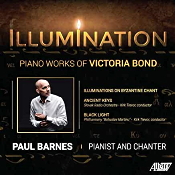
Illumination: Piano Works of Victoria Bond. Illuminations on Byzantine Chant; Ancient Keys*; Black Light**; Byzantine Chant. Paul Barnes, pianist and chanter; Kirk Trevor, *Slovak Radio Orchestra; Philharmony “Bohuslav Martinu”. Albany Records TROY1880.

Once again we encounter a composer – and performer – whom we have not encountered before, and we are once again rewarded with some music that is interesting, entertaining, and uplifting. The American composer and conductor Victoria Bond (b. 1945) was the first woman to be awarded a doctorate in conducting from the Juilliard School and has composed eight operas, six ballets, two piano concertos, as well as other works. In her liner notes, Bond explains that the works included on this release stem from more than two decades of collaboration with the American pianist Paul Barnes (b. 1961). This temporal span is exemplified not only by the recording dates of the compositions (Ancient Keys, 1997; Black Light, 2003; Illuminations on Byzantine Chant, 2021) but also by dates of the composition that opens the program, Illuminations on Byzantine Chant, a work for solo piano in three parts: Potirion Sotiriu, 1999; Simeron Kremate, 2019; and Enite ton Kyrion, 2021.

The first two movements of Illuminations, Potirion Sotiriu and Simeron Kremate, are energetic and intense, with an Eastern flavor that is consistent with their roots in the Greek Orthodox tradition. The third movement, Enite ton Kyrion, is more meditative in mood, more peaceful and lyrical. Ancient Keys, a piano concerto in one movement, begins with a chant from pianist Barnes before the orchestra enters, followed by his piano. According to Bond, Ancient Keys is based on Potirion Sotiriu. “In expanding the solo piano work for piano and orchestra, I pictured an enormous space, like a great cathedral, gradually filling up with rich and sonorous bass [sic] tones that swirled around, echoing and disappearing like delicate smoke into the high dome.” (Given the way the piece opens, I’m pretty sure she meant “brass tones.”) Over its 17 minutes, this is a piece that provides drama and a sense of mystery. Impressive! Black Light is in three movements. Interestingly enough, Bond writes that “the title Black Light implies the light that shines from African American music, which has had a profound effect on my compositions.” The first movement is almost jarringly energetic – it is marked “Aggressively driving” and is certainly that. Not unpleasant, mind you, but something that will definitely wake you up. The second movement, marked “Forcefully,” is much less aggressive, and is said by the composer to be inspired by Jewish liturgical music. The final movement, marked “Presto,” said to be inspired by the scat singing of Ella Fitzgerald, is quite a fun romp. The program then ends in a completely different vein as Barnes performs four brief Byzantine chants, including the three that undergird the beginning of the program: Potirion Sotiriu, Simeron Kremate, and Enite ton Kyrion. All in all, then, what we have here is something of an unusual musical program, but nonetheless a recording that is coherent, stimulating, and satisfying, with more than satisfactory engineering and informative liner notes. Well worth an audition by the musically curious.

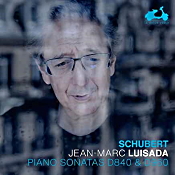
Schubert: Piano Sonatas D. 840, ‘Reliquie’ & D. 960. Jean-Marc Luisada, piano, La Dolce Volta LDV 93. 

The Tunisian-born French pianist Jean Marc Luisada (b. 1958) offers performances of two piano sonatas by Schubert on this beautifully engineered recording that comes in a hardbound book-type bound format featuring liner notes in four languages: French, English, Japanese, and German. This is surely one one of the most imposing and impressive presentations that I have encountered in quite some time. The question that remains, then, is whether the musical performance is worthy of the engineering and packaging quality lavished upon it. To these ears, at least, the answer is affirmative.

Luisada plays only the first two movements of the Sonata in C major, D. 840, known as the “Relique” a name it was given because when it was first published it was mistakenly thought to be Schubert’s final work in piano sonata form. These first two movements, marked Moderato and Andante, being the only two that Schubert completed himself. By the way, although there are only two movements, they are substantial, taking up more than 28 minutes. There exists a longer version that includes later movements that were completed by Ernst Krenek. In Luisada’s view, “In Schubert’s case, incompletion is not a sign of impotence. It’s a deliberate gesture, because he has already said the essential, revealed the suffering of the moment.” As we listen to Luisada’s tenderly expressive performance and ponder his perspective on this work, we find ourselves confronting one of music’s – of art’s – paradoxes, how the expression of sorrow and suffering can at the same time be so beautiful and life-affirming.

Then it is on to the Sonata in B-flat major, D. 960, which truly was Schubert’s final piano sonata, of which Luisada comments “is a culmination, the completion of a life… Certain passages in the first movement of the sonata are among the highpoints of the whole nineteenth-century musical literature. Then there are the moments bathed in an immaterial atmosphere, when the Wanderer calmly accepts death in the C major modulation at the end of the second movement, the Andante sostenuto. This imposes a feeling of stillness, a sensation of eternity… In this recording, I play [the Scherzo] slower than usual and in the spirit of an angel dance with a certain reserve… In truth, nothing is improvised in Schubert. Sometimes he gives the illusion of improvisation, pulls the wool over our eyes. Everything is ‘orchestrated’ without ever reaching a climax, for he must constantly postpone the inevitable, gain time. Only the Faustian finale with its galloping theme and its syncopations in the left hand ends the Wanderer’s race to the abyss.”  

For those who might be unfamiliar with this composition, it is an imposing work, but one that is ever so beautiful. The first movement is the longest; at 20 minutes or so, it could pretty much stand on its own as an independently satisfying work of art. (I must confess that there have been times when I have come to the end of the movement and then rather than going on to the next, have immediately returned to the beginning of the movement again, lingering with this music for another 20 minutes, because it is just so beautiful that I cannot bear to part from it.) But then comes the second movement, that Andante sostenuto, slow and tender for nearly 10 minutes, music to melt your heart, with Luisada playing it as expressively as can be imagined without ever taking it over the top. The relatively brief Scherzo follows, dancing along for less than five minutes before we come to the closing nine-minute Allegro, which bounces along until it seems to hesitate questioningly near the end before seeming to take a deep breath and conclude with a flourish. Overall, Luisada plays with great imagination and emotion, bringing out the drama in the music. D. 960 truly is one of the truly great piano sonatas, a work that every classical music listener should encounter at some point. A great place to start for those who have not yet heard the piece would be the recording by Mitsuko Uchida on Philips, a more straightforward but still quite beautiful performance; however, for those who are already acquainted with the piece, this new recording by Luisada offers a fascinating interpretation that is well worth an audition, and the pairing of both sonatas on one disc and the superb recorded sound make this an especially appealing choice.  

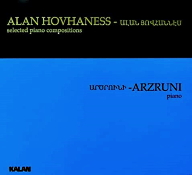
Hovhaness: Invocations to Vahakn; Yenovk; Lalezar; Suite on Greek Tunes; Mystic Flute; Journey Into Dawn; Laona; Lake of Van Sonata; Vijag; Sonata “Hakhpat”. Sahan Arzruni, piano; Adam Rosenblatt, percussion. KALAN 773. 

Many classical music fans are no doubt familiar with the orchestral works of the late American composer Alan Hovhaness (1911-2000), who wrote 67 symphonies as well as other symphonic works such as the symphonic poem And God Created Great Whales. With something like 464 works in his published catalog plus additional unpublished manuscripts, Hovhaness wrote not only for orchestra, but for other ensembles and solo instruments as well, including the piano. The Armenian pianist Sahan Arzruni (b. 1943) has studied the piano music of Hovhaness in preparation for recording this album of selected piano works by the composer. Clearly this was a work of love, for Arzruni points out that the majority of the compositions he chose to include are unpublished, existing in manuscript form only. Arzruni comments that Hovhaness “was a musician-mystic who rejected the materialistic values of the Machine Age. He explored, instead, the transcendental realm – using music as a link between the physical and metaphysical worlds. Hovhaness took non-Western cultures as his point of departure, while employing Western music as his frame of reference.” Arzruni goes on to quote the American composer and critic Virgil Thomson who wrote of Hovhaness in 1947 that “the music is at times strophic in phraseology and emotionally continuous, never climactic. Each piece is like a hand-made wallpaper. Its motionless quality is a little hypnotic. Its expressive function is predominantly religious, ceremonial, incantatory, its spiritual content of the purest.”

Even before reading the extensive liner notes in which Arzruni provides detailed background information on each track, you begin to get a sense of what Thomson was writing about even before you read it. The music does have a sense of the mystical about it, a feeling of striving for something beyond the notes. The occasional addition of percussion adds to the sense that the music is part of some sort of ritual. That is not to say, however, that it cannot be enjoyed purely as music, for it is music that is lively, energetic, and quite capable of capturing the imagination. On the back cover of the booklet is a quotation from Hovhaness himself that makes his intentions clear: “I propose to create a heroic, monumental style of composition simple enough to inspire all people, completely free from fads, artificial mannerisms and false sophistications, direct, sincere, always original but never unnatural.” That is a bold, ambitious statement, but for the music on this album at least, I would say that he pretty much succeeded, with the able assistance of Arzruni, Rosenblatt, and the engineering team. The booklet and disc are packaged in a sturdy box; all in all, this is a first-class production of some fascinating music that deserves to be heard. Highly recommended!

KWN

Nov 6, 2019

RCA Living Stereo (CD reviews)

Dvorak: Symphony No. 9 "From the New World," and other orchestral masterworks. Fritz Reiner, Chicago Symphony Orchestra.  RCA Living Stereo 09026-62587-2.
Hovhaness: Mysterious Mountain; Prokofiev: Lt. Kije; Stravinsky: The Fairy's Kiss. Reiner, CSO. RCA Living Stereo 09026-61957-2.
Respighi: Pines and Fountains of Rome; Debussy: La Mer.  Reiner, CSO. RCA Living Stereo 09026-68079-2. 

By now, the names Fritz Reiner and "Living Stereo" should be synonymous with highest recommendation. It's a no-brainer, a win-win situation. Between the years 1954 and 1962 Reiner made a remarkable number of stereo recordings for RCA. They were remarkable for two reasons:  first, because almost all of them were immediately recognized as superb performances and have remained on practically everyone's list of recommended recordings for the last forty years; second, because they were recorded in the pioneering days of stereo before sound engineers had learned much about screwing things up.

Back then, a lot of recording engineers appeared to be interested in minimal miking, a wide stereo spread, good front-to-back dimensional information, as well as wide dynamic and frequency ranges and reasonably unaffected tonal balance. Things like stereo multi-miking, spotlighting, highlighting, partitioning, reverb, compression, dynamic and frequency limiting, and artificial brightness were just starting to come into their own. For the most part, the conductor was still in charge of the sound of his orchestra. Lovingly remastered by RCA, the "Living Stereo" CD series, which RCA introduced in the mid 1990's, especially the ones with Reiner, show us just how good those simple, early techniques were, techniques later adopted by many prominent audiophile labels in their own recordings.

Anyway, of the three early discs in RCA's "Living Stereo" CD line, Reiner's Dvorak is the only recording I had not heard in many years. This Dvorak Ninth Symphony from 1957 still does not displace my favored Kertesz (Decca) or Horenstein (Unicorn) recordings, but it packs much mature drama and conviction into a powerful and enjoyable performance.

Fritz Reiner
The Reiner recording of Hovhaness's Mysterious Mountain, also from 1957, has been a classic for four decades and helped put Hovhaness on the musical map. It may not hold up as well sonically as, say, Gerard Schwarz's Seattle Symphony disc on Delos, but it is clearly among the most profoundly spiritual readings imaginable. Its coupling with Stravinsky's Fairy's Kiss and a delightful rendition of Prokofiev's Lt. Kije makes this an attractive package. Each of these recordings had appeared previously on CD from RCA. Perhaps in the "Living Stereo" series they lose a little something in overall brilliance, but they have never sounded quieter, smoother, or more natural.

The third disc I'll mention is an absolute must-buy. I think I have owned Reiner's Respighi tone poems, the Pines of Rome and Fountains of Rome, in one form or another for as long they have been around (RCA recorded them in 1959, and I bought the LP in the early 60's). Yes, the newer Muti and Dutoit recordings sound a little better in some ways, but no one has yet captured the color and splash of these works as well as Reiner. Coupled with yet another classic among classics, Debussy's La Mer, itself a perennial top-of-the-pile choice, this disc gets my highest  recommendation.

The reader newly acquainted with classical music could do worse than to purchase anything in the Reiner series; the reader newly acquainted with audiophile sound could do worse with many, if not most, modern recordings.

Incidentally, since issuing their "Living Stereo" series on CD, RCA has also issued many of the recordings on SACD, and JVC has remastered many of them in XRCD24. Choices, choices....

JJP

To listen to a brief excerpt from this album, click below:

Sep 3, 2014

Hovhaness: Mysterious Mountains (CD review)

Also, Mysterious Mountain, Hymn to Glacier Peak, Mt. St. Helens, Storm on Mount Wildcat. Gerard Schwarz, Royal Liverpool Philharmonic Orchestra. Telarc CD-80604.

Alan Hovhaness (1911-2000) was one of the last of the Romantics, a composer who still believed that music should be enjoyed for its melodies, its harmonies, its sheer beauty of expression rather than any radical experimentation. Apparently, the public appreciated his work, too, because he became one of the late twentieth century's most popular living classical composers.

This Telarc disc from 2003 offers a program of four works on one of Hovhaness's favorite subjects: mountains. As Hovhaness said, "Mountains are symbols, like pyramids of man's attempt to know God. Mountains are symbolic meeting places between the mundane and spiritual world."

The selections begin with his most-celebrated and most-recorded work, the Symphony No. 2, "Mysterious Mountain." Even though Hovhaness had been composing professionally for twenty-odd years before Leopold Stokowski premiered the Second Symphony in 1955, "Mysterious Mountain" made the composer famous, and it remains today probably his most well-known piece of music. The composer's own comment about his music in general applies equally to "Mysterious Mountain":  "My purpose is to create music, not for snobs, but for all people--music which is beautiful and healing--to attempt what old Chinese painters called 'spirit resonance in melody and sound.'"

Maestro Gerard Schwarz recorded "Mysterious Mountain" once before, with the Seattle Symphony for Delos, and this time on Telarc with the Royal Liverpool Philharmonic he's a bit slower going about his business, a tad more reverentially cautious. There isn't quite the same dash or thrill in the work, not quite the same majesty we heard earlier. Yet he has replaced it with a tranquility that may suit the piece even better. Perhaps it's age creeping up on Schwarz or just a reconsideration of the work, but in any case the reading makes a good companion performance if you already own the Delos disc because the interpretations are different enough to enjoy both. The same goes if you own the classic RCA Living Stereo edition with Fritz Reiner and the Chicago Symphony, another first-rate choice.

Coupled with "Mysterious Mountain" are Hovhaness's Symphony No. 66, "Hymn to Glacier Peak" (1991); Symphony No. 50, "Mt. St. Helens" (1982); and a particularly energetic rendering of a short early work, "Storm on Mount Wildcat" (1931). I found the Allegro to "Mt. St. Helens" as moving a piece of music as I've heard in a long time.

The Telarc engineers, recording the Royal Liverpool Philharmonic for the first time, produced as smooth a sound as anything they've done. It's not necessarily the most transparent or the most-dimensional sound they've ever recorded, but it is certainly dynamic, natural, and listenable, and it suits the spiritual nature of the music making nicely.

JJP

To listen to a brief excerpt from this album, click here:


Dec 12, 2011

Hovhaness: American Mystic (CD review)

Music of Alan Hovhaness: Centennial Collection. Gerard Schwarz, Seattle Symphony Orchestra; Keith Brion, Ohio State University Concert Band; Shanghai Quartet. Delos DE 3421.

If Alan Hovhaness had been born in the nineteenth century, people would have called him a Romantic (or a Romanticist). But he was born and lived in the twentieth century (1911-2000), surrounded by "modern" composers experimenting with impressionism, expressionism, twelve-tone techniques, microtones, aleatoric music, indeterminacy, stochastic music, intuitive music, neoclassicism, free improvisation, process music, atonal ideas, and the like. Hovhaness's more "spiritual" music, dwelling as it did on harmonies and melodies and moods of wonder, reflection, and meditation, must have seemed downright old-fashioned. Thus, his label as a "mystic."

Delos recorded quite a lot of Hovhaness's music in 80's and 90's, a dozen or more albums, and on the present disc they have collected together some of the composer's most-representative pieces, culled from their back catalogue and featuring several outstanding ensembles. The CD makes a good introduction to Hovhaness's vast output (the man wrote some sixty-seven symphonies alone) and for those listeners not familiar with the composer, it may whet the appetite for more intensive collecting of his material.

The relatively lengthy and diverse program begins with the little Prayer of St. Gregory, Op. 62b, with Gerard Schwarz leading the Seattle Symphony Orchestra and Charles Butler on trumpet. Delos recorded it beautifully--it sounds rich, resonant, and detailed--and the performance is heartfelt and serene.

Next is The Rubaiyat of Omar Khayam, Op. 308, again with Schwarz and the Seattle Symphony, featuring Michael York as the narrator and Diane Schmidt on accordion. It is atmospheric, romantic, and effective.

Following those items are 4 Bagatelles, Op. 30, done by the Shanghai Quartet. The group seems somewhat big-sounding for the occasion, but they play beautifully.

Then it's on to the centerpiece of the collection, the Symphony No. 2 "Mysterious Mountain," Op. 132. Although Hovhaness had been composing professionally for twenty-odd years before Leopold Stokowski premiered the Second Symphony in 1955, it was the work that made the composer famous, and it remains today probably his most well-known piece of music. Under Schwarz and the Seattle Symphony, it is certainly evocative and mystical in tone, although I have a slight preference for the much-older performance by Fritz Reiner and the Chicago Symphony (RCA). Oddly, too, the Seattle midrange sonics are a tad steely, yet without in any way sounding edgy and having a fine, extended high end.

The Shanghai Quartet return for the String Quartet No. 2, Op. 147, "Gamelan in Sosi Style" and "Spirit Murmur," two movements that are direct and sorrowful, with obvious Asian and South Pacific influences.

The most-surprising music on the program is The Flowering Peach, Op. 125, performed by the Ohio State University Concert Band under director Keith Brion. It sounds nothing like band music but is chamber-like in its approach, using saxophone, clarinet, harp, and various percussion instruments. Also surprising, it is incidental music Hovhaness wrote in 1954 for a Broadway play by Clifford Odets, and it includes a whole passel of different cultural idioms. As with most of the recordings on the album, it sounds wonderful in its laid-back, leisurely style.

The program concludes with a personal favorite of mine, And God Created Great Whales, Op. 229, again with Schwarz and his Seattle Orchestra. It is probably the most environmentally correct music ever written, incorporating as it does the actual songs of whales within the score. Hovhaness composed it in 1970, and I remember first hearing it during a presentation on whales at a local natural museum show. A delightfully soft, relaxed recording helps make the piece a fascinating and totaling engrossing work.

I might add that Delos provide over seventy-five minutes of selections on the disc, a generous offering that only just touches the surface of the composer's prodigious output.

JJP

Meet the Staff

Meet the Staff
John J. Puccio, Founder and Contributor

Understand, I'm just an everyday guy reacting to something I love. And I've been doing it for a very long time, my appreciation for classical music starting with the musical excerpts on the Big Jon and Sparkie radio show in the early Fifties and the purchase of my first recording, The 101 Strings Play the Classics, around 1956. In the late Sixties I began teaching high school English and Film Studies as well as becoming interested in hi-fi, my audio ambitions graduating me from a pair of AR-3 speakers to the Fulton J's recommended by The Stereophile's J. Gordon Holt. In the early Seventies, I began writing for a number of audio magazines, including Audio Excellence, Audio Forum, The Boston Audio Society Speaker, The American Record Guide, and from 1976 until 2008, The $ensible Sound, for which I served as Classical Music Editor.

Today, I'm retired from teaching and use a pair of bi-amped VMPS RM40s loudspeakers for my listening. In addition to writing for the Classical Candor blog, I served as the Movie Review Editor for the Web site Movie Metropolis (formerly DVDTown) from 1997-2013. Music and movies. Life couldn't be better.

Karl Nehring, Editor and Contributor

For nearly 30 years I was the editor of The $ensible Sound magazine and a regular contributor to both its equipment and recordings review pages. I would not presume to present myself as some sort of expert on music, but I have a deep love for and appreciation of many types of music, "classical" especially, and have listened to thousands of recordings over the years, many of which still line the walls of my listening room (and occasionally spill onto the furniture and floor, much to the chagrin of my long-suffering wife). I have always taken the approach as a reviewer that what I am trying to do is simply to point out to readers that I have come across a recording that I have found of interest, a recording that I think they might appreciate my having pointed out to them. I suppose that sounds a bit simple-minded, but I know I appreciate reading reviews by others that do the same for me — point out recordings that they think I might enjoy.

For readers who might be wondering about what kind of system I am using to do my listening, I should probably point out that I do a LOT of music listening and employ a variety of means to do so in a variety of environments, as I would imagine many music lovers also do. Starting at the more grandiose end of the scale, the system in which I do my most serious listening comprises Marantz CD 6007 and Onkyo CD 7030 CD players, NAD C 658 streaming preamp/DAC, Legacy Audio PowerBloc2 amplifier, and a pair of Legacy Audio Focus SE loudspeakers. I occasionally do some listening through pair of Sennheiser 560S headphones. I miss the excellent ELS Studio sound system in our 2016 Acura RDX (now my wife's daily driver) on which I had ripped more than a hundred favorite CDs to the hard drive, so now when driving my 2024 Honda CRV Sport L Hybrid, I stream music from my phone through its adequate but hardly outstanding factory system. For more casual listening at home when I am not in my listening room, I often stream music through a Roku Streambar Pro system (soundbar plus four surround speakers and a 10" sealed subwoofer) that has surprisingly nice sound for such a diminutive physical presence and reasonable price. Finally, at the least grandiose end of the scale, I have an Ultimate Ears Wonderboom II Bluetooth speaker and a pair of Google Pro Earbuds for those occasions where I am somewhere by myself without a sound system but in desperate need of a musical fix. I just can’t imagine life without music and I am humbly grateful for the technologies that enable us to enjoy it in so many wonderful ways.

William (Bill) Heck, Webmaster and Contributor

Among my early childhood memories are those of listening to my mother playing records (some even 78 rpm ones!) of both classical music and jazz tunes. I suppose that her love of music was transmitted genetically, and my interest was sustained by years of playing in rock bands – until I realized that this was no way to make a living. The interest in classical music was rekindled in grad school when the university FM station serving as background music for studying happened to play the Brahms First Symphony. As the work came to an end, it struck me forcibly that this was the most beautiful thing I had ever heard, and from that point on, I never looked back. This revelation was to the detriment of my studies, as I subsequently spent way too much time simply listening, but music has remained a significant part of my life. These days, although I still can tell a trumpet from a bassoon and a quarter note from a treble clef, I have to admit that I remain a nonexpert. But I do love music in general and classical music in particular, and I enjoy sharing both information and opinions about it.

The audiophile bug bit about the same time that I returned to classical music. I’ve gone through plenty of equipment, brands from Audio Research to Yamaha, and the best of it has opened new audio insights. Along the way, I reviewed components, and occasionally recordings, for The $ensible Sound magazine. Most recently I’ve moved to my “ultimate system” consisting of a BlueSound Node streamer, an ancient Toshiba multi-format disk player serving as a CD transport, Legacy Wavelet II DAC/preamp/crossover, dual Legacy PowerBloc2 amps, and Legacy Signature SE speakers (biamped), all connected with decently made, no-frills cables. With the arrival of CD and higher resolution streaming, that is now the source for most of my listening.

Ryan Ross, Contributor

I started listening to and studying classical music in earnest nearly three decades ago. This interest grew naturally out of my training as a pianist. I am now a musicologist by profession, specializing in British and other symphonic music of the 19th and 20th centuries. My scholarly work has been published in major music journals, as well as in other outlets. Current research focuses include twentieth-century symphonic historiography, and the music of Jean Sibelius, Ralph Vaughan Williams, and Malcolm Arnold.

I am honored to contribute writings to Classical Candor. In an age where the classical recording industry is being subjected to such profound pressures and changes, it is more important than ever for those of us steeped in this cultural tradition to continue to foster its love and exposure. I hope that my readers can find value, no matter how modest, in what I offer here.


Bryan Geyer, Technical Analyst

I initially embraced classical music in 1954 when I mistuned my car radio and heard the Heifetz recording of Mendelssohn's Violin Concerto. That inspired me to board the new "hi-fi" DIY bandwagon. In 1957 I joined one of the pioneer semiconductor makers and spent the next 32 years marketing transistors and microcircuits to military contractors. Home audio DIY projects remained a personal passion until 1989 when we created our own new photography equipment company. I later (2012) revived my interest in two channel audio when we "downsized" our life and determined that mini-monitors + paired subwoofers were a great way to mate fine music with the space constraints of condo living.

Visitors that view my technical papers on this site may wonder why they appear here, rather than on a site that features audio equipment reviews. My reason is that I tried the latter, and prefer to publish for people who actually want to listen to music; not to equipment. My focus is in describing what's technically beneficial to assure that the sound of the system will accurately replicate the source input signal (i. e. exhibit high accuracy) without inordinate cost and complexity. Conversely, most of the audiophiles of today strive to achieve sound that's euphonic, i.e. be personally satisfying. In essence, audiophiles seek sound that's consistent with their desire; the music is simply a test signal.

Mission Statement

It is the goal of Classical Candor to promote the enjoyment of classical music. Other forms of music come and go--minuets, waltzes, ragtime, blues, jazz, bebop, country-western, rock-'n'-roll, heavy metal, rap, and the rest--but classical music has been around for hundreds of years and will continue to be around for hundreds more. It's no accident that every major city in the world has one or more symphony orchestras.

When I was young, I heard it said that only intellectuals could appreciate classical music, that it required dedicated concentration to appreciate. Nonsense. I'm no intellectual, and I've always loved classical music. Anyone who's ever seen and enjoyed Disney's Fantasia or a Looney Tunes cartoon playing Rossini's William Tell Overture or Liszt's Hungarian Rhapsody No. 2 can attest to the power and joy of classical music, and that's just about everybody.

So, if Classical Candor can expand one's awareness of classical music and bring more joy to one's life, more power to it. It's done its job. --John J. Puccio

Contact Information

Readers with polite, courteous, helpful letters may send them to classicalcandor@gmail.com

Readers with impolite, discourteous, bitchy, whining, complaining, nasty, mean-spirited, unhelpful letters may send them to classicalcandor@recycle.bin.

"Their Master's Voice" by Michael Sowa

"Their Master's Voice" by Michael Sowa