Showing posts with label Komitas. Show all posts

Dec 6, 2023

Earthdrawn Skies (CD Review)

by Karl Nehring

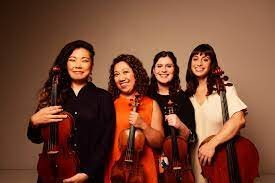
Hildegard von Bingen: Columba aspexit (arr. Alex Fortes); Eleanor Alberga: String Quartet No. 1; Komitas Vardapet: Armenian Folk Songs (arr. Sergei Aslamazian) - Yergink Ampel A (It’s Cloudy); Haprpan (Festive Song); Shoushigi (For Shoushing); Echmiadzni Bar (Dance from Echmiadznin); Kaqavik (The Partridge); Sibelius: String Quartet in D minor Op. 56, “Voces Intimae.” Aizuri Quartet (Emma Frucht and Miho Saegusa violins; Ayane Kozasa, viola; Karen Ouzounian, cello). Azica ACD-71359 

Having never heard of the Aizuri Quartet before receiving this disc for review, I was not quite sure what to expect. The program seemed to be a bit unusual, too, what with music from Hildegard, Komitas, and Sibelius – familiar names, but not ones I would have expected to find together on the same program – plus a quartet from a composer whose name was unfamiliar to me, Eleanor Alberga. Opening the booklet that came with the CD, I found these words of explanation from Aizuri’s cellist, Karen Ouzounian: “Earthdrawn Skies explores deep connections between humankind and the natural world through the distinct lenses of four composers forging personal relationships with the soil and the stars. These works by Hildegard von Bingen, Eleanor Alberga, Komitas Vardepet and Jean Sibelius are rooted in a sense of tradition and connection to the land, even as the composers seek something beyond their reach: an understanding of God, the physics of the cosmos, homeland, happiness. The music on this album draws from the earth as it reaches upward and outward. these composers share an impulse to understand the sky, the heavens, the larger things in life. This is music we have kept returning to as a quartet, as it speaks to us in deeply personal ways. We cherish playing this music together, and we hope it resonates as much with you as it does with us.”

The opening piece by Hildegard von Bingen (1098-1179) is an unusual choice for a string quartet in that rather than highlight the interplay among the four members, with the first and second violins swapping melodic lines in the upper registers while engaging in interplay with the darker tones of the viola and cello, weaving in and out of each other’s lines, the four players are bound tightly together. "The four of us have often talked about ‘singing through our instruments’ and how the quartet is one organism," remarks violinist Miho Saegusa. "Alex Fortes's arrangement of Hildegard's Columba aspexit presented us with a unique and challenging question, one we were excited to explore: how can we truly become one voice?" It’s an unusual sonority for a string quartet, but one that draws the listener in. What an effective way to begin an album!

Next on the docket is the three-movement String Quartet No. 1 by Eleanor Alberga (b.1949), a Jamaican-born composer who lives and works in the UK. From the very first measures of the first movement it is clearly a work that in tone and texture stands in contrast from the Bingen that preceded it. The pace is frantic, the mood more abstract. The overall pattern is the familiar fast-slow-fast, the engaging second movement (the highlight of the piece, designated Expressivo, with wonder and yearning) being followed by the more frenetic finale, with its sharper rhythms and pizzicato passages (it is designated Frantically driven yet playful). It sounds like one of those pieces that would be especially rewarding to see performed live, observing the interactions of the four players.


Then comes another shift in pace and mood with the five brief (none over three minutes) folk songs by the Armenian Komitas Vardapet (1869-1935), usually known simply as “Komitas,” an Armenian musicologist, composer, music teacher, choir director, priest (thus the “Vardapet,”), whose actual given name was Soghomon Gevorki Soghomonyan. He is considered the father of Armenian classical music. These folk songs are lively and charming, enjoyable to hear as well as to play. "The music of Komitas gave us a sense of our roots, our homes and lands from which we were displaced, the contours and nuances of our language, the warmth and sorrow and ebullience of our families, a link between those who perished and those who are living," writes Ouzounian of the album's link to her Armenian heritage.


The album closes with the “Voces Intimae” quartet by Sibelius. As popular as his symphonies have become, his string quartet has never really caught on to the same degree. Some years back I read a fascinating book that I highly recommend titled Indivisible by Four: A String Quartet in Pursuit of Harmony by Arnold Steinhardt, who was the first violinist of the famed Guarneri String Quartet. One of the tales from his account of his career with the group revolves around his repeated attempts to persuade the other members to add the Sibelius to the Guarneri’s repertoire. Surprisingly, it took many years before he was finally successful, as the other quartet members would not come to agreement that the Sibelius quartet was a worthy piece. My goodness! Violist Ayane Kokasa points out that “there are five movements instead of the traditional three or four. Each movement feels like a character piece, with the heart and soul of the work placed in three intimate and hushed chords tucked in the third movement. No matter how many times I listen to this piece, it feels new, like we are on the precipice of discovering something great.” It’s not one of those dramatic quartets that makes a memorable first impression; it’s a quartet that deserves and then rewards repeat listening. 

Azica Records deserves kudos for the liner notes that provide some insight into the music and musicians, the simple but compelling art that graces both cover and booklet, and the attractive sound quality. With Earthdrawn Skies, they have produced a CD that deserves and then rewards repeated listening.

Feb 12, 2023

Recent Releases No. 43 (CD Mini-reviews)

by Karl Nehring

Theory of Becoming. Evgueni Galperine: This Town Will Burn Before Dawn; Cold FrontOumuamua, Space WanderingsSoudain, le vide; KaddishThe Wheel Has Come Full CircleLe letter d’un disparuAfter the StormDon’t TellLoplop im Wald. Evgueni Galperine, electronics, sampling; Sergei Nakariakov, trumpet; Sébastien Hurtaud, violoncello; Maria Vasyukova, voice. ECM New Series 2744 485 7282


This fascinating album is hard to categorize, lying as it does somewhere between classical, jazz, and electronica – but to these ears at least, it can reasonably be classified as classical, or at least as strongly classically influenced. Russian-born French composer Evgueni Galperine (b.1974) writes that “the sound world of this album can be regarded as a kind of ‘augmented reality of acoustic instruments.’ It is created from recordings I make from recordings I make with real and virtual instruments, which I subsequently alter. The numerous transformations the instruments undergo allow me to capture their acoustic nature while also adding techniques and colours that are completely impossible to produce in reality. This process leads to new and unexpected, yet organically grounded sounds.”  Not just the sounds, but the music also seems organically grounded. Galperin provides brief notes on four of the tracks, explanations that make each piece sound as though it was conceived as a brief tone poem. Theory of Becoming is boldly imaginative, musically captivating, and sonically stimulating, regardless of how you decide to classify it. It’s classical enough for me.

 Gems from Armenia: Aznavoorian Duo. Komitas Vartabed: Chinar Es; Tsirani Tsar; Garoun A; Al Ailux; Krunk; Aram Khachaturian: Ivan Sings (arr. Antti Hakkarainen); Yerevan; Arno Babajanian: ElegyAria & Dance; Avet Terterian: Sonata for Cello and Piano; Serouj Kradjian: Sari Siroun Yar (Traditional); Alexander Arutiunian: Impromptu; Vache Sharafyan: Petrified Dance; Peter Boyer: Mount Ararat. Ani Aznavoorian, cello; Marta Aznavoorian, piano. Cedille CDR 90000 209


The Aznavoorian Duo comprises two sisters of Armenian descent who hail from the Chicago area. On this new Cedille release, they present compositions by seven Armenian composers, plus one composition by an American composer, Peter Boyer, who wrote Mount Ararat especially for this album and project. The Duo have been presenting concert programs based on the Gems from Armenia theme, and when they performed it in Chicago, Boyer was on hand to explain the inspiration for and ideas behind his composition to the audience. It is a dramatic piece, closing the program on a serious note after it had begun with much lighter fare. The opening tracks on the disc by Komitas (1869-1935), Khachaturian (1903-1978), and Babajanian (1921-1983) are all relatively brief, melodic, and folk-based. Two of the pieces, Garoun A by Komitas and the Elegy by Babajanian are for solo piano, played by Marta; all the other compositions are for both cello and piano. (The liner notes state, by the way, that Marta is a Steinway Artist, while “Ani proudly performs on a cello made in Chicago by her father, Peter Aznavoorian.”) The sonata by Terterian (1929-1994) is the longest selection (20:41), but it continues in the same populist musical spirit as the preceding pieces, suffused with melody, as are the next two tracks by Serouj Kradjian (b. 1973) and Alexander Arutiunian (1920-2012). The penultimate piece on the program, Petrified Dance by Vache Sharafyan, has a brooding, haunted quality to it, setting the stage for the dramatic opening bars of Boyer’s Mount Ararat. As usual with Cedille, the engineering is flawless and the liner notes are helpful.

Bohuslav Martinu: Concerto for Harpsichord and Small Orchestra; Hans Krása: Kammermusik for Harpsichord and 7 Instruments; Viktor Kalabis: Concerto for Harpsichord and String Orchestra, Op. 42. Mahan Esfahani, harpsichord; Prague Radio Symphony Orchestra, Alexander Liebreich, conductor. Hyperion CDA68397


This refreshing release presents unfamiliar music with energy and enthusiasm. Iranian-born harpsichordist Mahan Esfahani (b.1984) grew up in the United States and now lives in Prague. He has been a rising star on his instrument (he first came to my attention with his energetic recording of Bach’s Goldberg Variations) and he is a passionate advocate for its more widespread recognition. The most familiar figure among the three Czech composers represented on this release for most listeners will no doubt be Bohuslav Martinu (1890-1959), although this particular composition of Martinu’s will likely be unfamiliar to most. Despite being titled as a work for harpsichord and small orchestra, the piece opens sounding as if it is going to be a piano concerto. The harpsichord does eventually gain the spotlight, its distinctive sound seemingly offering a reflective commentary on what has come before. It is interesting to hear how the piano sound emanates from the left rear of the soundstage while the harpsichord is placed forward, but still the sound of the piano threatens to dominate. Musically, it is a sparkling piece, the diminutive sound of the harpsichord drawing the listener in closer to the heart of the music.

The relatively brief (14:24) two-movement Kammermusik for Harpsichord and Seven Instruments by Hans Krása (1899-1944), who was murdered at Auschwitz, another tragic victim of the Holocaust, is by turns jaunty, witty, tart, and playful (is that a bit of Bolero we hear being snuck in there?) as it moves energetically along through it exuberant first movement. The second movement begins slowly but soon picks up speed and becomes downright jaunty, with some energetic playing by Esfahani setting the pace, before finally ending more peacefully. Concerning the Concerto for Harpsichord and String Orchestra by Viktor Kalabis (1923-2006), Esfahani writes: “Of the three works on this recording – indeed, of all modern harpsichord works – Viktor Kalabis’s 1975 Concerto for Harpsichord and String Orchestra, Op. 42, is the most personal. It certainly has an intense personal connection for me ii I was, after all, the last student of the work’s dedicatee, who was herself the wife of the composer.” This is the work of the three that stands out most distinctly as a bona fide harpsichord concerto, and Esfahani makes a convincing case for it, playing exuberantly in the outer movements and more introspectively in the middle movement. All in all, this is an album that deserves to win a wider audience for both Esfahani and his chosen instrument, the harpsichord.


Last Decade: Benjamin Lackner. Where Do We Go from HereCircular ConfidenceCamino CieloHung Up on That GhostLast GhostLast DecadeRemember ThisOpen Minds LostÉmileMy People. Benjamin Lackner, piano; Mathias Eick, trumpet; Jérôme Regard, double bass; Manu Katché, drums. ECM 2738 389 9024


Last Decade is another of those ECM albums that exemplify the overlap between chamber music and jazz. Although it is clearly a jazz album, the way the musicians interact, the balance among the various parts, the way all seem to be working toward a common goal rather than trying to showcase their own individual talents – it calls to mind the interaction of, say, a string quartet and pianist getting together to perform the Brahms Piano Quintet. Although pianist Lackner is listed as the leader, his piano does not dominate. Eick on trumpet weaves some spellbinding melodies, but never to the extent of unleashing any kind of splashy virtuosic, attention-grabbing display. Nor does Lackner indulge in any flashy displays, but rather plays subtle, pastel melodic lines. For classical music fans who might want to widen their musical horizons, this is an album well worth an audition.  


Meet the Staff

Meet the Staff
John J. Puccio, Founder and Contributor

Understand, I'm just an everyday guy reacting to something I love. And I've been doing it for a very long time, my appreciation for classical music starting with the musical excerpts on the Big Jon and Sparkie radio show in the early Fifties and the purchase of my first recording, The 101 Strings Play the Classics, around 1956. In the late Sixties I began teaching high school English and Film Studies as well as becoming interested in hi-fi, my audio ambitions graduating me from a pair of AR-3 speakers to the Fulton J's recommended by The Stereophile's J. Gordon Holt. In the early Seventies, I began writing for a number of audio magazines, including Audio Excellence, Audio Forum, The Boston Audio Society Speaker, The American Record Guide, and from 1976 until 2008, The $ensible Sound, for which I served as Classical Music Editor.

Today, I'm retired from teaching and use a pair of bi-amped VMPS RM40s loudspeakers for my listening. In addition to writing for the Classical Candor blog, I served as the Movie Review Editor for the Web site Movie Metropolis (formerly DVDTown) from 1997-2013. Music and movies. Life couldn't be better.

Karl Nehring, Editor and Contributor

For nearly 30 years I was the editor of The $ensible Sound magazine and a regular contributor to both its equipment and recordings review pages. I would not presume to present myself as some sort of expert on music, but I have a deep love for and appreciation of many types of music, "classical" especially, and have listened to thousands of recordings over the years, many of which still line the walls of my listening room (and occasionally spill onto the furniture and floor, much to the chagrin of my long-suffering wife). I have always taken the approach as a reviewer that what I am trying to do is simply to point out to readers that I have come across a recording that I have found of interest, a recording that I think they might appreciate my having pointed out to them. I suppose that sounds a bit simple-minded, but I know I appreciate reading reviews by others that do the same for me — point out recordings that they think I might enjoy.

For readers who might be wondering about what kind of system I am using to do my listening, I should probably point out that I do a LOT of music listening and employ a variety of means to do so in a variety of environments, as I would imagine many music lovers also do. Starting at the more grandiose end of the scale, the system in which I do my most serious listening comprises Marantz CD 6007 and Onkyo CD 7030 CD players, NAD C 658 streaming preamp/DAC, Legacy Audio PowerBloc2 amplifier, and a pair of Legacy Audio Focus SE loudspeakers. I occasionally do some listening through pair of Sennheiser 560S headphones. I miss the excellent ELS Studio sound system in our 2016 Acura RDX (now my wife's daily driver) on which I had ripped more than a hundred favorite CDs to the hard drive, so now when driving my 2024 Honda CRV Sport L Hybrid, I stream music from my phone through its adequate but hardly outstanding factory system. For more casual listening at home when I am not in my listening room, I often stream music through a Roku Streambar Pro system (soundbar plus four surround speakers and a 10" sealed subwoofer) that has surprisingly nice sound for such a diminutive physical presence and reasonable price. Finally, at the least grandiose end of the scale, I have an Ultimate Ears Wonderboom II Bluetooth speaker and a pair of Google Pro Earbuds for those occasions where I am somewhere by myself without a sound system but in desperate need of a musical fix. I just can’t imagine life without music and I am humbly grateful for the technologies that enable us to enjoy it in so many wonderful ways.

William (Bill) Heck, Webmaster and Contributor

Among my early childhood memories are those of listening to my mother playing records (some even 78 rpm ones!) of both classical music and jazz tunes. I suppose that her love of music was transmitted genetically, and my interest was sustained by years of playing in rock bands – until I realized that this was no way to make a living. The interest in classical music was rekindled in grad school when the university FM station serving as background music for studying happened to play the Brahms First Symphony. As the work came to an end, it struck me forcibly that this was the most beautiful thing I had ever heard, and from that point on, I never looked back. This revelation was to the detriment of my studies, as I subsequently spent way too much time simply listening, but music has remained a significant part of my life. These days, although I still can tell a trumpet from a bassoon and a quarter note from a treble clef, I have to admit that I remain a nonexpert. But I do love music in general and classical music in particular, and I enjoy sharing both information and opinions about it.

The audiophile bug bit about the same time that I returned to classical music. I’ve gone through plenty of equipment, brands from Audio Research to Yamaha, and the best of it has opened new audio insights. Along the way, I reviewed components, and occasionally recordings, for The $ensible Sound magazine. Most recently I’ve moved to my “ultimate system” consisting of a BlueSound Node streamer, an ancient Toshiba multi-format disk player serving as a CD transport, Legacy Wavelet II DAC/preamp/crossover, dual Legacy PowerBloc2 amps, and Legacy Signature SE speakers (biamped), all connected with decently made, no-frills cables. With the arrival of CD and higher resolution streaming, that is now the source for most of my listening.

Ryan Ross, Contributor

I started listening to and studying classical music in earnest nearly three decades ago. This interest grew naturally out of my training as a pianist. I am now a musicologist by profession, specializing in British and other symphonic music of the 19th and 20th centuries. My scholarly work has been published in major music journals, as well as in other outlets. Current research focuses include twentieth-century symphonic historiography, and the music of Jean Sibelius, Ralph Vaughan Williams, and Malcolm Arnold.

I am honored to contribute writings to Classical Candor. In an age where the classical recording industry is being subjected to such profound pressures and changes, it is more important than ever for those of us steeped in this cultural tradition to continue to foster its love and exposure. I hope that my readers can find value, no matter how modest, in what I offer here.


Bryan Geyer, Technical Analyst

I initially embraced classical music in 1954 when I mistuned my car radio and heard the Heifetz recording of Mendelssohn's Violin Concerto. That inspired me to board the new "hi-fi" DIY bandwagon. In 1957 I joined one of the pioneer semiconductor makers and spent the next 32 years marketing transistors and microcircuits to military contractors. Home audio DIY projects remained a personal passion until 1989 when we created our own new photography equipment company. I later (2012) revived my interest in two channel audio when we "downsized" our life and determined that mini-monitors + paired subwoofers were a great way to mate fine music with the space constraints of condo living.

Visitors that view my technical papers on this site may wonder why they appear here, rather than on a site that features audio equipment reviews. My reason is that I tried the latter, and prefer to publish for people who actually want to listen to music; not to equipment. My focus is in describing what's technically beneficial to assure that the sound of the system will accurately replicate the source input signal (i. e. exhibit high accuracy) without inordinate cost and complexity. Conversely, most of the audiophiles of today strive to achieve sound that's euphonic, i.e. be personally satisfying. In essence, audiophiles seek sound that's consistent with their desire; the music is simply a test signal.

Mission Statement

It is the goal of Classical Candor to promote the enjoyment of classical music. Other forms of music come and go--minuets, waltzes, ragtime, blues, jazz, bebop, country-western, rock-'n'-roll, heavy metal, rap, and the rest--but classical music has been around for hundreds of years and will continue to be around for hundreds more. It's no accident that every major city in the world has one or more symphony orchestras.

When I was young, I heard it said that only intellectuals could appreciate classical music, that it required dedicated concentration to appreciate. Nonsense. I'm no intellectual, and I've always loved classical music. Anyone who's ever seen and enjoyed Disney's Fantasia or a Looney Tunes cartoon playing Rossini's William Tell Overture or Liszt's Hungarian Rhapsody No. 2 can attest to the power and joy of classical music, and that's just about everybody.

So, if Classical Candor can expand one's awareness of classical music and bring more joy to one's life, more power to it. It's done its job. --John J. Puccio

Contact Information

Readers with polite, courteous, helpful letters may send them to classicalcandor@gmail.com

Readers with impolite, discourteous, bitchy, whining, complaining, nasty, mean-spirited, unhelpful letters may send them to classicalcandor@recycle.bin.

"Their Master's Voice" by Michael Sowa

"Their Master's Voice" by Michael Sowa