Showing posts with label Hindemith. Show all posts

Jan 16, 2024

Mikyung Sung: The Colburn Sessions

by Bill Heck

Bottesini: Tarantella, Capriccio di Bravura, Elegy No. 1 in D Major; Massenet: Meditation from Thaïs; Hindemith: Sonata for Double Bass and Piano; Montag: Sonata in E Minor for Double Bass and Piano; Mendelssohn: Cello Sonata No. 2 in D Major; Rachmaninoff: Sonata in G minor for Cello and Piano, Op. 19 (third movement); Franck: Sonata in A major for Violin and Piano. Jaemin Shin, Mikyung Sung. Modus Vivendi Media MVM2301

When I first happened upon this album, I was dumbfounded. So far as I can tell, it should be physically impossible to play a double bass in the manner that Ms. Sung does. Flying through endless quick series of notes with on the nose intonation along the extended neck with thick strings of this instrument: how in the world does she do that?

But, of course, there is more to this two-CD set than mere technical brilliance, so let’s explore. 

Giovanni Bottesini
The first disc opens with three works by Giovanni Bottesini (1821 – 1899), considered in his time as the “Paganini of the Double Bass”, and who moved from virtuoso command of that instrument to conducting and composing. The first piece, Tarantella, certainly is a showpiece for the double bass, with shifting tempi and virtuoso runs: If you do think of Paganini on the bass instead of the violin, you’ll have the general idea. The next, Capricio di bravura, begins as a soulful singing piece that moves across the entire range of the instrument. It breaks into a lively dance, and back and forth we go, ending it all with a flourish; the overall feel is reminiscent of a dance scene from an opera. Finally, we have the Elegy, several minutes of quite lovely playing. Showpieces all, the music is interesting and enjoyable, and in any case bravura playing is enough to carry the day.

Massenet’s Meditation from Thais is one of those works that you’ve heard somewhere, even if you didn’t know what it was. Originally composed for violin and orchestra, in the wrong hands it can degenerate into a rather saccharine tearjerker, but the transposition of the work to double bass with piano accompaniment gives it a whole new sound, perhaps more straightforward than the original. In any case, Sung’s playing is moving without turning into treacle.

Next up are two more recent works also originally composed for the double bass, namely Paul Hindemith’s Sonata for Double Bass and Piano, followed by Vilmas Montag’s work of the same name.

The Hindemith Sonata is in much the same vein as some of his better know and more popular works, such as the Mathis der Maler or the Metamorphosis (on Themes by Weber). Although there are moments of dissonance, the composition still is tonal, with a mood best described as mysterious, and developed mostly in minor keys. Personally, I found it quite engaging and I’m glad to have made its acquaintance.

I’m less certain of the Montag composition but can say with confidence that Sung makes the best possible case for it. Her playing, especially in the lower register of the instrument, is lovely and powerful at the same time.

This is a good time to mention that the contributions from pianist Jaemin Shin are beyond mere accompaniment: there’s no doubt that the album is about Sung, but she and Shin are very much partners in music making.

The second disc contains works originally composed for other instruments and redone for the double bass. There are three: Mendelssohn‘s Cello Sonata No. 2, Rachmaninoff’s Sonata in G minor for Cello and Piano (third movement), and Franck’s Sonata in A for Violin and Piano. You may be familiar with these works in their original versions, so I won’t go into a lot of description here. What I will say is that all of them sound absolutely natural when played on the double bass; indeed, if you didn’t know that they were originally composed for different instruments, you could easily presume that they were composed for the bass. (That’s not too surprising in the first two works, as the move from cello to bass at least seems like a plausible idea. But it really is amazing that the third piece loses nothing in the translation.) In all three, what could have sounded just gimmicky are instead propelled by Sung’s musical sensitivity as well as her virtuosity and come across simply as wonderful music. Yes, the bass gives the pieces more sonic weight, but it never weighs them down.

The sound on both discs is clean and natural, although that on the second is just a touch more distant that on the first. (The recording venues were different.) I listened to the album on my streaming service; sadly, the CD booklet was not available there. (I wish I knew why booklets are or are not available on streaming service that support them; they are for some newer works but not for all.) The CD is generally available, but you also can purchase a digital download of the entire thing at Mikyung Sung’s website.

May 15, 2022

When There Are No Words... (CD review)

Revolutionary Works for Oboe and Piano by Hindemith, Haas, Bolcom, Britten, Siqueira, and Slavicky. Alex Klein, oboe; Phillip Bush, piano. Cedille CDR 90000 208.

By John J. Puccio

Are we experiencing an oboe renaissance? Seems that way, given the number of new, classical oboe recordings I’m seeing: concertos, sonatas, solos, you name it. I’m not complaining, mind you. The oboe will never compete with the violin or piano in terms of featured musical instruments, but the oboe deserves its place in the sun. Power to the oboe!

More important, the works on the present album express the musical views of five composers who faced the realities of war, hate, and exile. The music represents their frustrations and grievances towards a world gone mad. They attempted to express in music what words alone could not.

On this Cedille disc, oboist Alex Klein and pianist Phillip Bush provide us with six oboe and piano compositions, and they do them up in accomplished style. First, though, a word about the players. Klein (b. 1964) began playing the oboe at the age of nine in his native Brazil and made his solo orchestral debut a year later. By the time he was eleven he joined one of Brazil’s foremost chamber ensembles, the Camerata Antigua. In his teens he performed as a soloist with several orchestras in Brazil and then studied at the Oberlin Conservatory of Music. He went on to win numerous awards before becoming an Assistant Professor of Music at the University of Washington and joined the Chicago Symphony Orchestra in 1995 as principal oboe. Since then, he has performed as soloist with the Chicago Symphony, Philadelphia Orchestra, the Orchestre de la Suisse Romande, and the Chicago Sinfonietta. His partner on the current album, Phillip Bush (b. 1961), is an American concert pianist whose career has largely focused on chamber and contemporary works.

First up on the program is the Sonata for Oboe and Piano, written in 1938 by the German composer Paul Hindemith (1895-1963). The sonata expresses the composer’s anxiety over a Germany obsessed with hatred. The first of two movements is actively rhythmic in the manner of slightly askew military march; the second is mournful, drawing on long, intense, soulful passages. The players do it up in a forthright manner, amply conveying the melancholy of loss and impending doom.

Next is the three-movement Suite for Oboe and Piano, written in 1939 by the Czech composer Pavel Haas (1899-1944). He, too, faced a world haunted by fear, anger, and hostility. The music is both discomforting and uplifting by turns, and Klein and Bush make the most of its pulsating beat, its dramatic pauses, its woeful, sometimes fearful tone, and its inspiring emotion. The oboe seems a most-appropriate instrument for this type of music, and Klein proves an expert practitioner at drawing from it the most expressive elements.

The central work on the disc is titled Aubade--for the Continuation of Life, written in 1980 by the American composer and pianist William Bolcom (b. 1938). An “aubade” is a poem written to greet the dawn, a morning song, only here Bolcom is more concerned with that dawn possibly never happening at all. The world looked on as the U.S. and Europe engaged in a Cold War with the Soviet Union, and the chance of a nuclear war was ever present. It’s a frankly gloomy piece, grounded in loneliness and a sense of hopelessness, moods well captured by the tone of the oboe.

After that is Temporal Variations, written in 1936 by the English composer, conductor, and pianist Benjamin Britten (1913-1976). He intended it as an antiwar statement when the threat of war with Germany loomed ever closer. It’s in nine brief movements, each a variation of a two-note, two-syllable theme that seems to repeat “enough.” It’s probably the most interesting item on the agenda, the most urgent in its thoughts, the most musically variable and insightful. Klein and Bush are at their best here, too, shaping each short proclamation as an independent thought yet keeping everything together as a cohesive whole.

The penultimate item is Three Etudes for Oboe with Piano Accompaniment, published in 1969 by the Brazilian composer, conductor, and musicologist Jose Siqueira (1907-1985). He was forcibly expelled from his native country and wrote music to convey his feelings. These are somewhat nostalgic, evocative melodies, more lyrical than those of the other composers on the program, the Etudes featuring a central, dance-like scherzo. Above all, the performers bring out the colorful language of the piece, capturing the spirit, grace, and beauty of Siqueira’s homeland.

Concluding the album we find the Suite for Oboe and Piano, written in 1960 by Czech composer Klement Slavicky (1910-1999). Like Siqueira, Slavicky was expressing in music his regret at what was happening in his country, in this case under the Soviet regime. It alternates bright, positive accents with doleful, ominous ones, the oboe capturing the wistful, introspective nature of the music, with the piano in complete sympathy.

Producer James Ginsburg and engineer Bill Maylone recorded the music at Gannon Hall, DePaul University, Chicago, Illinois in July, 2021. As we expect from Cedille and its chief engineer, the sound is as realistic as being in the room with the players. Both the oboe and piano are clear and natural, with no edginess, no dullness, no oddities whatsoever. It’s just good, pure sound.

JJP

Jan 26, 2022

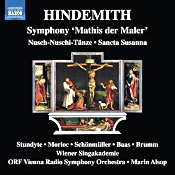
Hindemith: Symphony ‘Mathis der Maler’ (CD review)

Also, Nusch-Nuschi Tanze; Sancta Susanna, Op 21. Ausrine Stundyte, soprano; Renöe Morloc, contralto; Annette Schönmüller, mezzo-soprano; Caroline Baas, female voice; Enzo Brumm; male voice; Women of the Wiener Singakadamie (Chorus Master, Heinz Ferlesch); Marin Alsop, ORF Vienna Radio Symphony Orchestra. Naxos 8.574283.

By Karl W. Nehring

When asked to name some of our favorite symphonies, most of us will immediately begin to think of symphonies by the “usual suspects” such as Beethoven, Brahms, Mozart, Mahler, Sibelius, Bruckner, or perhaps Vaughan Williams. Well, those gentlemen would certainly figure on my list as well, but my list would also include a symphony by a composer who is seldom thought of as a symphonic composer, the German composer Paul Hindemith (1895-1963). His three-movement
Symphony Mathis der Maler (Mathis the Painter) has long been one of my favorites, now available here in a newly released Naxos recording led by the gifted American conductor Marin Alsop.

For those unfamiliar with this symphony, Hindemith started composing it in 1933 and completed in 1934. He had in mind composing an opera based on the life of the painter Mathias Grunewald (1470-1528), but decided to begin with a symphony, figuring he would later incorporate some of the music into the opera, which he completed in 1935. The cover of the CD booklet features a reproduction of some of the paintings by Grunewald that inspired Hindemith. They are part of an elaborate construction of panels behind the altar at a church in Isenheim, Germany. Various scenes are revealed as the panels are unfolded and from these scenes, Hindemith chose three to represent musically. The three movements are titled Engelkonzert (Angelic Concert), Grablegung (Entombment); Versuchung des heiligen Antonius (The Temptation of Saint Anthony). You might expect a concert of angels to sound gentle and ethereal, but Hindemith endows these angels with energy and luminosity befitting the celestial realm, and Alsop does a fine job of making the orchestra sing. As you might well imagine from the title, the second movement is much more somber in tone. It is not maudlin, however, as there are reflective passages and dramatic passages, leading without pause into the more dramatic third movement, with Alsop getting the orchestra to play with both precision and power. This is truly an excellent performance.

Music lovers who are already Hindemith fans probably already have a favorite recording of
Mathis. For example, my favorite has long been the Blomstedt/San Francisco Symphony Orchestra recording, which, when in comparison to this new Naxos, presents a more powerful, vivid sound (the SFSO brass in particular way outshine their European counterparts) and a more energetic performance overall. Nevertheless, there are a couple of  points to ponder regarding this new Naxos release. First, Alsop’s performance of Mathis really is pretty darned good, and certainly worthy of audition. Second, and perhaps more compelling, Naxos has included a couple of relatively unusual disc-mates that are more likely than not compositions you have not heard before. First up on the program is a brief (10:03) trio of dances that Hindemith extracted from his one-act opera Das Nusch-Nuschi (1921). Admittedly, there is nothing really profound in these brief pieces, but they are lively and entertaining, well worth a listen. Next up is the one-act opera Sancta Susanna, the libretto of which is included in the liner notes. It is a dramatic piece, with plenty of high-powered singing. The music is interesting, but the sheer intensity of the piece may not lend itself well to repeated listening. Music lovers with more fondness for opera might disagree. In any event, it is certainly well played, well sung, and decenly recorded. Kudos to Naxos for releasing such an interesting program and putting forth the effort to include informative liner notes, props to the engineering team for capturing the large-scale forces in full-range, believable stereo sound, and bravo to Marin Alsop and the orchestra, chorus, and soloists for their fine performances of Hindemith’s music.

KWN

To listen to a brief excerpt from this album, click below:

Mar 24, 2014

Miraculous Metamorphoses (CD review)

Hindemith: Symphonic Metamorphosis; Prokofiev: The Love of Three Oranges; Bartok: The Miraculous Mandarin. Michael Stern, Kansas City Symphony. Reference Recordings RR-132.

The Random House Unabridged Dictionary tells us that a metamorphosis is "1. a profound change in form from one stage to the next in the life history of an organism, as from the caterpillar to the pupa and from the pupa to the adult butterfly. 2. a complete change of form, structure, or substance, as transformation by magic or witchcraft. 3. any complete change in appearance, character, circumstances, etc. 4. a form resulting from any such change." But you knew that. The question is why Reference Recordings chose to title their album "Miraculous Metamorphoses." The answer, of course, is that each of the three works included on the disc represents a kind of metamorphosis, the music originally deriving from something quite different from what it became.

The first selection is the most obvious example of the album's theme: Symphonic Metamorphosis of Themes by Carl Maria von Weber, written by German-born U.S. composer Paul Hindemith (1895-1963) for ballet performance. Hindemith completed the work in 1943, based on music originally composed by Weber in the early nineteenth century as incidental music for a play by Carlo Gozzi. Although the piece continues to get some ballet performances, we more often hear the symphonic arrangement presented here by Maestro Michael Stern and his Kansas City Symphony.

The music is generally light and lively, and that's the way Maestro Stern plays it. Just as Hindemith maintained a healthy respect for Weber's music, so does Stern maintain a respect for Hindemith, neither over-dramatizing the more boisterous sections nor romanticizing the slower, more sentimental parts. He executes the Turandot Scherzo especially well, the percussion putting on a splendidly vigorous show. The Andantino is appropriately calm yet never so gentle as to put one to sleep. Then Hindemith returns to the lighthearted energy of the first movement with an exuberant closing March, which Stern handles well, efficiently building the excitement incrementally until we arrive at an enormously rousing climax. Fun stuff.

Following the Hindemith piece is the suite from The Love of Three Oranges by Russian composer Sergei Prokofiev (1891-1953). The composer intended The Love of Three Oranges as a satirical opera, premiered in 1921 and based again on the works of Carlo Gozzi, so we get two connections between the Hindemith and Prokofiev pieces--the composers meant them to be amusing and based them on works by the same earlier author.

Anyway, here we get the six-movement suite Prokofiev lifted from his opera. Once more Stern takes on the music gleefully. Maybe it's in the nature of the music, but Maestro Stern seems to have an even better time with Prokofiev's rather silly music than he did with Hindemith's. Never going overboard to make the Prokofiev sound too caustic or too absurd, he goes for a polite charm that actually makes it more delightful. The third-movement March is probably the most-famous music in the set, and Stern does it up in properly straight-faced, tongue-in-cheek fashion. It's a pleasure from beginning to end.

Finally, we get the suite from The Miraculous Mandarin by Hungarian composer Bela Bartok (1881-1945), and the album's theme is complete. At least insofar as concerns the "miraculous" part. It was originally a one-act pantomime ballet that quite infuriated audiences of the time, caused a scandal, and eventually got banned. Today, we mostly hear the concert suite offered here.

The tone of the music is quite different from that of the first two selections on the album. The Miraculous Mandarin is rather grim in mood, its plot concerning three tramps who use a beautiful girl to attract men to an apartment, where they rob and attempt to murder them. It's heavy-going music, dark and somber. Gone are the fun and games of the Hindemith and Prokofiev pieces, replaced by an atmosphere of unyielding despair. Stern makes no attempt to glamorize a score that clearly the composer intended as gloomy, mysterious, and forbidding. At least that's the way Stern plays it, with a heavy emphasis on the mysterious angle. A lot of it sounds downright scary. The Kansas City Orchestra provides Maestro Stern with a secure accompaniment, again with the percussion section lending solid support.

It's always a pleasure listening to an album made by the Reference Recordings team of producer David Frost, recording wizard Keith Johnson, and executive producers Tam Henderson and Marcia Martin. They never attempt to attain the kind of absolute transparency so beloved of the audiophile community but instead capture something closer to the actual sound of a concert hall, in this case Helzberg Hall at the Kauffman Center for the Performing Arts, Kansas City, Missouri in 2012.

The sound is wonderfully spacious, dimensional, and dynamic, as you would expect to hear from a symphony orchestra at perhaps the eighth or tenth row center. While the stereo spread is wide, the miking is not so close that you're on top of the instruments. Instead, we hear a depth to the ensemble, with plenty of impact and wide frequency extremes. It's some of the most-natural, most-realistic, most-lifelike new sound you'll find around.

JJP

To listen to a brief excerpt from this album, click here:


Mar 28, 2013

Declarations: Music Between the Wars (CD review)

Chamber works by Leos Janacek, Ruth Crawford Seeger, and Paul Hindemith. Pacifica Quartet. Cedille CDR 900000 092.

I admit I find it hard to concentrate for any amount of time on much twentieth-century chamber music.
Largely, this is due to my having the attention span of a gnat; partly, it’s because I often find the music repetitious and unengaging. But I must also admit I found the three pieces on this Cedille album fascinating and appealing, particularly in the hands of the Pacifica Quartet, fascinating and appealing enough to keep me seated between the speakers for over an hour.

The three composers involved are roughly contemporaneous, the works coming from the period as the title says “Between the Wars.” Certainly, the First World War changed the entire world in general as well as the world of music. Mainly gone was the lush, lyrical Romanticism of the nineteenth century, replaced by the more daring, more experimental, sometimes atonal, sometimes disharmonic music of the twentieth. The Janacek, Seeger, and Hindemith pieces come from a period less than a decade apart, from 1922 to 1931, and they reflect a new age.

Of the three works, the opening one, Janacek’s String Quartet No. 2 from 1928, is the most traditional. Called “Intimate Letters,” its four movements convey the composer’s feelings toward a loved one in his life, an affair beyond his marriage that he may or may not have consummated but according to his letters was apparently quite intense. The music alternates between strong, dramatic emotion, tranquil contemplation, and not a little melanchoy, some changes of moods occurring within seconds, which the Pacifica Quartet are quick to relay to the listener.

The Seeger piece from 1931 that follows, simply called String Quartet, is more atmospheric and moody, most of it sounding eerily sinister in its minimalist tone. The final work, Paul Hindemith’s String Quartet No. 4 is the earliest of the compositions, premiered in 1922, and it is perhaps the most unconventional of the trio in that it can sound both modern and Romantic by turns; but, ironically, it is also the freer in its composer’s flowing, unscheduled, yet strict musical notations.

The Pacifica Quartet--Brandon Vamos, Simin Ganatra, Masumi Per Rostad, and Sibbi Bernhardsson--play with a welcome finesse and intense enthusiasm. And the Cedille engineers--Judith Sherman and Bill Maylone--capture the sound quite realistically, with a strong sense of presence and without a trace of forwardness. For fans of chamber music or for folks looking toward something a little different, Declarations makes an arresting listen.

To hear a brief excerpt from this album, click here:

JJP

Meet the Staff

Meet the Staff
John J. Puccio, Founder and Contributor

Understand, I'm just an everyday guy reacting to something I love. And I've been doing it for a very long time, my appreciation for classical music starting with the musical excerpts on the Big Jon and Sparkie radio show in the early Fifties and the purchase of my first recording, The 101 Strings Play the Classics, around 1956. In the late Sixties I began teaching high school English and Film Studies as well as becoming interested in hi-fi, my audio ambitions graduating me from a pair of AR-3 speakers to the Fulton J's recommended by The Stereophile's J. Gordon Holt. In the early Seventies, I began writing for a number of audio magazines, including Audio Excellence, Audio Forum, The Boston Audio Society Speaker, The American Record Guide, and from 1976 until 2008, The $ensible Sound, for which I served as Classical Music Editor.

Today, I'm retired from teaching and use a pair of bi-amped VMPS RM40s loudspeakers for my listening. In addition to writing for the Classical Candor blog, I served as the Movie Review Editor for the Web site Movie Metropolis (formerly DVDTown) from 1997-2013. Music and movies. Life couldn't be better.

Karl Nehring, Editor and Contributor

For nearly 30 years I was the editor of The $ensible Sound magazine and a regular contributor to both its equipment and recordings review pages. I would not presume to present myself as some sort of expert on music, but I have a deep love for and appreciation of many types of music, "classical" especially, and have listened to thousands of recordings over the years, many of which still line the walls of my listening room (and occasionally spill onto the furniture and floor, much to the chagrin of my long-suffering wife). I have always taken the approach as a reviewer that what I am trying to do is simply to point out to readers that I have come across a recording that I have found of interest, a recording that I think they might appreciate my having pointed out to them. I suppose that sounds a bit simple-minded, but I know I appreciate reading reviews by others that do the same for me — point out recordings that they think I might enjoy.

For readers who might be wondering about what kind of system I am using to do my listening, I should probably point out that I do a LOT of music listening and employ a variety of means to do so in a variety of environments, as I would imagine many music lovers also do. Starting at the more grandiose end of the scale, the system in which I do my most serious listening comprises Marantz CD 6007 and Onkyo CD 7030 CD players, NAD C 658 streaming preamp/DAC, Legacy Audio PowerBloc2 amplifier, and a pair of Legacy Audio Focus SE loudspeakers. I occasionally do some listening through pair of Sennheiser 560S headphones. I miss the excellent ELS Studio sound system in our 2016 Acura RDX (now my wife's daily driver) on which I had ripped more than a hundred favorite CDs to the hard drive, so now when driving my 2024 Honda CRV Sport L Hybrid, I stream music from my phone through its adequate but hardly outstanding factory system. For more casual listening at home when I am not in my listening room, I often stream music through a Roku Streambar Pro system (soundbar plus four surround speakers and a 10" sealed subwoofer) that has surprisingly nice sound for such a diminutive physical presence and reasonable price. Finally, at the least grandiose end of the scale, I have an Ultimate Ears Wonderboom II Bluetooth speaker and a pair of Google Pro Earbuds for those occasions where I am somewhere by myself without a sound system but in desperate need of a musical fix. I just can’t imagine life without music and I am humbly grateful for the technologies that enable us to enjoy it in so many wonderful ways.

William (Bill) Heck, Webmaster and Contributor

Among my early childhood memories are those of listening to my mother playing records (some even 78 rpm ones!) of both classical music and jazz tunes. I suppose that her love of music was transmitted genetically, and my interest was sustained by years of playing in rock bands – until I realized that this was no way to make a living. The interest in classical music was rekindled in grad school when the university FM station serving as background music for studying happened to play the Brahms First Symphony. As the work came to an end, it struck me forcibly that this was the most beautiful thing I had ever heard, and from that point on, I never looked back. This revelation was to the detriment of my studies, as I subsequently spent way too much time simply listening, but music has remained a significant part of my life. These days, although I still can tell a trumpet from a bassoon and a quarter note from a treble clef, I have to admit that I remain a nonexpert. But I do love music in general and classical music in particular, and I enjoy sharing both information and opinions about it.

The audiophile bug bit about the same time that I returned to classical music. I’ve gone through plenty of equipment, brands from Audio Research to Yamaha, and the best of it has opened new audio insights. Along the way, I reviewed components, and occasionally recordings, for The $ensible Sound magazine. Most recently I’ve moved to my “ultimate system” consisting of a BlueSound Node streamer, an ancient Toshiba multi-format disk player serving as a CD transport, Legacy Wavelet II DAC/preamp/crossover, dual Legacy PowerBloc2 amps, and Legacy Signature SE speakers (biamped), all connected with decently made, no-frills cables. With the arrival of CD and higher resolution streaming, that is now the source for most of my listening.

Ryan Ross, Contributor

I started listening to and studying classical music in earnest nearly three decades ago. This interest grew naturally out of my training as a pianist. I am now a musicologist by profession, specializing in British and other symphonic music of the 19th and 20th centuries. My scholarly work has been published in major music journals, as well as in other outlets. Current research focuses include twentieth-century symphonic historiography, and the music of Jean Sibelius, Ralph Vaughan Williams, and Malcolm Arnold.

I am honored to contribute writings to Classical Candor. In an age where the classical recording industry is being subjected to such profound pressures and changes, it is more important than ever for those of us steeped in this cultural tradition to continue to foster its love and exposure. I hope that my readers can find value, no matter how modest, in what I offer here.


Bryan Geyer, Technical Analyst

I initially embraced classical music in 1954 when I mistuned my car radio and heard the Heifetz recording of Mendelssohn's Violin Concerto. That inspired me to board the new "hi-fi" DIY bandwagon. In 1957 I joined one of the pioneer semiconductor makers and spent the next 32 years marketing transistors and microcircuits to military contractors. Home audio DIY projects remained a personal passion until 1989 when we created our own new photography equipment company. I later (2012) revived my interest in two channel audio when we "downsized" our life and determined that mini-monitors + paired subwoofers were a great way to mate fine music with the space constraints of condo living.

Visitors that view my technical papers on this site may wonder why they appear here, rather than on a site that features audio equipment reviews. My reason is that I tried the latter, and prefer to publish for people who actually want to listen to music; not to equipment. My focus is in describing what's technically beneficial to assure that the sound of the system will accurately replicate the source input signal (i. e. exhibit high accuracy) without inordinate cost and complexity. Conversely, most of the audiophiles of today strive to achieve sound that's euphonic, i.e. be personally satisfying. In essence, audiophiles seek sound that's consistent with their desire; the music is simply a test signal.

Mission Statement

It is the goal of Classical Candor to promote the enjoyment of classical music. Other forms of music come and go--minuets, waltzes, ragtime, blues, jazz, bebop, country-western, rock-'n'-roll, heavy metal, rap, and the rest--but classical music has been around for hundreds of years and will continue to be around for hundreds more. It's no accident that every major city in the world has one or more symphony orchestras.

When I was young, I heard it said that only intellectuals could appreciate classical music, that it required dedicated concentration to appreciate. Nonsense. I'm no intellectual, and I've always loved classical music. Anyone who's ever seen and enjoyed Disney's Fantasia or a Looney Tunes cartoon playing Rossini's William Tell Overture or Liszt's Hungarian Rhapsody No. 2 can attest to the power and joy of classical music, and that's just about everybody.

So, if Classical Candor can expand one's awareness of classical music and bring more joy to one's life, more power to it. It's done its job. --John J. Puccio

Contact Information

Readers with polite, courteous, helpful letters may send them to classicalcandor@gmail.com

Readers with impolite, discourteous, bitchy, whining, complaining, nasty, mean-spirited, unhelpful letters may send them to classicalcandor@recycle.bin.

"Their Master's Voice" by Michael Sowa

"Their Master's Voice" by Michael Sowa