Showing posts with label Hildegard von Bingen. Show all posts

Mar 5, 2026

Four Views of the Holy (CD Reviews)

by Karl Nehring

Each of the four recordings reviewed below is of music expressing religious faith. Although the music on all four recordings seeks to express religious faith rooted in the Judeo-Christian tradition, the means of musical expression take decidedly different forms, from quiet contemplation to joyous jubilation. 


Arvo Pärt: And I Heard a Voice... Pärt: Nunc dimittisO Holy Father NicholasSieben Magnificat-Antiphonen*Für Jan van EyckKleine LitaneiAnd I heard a voice… Vox Clamantis; Jaan-Eik Tulve, conductor; *Ene Salumäe, organ. ECM New Series 2780 


Those readers who follow Classical Candor on a regular basis (thank you!) may recall that we recently reviewed a DG release from the young Latvian pianist Georgjis Osokins of piano music by the Estonian composer Arvo Pärt, who celebrated his 90th birthday on September 11, 2025 (you can find that review here). But Pärt is more celebrated for his choral compositions, the majority of which center on religious themes and have a sound which evokes feelings of reverence and spirituality. We have also reviewed several choral recordings of Pärt’s music in the past, including a Harmonia Mundi release from 2020 (you can find that review here), a BR Klassik release from 2021 (you can find that review here), and a 2023 ECM release that also includes some works for orchestra (which you can find here). As you can no doubt infer from the titles listed above, this latest release on ECM is suffused with a sense of the holy from start to finish. Founded by conductor Jaan-Eik Tulve in 1996, the Estonian vocal ensemble Vox Clamantis is composed of twelve singers who share a passion for early polyphony and contemporary music, and here they sound just right giving voice to Pärt’s compositions – small enough to bring clarity, but large enough to bring weight. Recorded in Haapsula Cathedral in Estonia, the transparent sound quality allows the listener to get lost in the music. The liner notes discuss the works and include the texts, plus several photographs. It’s a beautiful release.

Radiant Dawn. Alec Roth (b. 1948): *Night Prayer; Thomas Tallis (c1505-1585): O nata lux de lumine; Eleanor Daley (b. 1955): Grandmother Moon; Deborah Pritchard (b. 1977): *The Light Thereof; Sir James MacMillan (b.1959): O Radiant Dawn; Tallis: *Dum transisset Sabbatum; Saint Hildegard of Bingen (1098-1179): O gloriosissimi; Roxanna Panufnik: (b.1968): Hearken; Robert White (1538-1574): *Christe, qui lux es dies II; Richard Barnard (b.1977): *Aura; Judith Bingham (b. 1952): Enter Ghost; Owain Park (b.1993): Sommernacht; Joseph Rheinberger 1839-1901): Abenlied; MacMillan: *In splendoribus sanctorum; Geoffrey Burgon (1931-2010): *Nunc dimittis. The Gesualdo Six (Guy James, Alasdair Austin, countertenor; Joseph Wicks, Josh Cooter, tenor; Michael Craddock, baritone; Owain Park, bass); Owain Park, conductor; with *Matilda Lloyd, trumpet. Hyperion CDA68665


When I received this album for review, my immediate assumption was that it was a 21st-century version of an ECM release titled Officium (ECM 1525) from 1994 that featured the vocal quartet The Hilliard Ensemble (David James, countertenor; Rogers Covey-Crump, tenor; John Potter, tenor; Gordon Jones, baritone) accompanied by famed jazz saxophonist Jan Garbarek improvising on his horn as the ensemble sang sacred texts in a monastery, a recording that caught the attention of the general public through radio play and went on to become an unlikely best seller. However, beyond the obvious difference of trumpet rather than saxophone, Radiant Dawn also differs from Officium in that Matilda Lloyd plays a less prominent role than did Jan Garbarek, appearing as she does on fewer than half the tracks; moreover, when she does appear, her trumpet is sometimes not as prominent a part of the musical tapestry as was Garbarek’s saxophone. On the tracks Enter Ghost by Judith Bingham and In splendoribus sanctorum by James MacMillan, however, her trumpet stands front and center. The variety of composers included means that there is no single musical style or textual message to be found here; however, the majority of the tracks are rooted in religion and ritual, and as the liner notes proclaim, “plainchant threads this programme together – sometimes finely woven into the structural framework, and at other times as a fragment of the composer’s imagination.” As usual with with Hyperion, the liner notes are excellent and include texts. Warmly recommended for fans of vocal music.

Joel Ross: Gospel Music. Ross: Wisdom Is Eternal (For Barry Harris)Trinity (Father, Son, and Holy Spirit)Protoevangelium (The First Gospel)HostileThe ShadowlandsNeverthelessWord for WordRepentanceThe Sacred PlaceA Little Love Goes a Long Way; Frank Schoen: *Praise to You, Lord Jesus Christ; Betty King Jackson: **Calvary; Ross: ***The GiverTo the Throne (The Mercy Seat)Be PatientThe New Man; ****Now and Forevermore.  Joel Ross, vibraphone, celeste, glockenspiel, drums; mellotron; Josh Johnson, alto saxophone; Maria Grand, tenor saxophone; Jeremy Corren, piano; Kanoa Mendenhall, bass; Jeremy Dutton, bass; with *Laura Bibbs, vocals; *Geoff Gallante, piano; **Ehep Nkwelle, vocals; ***Andy Lewis, vocals, guitar; ****Brandee Younger, Harp; ****Laura Bibbs, flugelhorn; ****Austin White, synthesizers. Blue Note 006022488058292


This past spring I was fortunate enough to catch Joel Ross’s Good Vibes in concert. The band – the same sextet that form the nucleus here – played nonstop for more than an hour in one continuous stream, musical phrases appearing, getting passed around among the group, disappearing, perhaps to reappear later in a subtly different form or tempo (you can read more about their performance here). The title of the album and the titles of its tracks might well lead many potential listeners to expect Gospel Music to be a collection of church music – hymns, spirituals, and such. Rest assured, friends, this album is a jazz album, not a collection of jazzified instrumental covers of hymn tunes. But that’s not to say it’s not spiritually oriented. According to Ross in the March 2026 issue of the jazz magazine Downbeat, “the album represents nothing less than a musical trip through the Holy Bible.” Ross’s liner notes present a spiritual thought for each of the 17 tracks, along with references to specific Bible verses. But the spirit I hear in the opening track, Wisdom Is Eternal (For Barry Harris), is the spirit of Johann Sebastian Bach, who seems to be hovering invisibly over Ross’s shoulder as he plays (you can watch a video of the group performing "Wisdom Is Eternal” here). While Wisdom has a fairly measured, Bach-like feel, Ross and his fellow players are also capable of a more frenetic – although still disciplined – groove, as on the energetic track Hostile (you can watch the band perform "Hostile" here). There are a few tracks with vocals that lean more toward a genuine gospel music feeling, but the underlying jazz element is still there. All in all, Gospel Music is a compelling witness to the power of music to express human striving for something beyond human imperfection. 

Ron Carter and Ricky Dillard: Sweet, Sweet Spirit. Clara H. Scott: Open My Eyes (1895); F.M. Bartlett: Everybody Will Be Happy (1921); Francis Jane Crosby: Pass Me Not (1868); W.R. Stevens: Farther Along (1927); Traditional: Just a Closer Walk with Thee; Charles Austin Miles; In the Garden (1912); Cleavant Derricks: Just a Litte Talk with Jesus (1937); Will I. Thompson: Softly and Tenderly (1880); Robert S. Arnold: No Tears in Heaven (1935); Doris Akers: Sweet, Sweet Spirit (1962) [all songs arranged by Ronald L. Carter, Sr., and Ricky Dillard]. Motown Gospel/Capitol/Blue Note 603488384759


Ron Carter (b. 1937) is a legend in the world of jazz. Perhaps best known for being the anchor of the legendary Miles Davis Quintet (Miles Davis, trumpet; Wayne Shorter, tenor saxophone; Herbie Hancock, piano; Ron Carter, double bass; Tony Wiiliams, drums), he has appeared on more than 2,200(!) recordings throughout his career – jazz, folk, rock, R&B, hip-hop, big band, soundtracks, crooners, poets – and is still actively touring today with his Foursight jazz quartet at the age of 88. Ricky Dillard (b. 1965) is an American gospel songwriter, singer, and choir director. The album is intended as a tribute to Ron Carter’s mother, the late Mrs. Willie O. Carter. Her favorite hymns were often sung in the Carter household, and late in her life, when she was in an assisted living facility, Ron recorded arrangements of ten of her favorite hymns he had made for his upright bass so that she could enjoy them during her final days. To give those beloved hymns a new dimension and share them with a wider audience, Carter turned to Dillard; together, the pair crafted arrangements combining the voices of the choir with Carter’s bass lines. The end result is highly energetic praise music sung with sincerity and devotion. You can see a video of Carter, Dillard, and choir performing the hymn Pass Me Not (by following this link). If you’ve never encountered gospel music before, you’re in for quite a treat. My only quibble about this release is the way the liner notes are printed – teeny-tiny font, low-contrast, virtually unreadable. Other than that, Sweet, Sweet Spirit is sweet indeed.

Dec 6, 2023

Earthdrawn Skies (CD Review)

by Karl Nehring

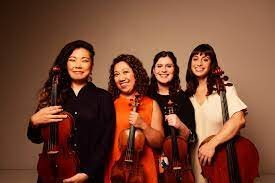
Hildegard von Bingen: Columba aspexit (arr. Alex Fortes); Eleanor Alberga: String Quartet No. 1; Komitas Vardapet: Armenian Folk Songs (arr. Sergei Aslamazian) - Yergink Ampel A (It’s Cloudy); Haprpan (Festive Song); Shoushigi (For Shoushing); Echmiadzni Bar (Dance from Echmiadznin); Kaqavik (The Partridge); Sibelius: String Quartet in D minor Op. 56, “Voces Intimae.” Aizuri Quartet (Emma Frucht and Miho Saegusa violins; Ayane Kozasa, viola; Karen Ouzounian, cello). Azica ACD-71359 

Having never heard of the Aizuri Quartet before receiving this disc for review, I was not quite sure what to expect. The program seemed to be a bit unusual, too, what with music from Hildegard, Komitas, and Sibelius – familiar names, but not ones I would have expected to find together on the same program – plus a quartet from a composer whose name was unfamiliar to me, Eleanor Alberga. Opening the booklet that came with the CD, I found these words of explanation from Aizuri’s cellist, Karen Ouzounian: “Earthdrawn Skies explores deep connections between humankind and the natural world through the distinct lenses of four composers forging personal relationships with the soil and the stars. These works by Hildegard von Bingen, Eleanor Alberga, Komitas Vardepet and Jean Sibelius are rooted in a sense of tradition and connection to the land, even as the composers seek something beyond their reach: an understanding of God, the physics of the cosmos, homeland, happiness. The music on this album draws from the earth as it reaches upward and outward. these composers share an impulse to understand the sky, the heavens, the larger things in life. This is music we have kept returning to as a quartet, as it speaks to us in deeply personal ways. We cherish playing this music together, and we hope it resonates as much with you as it does with us.”

The opening piece by Hildegard von Bingen (1098-1179) is an unusual choice for a string quartet in that rather than highlight the interplay among the four members, with the first and second violins swapping melodic lines in the upper registers while engaging in interplay with the darker tones of the viola and cello, weaving in and out of each other’s lines, the four players are bound tightly together. "The four of us have often talked about ‘singing through our instruments’ and how the quartet is one organism," remarks violinist Miho Saegusa. "Alex Fortes's arrangement of Hildegard's Columba aspexit presented us with a unique and challenging question, one we were excited to explore: how can we truly become one voice?" It’s an unusual sonority for a string quartet, but one that draws the listener in. What an effective way to begin an album!

Next on the docket is the three-movement String Quartet No. 1 by Eleanor Alberga (b.1949), a Jamaican-born composer who lives and works in the UK. From the very first measures of the first movement it is clearly a work that in tone and texture stands in contrast from the Bingen that preceded it. The pace is frantic, the mood more abstract. The overall pattern is the familiar fast-slow-fast, the engaging second movement (the highlight of the piece, designated Expressivo, with wonder and yearning) being followed by the more frenetic finale, with its sharper rhythms and pizzicato passages (it is designated Frantically driven yet playful). It sounds like one of those pieces that would be especially rewarding to see performed live, observing the interactions of the four players.


Then comes another shift in pace and mood with the five brief (none over three minutes) folk songs by the Armenian Komitas Vardapet (1869-1935), usually known simply as “Komitas,” an Armenian musicologist, composer, music teacher, choir director, priest (thus the “Vardapet,”), whose actual given name was Soghomon Gevorki Soghomonyan. He is considered the father of Armenian classical music. These folk songs are lively and charming, enjoyable to hear as well as to play. "The music of Komitas gave us a sense of our roots, our homes and lands from which we were displaced, the contours and nuances of our language, the warmth and sorrow and ebullience of our families, a link between those who perished and those who are living," writes Ouzounian of the album's link to her Armenian heritage.


The album closes with the “Voces Intimae” quartet by Sibelius. As popular as his symphonies have become, his string quartet has never really caught on to the same degree. Some years back I read a fascinating book that I highly recommend titled Indivisible by Four: A String Quartet in Pursuit of Harmony by Arnold Steinhardt, who was the first violinist of the famed Guarneri String Quartet. One of the tales from his account of his career with the group revolves around his repeated attempts to persuade the other members to add the Sibelius to the Guarneri’s repertoire. Surprisingly, it took many years before he was finally successful, as the other quartet members would not come to agreement that the Sibelius quartet was a worthy piece. My goodness! Violist Ayane Kokasa points out that “there are five movements instead of the traditional three or four. Each movement feels like a character piece, with the heart and soul of the work placed in three intimate and hushed chords tucked in the third movement. No matter how many times I listen to this piece, it feels new, like we are on the precipice of discovering something great.” It’s not one of those dramatic quartets that makes a memorable first impression; it’s a quartet that deserves and then rewards repeat listening. 

Azica Records deserves kudos for the liner notes that provide some insight into the music and musicians, the simple but compelling art that graces both cover and booklet, and the attractive sound quality. With Earthdrawn Skies, they have produced a CD that deserves and then rewards repeated listening.

Jul 6, 2022

Recent Releases, No. 32 (CD reviews)

By Karl W. Nehring

LYS: Mari Samuelsen
Program includes: (1) Meredi: White Flowers Take Their Bath; (2) Dobinka Tabakova: Nocturne (arr. for violin & piano); (3) Hannah Peel: Signals; (4) Caroline Shaw: The Orangery; The Beech Tree; (5) Laura Masotto: Sol Levante; (6) Margaret Hermant: Lightwell; (7) Hildegard of Bingen: O vis eternitatis (arr. by Tormod Tvete Vik); (8) Beyoncé: Halo; (9) Lera Auerbach: Adagio sognando; (10) Hildur Guðnadóttir: Baer (arr. by Max Knoth); (11) Hannah Peel: Reverie (arr. for solo violin, strings, & electronics); (12) Hania Rani: La Luce; (13) Clarice Jensen: Love Abounds in Everything; (14) Anna Meredith: Midi (Arr. for solo Violin & electronics). Mari Samuelsen, violin; with support on the tracks indicated by Hania Rani, piano (12); Dobrawa Czecher, solo cello (12); Margaret Hermant, harp, violin, electronics (6); Fabien Leisure, electronics (6); Meredi, electronics (1); Clarice Jensen, electronics, cello, and artistic director (13); American Contemporary Music Ensemble (Ben Russell, violin; Laura Lutzke, violin; Isabel Hagen, viola; Paul Wiancko, cello) (13); Anna Meredith, electronics (14); Hannah Peel, electronics (3); 11; Erland Cooper, programming (11); Julien Quentin, piano (2, 9); Scoring Berlin (1, 3-7, 8, 10-12); Jonathan Stackhammer, conductor (1, 3-7, 6-8, 12). Deutsche Grammophon 486 2096.

Mari Samuelsen’s previous album for DG, titled simply “Mari,” was a 2-CD affair featuring a generous helping of work by contemporary composers plus a couple of works by Bach. You can read my review of that album here: https://classicalcandor.blogspot.com/2019/09/mari-cd-review.html Although it I must confess that it never occurred to me at the time, in the light of familiarizing myself with her new album it is now glaringly obvious that all the composers were male. To help restore some balance to the universe, all of the music on LYS (“light”) is the work of female composers; moreover, with the obvious exception of Hildegard, all are contemporary composers. As you can see, then, Ms. Samuelsen is vitally interested in presenting new music to the classical music listening public.

Do not fear, however, for all of the music on this album is quite listenable. There is nothing here that is dissonant or aurally challenging. On the contrary, this is music that is uplifting, hopeful, and engaging. Several of the composers provide brief notes about their compositions, this excerpt from Laura Masotto effectively capturing the spirit of the entire program: “Sol Levante was composed while holding in mind Mari’s discography and the way she plays the violin… While composing, I felt I wanted her and the string quartet to enjoy playing this piece, to have fun.” That sense of fun comes through not just on Marotto’s piece, but throughout the 52-minute recording. To hear such vibrant music from young musicians – players and composers alike – makes me feel confident about the future of what we still cling to calling “classical” music. Whatever you might choose to call it, it’s in good hands, folks.

Solus et una: Amit Peled
Bach: Suite No. 4 in E-flat Major for Violincello Solo, BWV 1010; Suite No. 5 in C Minor for Violincello Solo, BWV 1013; Brahms: Symphony No. 3 – Andante (arr. by Konstantin Blagojevic for eight cellos and piano)*. Amit Peled, cello; *Mount Vernon Virtuosi Cello Gang (Nick Pascucci, Natalia Vilchis, Lindsey Choung, Amit Peled, Mairéad Flory, Kyle Victor, Jiaoyang Xu, Álvaro Vázquez Osa, cellos); *Allison Freeman, piano. CTM Classics 95269 15090.  

This is yet another of those recordings arising from the pandemic. Israeli-American cellist Peled (b. 1973) says of this recording that it “is a reflection on my musical journey during the COVID-19 pandemic. As my mentor Boris Pergamenschikov wrote: ‘The Bach Cello Suites is music that cleanses the soul, especially if you ply it just for yourself, preferably without any audience.” As with many of us cellists, I found myself spending a lot of time with the Bach Suites in my home studio during the long months of the lockdown. The two suites that attracted me the most were the fourth suite in E-flat Major, which represents triumph, daring, and heroism – all the qualities I found myself searching for while trying to make sense of the artistic dryness that we all experienced at the beginning of the pandemic. And in contrast, the monumental fifth suite in C Minor, which bubbled up in me about a year into the lockdown when questions about supernatural power, God, love, religion and a search for belonging to something bigger than just us here on earth emerged in me – all the elements one finds in that almost religious most philosophical suite.”

With so many recordings of the complete set of Bach cello suites available by so many celebrated cellists – in many cases, multiple sets by celebrated artists such as Yo-Yo Ma, for example, who has no fewer than three fine sets available to choose from – what is the appeal of a single CD from a less well-known artist that contains only two of the six suites? First of all, not everyone needs to have a recording of all six suites, at least not at first (after becoming familiar with this glorious music by means of this splendid release, they may well decide to take the plunge. If they really want to jump in deep, besides picking up a recording of the complete set, they might also want to take a look at British cellist Steven Isserlis’s recent book about the Bach cello suites).

Second of all, Solus et una (“alone and together”) is in itself a splendid introduction to the suites, with Peled delivering heartfelt performances that are captured in excellent sound. I did a quick comparison of Eled’s performance  of No. 5 with Janos Starker’s venerable version on Mercury Living Presence and concluded that Eled’s version held its own. Again, for the listener new to classical music (or at least to the cello suites of Bach), Solus et una would certainly be a fine place to start.

Finally, Esed offers listeners a bonus: “As an encore track, I have included on this release the one piece that I was able to record during the lockdown with my dear cello students. Teaching during the pandemic, both online and in person, has been a source of hope, comfort and inspiration. Moreover, being able to make music with other people and with my own students was a real musical climax. For me, there’s nothing better to conclude this musical journey than the music of Brahms with its beauty of line and intimacy.” After the intensity of the Bach, the Brahms provides a relaxing change of pace. The sound quality is also different, with the instruments being more distant, the cellos blending into each other and the piano seeming to be a bit too far off in the distance to be completely effective musically. With the cellos not providing the treble parts that the violins would have provided in the original orchestral score, I had hoped the piano would have provided more of that sense, but the arrangement and engineering did not allow me to hear what I had hoped to hear. Still, as Esed writes, there does come through a sense of that Brahmsian beauty of line, even if it sounds a bit muffled. Perhaps I should not quibble about a bonus track recorded by students. All in all, this is a noteworthy release that is an excellent introduction to the wondrous world of the Bach cello suites.     

Enfolding
Scott Wollschleger: Outside Only Sound; Anne Leilehua Lanzilotti: with eyes the color of time. Eli Spindel, Brooklyn String Orchestra. New Focus FCR331.

Although there is nothing about the music on this release that is dissonant or “in-your face” (quite the opposite, actually), I will point out at the outset of this review that this is a CD that is not like to appeal to a broad swath of classical music lovers. However, there are some who may well find it fascinating, so for you folks (you know who you are, or at least I hope you will if you read on for a few more minutes), let me do my best to give you a quick thumbnail of these two compostions. The liner notes are quite skimpy, almost nonexistent, but if you are interested, you can find out more about the music at newfocusrecordings.com.  

There you will discover that “Scott Wollschleger’s Outside Only Sound was written upon request from the String Orchestra of Brooklyn to facilitate performance under lockdown restrictions. Wollschleger was asked to write a work that would require only a few minutes of rehearsal and could be performed outside. His answer was to write a work where each player is like an insect in a swarm; making sounds independently that are coordinated in accordance with time stamps in the score to create a mass of sound that moves in waves across the fourteen and half minute score. Bells, triangles, string harmonics, scratch tones, and cymbals merge with the sounds of an outdoor park, replete with laughing voices and the backing up signal of a truck. By the time the work is finished, one can sense the transformation of the public space into something shared and contemplative.” Well, for pretty much the first three minutes, the predominant sounds on the recording are ambient sounds, e.g., traffic noise, people talking, and so forth, with the instrumental sounds being way in the background. The instrumental sounds move to the foreground for the next nine minutes or so, but never really establish much in the way of melody, not that the sounds are in any way offensive. With about two minutes left, the background sounds begin to take back over. The whole effect is dreamlike, perhaps best enjoyed on headphones.

Anne Leilehua Lanzilotti’s with eyes the color of time, which was a finalist for the 2022 Pulitzer Prize in music, is said to be inspired by a series of works on display at The Contemporary Museum (Spalding House) in Honolulu. Although the notes on the lable’s website describe it as a nine-movement piece, there are only eight movements/tracks on the CD. Go figure. But while Wollschleger’s composition was recorded live in a park (and sounds like it, as described above), with eyes the color of time was recorded in a studio and although still not abounding with melody in the traditional sense, sounds more like composed music.  The composer is able to evoke a variety of moods and sounds from the assembled strings and percussion, especially in the final two movements, titled “mahina” and “enfolding,” which are both more than seven minutes in duration. The latter movement in particular is quite spellbinding, closing the program on a seemingly metaphysical plane evoked by haunting sounds that lead the mind of the listener inevitably inward. No, this is not an album for everyone, but there are certainly some who will find it fascinating.

KWN

Dec 15, 2021

Emily D’Angelo: Enargeia (CD review)

Hildur Guðnadóttir (arr. Jarko Riihimäki): Fólk fær andlit; Hildegard von Bingen (arr. Sarah Kirkland Snider): O virtus sapientae; Missy Mazzoli (arr. Riihimäki): This World Within Me Is too Small; Kirkland Snider: Caritas; Mazzoli: Hello Lord; Mazzoli: You Are the Dust; Kirkland Snider: Dead Friend; Kirkland Snider: Nausicaa; Hildegard von Bingen (arr. Mazzoli): For the Virgin; Mazzoli: A Thousand Tongues; Guðnadóttir (arr. Riihimäki): Lidur; Kirkland Snider: The Lotus Eaters. Emily D’Angelo, mezzo-soprano; Jarkko Riihimäki, das freie orchester Berlin; Kuss Quartett; Matangi Quartet; Wolfgang Fischer, percussion; Rene Flächsenhaar, Mikayel Hakhnazaryan, cello; Frédéric L’Épée, electric guitar; Jonas Niederstadt, glockenspiel; Marc Prietzel, drums; Marion Ravot, harp; Christian Vogel, bass clarinet; Norbert Wahren, double bass. Deuthsche Grammophon 486 0536.

by Karl W. Nehring

Enargeia
 is the debut album from Canadian mezzo-soprano Emily D’Angelo (b. 1994). As a glance at the program should tell you, this is hardly the typical debut recital album one would expect to hear from a rising young opera star. Rather than the usual familiar arias by famous operatic composers, she has brought together unfamiliar music by women composers both past and present, arranging them into a varied but coherent program that captivates from start to finish. As she remarks in her liner notes, “the pieces in this program are bound together by the ancient Greek concept of enargeia, whose spirit is found throughout the music of each composer and the texts they have made manifest on the sound waves. Each piece is part of a sonic journey, each track born out of the previous one as the listener is guided through a progression, a cohesive and exploratory listening experience.”

Regarding the composers represented on this album, D’Angelo first encountered the music of Hildegard (1098-1179) while singing in a choir during her youth and was quite taken by what she heard. Of Hildegard, D’Angelo writes that “her belief in music as a heightened communicative mode (is) woven throughout the songs on this album.” Moving ahead to our current time, D’Angelo has included music by the Icelandic composer Hildur Guðnadóttir, of whom she observes, “creates compostions that evoke otherworldly, multidimensional qualities, which have translated into diverse mediums ranging from scores for film and television to solo recordings. The use of bowed instruments as a drone harkens back to medieval music but seen through a modern, ambient lens.”    The other two composers represented on Enargiea are the Americans Missy Mazzoli (b. 1980), whom D’Angelo credits as being adept at the “crossing of sacred themes and electronic instrumentation,” and Sarah Kirkland Snider (b. 1973), who D’Angelo observes is “known for her direct expression and vivid narrative.”

Although the music is by four different composers, the program is focused and unified. Certainly Ms. D’Angelo’s voice, which is rich and strong and persuasive, brings coherence to the music, along with conviction and great beauty. The songs focus on death, but not in a morbid, obsessive manner (texts are provided). The instrumental accompaniments are generally quite spare, but varied in timbre and texture, at times augmented by electronic effects; however, there is an overall rightness and naturalness to the sound that makes the whole effort sound as though it could be a contemporary version of a song cycle by Mahler, something along the lines of his Kindertotenlieder, or perhaps a scaled-down Das Lied von der Erde. If you are a classical music lover who enjoys that sort of vocal music, you should find Enargeia to be a most fascinating recording. D’Angelo has a truly special voice, the instrumental arrangements are apt and imaginative, and the engineering frames everything well. Brava, Ms. D’Angelo! Your bold vision has brought us something special indeed, and just in time for the holidays.

KWN

To listen to a brief excerpt from this album, click here:

Aug 27, 2013

Hildegard von Bingen: Celestial Hierarchy (CD review)

Benjamin Bagby, Sequentia. Deutsche Harmonia Mundi 88765468642.

Everything seems to go in cycles, and what’s popular one day may not be as popular the next. For instance, after Mahler died, his music generally fell out of favor with the public until the Fifties and Sixties when the stereo/hi-fi era began and conductors like Leopold Stokowski, Dimitri Mitropoulos, John Barbirolli, Bruno Walter, Otto Klemperer, Leonard Bernstein, and Georg Solti revived audience interest. In the Seventies we had a renaissance in Chant; in the Eighties and Nineties we got a renewed interest in period instruments; and so on. Today, we seem to be in an age of the Singing Nun, with various groups like the Benedictines of Mary producing chart-busting albums. It appears to be an appropriate time, then, for the early music ensemble Sequentia to release the final album, Celestial Hierarchy, in their series of discs containing the complete works of the medieval abbess, writer, philosopher, poet, and composer Hildegard von Bingen.

Sequentia made this ninth and concluding entry in their survey of Hildegard’s work exactly thirty years after their first album in the run, which they made back in 1982, all of them for Deutsche Harmonia Mundi. That’s both dedication and staying power. And releasing this final disc at a point where the meditative music composed or sung by women is so much in the public eye shouldn’t hurt sales.

Hildegard von Bingen (1098-1179), also known as Saint Hildegard of Bingen and Sibyl of the Rhine, was something of a jack-of-all trades. As I mentioned above, she was a German writer, composer, philosopher, Christian mystic, Benedictine abbess, visionary, and intellectual. Her fellow nuns elected her a magistrate in 1136; she founded the monasteries of Rupertsberg and Eibingen in 1150 and 1165 respectively; and scholars consider one of her works, the Ordo Virtutum, an early example of liturgical drama and perhaps the oldest surviving morality play. Beyond her many volumes of visionary theology, she wrote a variety of musical compositions for use in liturgical services, which is what Sequentia have now addressed in their nine albums documenting Hildegard’s work.

Sequentia as currently constituted comprise seven female singers: Lydia Brotherton, Agnethe Chritensen, Esther Labourdette, Sabine Lutzenberger, Christine Mothes, Elodie Mourot, and Lena Susanne Norin; plus two instrumentalists on select numbers: Norbert Rodenkirchen, flutes, and the group’s cofounder Benjamin Bagby, harp. Mr. Bagby and the late Barbara Thornton founded the group in 1977, and even though with the exception of Bagby the performers have changed over the years, they perform together as if they had been doing it all their lives; that is, heavenly.

The music on Celestial Hierarchy represents the hymns Hildegard devoted to the angels, patriarchs, prophets, martyrs, and confessors, as well as John the Evangelist and Mary the Mother of Jesus. That was the "celestial hierarchy" she celebrated. Praising God in word and song was an important part of Hildegard's worship, a practice she believed allowed her to reconnect with her origins and achieve a state of self-realization. The present album contains ten numbers (a little over seventy minutes) representing the devotions of her theology, a collection of antiphons (psalms, hymns, or prayers sung in alternate parts) and responsories (anthems sung after a portion of sacred writing by a soloist and choir alternately).

The songs float radiantly above us, sweet and ethereal, and Sequentia perform them with exquisite care and precision. However, I wish I could be as enthusiastic about Hildegard of Bingen’s music as I am about Sequentia’s performance of it. Hildegard's venerations of the Saints can begin sounding a bit the same after the first few items, and over an hour of them can become tiring to a novice like me. What's more, Sequentia use instrumental accompaniment, flute and harp, quite sparingly and only on three of the ten selections. I would advise a word of caution, therefore, upon entering these waters: If you are already a fan of Hildegard's work, you will find no better a collection of her music than the present disc; but if you are new to the genre, you may find yourself wondering if it isn't too much of a good thing. Nevertheless, since when is too much of something good ever a bad thing? I'd further advise the first-time listener to begin with track six, "O Victoriosissimi Triumphatores," with its lovely harp accompaniment.

Producer and engineer Nicolas Bartholomee recorded the album at the Church of Saint Remigius, Franc-Waret, Belgium in November, 2012. The acoustic is open and airy, very much like the large church-cathedral it is, with plenty of ambient air in the resonant venue. Voices are miked at a moderate distance for ultimate realism, and while they can sound perhaps a touch bright and ringing at times in this setting, they are reasonably rich and clear.

To listen to a brief excerpt from this album, click here:

JJP

Meet the Staff

Meet the Staff
John J. Puccio, Founder and Contributor

Understand, I'm just an everyday guy reacting to something I love. And I've been doing it for a very long time, my appreciation for classical music starting with the musical excerpts on the Big Jon and Sparkie radio show in the early Fifties and the purchase of my first recording, The 101 Strings Play the Classics, around 1956. In the late Sixties I began teaching high school English and Film Studies as well as becoming interested in hi-fi, my audio ambitions graduating me from a pair of AR-3 speakers to the Fulton J's recommended by The Stereophile's J. Gordon Holt. In the early Seventies, I began writing for a number of audio magazines, including Audio Excellence, Audio Forum, The Boston Audio Society Speaker, The American Record Guide, and from 1976 until 2008, The $ensible Sound, for which I served as Classical Music Editor.

Today, I'm retired from teaching and use a pair of bi-amped VMPS RM40s loudspeakers for my listening. In addition to writing for the Classical Candor blog, I served as the Movie Review Editor for the Web site Movie Metropolis (formerly DVDTown) from 1997-2013. Music and movies. Life couldn't be better.

Karl Nehring, Editor and Contributor

For nearly 30 years I was the editor of The $ensible Sound magazine and a regular contributor to both its equipment and recordings review pages. I would not presume to present myself as some sort of expert on music, but I have a deep love for and appreciation of many types of music, "classical" especially, and have listened to thousands of recordings over the years, many of which still line the walls of my listening room (and occasionally spill onto the furniture and floor, much to the chagrin of my long-suffering wife). I have always taken the approach as a reviewer that what I am trying to do is simply to point out to readers that I have come across a recording that I have found of interest, a recording that I think they might appreciate my having pointed out to them. I suppose that sounds a bit simple-minded, but I know I appreciate reading reviews by others that do the same for me — point out recordings that they think I might enjoy.

For readers who might be wondering about what kind of system I am using to do my listening, I should probably point out that I do a LOT of music listening and employ a variety of means to do so in a variety of environments, as I would imagine many music lovers also do. Starting at the more grandiose end of the scale, the system in which I do my most serious listening comprises Marantz CD 6007 and Onkyo CD 7030 CD players, NAD C 658 streaming preamp/DAC, Legacy Audio PowerBloc2 amplifier, and a pair of Legacy Audio Focus SE loudspeakers. I occasionally do some listening through pair of Sennheiser 560S headphones. I miss the excellent ELS Studio sound system in our 2016 Acura RDX (now my wife's daily driver) on which I had ripped more than a hundred favorite CDs to the hard drive, so now when driving my 2024 Honda CRV Sport L Hybrid, I stream music from my phone through its adequate but hardly outstanding factory system. For more casual listening at home when I am not in my listening room, I often stream music through a Roku Streambar Pro system (soundbar plus four surround speakers and a 10" sealed subwoofer) that has surprisingly nice sound for such a diminutive physical presence and reasonable price. Finally, at the least grandiose end of the scale, I have an Ultimate Ears Wonderboom II Bluetooth speaker and a pair of Google Pro Earbuds for those occasions where I am somewhere by myself without a sound system but in desperate need of a musical fix. I just can’t imagine life without music and I am humbly grateful for the technologies that enable us to enjoy it in so many wonderful ways.

William (Bill) Heck, Webmaster and Contributor

Among my early childhood memories are those of listening to my mother playing records (some even 78 rpm ones!) of both classical music and jazz tunes. I suppose that her love of music was transmitted genetically, and my interest was sustained by years of playing in rock bands – until I realized that this was no way to make a living. The interest in classical music was rekindled in grad school when the university FM station serving as background music for studying happened to play the Brahms First Symphony. As the work came to an end, it struck me forcibly that this was the most beautiful thing I had ever heard, and from that point on, I never looked back. This revelation was to the detriment of my studies, as I subsequently spent way too much time simply listening, but music has remained a significant part of my life. These days, although I still can tell a trumpet from a bassoon and a quarter note from a treble clef, I have to admit that I remain a nonexpert. But I do love music in general and classical music in particular, and I enjoy sharing both information and opinions about it.

The audiophile bug bit about the same time that I returned to classical music. I’ve gone through plenty of equipment, brands from Audio Research to Yamaha, and the best of it has opened new audio insights. Along the way, I reviewed components, and occasionally recordings, for The $ensible Sound magazine. Most recently I’ve moved to my “ultimate system” consisting of a BlueSound Node streamer, an ancient Toshiba multi-format disk player serving as a CD transport, Legacy Wavelet II DAC/preamp/crossover, dual Legacy PowerBloc2 amps, and Legacy Signature SE speakers (biamped), all connected with decently made, no-frills cables. With the arrival of CD and higher resolution streaming, that is now the source for most of my listening.

Ryan Ross, Contributor

I started listening to and studying classical music in earnest nearly three decades ago. This interest grew naturally out of my training as a pianist. I am now a musicologist by profession, specializing in British and other symphonic music of the 19th and 20th centuries. My scholarly work has been published in major music journals, as well as in other outlets. Current research focuses include twentieth-century symphonic historiography, and the music of Jean Sibelius, Ralph Vaughan Williams, and Malcolm Arnold.

I am honored to contribute writings to Classical Candor. In an age where the classical recording industry is being subjected to such profound pressures and changes, it is more important than ever for those of us steeped in this cultural tradition to continue to foster its love and exposure. I hope that my readers can find value, no matter how modest, in what I offer here.


Bryan Geyer, Technical Analyst

I initially embraced classical music in 1954 when I mistuned my car radio and heard the Heifetz recording of Mendelssohn's Violin Concerto. That inspired me to board the new "hi-fi" DIY bandwagon. In 1957 I joined one of the pioneer semiconductor makers and spent the next 32 years marketing transistors and microcircuits to military contractors. Home audio DIY projects remained a personal passion until 1989 when we created our own new photography equipment company. I later (2012) revived my interest in two channel audio when we "downsized" our life and determined that mini-monitors + paired subwoofers were a great way to mate fine music with the space constraints of condo living.

Visitors that view my technical papers on this site may wonder why they appear here, rather than on a site that features audio equipment reviews. My reason is that I tried the latter, and prefer to publish for people who actually want to listen to music; not to equipment. My focus is in describing what's technically beneficial to assure that the sound of the system will accurately replicate the source input signal (i. e. exhibit high accuracy) without inordinate cost and complexity. Conversely, most of the audiophiles of today strive to achieve sound that's euphonic, i.e. be personally satisfying. In essence, audiophiles seek sound that's consistent with their desire; the music is simply a test signal.

Mission Statement

It is the goal of Classical Candor to promote the enjoyment of classical music. Other forms of music come and go--minuets, waltzes, ragtime, blues, jazz, bebop, country-western, rock-'n'-roll, heavy metal, rap, and the rest--but classical music has been around for hundreds of years and will continue to be around for hundreds more. It's no accident that every major city in the world has one or more symphony orchestras.

When I was young, I heard it said that only intellectuals could appreciate classical music, that it required dedicated concentration to appreciate. Nonsense. I'm no intellectual, and I've always loved classical music. Anyone who's ever seen and enjoyed Disney's Fantasia or a Looney Tunes cartoon playing Rossini's William Tell Overture or Liszt's Hungarian Rhapsody No. 2 can attest to the power and joy of classical music, and that's just about everybody.

So, if Classical Candor can expand one's awareness of classical music and bring more joy to one's life, more power to it. It's done its job. --John J. Puccio

Contact Information

Readers with polite, courteous, helpful letters may send them to classicalcandor@gmail.com

Readers with impolite, discourteous, bitchy, whining, complaining, nasty, mean-spirited, unhelpful letters may send them to classicalcandor@recycle.bin.

"Their Master's Voice" by Michael Sowa

"Their Master's Voice" by Michael Sowa