Showing posts with label Ligeti. Show all posts

Jun 20, 2025

Piano Potpourri No. 12 (CD/Streaming Reviews)

by Karl Nehring

Ravel: The Complete Solo Piano Works and Concertos. (CD1) Sérénade grotesque, M. 5Menuet antique, M. 7Pavane pour une infante défunteM. 19Jeux d'eau, M. 30Sonatine, M. 40Miroirs M. 43; (CD2) Gaspard de la nuit, M. 55Menuet sur le nom d'Haydn, M. 58Valses nobles et sentimentales, M. 61Prélude, M. 65À la manière de Borodine, M. 63/1À la manière de Chabrier, M. 63/2Le tombeau de Couperin, M. 68; (CD3) Piano Concerto for the Left Hand, M. 82Piano Concerto in G Major, M. 83. Seong-Jin Cho, piano; Boston Symphony Orchestra; Andris Nelsons, conductor. Deutsche Grammophon Limited Edition 3 CD 486 6824


Earlier this year, we reviewed a Deutsche Grammophon recording of Maurice Ravel’s complete music for solo piano by the young Korean pianist Seong-Jin Cho (b. 1994), a review that you can read here. Following the release of that album, DG released his recording of the two Ravel piano concertos with the Boston Symphony Orchestra conducted by Andris Nelsons. As many music lovers are no doubt aware, 2025 marks 150 years since Ravel’s birth; in May, DG released this deluxe album -- that combines those previous albums as part of this limited-edition 3-CD set. The album cover looks like it should hold LPs rather than CDs (when my copy arrived, my first thought was that I had been sent a vinyl version by mistake). That large, sturdy package comprises (in addition to the three CDs themselves) a hardcover book with full track listings and notes on the music; numerous photos of the artist; and the offer of three months’ free access to STAGE+, DG’s online video repository of concert performances and audio albums. Because we have already reviewed the solo piano music (link above), we’ll confine our comments to the concerto disc, which, given the talent shown by Cho in the solo piano music combined with the undeniable excellence of the BSO, is a worthy release indeed. Cho brings something of a light touch to Ravel’s music, which may well be why the album’s producers thought to devote a page devoted to this quote from Ravel: “The music of a concerto should, in my opinion, be lighthearted and brilliant, and not aim at profundity or at dramatic effects.”  Delightful music in an impressive package – it’s a limited edition (only 4000 to be produced), and of course the solo piano music and concerto releases are also available – these are all recommendable as appropriate.


Arc III. Louise Talma: Alleluia in Form of Toccata; Schubert: Fantasie in C major, Op. 15, D. 760“Wandererfantasie”; Debussy: L’Isle Joyeuse, L. 106; Dohnányi: Pastorale on a Hungarian Christmas Song; Brahms: Piano Sonata No. 3 in F minor, Op. 5; Ligeti: Études, Book 1: No. 5 Arc-en-ciel. Orion Weiss, piano. First Hand Records FHR129


Back in 2014, Ohio-born pianist Orion Weiss (b. 1981) embarked on a recording project that eventually yielded three releases, Arc I (our review of which you can read here) being the first. In the liner note essay of the first release of his projected trilogy, Weiss explained that “the arc of this recital trilogy is inverted, like a rainbow’s reflection in water. Arc I’s first steps head downhill, beginning from hope and proceeding to despair. The bottom of the journey, Arc II, [you can find our review of Arc II here] is Earth’s center, grief, loss, the lowest we can reach. The return trip, Arc III, is one of excitement and renewal, filled with the joy of rebirth and anticipation of a better future.” Weiss recorded Arc III in 2022 as the world was beginning to emerge from the COVID-19 shutdown and he found that to him, “everything seemed utterly transformed, almost unrecognizable. My perception of humanity had undergone a fundamental change… The music was another world, another set of ideas, able to lift me above my own, to teach me and guide me.” The generally uplifting spirit of the album is established at the outset with the exuberant Alleluia in Form of Toccata by the American composer Louise Talma (1906-1996), a piece that seems to be bursting at the seams with exuberance. Following this unfamiliar beginning, Weiss then brings us back into the realm of the familiar, with music from Schubert and Debussy, before once again bringing us something less familiar, Erno Dohnányi’s Pastorale on a Hungarian Christmas Song. This piece sounds more like a dreamlike dance fantasy than an ode to Yule logs or Christmas trees; but it has a wistful, hopeful charm that makes it quite appealing. Weiss then brings us the major work on his program, Brahms’s Piano Sonata No. 3, an imposing work in no fewer than five movements that total more than 35 minutes. Brahms composed this sonata at the age of 20, eager to display his talents as both composer and pianist, and Weiss channels the exuberance and youthful spirit of the young Brahms before closing his program in a more reflective vein with the colorful but enigmatic Ligeti Étude.

And thus we come to the end of Weiss’s Arc series of recordings. As the pianist himself summarizes it: “The music recorded on Arc I (FHR127) expresses foreboding from the brink of disaster. The music on Arc II (FHR128) was written by composers dealing with tragedy. At last, Arc III is a set of pieces born from the bright points of life. Peace, hope, love, ambition, optimism and the divine – the inspirations are myriad. These compositions spring from the million shades of happiness.” Arc III certainly is a delightful conclusion to the trilogy – well worth an audition, as are its two predecessors.


The Art of MemoryBach: The Well-Tempered Clavier, Book II; Lasser: 12 Preludes for Solo Piano "The Art of Memory". Anton Mejias, piano. Deutsche Grammophon (digital-only release)


The Finnish-Cuba pianist Anton Mejias (b. 2001) was fascinated by the music of Bach from a very young age. He made his recital debut at the age of eight, and by ten, he had already learned the entire Well- Tempered Clavier, Book I. Since then he has added the complete French and English Suites, all six Partitas, and the Well-Tempered Clavier, Book II, to his repertoire. The title of this new release has a dual reference: the recording captures a concert performance that in which Mejias played these works by Bach and Lasser from memory – no mean feat, to be sure – and the subtitle of Lasser’s work, “The Art of Memory.” Rather than present the Bach and Lasser compositions separately, Mejias has chosen to weave them together: four tracks of Bach, a track of Lasser – repeated in this way through all 48 preludes and fugues of The Well-Tempered Clavier, Book II and all 12 Preludes for Solo Piano "The Art of Memory."

Philip Lasser (b. 1961) is an American composer and pianist who is currently on the faculty at Julliard. Of his “The Art of Memory” he writes, “I began my Twelve Preludes many years ago with the idea of creating a set of works wherein as we went from one to the next, each prelude would collect remembrances of the past preludes until, at last, we reach the twelfth, which would be entirely made up of memories. . . I began to realize that this was a metaphor for human memory. With each new day, we become richer with new events, emotions, apperceptions; and yet, we receive the new only through the filter of our own personal experience which is then nothing more than a sum of our past remembrances. . . I am deeply honored that Anton Mejias has taken the bold move to perform and record my Preludes inside Bach's Well-Tempered Clavier and I hope that my work nests quietly in Bach's great work and offers yet another rhythm to the mastery of his unfolding of time.” Lasser’s brief, subtly ambiguous-sounding Preludes offer a subtle contrast to Bach’s more resolute music; woven together, the net effect is entrancing. At more than two hours in length, this is hardly an album suitable for a quick listen; to be sure, many listeners will use it as background music – not that there’s anything wrong with that. It will also reward serious listening for those who have the time and the inclination. It’s a remarkable recording.

Sep 27, 2023

Recent Releases No. 60 (CD Reviews)

by Karl Nehring

Wonderland. Makiko Kinoshita: Ashita no uta; Ligeti: Nonsense Madrigals: I. Two Dreams and Little Bat; Gjeilo: A Dream within a Dream; Ligeti: Nonsense Madrigals: II. Cuckoo in the Pear-Tree; Francesca Amewudah-Rivers: Alive; Ligeti: Nonsense Madrigals: III. The Alphabet; Joe Hisaishi: I was there; Ligeti: Nonsense Madrigals: IV. Flying Robert; Judith Bingham: Tricksters; Ligeti: Nonsense Madrigals: V. The Lobster Quadrille; Malcolm Williamson: The Musicians of Bremen; Ligeti: Nonsense Madrigals: VI. A Long, Sad Tale; Paul Patterson: Time Piece. The King's Singers. Signum Classics SGCD739

The King’s Singers is one of those British musical groups that just seem to have been around forever, kind of like the Rolling Stones. Unlike Jagger and company, however, they don’t look or sound like a bunch of withered old men: they have obviously changed members over the years. Their website (which you can find here) is full of useful information about the group, including an account of their origin: “People often ask us where our name comes from, and the answer is from King's College, Cambridge. The original six members of The King's Singers were all choral scholars at King's College, part of Cambridge University. They first recorded in 1965, under the not-so-catchy name 'Schola Cantorum Pro Musica Profana in Cantabridgiense'. This recording put the group into the consciousness of the famous conductor Sir Neville Marriner, who in August 1966, invited them to perform in concert. Several more concerts followed, under the name 'Six Choral Scholars of King's College, Cambridge', before, on 1st May 1968, the group made its London debut in another of Neville Marriner's concerts, this time under another new name: The King's Singers.” The current lineup that performs on this release comprises Patrick Dunachie, first countertenor; Edward Button, second countertenor; Julian Gregory, tenor; Christopher Bruerton, first baritone; Nick Ashby, second baritone; Jonathan Howard, bass.

The music on Wonderland features compositions commissioned by the ensemble over its 55-year history, highlighted by the six Nonsense Madrigals by the late Hungarian composer György Ligeti. In addition, to honor Ligeti’s 100th birthday in 2023, The King’s Singers commissioned six sets of cartoons, each of which has since been turned into a music video by illustrator Coralie Muce, to accompany the six Nonsense Madrigals. A QR code included in the CD booklet provides a link to these colorful videos for those who might be interested in seeing them. The  booklet also includes lyrics for all of the works on the album along with background information on the history of the ensemble. The music itself is varied, although there are threads that bind the album together. For example, woven throughout the Nonsense Madrigals is the fairytale The Musicians of Bremen, which has been set to music by the Australian composer and Master of the Queen's Music Malcolm Williamson, a piece that was premiered by The King’s Singers in 1972. Ola Gjeilo's A Dream within a Dream, which questions the very nature of perception and reality, sets the stage for much of the music on the album, which is replete with lyrics that blur the line between the real and the imaginary: Paul Patterson’s Time Piece tells an eccentric alternative creation story (1972); and Judith Bingham’s Tricksters imagines what could happen if pranksters from different world mythologies came together for the first time. 

The recorded sound of the voices is flawless. The only potential negative aspect of this release is that the voices sound so similar from song to song. I can imagine some listeners just finding that sound to be too much of a good thing. Other listeners will love every moment of it. The King’s Singers are a world-class vocal ensemble, and Signum has done a remarkable job in putting this thoughtfully crafted package together. A remarkable release.


Seven Psalms. Paul Simon. The LordLove Is Like a BraidMy Professional OpinionYour ForgivenessTrail of VolcanoesThe Sacred HarpWait. Paul Simon, Vocals, Harmonica, Bells, Chromelodeon, Cloud Chamber Bowls, Dobro, Frame Drum, Gamelan, Glockenspiel, Gong, Gopichan, Guitars, Harmonium, Keyboards, Percussion, Talking Drum; Nadia Sirota, Viola;

Alexandra Sopp, Flute; Nina Stern, Chalumeau. Edie Brickell, vocals; Voces8, vocals. Owl Records 19658779112


Seven Psalms is unlike any Paul Simon album that you have ever heard. You won’t hear anything upbeat like “Kodachrome,” and no, Paul is no longer heading to Graceland in Memphis, Tennessee, where he once felt sure to be received. Older now, and losing his hearing, he has other things on his mind, as evidenced by lyrics that begin: “I've been thinking about the great migration / Noon and night they leave the flock / And I imagine their destination / Meadow grass, jagged rock / The Lord is my engineer / The Lord is the earth I ride on / The Lord is the face in the atmosphere / The path I slip and I slide on.” Shortly thereafter he sings, “The Covid virus is the Lord / The Lord is the ocean rising / The Lord is a terrible swift sword / A simple truth surviving.” As the music continues in an unbroken stream, Simon’s musings turn inward as he contemplates his own mortality. 


The Tom & Jerry of “Hey, Schoolgirl!” and Simon and Garfunkel of “Bridge Over Troubled Water” are now distant memories; the hard-of-hearing veteran musician has entered his 80s only to discover that “life is a meteor” and that it may soon be “time to come home.” This album is very likely his final recorded musical statement. The album is brief at just over 33 minutes, but there are many questions raised in  that brief span. Those with an interest in this album will be pleased to learn that the lyrics are included in the CD booklet. There you will find poetry to both delight and disturb even as you enjoy the imaginative and stimulating sounds coming from your speakers, earbuds, or headphones. 

Apr 30, 2023

Recent Releases No. 50 (CD Reviews)

by Karl Nehring

György Ligeti: Complete Works for a cappella Choir. (CD1) Hey, Youth!Mrs. PápaiCouple Dances from KállôSongs from MàtraszentimreSolitudeEjszaka – ReggelEasterThe Three Kings of BethlehemChoir Song after GoetheChoralThe SeamstressesIn a Strange LandThe FugitiveOn the Side of a High CliffFour Wedding DancesWedding SongSongs from Inakttelke; (CD2) HartobàgyBurial at SeaDawnBuryat Harvest SongGreat TimesDawn Is BreakingWinterTwo Choirs on Poems by Bàlint BalassaOrbànThe Woman and the SoldierTwo CanonsLux AeternaHungarian Etudes after Poems by Sàndor WeöresThree Fantasies after Friedrich Holderlin. Yuval Weinberg, SWR Vokalensemble. SWR Classic SWR1912BCD


The late Hungarian composer György Ligeti (1923-2006) is probably most remembered for his contribution to the soundtrack of Stanley Kubrick’s film 2001: A Space Odyssey, which used his choral piece Lux Aeterna to great effect to give a sense of the spiritual dimension of the cosmos. Interestingly, DG once followed a similar idea when they released a recording in which William Steinberg’s scintillating performance of Holst’s The Planets was followed by Lux Aeterna. As Buzz Lightyear would say, “to infinity and beyond!” If, like me, you are most familiar with the music of Ligeti primarily from his instrumental work, perhaps from one of the box sets such as Clear and Cloudy from DG or The Ligeti Project from Teldec, and especially if like me your exposure to Ligeti’s choral music has been confined to Lux Aeterna, you might view the prospect of a two-CD set of Ligeti choral works with some sense of trepidation, wondering what kind of strange harmonies and dissonances you might run into over the next couple of hours or so. Not really knowing what to expect when I popped the first of the two CDs into the drawer of my player and hit the PLAY button. However, it was a bit of an anticlimax a few seconds later when the sounds that came out of my speakers were “normal” choral sounds – no dissonances or other otherworldly sounding vocal effects; instead, Hey Youth! the first track, turned out to be a lively, energetic piece that was immediately appealing and attractive. And so it continued throughout most of both discs, with Lux Aeterna itself being the only real outlier, the rest of the program, although varied in harmony and rhythm, sounding much more conventional than avant-garde (although the Hölderlin Fantasiesdo get bit harmonically adventurous in spots).

The liner notes point out that “with the exception of the Latin “Lux aeterna” (1966) and “Three fantasias based on Friedrich Hölderlin” (1982) Ligeti exclusively on setting Hungarian poetry to music… Ligeti did not only realise the respective contents programmatically but focussed especially on particular phonetic sound sequences, rhythms, intonations and accentuations of the Hungarian language… you do not have to understand the words in order to experience the choral works as music that is rich in tone colours, rhythmically concise and extremely expressive.” To that list of adjectives I would add “entertaining,” which this release certainly is. The mathematically inclined have no doubt deduced that 2023 marks the 100th anniversary of Ligeti’s birth. This noteworthy release is a fine way to honor that occasion; let’s hope for more Ligeti as the year rolls on.


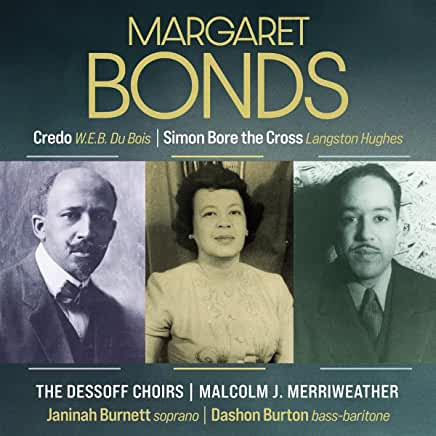
Margaret Bonds: Credo (text: W.E.B. Du Bois, ed. Rollo Dilworth); Simon Bore the Cross (text: Langston Hughes, ed. & arr. Malcolm J. Merriweather). Janinah Burnett, soprano; Dashon Burton, bass-baritone; The Dessoff Choirs and Orchestra; Malcolm J. Merriweather, conductor. AVIE AV2589


It is always interesting to come across music by a composer previously unknown to you. Composer and pianist Margaret Bonds (1913-1972) grew up in a musically rich environment in Chicago. In fact, in high school she studied piano and composition under the tutelage of Florence Price (1857-1953), another female African-American composer who has recently begun to be recognized. In 1934, Bonds became the first Black soloist to play with the Chicago Symphony Orchestra, performing – what else? – Price’s Piano Concerto in D Minor. However, because of her race, life was not easy for her. Although she was able to earn her B.M. and M.M. degrees from Northwestern University, she was not allowed to live on campus. After unsuccessfully trying to start a music academy in Chicago, she moved to New York in 1939, where she worked in musical theater. Here, she immersed herself in the world of musical theatre and became an important figure in the Harlem Renaissance. She also wrote song for singers such as Leontyne Price and Betty Allen, then most famous being the spiritual, “He’s Got the Whole World in His Hand” for Ms. Price. Having been inspired by a Langton Hughes poem during her time at Northwestern, she was able to meet and strike up a close friendship with the poet during her time in New York. After Hughes’s death, Bonds moved to Los Angeles in 1967. During her lifetime she wrote over 200 compositions, but of these, only 75 scores survive; furthermore, only 47 were published during her lifetime.

The two works on this recording both date from the final decade of her life, and neither was performed in its entirety during her lifetime. She had premiered a piano/vocal version of Credo in in 1967, but then Hughes died, she moved to California, and it was not until a year after her death that excerpts of an orchestrated version were performed by the Los Angeles Philharmonic under Zubin Mehta, with a complete performance following a year later. We now have this impassioned performance by New York’s Dessoff Choirs and Orchestra with soloists Janinah Burnett and Dashon Burton, all under the direction of conductor Malcolm J. Merriweather. The text by W.E.B. Du Bois is straightforward and forceful. It makes a plea for freedom and dignity that is if anything – sadly enough – even more relevant today than it was when first written. Powerful words, powerful music, given an appropriately robust performance and recording. It is hard to imagine anyone listening to this music and not being moved. Simon Bore the Cross is also powerful in its musical appeal, although its text, based on Passion poetry by Langston Hughes, may not have quite the impact for some people that Credo carries. Still, it is an impressive performance. Kudos to AVIE for including full texts of both compositions; photos of Price, Du Bois, and Hughes; and information about the performers. In all aspects, this is an admirable, recommendable release. 


Dec 1, 2021

Piano Potpourri, No. 3 (CD reviews)

Echoes of Life. IN THE BEGINNING WAS | Francesco Tristano: In the Beginning Was; Chopin: Preludes op. 28: Nos. 1-4: INFANT REBELLION | Ligeti: Musica ricercata I; Chopin: Preludes op. 28. Nos. 5-9; WHEN THE GRASS WAS GREENER | Nino Rota: Valzer; Chopin: Preludes op. 28: Nos. 10-15; NO ROADMAP TO ADULTHOOD | Chilly Gonzales: Prelude in C sharp major; Chopin: Preludes op. 28: Nos. 16-18; IDENTITY | Takemitsu; Litany I; Chopin: Preludes op. 28: Nos. 19-20; A PATH TO WHERE | Arvo Pärt: Für Alina; Chopin: Preludes op. 28: Nos. 21-24; LULLABY TO ETERNITY | Alice Sara Ott: Lullaby to Eternity. Alice Sara Ott. Piano. Deutsche Grammophon 486 0474.

By Karl W. Nehring

With so much of recorded music trending toward the “song” as the fundamental commodity, and with even classical music labels such as, yes, Deutsche Grammophon releasing individual digital tracks as singles, it is encouraging to see that the concept of the album is still alive and well; moreover, what we have here is not just an album, but by golly, a concept album. Not just a collection of pieces, but a collection assembled in an attempt to tell some sort of story, augmented by the liner notes and art. You have probably already noticed the all-caps interjections in the list of compositions above, which are taken directly from the back cover of the CD digipack. As the German pianist Alice Sara Ott (b. 1988) explains it, “Echoes of Life is a personal reflection on the thoughts and moments that influence and change our lives. It also portrays the journey and transformation I took to become the person and artist I see myself as today. In interpreting music from composers who, in their own time, challenged the system and redefined music, I see it as my role as a classical musician to carry this spirit forward by not insisting on reproducing bygone traditions and limitations… With his Preludes op. 28, Frédéric Chopin composed a collection of individual character pieces – very different from each other and yet all connected in some way. They remind me of life. I have chosen seven contemporary works to intersperse the Preludes and, while they echo some of my most personal and vulnerable experiences, they also conform how modern, provocative, and timeless Chopin’s music is.”  

The end result is a musical delight, as Ott mingles stimulating newer music together with the music of Chopin to create a program that flows smoothly and draws the listener in. You really don’t get the sense that you are jumping back and forth in time or making abrupt shifts in style. Yes, the Ligeti piece has a fierceness about it, but not overwhelmingly so, and yes, when you think about it, Chopin’s music has energy in abundance also. And so it goes with Takemitsu and Chopin, and Pärt and Chopin; in the hands of Alice Sara Ott, this music all makes sense together. The engineering is also first-rate, with a coherent piano sound. This truly is a splendid release.

When Do We Dance? George Gershwin: When Do We Dance?; Art Tatum: Tea for Two; William Bolcom; Graceful Ghost Rag; Fats Waller: Vipers Drag; Astor Piazzolla: Libertango; Alberto Ginastera: Argentine Dances No. 2; Manuel de Falla: Ritual Fire Dance; Maurice Ravel: Valses Nobles et Sentimentales; Camille Saint-Saëns: Étude en Forme de Valse; Béla Bartók: Romanian Folk Dances; Igor Stravinsky: Tango; Alexander Scriabin: Waltz in A flat Major; Rachmaninoff: Polka Italienne. Lise de la Salle, piano. Naïve V 5468.

As you can readily infer from the selections on this release from French pianist Lise de la Salle (b. 1988), the emphasis here is on dance music. As the pianist explains, “With so many dances and so much music to play, I could take ten albums to tell this whole story. So, I decided to focus on one century (1850-1950) but travel the world. I believe this is the most fascinating period in the history of all the arts, alive with new rules and techniques, and an explosion of potential – not just in music but also in literature, painting and dance. It all explodes, and the twentieth century opens up to a new modern world. This gives rise to new emotions of incredible depth. When Do We Dance? is a journey through this century to explore the different ways in which dance takes possession of the body: with an amazing swing in North America, developing a  strong sensuality in South America and Spain, with reserve, elegance and sophistication in France, or through the expression of a late, sentimental romanticism in eastern Europe and Russia.”

What is particularly rewarding about the program she has chosen is to see the names of Art Tatum, Fats Waller, and Astor Piazzolla in there along with more recognizable names from the classical music world. De la Salle obviously loves music, loves dance (which she has studied), and knows how to play dance music in a way that does it justice – that lets it swing and sway; however, she never lets herself get carried away, she never takes it over the top. From Tatum to Ravel to Stravinsky, she lets the music dance. My only reservation about this release is the engineering. Although the sound of the piano is clean and clear, the stereo imaging is a bit odd, with the piano seeming too wide and not quite coherent. If your system has a mono setting, that might be the best. Really, the sound is not at all a deal-breaker, and many listeners will find it just fine, so don’t let my sonic quibbles dissuade you from listening to this energetic collection, which Ms. de la Salle characterizes as “a journey to explore the different ways in which dance takes possession of the body.”

Northscapes. Lasse Thoresen: Invocation of Pristine Light Op. 52, No. 1; Anna Thorvaldsdottir: Scape; Bent Sorensen: (from 12 Nocturnes) I: Mignon - Und die Sonne geht Unter; III: Nachtlicher Fluss; VII: Mitternacht mit Mignon; Kaija Saariaho: Prelude; Raminta Serksnyte: Fantasia; Peteris Vasks: Music for a Summer Evening; Lasse Thoresen: Invocation of Rising Air, Op. 52, No. 2. Ieva Jokubaviciute, piano. Sono Luminus DSL-92251.

Although I was not quite sure what to expect from this release, I certainly looked forward to auditioning it. As for as the composers, I was quite familiar with the orchestral music of Vasks, but had never heard any of his piano music; had heard some orchestral music by Saariaho but none of her piano music; some chamber music by Thorvaldsdottir but no piano music; and nothing at all by any of the other composers or the pianist. So why did I look forward to auditioning it? Because I knew that Sono Luminus had great sound and because the program looked intriguing indeed. I knew I had to give it a listen.

I’m glad I did so, for I was richly rewarded. Lithuanian pianist Ieva Jokubaviciute is able to draw astonishing sounds from the piano, both form the keyboard and from “under the hood” if so requested by the composer; and Sono Luminus has captured in all in gloriously realistic sound quality. Particularly impressive are the two contributions by Norwegian composer Lasse Thoresen, which open and close the program. Invocation of Pristine Light really does evoke a feeling of illumination, a sense of wonder, discovery, and joy. Although of course I have never heard anyone else interpret this piece before, it is hard to imagine anyone bringing any more sensitivity to it than Ms. Jokubaviciute. The closing Invocation of Rising Air has a contrasting energy to it, more subdued, but still imbued with wonder. Thorvaldsdottir’s Scape finds the pianist drawing some unusual sounds from her instrument. As the liner notes explain, Scape “calls for the piano to be prepared with screws placed between certain strings, for the use of a thimble, and for the application of an e-bow. Already, we have here the composer asking the performer to coax a host of sounds and gestures from inside the piano beyond hammers striking strings. The preparation of the piano and the use of extended techniques unleash sounds inherent to the instrument yet repressed by the mechanisms of the tradition.”  One of the liner note photos depicts Ms. Jokubaviciute manipulating the strings inside the piano. Although to read of these techniques might lead one to believe that the music must sound hostile and unlistenable, the end result is far from that. Strange, perhaps, but compelling – musically compelling at that. And so the rest of the album goes, fresh, bracing new sounds, expertly played and magnificently recorded. If you are a fan of piano music and have at least a modicum of musical adventurousness in your soul, Northscapes belongs on your audition list.

Bonus Recommendations:

Puerta. Jorge Rossy, vibraphone, marimba; Robert Landfermann, double bass; Jeff Ballard, drums, percussion. ECM 2661 382 2596.

There is an interesting backstory here. Jorge Rossy was for a time the drummer in the Brad Mehldau Trio, but left that group to return to his native Spain and concentrate on his piano playing. He was replaced in Mehldau’s piano trio by the American drummer Jeff Ballard. And now we have here Rossy on neither drums nor piano, but rather on vibes and marimba, recording an album of mostly his own compositions supported by Ballard on drums and German bassist Landfermann. Most of the tunes have a relatively easygoing feel to them, medium tempos, minimum flash, with the musicians more interested in communicating with the listener than showing off their chops. It is fascinating to hear the sonic interplay between the drums and the vibes. Both involve instruments that are struck with sticks/mallets; both are being played by musicians who are experienced drummers. The crystal clear ECM sound allows you to really focus on their interaction, which is fascinating, and of course you also have the underlying plucking support of the double bass, which at times steps out into the foreground, occasionally bowed rather than plucked, marimba sometimes ringing…  Amazing now instruments that are struck and plucked can sound so soothing, yet while sounding so soothing still hold our attention.  

Mozart in the Jungle: Sex, Drugs, and Classical Music. Tindall, Blair. Grove Press (2005).

Although this book covers the classical music world of several decades ago, many of the issues that Blair Tindall brings up regarding the financial and management practices within the industry are still relevant today. In addition, many of the personalities she discusses involve names that would be recognizable to most fans of classical music. Yes, there are some salacious details involving sex and drugs that could well have been left out, some of those salacious details do serve to give readers a perspective on the world of classical music they might otherwise never have been afforded. As a quick example, I recall attending a performance by the famed violinist Ihtzak Perlman, who was accompanied on piano by Samuel Sanders, back in the early 1980s. According to Tindall, who came to know Sanders very well, Perlman was making around $33,000 for such appearances at that time, and paying Sanders all of $1,000. Interesting… Tindall also writes of how as orchestras came to get money from corporations and other donors, they tended to increase their spending; in fact, the more donations the received, the larger their debt became. There are also some interesting character sketches in this memoir; unfortunately, some of them turn out to have sad endings as some individuals fall prey to drugs, alcohol, disease, or despair. Tindall was one of the fortunate few, able to escape the classical music world she felt trapped in by discovering she had a talent for writing and actually earning a scholarship to Stanford and starting a second career in journalism, and eventually writing her book. It is not a volume I would recommend to everyone, but it is worth at least a skim through if you are interested in gaining another perspective on classical music – sex, drugs, money, and all the rest that goes with it.

KWN

Sep 18, 2016

Van der Sloot: Shadow, Echo, Memory (CD review)

Hans Jorgen Jensen, Northwestern University Cello Ensemble. Sono Luminus SLE-70004.

Here, I make a confession: Until auditioning this album, I had never before heard a cello ensemble. Indeed, I no idea what to expect from a large cello ensemble, what their tone or sound or level of expertise would be. Nor were any of my expectations very high, and the disc lay on my living-room shelf awaiting a listen for some weeks as I kept putting off what I thought might be a chore. Then I did listen.

Wow.

To say that the Northwestern University Cello Ensemble exceeded my wildest expectations by a mile would be an understatement. To say that the performers and their performances exceeded my expectations would be an understatement. And to say that the recording quality exceeded my expectations would be an understatement. This one goes down as a clear entry in my list of favorite recordings of 2016.

So, what is this cello ensemble all about? According to the disc's accompanying booklet, the Northwestern University Cello Ensemble was "established by artistic director and Northwestern University cello professor, Hans Jorgen Jensen." The ensemble "began as a result of bringing together Northwestern students, talented Chicago-area high school cellists, and 21 highly successful Northwestern alumni in May 2013 to record Mahler's Adagietto. This unique and memorable event inspired the continuation of the project and the decision to record this debut album."

Don't think this is a small group, either. Augmenting the twenty-one alumni referred to above are dozens more, the booklet naming about fifty-eight cellos, seven basses, a guitarist, a percussionist, and a harpist, depending on the piece of music. They make a glorious sound.

The program consists of eight selections, the first one in three movements. The agenda is as follows:

Zachary Wadsworth (b. 1983): Lacquer Prints
Gabriel Fauré (1845-1924): Après un rêve
Michael van der Sloot (b. 1991): Shadow, Echo, Memory
Sergei Rachmaninov (1873-1943): Vocalise 
Hans Thomalla (b. 1975): Intermezzo
Aaron Jay Kernis (b. 1960): Ballad
György Ligeti (1923-2006): Lux aeterna
Gustav Mahler (1860-1911): Adagietto from Symphony No. 5 in C sharp minor

Hans Jorgen Jensen
As you can see by the birth and death dates above, the program alternates modern numbers with older, Romantic transcriptions. Yet the modern material is hardly raucous, nonharmonic, or atonal. Appropriate to the mellifluous sound of the cello, Maestro Jensen has chosen music that complements the instruments, and most of it is quite beautiful, gracefully rhythmic, flowing, and satisfying.

Among the album's few tunes that sound at all "modern" is Michael van der Sloot's Shadow, Echo, Memory, which tends to be a bit more ambitiously experimental than the other items on the program. However, Van der Sloot fully utilizes the potential of the cello band, providing it with every opportunity to show off its range of possibilities. So, within its almost ten-minute structure, we hear slow and fast segments that are both dark and light, impressionistic, emotional, and visual. I was sorry when it ended.

Rachmaninov's Vocalise and Mahler's Adagietto are probably the most-familiar music on the agenda, although Ligeti's Lux Aeterna may come close (think Kubrick's 2001: A Space Odyssey). The Cello Ensemble performs them all wonderfully, and the music seems to exude an even more-profound mood than ever coming from such a large body of cellos.

Congratulations to producer Hans Jorgen Jensen and recording, mixing, and mastering engineer Christopher Willis for the excellent work they did. They made the album at Pick-Staiger Concert Hall, Northwestern University, Evanston, Illinois in 2013 and 2014. There is a realistic clarity to the music, by which I mean it sounds natural, with just the right amount of ambient bloom to give the instruments a lifelike appearance. There is also a truthful scope to the group's dimensionality, filling in all areas of side-to-side and front-to-back perspectives. With a wide, well-balanced frequency response and strong dynamics, the sound comes across as I would imagine it might in a live performance. It is a complete and utter pleasure listening to it.

JJP

To listen to a brief excerpt from this album, click on the forward arrow:


Meet the Staff

Meet the Staff
John J. Puccio, Founder and Contributor

Understand, I'm just an everyday guy reacting to something I love. And I've been doing it for a very long time, my appreciation for classical music starting with the musical excerpts on the Big Jon and Sparkie radio show in the early Fifties and the purchase of my first recording, The 101 Strings Play the Classics, around 1956. In the late Sixties I began teaching high school English and Film Studies as well as becoming interested in hi-fi, my audio ambitions graduating me from a pair of AR-3 speakers to the Fulton J's recommended by The Stereophile's J. Gordon Holt. In the early Seventies, I began writing for a number of audio magazines, including Audio Excellence, Audio Forum, The Boston Audio Society Speaker, The American Record Guide, and from 1976 until 2008, The $ensible Sound, for which I served as Classical Music Editor.

Today, I'm retired from teaching and use a pair of bi-amped VMPS RM40s loudspeakers for my listening. In addition to writing for the Classical Candor blog, I served as the Movie Review Editor for the Web site Movie Metropolis (formerly DVDTown) from 1997-2013. Music and movies. Life couldn't be better.

Karl Nehring, Editor and Contributor

For nearly 30 years I was the editor of The $ensible Sound magazine and a regular contributor to both its equipment and recordings review pages. I would not presume to present myself as some sort of expert on music, but I have a deep love for and appreciation of many types of music, "classical" especially, and have listened to thousands of recordings over the years, many of which still line the walls of my listening room (and occasionally spill onto the furniture and floor, much to the chagrin of my long-suffering wife). I have always taken the approach as a reviewer that what I am trying to do is simply to point out to readers that I have come across a recording that I have found of interest, a recording that I think they might appreciate my having pointed out to them. I suppose that sounds a bit simple-minded, but I know I appreciate reading reviews by others that do the same for me — point out recordings that they think I might enjoy.

For readers who might be wondering about what kind of system I am using to do my listening, I should probably point out that I do a LOT of music listening and employ a variety of means to do so in a variety of environments, as I would imagine many music lovers also do. Starting at the more grandiose end of the scale, the system in which I do my most serious listening comprises Marantz CD 6007 and Onkyo CD 7030 CD players, NAD C 658 streaming preamp/DAC, Legacy Audio PowerBloc2 amplifier, and a pair of Legacy Audio Focus SE loudspeakers. I occasionally do some listening through pair of Sennheiser 560S headphones. I miss the excellent ELS Studio sound system in our 2016 Acura RDX (now my wife's daily driver) on which I had ripped more than a hundred favorite CDs to the hard drive, so now when driving my 2024 Honda CRV Sport L Hybrid, I stream music from my phone through its adequate but hardly outstanding factory system. For more casual listening at home when I am not in my listening room, I often stream music through a Roku Streambar Pro system (soundbar plus four surround speakers and a 10" sealed subwoofer) that has surprisingly nice sound for such a diminutive physical presence and reasonable price. Finally, at the least grandiose end of the scale, I have an Ultimate Ears Wonderboom II Bluetooth speaker and a pair of Google Pro Earbuds for those occasions where I am somewhere by myself without a sound system but in desperate need of a musical fix. I just can’t imagine life without music and I am humbly grateful for the technologies that enable us to enjoy it in so many wonderful ways.

William (Bill) Heck, Webmaster and Contributor

Among my early childhood memories are those of listening to my mother playing records (some even 78 rpm ones!) of both classical music and jazz tunes. I suppose that her love of music was transmitted genetically, and my interest was sustained by years of playing in rock bands – until I realized that this was no way to make a living. The interest in classical music was rekindled in grad school when the university FM station serving as background music for studying happened to play the Brahms First Symphony. As the work came to an end, it struck me forcibly that this was the most beautiful thing I had ever heard, and from that point on, I never looked back. This revelation was to the detriment of my studies, as I subsequently spent way too much time simply listening, but music has remained a significant part of my life. These days, although I still can tell a trumpet from a bassoon and a quarter note from a treble clef, I have to admit that I remain a nonexpert. But I do love music in general and classical music in particular, and I enjoy sharing both information and opinions about it.

The audiophile bug bit about the same time that I returned to classical music. I’ve gone through plenty of equipment, brands from Audio Research to Yamaha, and the best of it has opened new audio insights. Along the way, I reviewed components, and occasionally recordings, for The $ensible Sound magazine. Most recently I’ve moved to my “ultimate system” consisting of a BlueSound Node streamer, an ancient Toshiba multi-format disk player serving as a CD transport, Legacy Wavelet II DAC/preamp/crossover, dual Legacy PowerBloc2 amps, and Legacy Signature SE speakers (biamped), all connected with decently made, no-frills cables. With the arrival of CD and higher resolution streaming, that is now the source for most of my listening.

Ryan Ross, Contributor

I started listening to and studying classical music in earnest nearly three decades ago. This interest grew naturally out of my training as a pianist. I am now a musicologist by profession, specializing in British and other symphonic music of the 19th and 20th centuries. My scholarly work has been published in major music journals, as well as in other outlets. Current research focuses include twentieth-century symphonic historiography, and the music of Jean Sibelius, Ralph Vaughan Williams, and Malcolm Arnold.

I am honored to contribute writings to Classical Candor. In an age where the classical recording industry is being subjected to such profound pressures and changes, it is more important than ever for those of us steeped in this cultural tradition to continue to foster its love and exposure. I hope that my readers can find value, no matter how modest, in what I offer here.


Bryan Geyer, Technical Analyst

I initially embraced classical music in 1954 when I mistuned my car radio and heard the Heifetz recording of Mendelssohn's Violin Concerto. That inspired me to board the new "hi-fi" DIY bandwagon. In 1957 I joined one of the pioneer semiconductor makers and spent the next 32 years marketing transistors and microcircuits to military contractors. Home audio DIY projects remained a personal passion until 1989 when we created our own new photography equipment company. I later (2012) revived my interest in two channel audio when we "downsized" our life and determined that mini-monitors + paired subwoofers were a great way to mate fine music with the space constraints of condo living.

Visitors that view my technical papers on this site may wonder why they appear here, rather than on a site that features audio equipment reviews. My reason is that I tried the latter, and prefer to publish for people who actually want to listen to music; not to equipment. My focus is in describing what's technically beneficial to assure that the sound of the system will accurately replicate the source input signal (i. e. exhibit high accuracy) without inordinate cost and complexity. Conversely, most of the audiophiles of today strive to achieve sound that's euphonic, i.e. be personally satisfying. In essence, audiophiles seek sound that's consistent with their desire; the music is simply a test signal.

Mission Statement

It is the goal of Classical Candor to promote the enjoyment of classical music. Other forms of music come and go--minuets, waltzes, ragtime, blues, jazz, bebop, country-western, rock-'n'-roll, heavy metal, rap, and the rest--but classical music has been around for hundreds of years and will continue to be around for hundreds more. It's no accident that every major city in the world has one or more symphony orchestras.

When I was young, I heard it said that only intellectuals could appreciate classical music, that it required dedicated concentration to appreciate. Nonsense. I'm no intellectual, and I've always loved classical music. Anyone who's ever seen and enjoyed Disney's Fantasia or a Looney Tunes cartoon playing Rossini's William Tell Overture or Liszt's Hungarian Rhapsody No. 2 can attest to the power and joy of classical music, and that's just about everybody.

So, if Classical Candor can expand one's awareness of classical music and bring more joy to one's life, more power to it. It's done its job. --John J. Puccio

Contact Information

Readers with polite, courteous, helpful letters may send them to classicalcandor@gmail.com

Readers with impolite, discourteous, bitchy, whining, complaining, nasty, mean-spirited, unhelpful letters may send them to classicalcandor@recycle.bin.

"Their Master's Voice" by Michael Sowa

"Their Master's Voice" by Michael Sowa