Showing posts with label Price.Florence. Show all posts

Nov 15, 2023

Anna Lapwood: Luna (CD Review)

by Karl Nehring

James Newton Howard: Flying (from “Peter Pan”); Olivia Belli: Grain Moon; Chopin: Nocturne Op. 9, No. 2; Kristina Arakelyan: Dreamland; Dario Marianelli; Dawn (from “Pride and Prejudice”); Hans Zimmer: Stay (from “Interstellar”); Bach & Gounod: Ave Maria: Glass: Mad Rush; Ghislaine Reece-Trapp: In Paradisum; Ēriks Ešenvalds & Sara Teasdale: Stars; Kristina Arakelyan: Star Fantasy; Max Richter: On the Nature of Daylight; Florence Price: An Elf on a Moonbeam; Ludovico Einaudi: Experience; Debussy: Clair de Lune. Anna Lapwood, organ and conductor; Pembroke College Chapel Choir. Sony Classical 19658831402

I have followed the young British musician Anna Lapwood (b. 1995) on Twitter (now known as “X” since its takeover by a notorious right-wing ultrabillionaire) for quite some time. Her posts there show her to be a charming and unpretentious artist, devoted not only to her craft, but also to helping other musicians, especially young musicians, express themselves through music. She is skilled not only as an organist, but as a conductor and broadcaster. Inn 2021, for example, she appeared at the BBC Proms both as a presenter for BBC Television and as soloist in the Saint-Saens Organ Symphony. In 2016, when she was just 21, she was appointed Director of Music at Pembroke College, Cambridge University, where in 2018 she established the Pembroke College Girls’ Choir for girls aged 11 to 18. She has become quite the ambassador for classical music through her outreach on social media (she’s known worldwide as “the TikTok organist”), her midnight sessions at the Royal Albert Hall, and her numerous concerts and personal appearances. In 2021, she released an organ recording for the Signum Classics label titled Images; you can find our review here. Now it is 2023, and she has a new recording out for a new label, Sony Classical, titled Luna.


While Luna featured a program consisting of established classical compositions, highlighted by a couple of larger-scale works, Ravel’s Le Tombeau de Couperin arranged for organ by Erwin Wiersinga and Britten’s Four Sea Interludes from Peter Grimes in an arrangement by Lapwood herself, the program for Luna is more varied. There are some traditional “classical” pieces for piano arranged for organ, some tunes from movies soundtracks, and among other things, even a couple of compositions not for organ, but for choir. Of the inspiration for this album, Lapwood writes, “one of the highlights of my year is the time I spend teaching music in Zambia. I love it for the people, the music, and the laughter, but I also always look forward to the first time I see the Zambian night sky again… You look up and it’s just completely full of stars, more stars than you ever thought possibly existed – bright stars, dull stars; some sparkling, some static; some glowing orbs and others dots smaller than pinpricks. With this album, I’m imagining that as we stare at the sky our minds can almost take us there, travelling through the night sky and exploring individual stars with their unique personalities and characteristics.”

Although the music is indeed varied in origin, the album seems to have an overall flow and consistency of sound – there are no abrupt shifts of mood, no jarring sonorities. That said, neither are the selections similar enough that they all sound the same as Lapwood makes her way from one to another. Highlights include the Chopin Nocturne, which is the kind of music you would not think of as a candidate for being played on the organ. Lapwood recalls learning the piece as a young piano student and then later teaching her own piano students to play. Of transcribing it for organ, she observes that “as with all transcriptions, there is an interesting decision-making process, exploring whether to try to make it as close as possible to the original, or to re-conceive it as an organ piece. In this case, I decided to go with the latter, experimenting with the huge variety of solo sounds this organ has to offer to give each section of melody its own unique character.”  Whatever her method, the end result is simply beautiful. Another highlight, the longest track on the album (6:47), is much different in style and mood from the Chopin. Stay, from the Hans Zimmer’s soundtrack for the film Interstellar, is less about melody and more about raw feeling.


Lapwood supplies notes on each of the selections, and it is from these notes that we learn the interesting fact that the energetic Philip Glass piece Mad Rush, another highlight of the album, was not originally composed for the piano, as it has often been recorded (including by Glass himself), but for the organ. “Glass wrote the piece in 1978, on and for the organ of St. John the Divine, New York,” Lapwood explains. “It was written for the Dalai Llama’s first public address in North America in 1979. The organizers were expecting a large number of people so they asked Glass to write a piece of indeterminate length that could be played while the congregation was arriving.” If you are familiar with Mad Rushfrom one of its piano recordings, hearing the original organ version should give you an added appreciation for its simple elegance and energy.


The two tracks that include the voices of the Pembroke College Chapel Choir are also both quite captivating and worthy of special mention. Stars, by the Latvian composer Ēriks Ešenvalds (b. 1977) sets a poem by the late American poet Sara Teasdale (1884-1993). (Speaking of Ešenvalds, there is an absolutely gorgeous album of his choral music that was engineered by none other than John Atkinson of Stereophile magazine fame. Both musically and sonically it is simply superb; you can read our review here). The ethereal sounds of tuned wine glasses mixed with the sound or the organ and the choir give a celestial glow to the sound of this track, which is rife with otherworldly overtones. The other piece featuring the chorus, On the Nature of Daylight by the German-born British composer Max Richter (b. 1966), has no text, but combines their voices with the sound of the organ in a gently meditative blend that is at once calming and hopeful. Lapwood writes of this piece that “it feels particularly special to be including this piece on the album as it brings together the two sides of who I am as a musician: playing the organ but also working with the amazing choirs at Pembroke.”

The album closes with another piece for piano that Lapwood has transcribed for the organ, Debussy’s popular Clair de Lune. “As with the Chopin,” she explains, “I had to make choice: be as loyal as possible to the original, or reimagine it as an organ piece? Once again, I decided on the latter, using it as an opportunity to explore the huge variety of soft, delicate colours the organ has to offer.” As she did with the Chopin, in transcribing the Debussy, she has created something most lovely, certainly a fitting way to end an album titled Luna. It’s an album that is fresh, fun, and full of light and life – well worth a listen.

Mar 26, 2023

Connecting Cultures: Four hand music from around the world (CD Review)

 by Karl Nehring

Dvořák: Slavonic Dance, Op 46No. 8Slavonic Dance, Op. 72 No. 2; Mozart: Andante and Five Variations in G major, K. 501; Wang Jianzhong: Colorful Clouds Chasing the Moon; Gong Huahua: Mountain Harvest: Manuel de Falla: Two Spanish Dances from “La Vida Breve”; Amy Marcy Cheney Beach: Summer Dreams, Op. 47; Florence Beatrice Price: Three Negro Spirituals – I Couldn’t Hear Nobody PrayLord I Want to Be a ChristianEv’ry Time I Feel the Spirit; Gershwin: Rhapsody in Blue (arranged by Henry Levine). Deborah Moriarty and Zhihua Tang, piano. Blue Griffin BGR633


This is one of those releases about which I just wasn’t quite sure what to expect. The program looked to be a mix of composers both familiar and unknown, the performers were both unknown to me, and I wondered what the arrangements for piano four hands would sound like – especially Rhapsody in Blue. For piano four hands? Really?? But no matter what questions or doubts I or any potential listener might have about this or any other recording, the music itself is what actually counts, so I just popped the disc into the player, settled into my listening chair, grabbed the remote, and pushed the PLAY button.

 The familiar melodies of the two Dvořák Slavonic Dances open the program with energy and enthusiasm from the four busy hands at the keyboard, with the sound matching the performance, lively and assertive – just right for this music. The following Andante and Five Variations by Mozart are in a more stately, buttoned-down style, but they still have an element of the dance about them, which the two pianists clearly communicate. Colorful Clouds Chasing the Moon by Wang Jianzhong (1933–2016), turns out to be as perfectly pleasant as its title implies, with a rhythmic pulse beneath and some fluttering melodies in the upper registers. Mountain Harvest by Gong Huahua (b. 1978) makes a different impression with its more serious, slightly dissonant sound. That said, it is not a forbidding piece; if anything, it has moments of playfulness and mystery. Overall, it is an intriguing work, one that invites repeated listening. 


It's then back to more familiar names, although not all of the music will be familiar to most listeners. From Manuel de Falla we get Two Spanish Dances from his opera La Vida Breve, which as you might expect, receive a splashy, extroverted performance from the two pianists, who are both on the faculty at the Michigan State University College of Music. The two women pianists next bring us music by two distinguished  American women composers. Amy Beach (1867-1944) was the first American female composer to have a symphony performed by a major orchestra (the Boston Symphony Orchestra premiered her “Gaelic” Symphony in 1896), while Florence Beatrice Price (1887-1953) was the first African-American woman to have a composition performed by a major orchestra (the Chicago Symphony performed her Symphony in E Minor in 1933).  Beach’s Summer Dreams comprises a half-dozen short musical sketches titled The BrowniesRobin RedbreastTwilightKaty-didsElfin Tarantelle, and Good Night. The first (which is the longest at 3:46) is dance-like, the next four (none of which is lasts more than two minutes) are generally playful, and then Good Night (longer again at 2:59) is, as you might expect, calmer in mood. Price’s Three Negro Spirituals are simply her brief arrangements of three spirituals: I Couldn’t Hear Nobody Pray (1:53), Lord I Want to Be a Christian(4:03), and Ev’ry Time I Feel the Spirit (1:32). Hearing the first of these immediately brought to mind the gospel stylings of Keith Jarrett in some of his solo improvisations, such as in parts of his Köln Concert recording on ECM. The longest of these, Lord I Want to Be a Christian, is slower, more intense, and quite moving in its own way. 


The two pianists end their program with a rousing rendition of Gershwin’s Rhapsody in Blue. This is a piece that has been played and recorded aa a concert piece for piano and full orchestra, as a more jazz-oriented piece for piano and jazz band – but who would have thought it would work so well as played on one piano by two pianists? These two artists did, and they were right. This is a marvelous performance of the work, exciting and involving from start to finish. With more than 74 minutes of well-recorded music from around the world including this revelatory performance of Gershwin’s showstopper, Connecting Cultures is an exciting new release.

Nov 23, 2022

Recent Releases, No. 39 (CD reviews)

By Karl W. Nehring

Arc II
Ravel: Le Tombeau de Couperin; Brahms: Variations on a Theme by R Schumann, Op. 9; Shostakovich: Piano Sonata No. 2 in B minor, Op 61; Brahms: 11 Chorale Preludes for Organ, Op. 122 (arr. for piano by F. Busoni) (excerpts) No. 10 in A minor, “Herzlich tut mich verlangen” (My heart is filled with longing); No. 11 in F major, “O Welt, ich muss dich lassen” (O World, I must leave you). Orion Weiss, piano. First Hand Records FHR128.

Ohio-born pianist Orion Weiss (b. 1981) has undertaken a recording project that will eventually yield three releases. My review of Arc I, the first release in the series, can be found here: https://classicalcandor.blogspot.com/2022/04/piano-potpourri-no-6-cd-reviews.html. In his liner notes for that album, Weiss explains that “the arc of this recital trilogy is inverted, like a rainbow’s reflection in water. Arc I’s first steps head downhill, beginning from hope and proceeding to despair. The bottom of the journey, Arc II, is Earth’s center, grief, loss, the lowest we can reach. The return trip, Arc III, is one of excitement and renewal, filled with the joy of rebirth and anticipation of a better future.” He goes on to give a quick preview and chronological overview: Arc I (Granados, Janacek, Scriabin) from before World War I; Arc II (Ravel, Shostakovich, Brahms) from during World Wars I and II, during times of grief; Arc III (Schubert, Debussy, Brahms, Dohnanyi, Talma) from young composers, times of joy, after World War I and after World War II.

Although the above might seem to indicate that the present release might be quite a morose listening experience, “grief, loss, the lowest we can reach,” such is not the case. Although this is not a collection of lighthearted pieces, it is not devoted to darkness and despair. As Weiss describes it, “this album strives to understand the varying ways composers comprehend grief, loss, and death. How did they cope, their hearts broken, their peace gone? In this compilation of works I have tried to follow the paths these great composers walked in their own grief. Their tracks lead us from death back towards life, from horror to hope.” We may be at the bottom of the arc, but Weiss already has us looking up, which is evident form the opening measures of Ravel’s Le Tombeau de Couperin. Weiss brings a sparkle to the familiar Prelude that makes it sound new and wonderful even if you have heard it so many, many times before in both piano and orchestral guise. To my ear, Weiss seem to let us hear what both his hands are playing, somehow making the music sound more complex and colorful, drawing your ears and imagination more deeply into the music. Perhaps he is aided in this by the engineering, which is superb. In any event, this is a first-class rendition of the Ravel.

Next up is the first of the music of Brahms to appear on this album, these “Short variations of a Theme by Him, Dedicated to Her,” (referring to Robert and Clara Schumann ) as the 20-year-old Brahms called this composition, which he wrote in the wake of Robert’s attempted suicide and subsequent institutionalization. Weiss characterizes it as “a homage to his friend and mentor, a first love letter to Clara and a book of condolences to the Schumann family.” Like the Ravel, then, it is music of varying moods, which Weiss communicates effectively with clarity and precision. The intensity level ratchets up several notches as Weiss next tackles a piece written nearly a century after the Brahms, Shostakovich’s Piano Sonata No. 2 from 1943, which Weiss describes as “emotional, romantic, wild, and raw.” This is not music for the faint of heart, and it is definitely not music for background listening. There are times when both hands are pounding out notes; at other times, the music is just a note at a time played by one hand.  Weiss is well up to the challenge of delivering the emotional impact without taking it over the top.

Like a SCUBA diver returning slowly to the surface to avoid the bends, Weiss allows listeners the chance to decompress by returning to the music of Brahms for the final segment of the program. As Weiss points out, this is not the same Brahms whose music we encountered previously on this CD. “More than 40 years after Op. 9, Brahms was at the end of his life. Sick, weak, worried for the future of music, and bereft of his life-long friend Clara, his music took on increasingly religious themes. These organ settings of centuries-old Lutheran hymns (transcribed for piano by his longtime admirer Ferrucio Busoni) tighten the thread between himself and Bach, between himself and his faith. Brahms’ compositional epilogue dates from immediately after Clara’s funeral; the Chorale Preludes, grieving yet heartbreakingly accepting and courageous, were the last notes he ever wrote.” After the anxiety and tension of the Shostakovich, the calmly reflective music of Brahms, although tinged with sadness, offers emotional closure and peace. Weiss caresses the keyboard in these chorales, communicating hope amidst grief.

Arc III awaits.

Wolfert Brederode:
Ruins and Remains
Ruins I; Swallow: Remains; Cloudless; Ruins and Remains; Ka; Ruins II; Duhra; Ruins III; Retrouvailles; Nothing for granted; Dissolve; March; Ruins IV. Wolfert Brederode, piano; Matangi Quartet (Maria-Paula major, violin; Danile Torrico Menacho, violin; Karsten Kleijer, viola; Arno ven der Vuurst, cello); Joost Lijbaart, drums/percussion. ECM 2734  458 1864

Once again I present an album of music that can be seen as a hybrid of jazz and classical, an album for which the case can be made that it can be viewed as chamber music with a twenty-first century sensibility. The back story offered in the liner notes is that “originally commissioned to commemorate the one-hundredth anniversary of the end of the First World War, Ruins and Remains was premiered on Armistice Day in November 2018. Its pervading tone had drawn influence from the melancholic atmospheres of Philippe Claudel’s WWI novel Les Âmes grises, with its world of characters harbouring stark secrets. Over time, however, the suite has come to embody meanings broader and more personal, with wide-ranging resonances.’ At a number of levels, the piece has to do with grief and loss and learning to stand up again,’ Brederode says.”

Although the piece was originally composed by the Dutch pianist/composer Wolfert Brederode (b.1974) in 2018, this recording was not made until August, 2021, and the music evolved over that span. “Calling it an evolving suite gave me the liberty to change pieces and add pieces as we went along,” he explained. As the recording was made, with producer Manfred Eicher taking an active role in the proceedings, new sections were introduced, including two that were totally improvised, Nothing for granted and Dissolve. Brederode’s piano serves as the musical thread that ties most of the sound together, with the strings of the Matangi Quartet adding body and color while the drums and percussion provide sonic seasoning. Musical themes and phrases drift in and out of some of the pieces, offering a loose, almost dreamlike sense of unity to tbe proceedings. The music throughout sustains an atmosphere of introspection, mystery, and reflection; however, it is not without energy, nor is it without shape or form. The final selection, Ruins IV, ends inconclusively, leaving the listener suspended, free to draw her own inferences. The engineering is up the usual ECM benchmark, which is clear, clean, open, spacious sound.

Scenes in Tin Can Alley: Piano Music of Florence Price
Scenes in Tin Can Alley; Thumbnail Sketches of a Day in the Life of a Washerwoman; Clouds; Village Scenes; Preludes; Cotton Dance; Three Miniature Portraits of Uncle Ned. Josh Tatsuo Cullen, piano. Blue Griffin Recording BGR615.

The American composer Florence Beatrice Price (1887-1953) was born in Little Rock, Arkansas. As a child in the South during that era, she was unfortunately rejected by her white teachers, so she received her first musical training from her mother. She showed remarkable musical talent, but because advanced musical training was largely unavailable to women of color in the South, her mother enrolled the 16-year-old Price in the New England Conservatory in Boston, majoring in organ and piano performance (while following her mother’s advice to present herself as being of Mexican descent). There she was taught music theory by the institution’s director, George Whitfield Chadwick, a leading figure of the so-called Second New England School of composers who had a special interest in African-American folk melodies and rhythms. Over the past couple of years there has been a spurt of interest in her life and works, resulting in a spate of recordings, several of which John Puccio and I have reviewed at Classical Candor:  

https://classicalcandor.blogspot.com/2022/06/new-york-youth-symphony-cd-review.html

https://classicalcandor.blogspot.com/2022/04/recent-releases-no-27-cd-reviews.html

https://classicalcandor.blogspot.com/2022/10/violin-concertos-by-black-composers.html

Those recordings are all orchestral, while this new one is a collection of some of her compositions for piano. Like her orchestral music, this is music that is pleasant and downright fun to listen to. In his liner notes, pianist Josh Tatsuo Cullen makes a thought-provoking argument about Price’s writing for the piano. “As a person of mixed Japanese and European descent, I feel a strong connection to Price’s desire to elevate the marginalized people of her own mixed-race heritage in Scenes in Tin Can Alley, Thumbnail Sketches of a Day in the Life of a Washerwoman, and Three Miniature Portraits of Uncle Ned. Price’s treatment of these neglected subjects using the classical idiom is also very powerful to me because like Price, I began studying classical piano at an early age. Some critics have noted that Price speaks in a borrowed idiom, in the sense that she uses musical language reminiscent of Schumann and Chopin, and not a language she invented herself or that derives from the vernacular of her own heritage. But I would argue that this is precisely what makes it authentic to her: as the daughter of a well-trained singer and pianist, and educated at the New England Conservatory, the classical idiom was her idiom.”

Cullen clearly enjoys playing this music; from the opening measures of the title piece, Scenes in Tin Can Alley, the energy he brings to his playing sounds just right for portraying the emotions and characters that Price is trying to sketch in here scores. But neither Cullen’s playing nor Price’s music is all about energy and bounce; in contrast, the pieces Clouds and Village Scenes reveal a more introspective, impressionistic dimension that are the highlights of this well-played and well recorded album.

KWN

Apr 6, 2022

Recent Releases, No. 27 (CD reviews)

By Karl W. Nehring

Florence Price: Symphony No. 3 in C minor; The Mississippi River; Ethiopia’s Shadow in America. John Jeter, ORF Vienna Radio Symphony Radio Symphony Orchestra. Naxos 8.559879.

Florence Price: Symphonies Nos. 1 & 3. Yannick Nézet-Séguin, The Philadelphia Orchestra. Deutsche Grammophon B0034879-02.

The American composer Florence Beatrice Price (1887-1953) was born in Little Rock, Arkansas. As a child in the South, she was rejected by white teachers, so she received her first musical training from her mother. As the liner notes of the DG release explain, “because advanced training was largely unavailable to women of color in the South, 16-year-old Price was enrolled in the New England Conservatory in Boston, majoring in organ and piano performance (while following her mother’s advice to present herself as being of Mexican descent). [As an aside, watching the performance of some of our white GOP Senators during the confirmation hearings for Supreme Court nominee Ketanji Brown Jackson as I write these words leaves me more than a little angry and skeptical about racial

and political matters in 2022 America, I’m sorry to have to say but I just can’t in good conscience let it go unsaid…] At the NEC she was taught music theory by the institution’s director George Whitfield Chadwick, a leading figure of the so-called Second New England School of composers who had a special interest in African-American folk melodies and rhythms. He used a pentatonic melody resembling a spiritual in a symphony seven years before Dvorak’s “New World'' Symphony of 1893.”

Although what we have here are two recordings on different labels featuring performances of the same major work, Symphony No. 3 by, my intention is not at all to present this as any sort of competitive review. If anything, these CDs complement and even supplement each other. Other than the Symphony No. 3, of course, the two releases are completely different, the DG giving us Price’s Symphony No. 1 while the Naxos includes two of her orchestral suites. All of these works are well worth an audition, another way in which the releases complement more that they compete.

Let me first briefly discuss the music not in common between the two releases. In Symphony No. 1, you can hear echoes of Dvorak (and the influence of Chadwick, or at least I think that would be a reasonable guess), not that there’s anything wrong with that. In the third movement, however, rather than a traditional scherzo, Price treats us to a movement based on an African dance known as “Juba,” which involves syncopated rhythms and body slapping. Of course we do not get the latter from the orchestra, but there are some lively rhythms from the percussion section as the music moves along in lively fashion. Again, those who love the music of Dvorak (think, for example, of his Symphony No. 8, with its stretches of dance rhythms) will find much to love in this symphony. The two tone poems on the Naxos CD on the Naxos CD are also quite enjoyable. Although in The Mississippi River, Price works in quotations from several well-known spirituals and folk tunes, this is not a lighthearted romp; rather, it is a serious, thoughtful composition that bears repeated listening. Likewise, Ethiopia’s Shadow in America, one of the few compositions for which Price provided a written narrative, is colorfully scored and certainly enjoyable.

Symphony No. 3 (her Symphony No. 2, sadly enough, has been lost forever) sounds less overtly like Dvorak but still has that familiar idiomatic vibe. As the Naxos liner booklet explains, “a letter written before the symphony’s premiere offers one of the only first-hand accounts of Price’s compositional approach. ‘It is intended to be Negroid in character and expression,’ she wrote, but ‘no attempt has been made to project Negro music solely in the traditional manner.’ That is, she wanted to project aspects of her cultural heritage in a symphonic framework without making direct references to an existing body of folk songs and dances – a broad creative challenge broached by many composers around the world.” Like the 1st, it too has a Juba-themed third movement rather than a traditional scherzo. The end result is a remarkable symphony that is well deserving of not just one, but two excellent new recordings.  

However, although both recordings are excellent, they vary significantly both musically and sonically. Nézet-Séguin takes a broader view of the first two movement than does Jeter, which is evident subjectively as you simply listen, with Nézet-Séguin seeming to draw things out and linger at times while Jeter moves things right along (although he never sounds actually hurried), and objectively as you note the timings: Nézet-Séguin 11:37 and 9:32 for the first two movements versus Jeter at 9:26 and 7:54. That is quite a difference in interpretation; to be honest, I am not sure which I prefer. I’ll just say that they are both enjoyable, and I will add that in the final two movements, the two conductors are within a few seconds of each other. Sonically, the DG release is clean, clear, and full-range, and the world-class Philadelphia Orchestra sounds large and in charge. However, you do not get a firm sense of the space in  which the orchestra was recorded (Verizon Hall at the Kimmel Center for the Performing Arts in Philadelphia), which becomes evident when you listen to the Naxos release. The ORF Vienna Radio Symphony Orchestra was recorded in Studio 6 at the ORF Funkhaus in Vienna, and the recording gives you a sense of the space they were in, which at least for me, establishes a stronger bond with the orchestra. Although the RSO does not sound quite as large or opulent as the Philadelphia ensemble, they play this music with expressive power under the baton of Maestro Jeter, who has been an enthusiastic advocate for the music of Florence Price (he previously recorded her Symphonies Nos 1 and 4 with the Fort Smith Symphony for Naxos)  .

Although it might sound like a reviewer copout, I really cannot pick one of these discs over the other. They really are complementary. Were some crazed wacko with an assault rifle to break into my home and force me to choose one or the other, I would probably pick the DG, because I would rather have the two symphonies; however, after he left with my Naxos disc in his backpack I would get on my computer and order a replacement copy of the Naxos, as both releases are musical delights that I simply could not live without, and as you might have guessed by now, I recommend them both with heartfelt enthusiasm. Just as we go to press, the DG recording has been awarded a Grammy for best classical recording of the year.

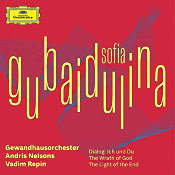
Gubaidulina: Dialog: Ich und Du; The Wrath of God; The Light of the End. Vadim Rapin, violin; Andris Nelsons, Gewandhausorchester Leipzig. Deutsche Grammophon 486 1457.

Ir is certainly quite a shift in both style and mood to go from the music of Florence Price to the music of Russian-born composer Sofia Gubaidulina (b. 1931), who has lived near Hamburg, Germany, for the past 30 years. While the music of Price is flowing and tuneful, the music of Gubaidulina is dense, dark, and at times almost explosive in its impact.  However, there is another fascinating dimension to her music, as the liner notes explain: “Sofia Gubaidulina’s miuic exerts its fascination not least as the result of its profound spirituality. ‘Whenever I’m composing,’ the deeply religious nonagenerian admits, ‘I pray, no, I actually speak to God.’ Her works focus on our relationship with God and are private dialogues with the divine. This is also true of the three works that are all appearing here in world-premiere recordings.”

Some will no doubt recognize that Dialog: Ich und Du (Dialogue: I and You), which is the title of her Violin Concerto No. 3, is a reference to the philosopher Martin Buber’s book Ich und Du, which in its English translation, I and Thou, was quite influential in intellectual circles in the 1970s and beyond. The work was written for violinist Vadim Repin, who gave the world premiere in 2018. The performance on this recording is from the work’s German premiere in 2019. You can envision the work as a dialog between Repin’s violin, representing a human, and the full orchestra, representing the divine. There is dialogue, at times pleading, at times tender, until finally, at the end, the violin plays in hushed tones. (Submission? Gratitude? Ecstasy? Exhaustion?)

Next up is the powerful Wrath of God, which opens with a mighty blast from the brass section and builds up simple musical motifs to present an impressively powerful display of what a large orchestra can do when they are given the green light. Beyond its musical virtues, which are considerable, this is a great piece for showing off a good audio system.

The program closes with The Light of the End, which to these ears at least is vaguely reminiscent at times of the music of Sibelius, with its whirling and swirling strings and brooding brass, punctuated by tinkling percussion. It is an energetic work, crackling with energy. According to the notes. “It is based on a fundamental conflict that characterizes the physics of music, namely, the irreconcilability between the natural overtone row and tempered tuning… In Sofia Gubaidulina’s own words, the work encapsulates the ‘irreconcilability of nature and real life, in which nature is often neutralized. Sooner or later, this pain had to be manifested in some composition.’ The work’s title refers to the final section in which the dazzling sonorities of the cymbals afford a ray of hope.” Fear not: although that liner note description might make it sound crazed and unlistenable, the piece is not painful to hear. Energetic, yes, and at times filled with tension, but never to the point of unlistenability. There truly is light at the end – and along the journey.

In the end, these are three remarkable compositions both musically and sonically. They have been well played by the remarkable Gewandhaus musicians under the direction of Maestro Nelsons, with a passionate contribution from violin soloist Rapin, and well recorded by the engineers. If you have an interest in present-day orchestral music, this is a must-hear release. Outstanding!

KWN

Meet the Staff

Meet the Staff
John J. Puccio, Founder and Contributor

Understand, I'm just an everyday guy reacting to something I love. And I've been doing it for a very long time, my appreciation for classical music starting with the musical excerpts on the Big Jon and Sparkie radio show in the early Fifties and the purchase of my first recording, The 101 Strings Play the Classics, around 1956. In the late Sixties I began teaching high school English and Film Studies as well as becoming interested in hi-fi, my audio ambitions graduating me from a pair of AR-3 speakers to the Fulton J's recommended by The Stereophile's J. Gordon Holt. In the early Seventies, I began writing for a number of audio magazines, including Audio Excellence, Audio Forum, The Boston Audio Society Speaker, The American Record Guide, and from 1976 until 2008, The $ensible Sound, for which I served as Classical Music Editor.

Today, I'm retired from teaching and use a pair of bi-amped VMPS RM40s loudspeakers for my listening. In addition to writing for the Classical Candor blog, I served as the Movie Review Editor for the Web site Movie Metropolis (formerly DVDTown) from 1997-2013. Music and movies. Life couldn't be better.

Karl Nehring, Editor and Contributor

For nearly 30 years I was the editor of The $ensible Sound magazine and a regular contributor to both its equipment and recordings review pages. I would not presume to present myself as some sort of expert on music, but I have a deep love for and appreciation of many types of music, "classical" especially, and have listened to thousands of recordings over the years, many of which still line the walls of my listening room (and occasionally spill onto the furniture and floor, much to the chagrin of my long-suffering wife). I have always taken the approach as a reviewer that what I am trying to do is simply to point out to readers that I have come across a recording that I have found of interest, a recording that I think they might appreciate my having pointed out to them. I suppose that sounds a bit simple-minded, but I know I appreciate reading reviews by others that do the same for me — point out recordings that they think I might enjoy.

For readers who might be wondering about what kind of system I am using to do my listening, I should probably point out that I do a LOT of music listening and employ a variety of means to do so in a variety of environments, as I would imagine many music lovers also do. Starting at the more grandiose end of the scale, the system in which I do my most serious listening comprises Marantz CD 6007 and Onkyo CD 7030 CD players, NAD C 658 streaming preamp/DAC, Legacy Audio PowerBloc2 amplifier, and a pair of Legacy Audio Focus SE loudspeakers. I occasionally do some listening through pair of Sennheiser 560S headphones. I miss the excellent ELS Studio sound system in our 2016 Acura RDX (now my wife's daily driver) on which I had ripped more than a hundred favorite CDs to the hard drive, so now when driving my 2024 Honda CRV Sport L Hybrid, I stream music from my phone through its adequate but hardly outstanding factory system. For more casual listening at home when I am not in my listening room, I often stream music through a Roku Streambar Pro system (soundbar plus four surround speakers and a 10" sealed subwoofer) that has surprisingly nice sound for such a diminutive physical presence and reasonable price. Finally, at the least grandiose end of the scale, I have an Ultimate Ears Wonderboom II Bluetooth speaker and a pair of Google Pro Earbuds for those occasions where I am somewhere by myself without a sound system but in desperate need of a musical fix. I just can’t imagine life without music and I am humbly grateful for the technologies that enable us to enjoy it in so many wonderful ways.

William (Bill) Heck, Webmaster and Contributor

Among my early childhood memories are those of listening to my mother playing records (some even 78 rpm ones!) of both classical music and jazz tunes. I suppose that her love of music was transmitted genetically, and my interest was sustained by years of playing in rock bands – until I realized that this was no way to make a living. The interest in classical music was rekindled in grad school when the university FM station serving as background music for studying happened to play the Brahms First Symphony. As the work came to an end, it struck me forcibly that this was the most beautiful thing I had ever heard, and from that point on, I never looked back. This revelation was to the detriment of my studies, as I subsequently spent way too much time simply listening, but music has remained a significant part of my life. These days, although I still can tell a trumpet from a bassoon and a quarter note from a treble clef, I have to admit that I remain a nonexpert. But I do love music in general and classical music in particular, and I enjoy sharing both information and opinions about it.

The audiophile bug bit about the same time that I returned to classical music. I’ve gone through plenty of equipment, brands from Audio Research to Yamaha, and the best of it has opened new audio insights. Along the way, I reviewed components, and occasionally recordings, for The $ensible Sound magazine. Most recently I’ve moved to my “ultimate system” consisting of a BlueSound Node streamer, an ancient Toshiba multi-format disk player serving as a CD transport, Legacy Wavelet II DAC/preamp/crossover, dual Legacy PowerBloc2 amps, and Legacy Signature SE speakers (biamped), all connected with decently made, no-frills cables. With the arrival of CD and higher resolution streaming, that is now the source for most of my listening.

Ryan Ross, Contributor

I started listening to and studying classical music in earnest nearly three decades ago. This interest grew naturally out of my training as a pianist. I am now a musicologist by profession, specializing in British and other symphonic music of the 19th and 20th centuries. My scholarly work has been published in major music journals, as well as in other outlets. Current research focuses include twentieth-century symphonic historiography, and the music of Jean Sibelius, Ralph Vaughan Williams, and Malcolm Arnold.

I am honored to contribute writings to Classical Candor. In an age where the classical recording industry is being subjected to such profound pressures and changes, it is more important than ever for those of us steeped in this cultural tradition to continue to foster its love and exposure. I hope that my readers can find value, no matter how modest, in what I offer here.


Bryan Geyer, Technical Analyst

I initially embraced classical music in 1954 when I mistuned my car radio and heard the Heifetz recording of Mendelssohn's Violin Concerto. That inspired me to board the new "hi-fi" DIY bandwagon. In 1957 I joined one of the pioneer semiconductor makers and spent the next 32 years marketing transistors and microcircuits to military contractors. Home audio DIY projects remained a personal passion until 1989 when we created our own new photography equipment company. I later (2012) revived my interest in two channel audio when we "downsized" our life and determined that mini-monitors + paired subwoofers were a great way to mate fine music with the space constraints of condo living.

Visitors that view my technical papers on this site may wonder why they appear here, rather than on a site that features audio equipment reviews. My reason is that I tried the latter, and prefer to publish for people who actually want to listen to music; not to equipment. My focus is in describing what's technically beneficial to assure that the sound of the system will accurately replicate the source input signal (i. e. exhibit high accuracy) without inordinate cost and complexity. Conversely, most of the audiophiles of today strive to achieve sound that's euphonic, i.e. be personally satisfying. In essence, audiophiles seek sound that's consistent with their desire; the music is simply a test signal.

Mission Statement

It is the goal of Classical Candor to promote the enjoyment of classical music. Other forms of music come and go--minuets, waltzes, ragtime, blues, jazz, bebop, country-western, rock-'n'-roll, heavy metal, rap, and the rest--but classical music has been around for hundreds of years and will continue to be around for hundreds more. It's no accident that every major city in the world has one or more symphony orchestras.

When I was young, I heard it said that only intellectuals could appreciate classical music, that it required dedicated concentration to appreciate. Nonsense. I'm no intellectual, and I've always loved classical music. Anyone who's ever seen and enjoyed Disney's Fantasia or a Looney Tunes cartoon playing Rossini's William Tell Overture or Liszt's Hungarian Rhapsody No. 2 can attest to the power and joy of classical music, and that's just about everybody.

So, if Classical Candor can expand one's awareness of classical music and bring more joy to one's life, more power to it. It's done its job. --John J. Puccio

Contact Information

Readers with polite, courteous, helpful letters may send them to classicalcandor@gmail.com

Readers with impolite, discourteous, bitchy, whining, complaining, nasty, mean-spirited, unhelpful letters may send them to classicalcandor@recycle.bin.

"Their Master's Voice" by Michael Sowa

"Their Master's Voice" by Michael Sowa