Showing posts with label Chopin. Show all posts

Sep 18, 2025

Chopin: Mazurkas, Volume 1 (Streaming Review)

by Ryan Ross

Ingrid Fliter, piano. LINN CKD780 


I’ll lay some cards on the table: I like only small dashes of rubato in Chopin’s music, or indeed in any music. One reads various stories about what Chopin himself preferred, and about what others heard when they listened to him play the piano. The consensus seems to be that he did not stray, or at least did not advocate straying, too far from strict tempo in the bass while sometimes rhythmically altering the right-hand melody for expressive effect, particularly at the ends of phrases. So, while he was perhaps a touch more liberal about rubato compared to myself, I’m guessing he was decidedly more conservative than Ingrid Fliter is in this release. For what we have here is a love letter to rubato. And if you don’t love rubato as much as Fliter apparently does, you’re in for a bumpy ride.

Chopin may not have composed his mazurkas to be danced to, but they are dances nonetheless. Moreover, they are dances in triple meter with the signature rhythmic stress on the second and sometimes third beat after a dotted-rhythm opening beat. This distinctive profile can bear some rubato, but too much obscures its character and disrupts what should be a delicate balance. In my estimation, the best performers of Chopin’s mazurkas apply only a little rubato and instead rely on dynamic shading, tone color, and the intrinsically ethnic flavor of the music for optimal results. These pieces welcome a light interpretive touch; Fliter’s is anything but light. She rather capriciously applies rhythmic alteration at any given point, sometimes in consistent patterns but often not. So, for instance, while Fliter lingers on all of Op. 7, No. 1’s quarter-note B-flat trills for noticeably longer than written, she alters the triplet rhythm in the opening melodic phrase of Op. 7, No. 2 to sound like an inverted mordent while correctly playing other triplets throughout the piece. Or hear how the rubato applied at the beginning of Op. 24, No. 3 ruins the effect of dotted versus straight rhythms in the melody, because the straight rhythm gets comparatively rushed over and therefore obscured. Or listen to the performance of Op. 50, No. 1, where in the second section melody Fliter plays the eighth note/sixteenth rest/sixteenth note rhythm as written the first time, but on repeat plays it straight.


Sometimes Fliter fudges more than the rhythms, and not always clearly in service of rubato. Maybe the worst example comes in Op. 6, No. 1, where she repeats (rather than holds) the tied A pitches spanning the second and third full measures. On other occasions Fliter simply ignores dynamic markings. In the second section of Op. 6, No. 3, for instance, she plays the first measure at fortissimo but introduces the following pianissimo dynamic one measure sooner than written, completely altering the indicated effect. In Op. 6/1 (again), the written dynamics are not always followed in the middle section. In WN 14 (which is actually Op. 68, No. 2 but not indicated as such on the track) she under-observes the crescendo at the poco piu mosso, blowing a dynamic differentiation that we should hear properly.

My chief impression here is that Fliter is not much of a musical thinker. She relies on whims and feelings to guide her more than she does meticulous attention to detail. Actually, I think this approach is intentional. These performances sound like someone trying hard to eke out interpretive territory. But while she ostensibly wants to make this repertoire her own, it merely sounds labored and undisciplined in her hands.


Which is unfortunate. Because despite all this Fliter is clearly quite talented. Once in a while, some great moments emerge. The sotto voce sounds she elicits in Op. 7, Nos. 1 and 3 are very nice. And truth be told, while excessive rubato yet afflicts most of the Opp. 50 and 59 mazurkas included, the seasoned introversion that marks some of these later pieces seems to elicit from her a modicum of needed restraint, allowing better playing to intermittently shine through


But we’re talking a whole lot of chaff surrounding relatively little wheat. On the whole, I’m not looking forward to the subsequent mazurka installments from Ms. Fliter. My best recommendation: go ahead and give this first entry a listen if you’re curious. Just don’t expect it to rival the Rubinstein or other celebrated Chopin mazurka performances in your affections. At least, not if you’re free from addiction to rubato. 

Apr 24, 2025

Chopin: Waltzes

by Bill Heck

Chopin: Complete Waltzes. Sir Stephen Hough, piano. Hyperion CDA 68479

What’s this, a new recording of the Chopin Waltzes by Sir Stephen Hough? Certainly an event to be celebrated, right? Well, not exactly, but I’m celebrating anyway. The first 21 tracks, the waltzes that have been known for years, were recorded and released in 2011, but never reviewed here at Classical Candor, so I’m celebrating the opportunity to hear and comment on this set. In addition, though, 2024 brought the news of a newly discovered waltz clearly written by Chopin, and that work is the 22nd track on this new release. I don’t know that this very short piece is sufficient cause for major celebration, but hey, we’ll go with it.

Sorting all this out a bit more, the performances here are, as we’ve come to expect from Hough, thoughtful, technically impeccable (of course), and personal while being true to the music. In the interesting booklet notes, Jeffrey Kallberg stresses the tension or contrast that Chopin found between the popular elements of the waltz as dance music and the deeper musical interest and values that could be added by the composer, a contrast that provides just one area for interpretive differences by a performer. 

By way of example, such differences are immediately apparent in comparison with the celebrated performances by Arthur Rubinstein (the later RCA recording in this case). In the very first waltz, Hough adds more personal touches, such as more frequent
rubato, while at the same time using subtle emphasis to make the rhythm, at least as I hear it, even more dance like. (An imperfect comparison might be the way that different players syncopate in jazz.) I must emphasize that, in this case, it’s not that Hough’s approach is either better or worse than Rubenstein’s; both are faithful to the scores and both reflect true artistry. They’re just (a little) different. Of course, there are plenty of other interpretations and performances out there; I mentioned Rubenstein’s only because it’s so well known, but we could just as well listen to Lipatti, Perahia, Ohlsson – the list goes on.

And naturally, the differences among performances are hardly confined to the first waltz. In general, Hough brings a wonderful artistic sensibility to all these works. Throughout the series, Hough plays expressively but never in ways that detract from the music, over-sentimentalize, or make the performances about him rather than about Chopin. I might also remark on the articulation of notes from both the left and right hands, often with the left playing simple chords that provide the “dance” waltz rhythm with the right getting all the good parts, so to speak.  
 
I should mention the recorded sound. It’s good, but the recording seems just a little more distant than I would like, leaving the sound just a little more clouded than optimal. I don’t mean to say it’s bad, I just wish it were a little closer and clearer. But that’s just me nitpicking.

But back to the release. Regardless of which of many recorded versions of Chopin’s waltzes may be your favorite, if you would like to hear another wonderful set, you should hear this one. Indeed, if you only want one such set in your collection, this would be a good one – but why would you want only one? Admittedly, for those who already have the 2011 CD, only the most avid Chopin collectors need feel obligated to grab this new release to hear that newly discovered work. But for the rest of us, this one comes highly recommended.

Nov 15, 2023

Anna Lapwood: Luna (CD Review)

by Karl Nehring

James Newton Howard: Flying (from “Peter Pan”); Olivia Belli: Grain Moon; Chopin: Nocturne Op. 9, No. 2; Kristina Arakelyan: Dreamland; Dario Marianelli; Dawn (from “Pride and Prejudice”); Hans Zimmer: Stay (from “Interstellar”); Bach & Gounod: Ave Maria: Glass: Mad Rush; Ghislaine Reece-Trapp: In Paradisum; Ēriks Ešenvalds & Sara Teasdale: Stars; Kristina Arakelyan: Star Fantasy; Max Richter: On the Nature of Daylight; Florence Price: An Elf on a Moonbeam; Ludovico Einaudi: Experience; Debussy: Clair de Lune. Anna Lapwood, organ and conductor; Pembroke College Chapel Choir. Sony Classical 19658831402

I have followed the young British musician Anna Lapwood (b. 1995) on Twitter (now known as “X” since its takeover by a notorious right-wing ultrabillionaire) for quite some time. Her posts there show her to be a charming and unpretentious artist, devoted not only to her craft, but also to helping other musicians, especially young musicians, express themselves through music. She is skilled not only as an organist, but as a conductor and broadcaster. Inn 2021, for example, she appeared at the BBC Proms both as a presenter for BBC Television and as soloist in the Saint-Saens Organ Symphony. In 2016, when she was just 21, she was appointed Director of Music at Pembroke College, Cambridge University, where in 2018 she established the Pembroke College Girls’ Choir for girls aged 11 to 18. She has become quite the ambassador for classical music through her outreach on social media (she’s known worldwide as “the TikTok organist”), her midnight sessions at the Royal Albert Hall, and her numerous concerts and personal appearances. In 2021, she released an organ recording for the Signum Classics label titled Images; you can find our review here. Now it is 2023, and she has a new recording out for a new label, Sony Classical, titled Luna.


While Luna featured a program consisting of established classical compositions, highlighted by a couple of larger-scale works, Ravel’s Le Tombeau de Couperin arranged for organ by Erwin Wiersinga and Britten’s Four Sea Interludes from Peter Grimes in an arrangement by Lapwood herself, the program for Luna is more varied. There are some traditional “classical” pieces for piano arranged for organ, some tunes from movies soundtracks, and among other things, even a couple of compositions not for organ, but for choir. Of the inspiration for this album, Lapwood writes, “one of the highlights of my year is the time I spend teaching music in Zambia. I love it for the people, the music, and the laughter, but I also always look forward to the first time I see the Zambian night sky again… You look up and it’s just completely full of stars, more stars than you ever thought possibly existed – bright stars, dull stars; some sparkling, some static; some glowing orbs and others dots smaller than pinpricks. With this album, I’m imagining that as we stare at the sky our minds can almost take us there, travelling through the night sky and exploring individual stars with their unique personalities and characteristics.”

Although the music is indeed varied in origin, the album seems to have an overall flow and consistency of sound – there are no abrupt shifts of mood, no jarring sonorities. That said, neither are the selections similar enough that they all sound the same as Lapwood makes her way from one to another. Highlights include the Chopin Nocturne, which is the kind of music you would not think of as a candidate for being played on the organ. Lapwood recalls learning the piece as a young piano student and then later teaching her own piano students to play. Of transcribing it for organ, she observes that “as with all transcriptions, there is an interesting decision-making process, exploring whether to try to make it as close as possible to the original, or to re-conceive it as an organ piece. In this case, I decided to go with the latter, experimenting with the huge variety of solo sounds this organ has to offer to give each section of melody its own unique character.”  Whatever her method, the end result is simply beautiful. Another highlight, the longest track on the album (6:47), is much different in style and mood from the Chopin. Stay, from the Hans Zimmer’s soundtrack for the film Interstellar, is less about melody and more about raw feeling.


Lapwood supplies notes on each of the selections, and it is from these notes that we learn the interesting fact that the energetic Philip Glass piece Mad Rush, another highlight of the album, was not originally composed for the piano, as it has often been recorded (including by Glass himself), but for the organ. “Glass wrote the piece in 1978, on and for the organ of St. John the Divine, New York,” Lapwood explains. “It was written for the Dalai Llama’s first public address in North America in 1979. The organizers were expecting a large number of people so they asked Glass to write a piece of indeterminate length that could be played while the congregation was arriving.” If you are familiar with Mad Rushfrom one of its piano recordings, hearing the original organ version should give you an added appreciation for its simple elegance and energy.


The two tracks that include the voices of the Pembroke College Chapel Choir are also both quite captivating and worthy of special mention. Stars, by the Latvian composer Ēriks Ešenvalds (b. 1977) sets a poem by the late American poet Sara Teasdale (1884-1993). (Speaking of Ešenvalds, there is an absolutely gorgeous album of his choral music that was engineered by none other than John Atkinson of Stereophile magazine fame. Both musically and sonically it is simply superb; you can read our review here). The ethereal sounds of tuned wine glasses mixed with the sound or the organ and the choir give a celestial glow to the sound of this track, which is rife with otherworldly overtones. The other piece featuring the chorus, On the Nature of Daylight by the German-born British composer Max Richter (b. 1966), has no text, but combines their voices with the sound of the organ in a gently meditative blend that is at once calming and hopeful. Lapwood writes of this piece that “it feels particularly special to be including this piece on the album as it brings together the two sides of who I am as a musician: playing the organ but also working with the amazing choirs at Pembroke.”

The album closes with another piece for piano that Lapwood has transcribed for the organ, Debussy’s popular Clair de Lune. “As with the Chopin,” she explains, “I had to make choice: be as loyal as possible to the original, or reimagine it as an organ piece? Once again, I decided on the latter, using it as an opportunity to explore the huge variety of soft, delicate colours the organ has to offer.” As she did with the Chopin, in transcribing the Debussy, she has created something most lovely, certainly a fitting way to end an album titled Luna. It’s an album that is fresh, fun, and full of light and life – well worth a listen.

Mar 29, 2023

Recent Releases No.48 (CD Reviews)

 by Karl Nehring

Impromptus. Fauré: Impromptu No. 1 in E-Flat Major, Op. 25; Chopin: Impromptu No. 1 in A-Flat Major, Op. 29; Fauré: Impromptu No. 2 in F Minor, Op. 31; Chopin: Étude in F Minor, Op. 25; Fauré: Impromptu No. 3 in A-Flat Major, Op. 34; Chopin: Fantaisie-Impromptu in C-Sharp Minor, Op. 66; Fauré: Impromptu No. 4 in D-Flat Major, Op. 91; Chopin: Impromptu No. 2 in F-Sharp Minor, Op. 36; Fauré: Impromptu No. 5 in F-Sharp Minor, Op. 102: Chopin: Impromptu No. 3 in G-Flat Major, Op. 51; Fauré: Impromptu No. 6 in D-Flat Major, Op. 86; Chopin: Berceuse in D-Flat Major, Op. 57; Fauré: Improvisation in C-Sharp Minor, Op. 84; Ismaël Margain: Improvisation. Ismaël Margain, piano, naïve V7860


The French pianist Ismaël Margain (b. 1992) says in the liner booklet that the idea for this new recording first came about “when I chanced upon Fauré’s impromptus four years ago, when I was looking for a repertoire. It is astonishing to see how rarely this composer’s piano music is played in his own country, and the impromptus are, with the exception of the third, largely unknown. Compared to Debussy and Ravel, Fauré  is much less in the limelight. On reading the impromptus, I was immediately struck by their beauty, by a desire to play them, and by how close the first three were to the language of Chopin… So I looked again at Chopin’s impromptus with the idea of juxtaposing them with Fauré’s.” Chopin wrote a total of four impromptus, while Fauré wrote a total of six. Margain has organized his program around similar tonalities, and to further balance the program and ensure the strict alternation between the two composers, Margain also adds the Chopin Étude op.25 no.2 in F minorBerceuse op.57, and the Fantaisie-Impromptu

 My guess would be that many readers will also be less familiar with the piano music of Fauré (1845-1924) than they are with that of Chopin (1810-1849,). For those in that particular circumstance, this recording would serve as an excellent introduction to the charming, inviting work of the French master. Just listening to the first few bars of his Impromptu No. 1, which opens the program, should be enough to entice most listeners to want to hear more. With six impromptus by Fauré on the program, there is plenty more to hear, not to mention some excellent Chopin playing by the young Margain. The music of Chopin will no doubt sound familiar to many listeners, who will be pleased to discover that the Fauré pieces, although certainly different from the Chopin, do indeed blend seamlessly into the program, which is beautifully played by Margain and beautifully recorded by engineer/producer Alice Legros.


Margain closes out the program with an something out of the ordinary, an improvisation of his own – played as an encore as he might do in a concert performance. Margain says of this idea, “I wanted to do an improvisation if we had time at the end of the recording. After three days in the studio, with my head full of all of Chopin’s and Fauré’s music, I made a start, without really knowing how to approach it all. I didn’t want to make an exercise in style, nor did I want to include absolutely all the themes. In the end I began by taking up the theme of Chopin’s berceuse, which is just before this on the album, to play with it, transform it, and then mix it with other pieces of the program, sometimes merely hinted at, before gradually moving away from it.” It’s a delightful piece, by turns wistful and playful, clearly inspired by what has come before – especially Chopin – “I’m Always Chasing Rainbows” – but original and imaginative as well, adjectives that apply fittingly to this entire release.

Tomer Cohen: Not the Same RiverNot the Same RiverConnecting DotsHithadshut (Regeneration)Empty?;PasturesSunriseProbably More Than TwoFirst Laps. Tomer Cohen, guitar; Matt Penman, Bass; Obed Calvaire, drums. Hypnote Records HR028


The Israeli-raised New York-based guitarist-composer Tomer Cohen (b. 1996) makes his debut as a leader with Not the Same River, an album that serves as another example of how jazz can be viewed as a form of chamber music. Sometimes classical music folks have a misguided idea that jazz is mostly improvisation, played by people who really do not know much about music theory and are just kind of getting together and making it all up as they go along. This is most assuredly not the case; in fact, the majority of professional jazz musicians are well-versed in the nuances of music theory. Their ability to improvise grows out of their knowledge of chords, scales, modes, transpositions, key changes, meters, rhythms, and such – plus plenty of practice, practice, practice. And you’d be surprised at how many top jazz musicians are also fans of classical music. But I digress…

Although Cohen composed all of the selections on this recording, and his guitar takes the spotlight in term of melodic invention, Penman’s bass and Calvaire’s drums provide more than merely rhythmic support, as the three musicians listen to and play off each other with drive and intensity. Cohen plays his guitar with an unusual technique of playing single notes with a pick between his thumb and forefinger while simultaneously chording and playing counterpoint with his three remaining fingers, which allows him to play arpeggios and melody lines while comping for himself. This gives him a smooth, tuneful sound that has an easy, natural flow to it


There is a consistency of sound throughout the album, as Cohen does not strive for effects or far-out sounds from his guitar. He maintains a consistent guitar tone throughout. The overall mood of the tunes does not vary much, either. That is not to say they all sound the same; rather, that there is an overall feeling or mood to the album that seems to point to a point to a single vision. Cohen says of the album, “I used to play outside with my guitar, watching the fields and the blue sky. I believe some of that vibe is reflected in some of the tunes on this record.” For example, he points to the tune Pastures as an example of offering a sense of place. “I’m trying to get the listener to see the place where I wrote the song. Basically, I’m saying to the listener: ‘Close your eyes and imagine that you’re sitting on a high hill. You see the green fields and you can see the wind move them like the waves in the sea. Above you only cloudless blue skies. Far back you can see two rivers, one is a bit bigger than the other. On your right you see a green forest with some white birds flying above the trees.’ That’s the image I’m trying to convey in that piece. That’s exactly what I was trying to do on this record, trying to connect some stories, images and life philosophies that I have into one thing.” That’s an ambitious agenda, to be sure, but it certainly demonstrates a seriousness of purpose that belies the idea that jazz is just some guys just getting together and playing whatever happens to come into their heads. This is a fine album of well-crafted, tuneful, engaging music that should appeal to a wide-cross-section of jazz and classical fans alike.

Aug 10, 2022

Piano Potpourri, No. 9 (CD mini-reviews)

By Karl W. Nehring

Rachmaninov: Piano Sonata No. 1 in D minor Op. 28; Prelude in D minor Op. posth.; Oskolki ‘Fragments’; Oriental sketch; Nunc dimittis from All-Night Vigil ‘Vespers’; Moments musicaux Op 16. Steven Osborne, piano. Hyperion CDA68365.

These days the tendency is to think of Russian composer Sergei Rachmaninov (1873-1943) primarily as the composer of piano concertos (especially his second and third) and symphonies (again, especially his second and third) and forget that he was one of the greatest piano virtuosos the world has ever known (blessed with amazingly large hands) and the composer of many and varied compositions for solo piano. It takes a true master of the keyboard to do these works justice, and the good gentleman from Scotland, Steven Osborne (b. 1971), is a modern-day pianist well-suited to the task. The major work on the program is the one that leads it off, the Piano Sonata No. 1, its imposing three movements taking up more than 35 minutes as performed here. From the opening measures you can gather that it was indeed composed by a keyboard virtuoso, with fingers being asked to fly and flutter across the keyboard with breathtaking abandon. The middle movement. marked Lento, is less feverishly paced but still densely packed with expression – and notes – and then the Allegro molto finale brings fourteen minutes of pianistic grandeur. Osborne then changes the mood with some shorter pieces before presenting the other major composition on the program, the six Moments musicaux, which present a variety of moods, from intense to reflective, from somber to playful. Hyperion provides Osborne with a warm sound, somewhat more ambient than then norm, but at least in my stero setup, the piano image seemed a bit too large at times, with the sections of the keyboard somewhat disconnected from each other. Still, I prefer this kind of sound to the too-close approach too often encountered. Overall, this is a splendid disc.

Chopin: Nocturne in C minor Op. 48/1; Nocturne in E Major Op. 62/2; Fantasy in F minor Op. 49; Piano Sonata No. 3 in B minor Op. 58. Ivo Pogorelich, piano. Sony Classics  9439912052.

The Yugoslav-born Croatian pianist Ivo Pogorelich (b. 1958) first received widespread attention in 1980 at the International Chopin Piano Competition when the famed and revered pianist Martha Argerich resigned from the jury in protest after Pogorelich was eliminated in the third round, calling the young pianist a “genius.” Some critics loved him, others looked down on him. His live recitals were wildly popular, but his early recordings received mixed reviews. He then went two decades without releasing a recording, finally returning to the studio in 2019. Which brings us to his most recent effort, which focuses on some of the later works of Chopin, and finds him now releasing this recording through the Sony Classics label after a long association with Deutsche Grammophon. Pogorelich brings out the dramatic elements in this music, emphasizing dynamic contrasts and displaying he ability to play with both power and sensitivity. This is clearly music that is close to his heart, but he does not let that constrain him to play it softly and sweetly – he plays it with power and authority. He is aided in this effort by the engineering, which presents his Steinway in very agreeable sound: powerful, yet smooth and focused.

Chopin: Scherzos Nos. 1-4; Polonaise-fantaisie in A-flat major, Op. 61; Andante Spianato et Grande Polonaise Brillante, Op. 22; Fantaisie-impromptu, Op. 66. Naive V 7700. 

1908. Ravel: Gaspard de la nuit; Rachmaninoff: Piano Sonata No. 1 in D minor Op. 28. Valentin Lisitsa, piano. Naïve V 7583.

Pianist Valentina Lisitsa (b. 1973) followed an unusual path to musical fame. In 2007 she posted a video of her playing Rachmaninoff to YouTube. She started getting some hits, picking up some followers, and things took off from there. In 2012, she parlayed her YouTube popularity into a contract with Decca, which led to a series of her recordings being released on that label. Today, she has well more than 500,000 subscribers on YouTube and a new three-year contract with the French recording label, Naïve. Should you be curious about what her videos might be like, you can find a sampling here: http://www.valentinalisitsa.com/video.

The liner notes of the Chopin album include an interview with Lisitsa that include some interesting observations about Chopin’s music and her approach to playing it, such as, “One of the best pieces of advice I received as a young student was: ‘Don’t ever play Chopin as if he were about to die from tuberculosis.’ I was startled by this phrase, and I only began to understand its many levels of meaning later on… Only when I heard the finished recording as a whole did I realise how dramatic it had turned out to be.” Those taking a look at the cover photo of Ms. Lisitsa who might somehow be expecting a dreamy, “feminine” (whatever that might quite be) performance will be in for something of a surprise, as these readings are, as the pianist has herself characterized them, on the dramatic side. These are compositions that are colorful and extroverted, not subdued and introspective, and that is how Ms. Lisitsa plays them. They are also varied in structure, Chopin letting his creative imagination wander freely; here they sound playful more so than dreamy. The piano (a Steinway) sounds full and warm; it was recorded by a Russian team that really seemed to have things dialed in just fine.

The liner notes for 1908 observe that “the year 1908 was one filled with activity: the Ford Model T car, the Paris premiere of Boris Godunov in Diaghilev’s Saison Russe, the mysterious Tunguska meteorite event, still not fully explained even today, the Messina earthquake… it was also then year in which two of the greatest living composers, from France and Russia respectively, composed their most substantial piano works. Maurice Ravel wrote Gaspard de la nuit and famously claimed it to be the hardest piano work ever composed, while Sergei Rachmaninoff wrote his Piano Sonata No. 1 – a monstrously difficult piece, and by far the longest solo piano work he would ever write. The two three-movement works may not sound the same — Ravel’s exquisite and dazzling suite versus Rachmaninoff’s powerful, dark, intense, and thrilling sonata.” Lisitsa presents the Ravel piece first on the program. In her hands, it does not seem to sound as though it is the most difficult piece to play ever composed (of course, more than a century has passed since its composition – yikes!), but it is certainly a dazzling work, an imaginative, lively, exuberant composition that the listener can hardly believe came from the same fellow who wrote the much more stately Le Tombeau de Couperin for piano, a performance of which was recently reviewed here:  https://classicalcandor.blogspot.com/2022/08/piano-potpourri-no-8-cd-reviews.html.

Then it is on to the Rachmaninoff, that imposing thunderstorm of a sonata. Once again, as in the Ravel, Lisitsa has the technique to master this difficult piece and play it with confidence and power. As in the Ravel, she does not sound in the least bit reticent about attacking the keyboard with assertive confidence, allowing the sheer energy of Rachmaninoff’s writing to burst forth. Her love for this music is apparent in the way she makes it ring out.

Given that I had the Osborne recording available for comparison, I spent some time going back and forth between these two excellent releases to listen for differences in both sonics and interpretation.  My goal is not to pick a “winner,” but rather to offer a quick overview of the differences that I heard between the two. In general, Osborne’s performance was on the smoother, more delicate side, while Lisitsa seemed to play with a bit more dramatic flair.

It is interesting to note that there is a very real sense in which it is simply not possible to completely impressions about sonics from judgments about musical interpretation. Things get complicated. For example, consider that Osborne on Hyperion was playing on a Steinway piano, while Lisitsa on Naïve was playing on a Bösendorfer, not to mention that of course the engineering teams and venues, recording equipment, etc., were completely different for each performer. And, of course, the output levels of the two CDs are not matched. With all those caveats in mind, I would venture to say that the sound of the Hyperion CD had a slightly warmer piano sound, with a touch more ambience, and Osborne’s performance came across as more deft, with a finer touch. The piano sound on the Naïve CD seemed a bit more closely miked, with the piano having a slightly “ringier” sound. However, the image seemed more coherent and the piano seemed livelier (which may have simply been a function of being mixed at a higher level). The performance by Lisitsa came across as more lively and dynamic, which may be in part be due to the lively and dynamic sound. In any event, the Lisitsa recording is an exciting and entertaining release.

The Turning Year. Roger Eno, piano, synthesizers; Scoring Berlin; Christian Badzura, electronics; Tibor Reman, clarinet. Deutsche Grammophon 486 2024.

Some time ago we reviewed an album titled Mixing Colours by the English brother duo Brian and Roger Eno, which you can read about here: https://classicalcandor.blogspot.com/2020/12/some-new-releases-cdsacd-mini-reviews.html. What we have here is an album by keyboardist and composer Roger (b. 1959), whose background has been primarily in ambient music. The music that Eno has composed for The Turning Year, however, has more of a serious, classical feel to it, even though his piano has a more processed sound than would be expected in a more straightforward classical album. There is some added ambience, some electronic processing; still, the overall sound has a nostalgic, almost sentimental sound at times. Eno says of the album, “On listening back to the finished album, I felt it could be seen as series of short stories or photographs of individual scenes, each containing their own character. It was only after I’d finally finalized the running order that I realized just how much of a close relationship one piece has to another and it was this realization perhaps that led to the album’s title.” As summer gets ready to turn into fall, this album might be a fitting soundtrack.

KWN

Jun 19, 2022

Daniel Barenboim: Encores (CD review)

Music of Albeniz, Chopin, Debussy, Liszt, Schubert, and Schumann. Daniel Barenboim, piano. DG 486 0932.

By John J. Puccio

By now, Daniel Barenboim’s name is undoubtedly familiar to almost every classical music fan far and wide. He came to my attention in the late 1960’s when I was becoming ever more serious about listening to and collecting classical music. He was among a handful of pianists whom I admired, among them Maurizo Pollini, Van Cliburn, Vladimir Ashkenazy, and Martha Argerich, which was pretty heady company.

Barenboim (b. 1942) is, of course, both a pianist and a conductor; a citizen of Argentina, Israel, Spain, and Palestine; the current Music Director of the Berlin State Opera and the Staatskapelle Berlin; and the former conductor of the Chicago Symphony Orchestra, the Orchestre de Paris, and La Scala. With his numerous recordings as both a pianist and conductor, it’s no wonder his name is so well known.

For the present solo piano album, he offers us a bit of respite from the hectic world in which we all live, some “encores” as he calls them. They are charming, well-known piano miniatures from some of the most well-known composers of the classical world, pieces he has often used as encores in his stage recitals. Here’s a rundown of the program:

Schubert: Impromptu in G flat
Schubert: Moment musical in F minor
Schumann: Traumerei
Schumann: Fantasiestucke, Op. 12
Schumann: Aufschwung. Warum? Traumes Wirren
Liszt: Consolation No. 3 in D flat
Chopin: Nocturne in F sharp major
Chopin: 3 Etudes, Op. 25, Nos. 1, 2 and 7
Chopin: 3 Etudes, Op. 10, Nos. 4, 6 and 8
Debussy: Clair de lune
Albeniz: Tango from Espana

As Barenboim remarks, these miniatures may be brief, but they are long on significance. They are packed with emotion, feeling, and atmosphere. The first two of the selections are from Franz Schubert, who practically invented the use of “songs without words.” It’s good to see that Barenboim hasn’t lost his touch when it comes to projecting a comfortably relaxed interpretation. This is especially true, too, of Robert Schumann’s lovely Traumerei (“Dreaming,” the seventh of Schumann’s thirteen Scenes from Childhood). Barenboim maintains the music’s serenity without giving in to sentimentality.

And so it goes with all of the selections. Each displays Barenboim’s subtlety and grace, his assured manner, and sensitive technique. Liszt’s Consolation No. 3 evokes a stillness and comfort; Chopin’s Nocturne No. 3 a dreamy ease; the Etudes a sweet, gentle purity contrasted with a lively spirit. Debussy’s Clair de lune comes in the penultimate spot, fitting for a major little masterpiece.  Needless to say,  Barenboim plays it with all due respect, a glowing, towering little gem. Then the pianist ends the show with one of my favorite tangos, No. 2 from Espana. It provides a fitting conclusion to an album of refinement, eloquence, and intellect.

Producer Friedemann Engelbrecht and engineer Julian Schwenkner recorded the music at Pierre Boulez Saal, Berlin in April 2020 and Teldex Studio Berlin in 2017. DG always do a good job recording piano music, and this is no exception. The piano tone is warmer and mellower than usual, but it’s still realistic, reminiscent of a piano playing in a large room, with plenty of rich resonance. Transparency is fine, and the instrument appears to be rather closely miked, so that adds to the detailing.

JJP

Jan 12, 2022

Piano Potpourri, No. 4 (CD reviews)

By Karl W. Nehring

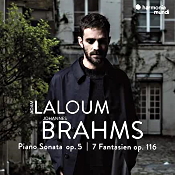
Brahms: Piano Sonata No. 3 in F minor, op. 5; 7 Fantasien, op. 116. Adam Laloum, piano. Harmonia Mundi HMM 902666. 

French pianist Adam Laloum (b.1987) brings us works from the early and late periods of Brahms’s writings for the keyboard. The composer produced his Piano Sonata No. 3 when he was only 20 years old. The liner notes marvel of the young Brahms that “even if his constricted, lower-middle-class family environment was not as miserable as frequently related, it remains incomprehensible how an eighteen-year-old buried entirely in his romantic dream world who had no contact at all to this ‘musical world,’ could invent at the kitchen table in his home, piano music that would astound Europe. And how it became known to the public is no less miraculous. As a nobody, he embarked in the spring of 1853 upon a journey that was supposed to be hardly more than a little concert tour, and ended it as an acclaimed ‘genius’ with the first printed works in his luggage. On this trip, which rather unexpectedly carried him to its turning point, the encounter with the Schumann family, the twenty-year-old Brahms wrote his Third Piano Sonata, which was to be his premature parting from this genre. This aspect, too, is mysterious.”

The sonata is a grand composition in five movements, spanning a total of nearly 40 minutes, with all the musical depth and complexity of a symphony. Speaking of symphonies, the attentive listener will hear occasional echoes of Beethoven’s Fifth as the sonata unfolds, that da-da-da-dum showing up every once in a while, almost spectrally in the opening movement, more forcefully in the fourth. This is truly a grand and glorious work, and Laloum plays it with both power and subtlety. Strangely and sadly enough, given the power and deep beauty of this grand sonata, it proved to be Brahms’s final composition in this genre.

However, Brahms did not abandon composing for the piano altogether; rather, he went on to compose other works for the keyboard, just no more sonatas. He completed his 7 Fantasien in 1892, nearly 40 years after composing his final sonata. They are much smaller in scale, the longest coming in at 4:34, the shortest at a mere 2:23. Four of the seven selections are intermezzi, which are especially lyrical, reflective, and calmingly beautiful (Bill Heck offers some insights about intermezzi in his review of a Brahms piano recording devoted to the genre: https://classicalcandor.blogspot.com/2021/04/brahms-intermezzi-cd-review.html); the other three are cappriccios, which are more, well, capricious. In both genres, Laloum;’ expressive playing is well-framed by the recorded sound, which is clear and full-bodied. All in all, this is a truly rewarding release that would serve as a fine introduction to the piano music of the amazing Johannes Brahms both the younger and the elder.

Vers Le Silence. Chopin: Polonaise in C minor, Op 40 No. 2; Bolcom: Twelve New Etudes for Piano, Book I - No. 1. Fast, furious | No. 2. Récitatif | No. 3. Mirrors; Chopin: Mazurka in C Major, Op. 68 No. 1; Mazurka in G minor, Op. 67 No. 2; Mazurka in A minor, “Emile Gaillard”; Bolcom: Twelve New Etudes for Piano Book II - No. 4. Scène d’opéra | No. 5. Butterflies, hummingbirds | Nocturne; Chopin: Waltz in B minor, Op. 69 No. 2; Waltz in A-flat Major, Op. 42; Bolcom: Twelve New Etudes for Piano, Book III - No. 7. Premonitions | No. 8. Rag infernal (Syncopes apocalyptiques) | No. 9. Invention; Chopin: Polonaise in A-flat Major, Op. 53; Bolcom: Twelve New Etudes for Piano, Book IV - No. 10. Vers le silence | No. 11. Hi-jinks | No. 12. Hymne à l’amour; Chopin: Mazurka in F minor, Op. 68 No. 4. Ran Dank, piano. AVIE Records AV2475. 

With this release we have releases by composers that most classical music fans would not be inclined to think of together, if for no other reason that they are far separated in time, but also because one is quite famous, especially for his piano music, while the other is, although certainly not obscure, far from widely known. As the Israeli-born (now residing in the United States) pianist Ran Dank (b. 1982) puts it, “At first glance, the musical worlds of Frédéric Chopin (1810-1849 and William Bolcom (b. 1938) seem disparate. The former, the national composer of Poland, who spent the lion’s share of his adult life in exile in the country of France, is one of classical music's most well-known and often-played composers, His writing style has become synonymous with pianistic elan and panache, with lush melodic lines in the bel canto style and brilliant bravura passage-work – all ensconced in sumptuous, romantic harmonies. The latter, a Seattle-born American composer, has become one of contemporary music’s most defining voices through boldness of invention and a nonpareil synthesis of musical languages and idioms that encompass the range of 20th-century music. As pianist-composers, they both share a perfect understanding of the human hand and the ability to use the piano to its full extent. They also possess an extraordinary ear for sounds and a keen sense of structure. All of these commonalities begin to unveil themselves when listening to these works side by side.”

As you can see from the track listing, Dank has chosen to intersperse selections of various types from Chopin’s catalog, including two Polonaises, four Mazurkas, and two Waltzes, amongst Bolcom’s 12 New Etudes for Piano. Bolcom began working on the Etudes in 1977, but put them aside when pianist Paul Jacobs, to whom they had been dedicated, passed away in 1983. However, Bolcom was persuaded to complete the work by pianists John Musto (b. 1954) and Marc-Andre Hamelin (b. 1961), so Bolcom set back to work and completed the set in 1986, expanding the dedication to include all three pianists. Although Dank opens and closes his program with Chopin, and devotes considerably more space in his liner note essay discussing the Chopin pieces he has chosen to include, he also writes, “At the core of this recording lie the Twelve New Etudes… The etudes as a whole exhibit all the traits of Bolcom’s writing: wonderfully eclectic, effortlessly moving between one musical idiom and another with seemingly endless ingenuity. The complete set won the Pulitzer Prize in 1988 and is one of the great etude sets in the pianistic repertoire… I would like to close with a few personal notes. With this debut recording, I have chosen to concentrate on two composers who have shaped my trajectory as a pianist and musician. The music of Chopin was, quite literally, the reason I began playing the piano. The waltzes of Chopin were the first musical pieces I remember hearing, and it was a recording of them that had me mesmerized by the age of 3. As a child of two Polish parents, the music of Chopin played a huge part in my upbringing, and every note of it resonates with me on an extremely personal level. Bolcom’s music was a much later discovery, but one that was equally valuable. Indeed, after having learned this set of etudes, I was so fascinated by it that I decided to write my doctoral dissertation on it. I have spent countless hours both playing, studying, and analyzing this text, and I hope to be able to impart some of my musical insights to the listener.”

It seems clear, then, that the primary purpose of the album is to present the Bolcom set, with the Chopin pieces being added for two main reasons: as a musical complement to the Bolcom based on Dank’s deep regard for both composers and to make the album easier to market and sell. Some might find the latter reason less than noble – either on my part for suggesting it or on the part of the producers for implementing it, if that is indeed the case. In any event, whatever the motivation, the end result is an entertaining album that succeeds in exposing music lovers to some music that they might otherwise might not ever have auditioned. The Bolcom Etudes are not going to be to everyone’s taste, but what music truly is? However, they are colorful, brief, spirited, imaginative, and varied. I will admit that they put me off a bit at first, but the more I listened, the more I came to enjoy them, and the more I came to appreciate Bolcom’s fascination with them. From the first of the dozen, titled “Fast, Furious,” which is just that, a shot of caffeinated keyboard adrenaline, we then go to “Recitatif,” a welcome island of calm. Another highlight is “Scene d’opera,” like some fantastic opera scene recalled in a dream. And so the Etudes continue, imaginative pianistic sketches, capturing moods and mental images, ending with the peaceful, reflective, perhaps resigned “”Hymne a l’amour” that completes the set. Dank then follows with a gentle performance of Chopin’s Mazurka in F Minor, op. 64, ending the album in a similar tone but offering a glimpse of hope, some light shining through the cracks. The engineering is by veteran engineer Judith Sherman, so the sound is first-rate, as you might expect. An unusual but rewarding release – try it, you might like it.

Nik Bärtsch: Entendre. Modul 58_12; Modul 55; Modul 26; Modul 13; Modul 5; Dejã-vu,Vienna. Nik Bartsch, piano. ECM 2703. 

Swiss pianist Nik Bartsch (b. 1971) has created an album of solo piano music that defies easy categorization. Although Bartach has led jazz groups that play music of a similar overall feel, the music on Entendre is not jazz; although it tends toward having a rhythmic pulse and a sense of repetitive buildup, it is not merely minimalism; and although it is in a sense composed and has titles (some of which have been played performed previously by his jazz groups), it is music that is not fully composed nor is it fully improvised. The music just seems to unfold as Bartsch plays patterns and then plays with those patterns, keeping a steady pulse but shifting accents, chords, riffs, finding “freedom in the groove” as he taps into the potential energy of the keyboard (and occasionally behind the keyboard) and channels it into kinetic energy that seems to chant and dance as it ebbs and flows. This is energetic music with an underlying sense of calm, music that can either stimulate or soothe, depending on the mood the listener brings to it. Something like a mash up of Philip Glass with Keith Jarretts Koln Concert, if that makes any sense to anyone besides me. Great driving music!

KWN

Dec 1, 2021

Piano Potpourri, No. 3 (CD reviews)

Echoes of Life. IN THE BEGINNING WAS | Francesco Tristano: In the Beginning Was; Chopin: Preludes op. 28: Nos. 1-4: INFANT REBELLION | Ligeti: Musica ricercata I; Chopin: Preludes op. 28. Nos. 5-9; WHEN THE GRASS WAS GREENER | Nino Rota: Valzer; Chopin: Preludes op. 28: Nos. 10-15; NO ROADMAP TO ADULTHOOD | Chilly Gonzales: Prelude in C sharp major; Chopin: Preludes op. 28: Nos. 16-18; IDENTITY | Takemitsu; Litany I; Chopin: Preludes op. 28: Nos. 19-20; A PATH TO WHERE | Arvo Pärt: Für Alina; Chopin: Preludes op. 28: Nos. 21-24; LULLABY TO ETERNITY | Alice Sara Ott: Lullaby to Eternity. Alice Sara Ott. Piano. Deutsche Grammophon 486 0474.

By Karl W. Nehring

With so much of recorded music trending toward the “song” as the fundamental commodity, and with even classical music labels such as, yes, Deutsche Grammophon releasing individual digital tracks as singles, it is encouraging to see that the concept of the album is still alive and well; moreover, what we have here is not just an album, but by golly, a concept album. Not just a collection of pieces, but a collection assembled in an attempt to tell some sort of story, augmented by the liner notes and art. You have probably already noticed the all-caps interjections in the list of compositions above, which are taken directly from the back cover of the CD digipack. As the German pianist Alice Sara Ott (b. 1988) explains it, “Echoes of Life is a personal reflection on the thoughts and moments that influence and change our lives. It also portrays the journey and transformation I took to become the person and artist I see myself as today. In interpreting music from composers who, in their own time, challenged the system and redefined music, I see it as my role as a classical musician to carry this spirit forward by not insisting on reproducing bygone traditions and limitations… With his Preludes op. 28, Frédéric Chopin composed a collection of individual character pieces – very different from each other and yet all connected in some way. They remind me of life. I have chosen seven contemporary works to intersperse the Preludes and, while they echo some of my most personal and vulnerable experiences, they also conform how modern, provocative, and timeless Chopin’s music is.”  

The end result is a musical delight, as Ott mingles stimulating newer music together with the music of Chopin to create a program that flows smoothly and draws the listener in. You really don’t get the sense that you are jumping back and forth in time or making abrupt shifts in style. Yes, the Ligeti piece has a fierceness about it, but not overwhelmingly so, and yes, when you think about it, Chopin’s music has energy in abundance also. And so it goes with Takemitsu and Chopin, and Pärt and Chopin; in the hands of Alice Sara Ott, this music all makes sense together. The engineering is also first-rate, with a coherent piano sound. This truly is a splendid release.

When Do We Dance? George Gershwin: When Do We Dance?; Art Tatum: Tea for Two; William Bolcom; Graceful Ghost Rag; Fats Waller: Vipers Drag; Astor Piazzolla: Libertango; Alberto Ginastera: Argentine Dances No. 2; Manuel de Falla: Ritual Fire Dance; Maurice Ravel: Valses Nobles et Sentimentales; Camille Saint-Saëns: Étude en Forme de Valse; Béla Bartók: Romanian Folk Dances; Igor Stravinsky: Tango; Alexander Scriabin: Waltz in A flat Major; Rachmaninoff: Polka Italienne. Lise de la Salle, piano. Naïve V 5468.

As you can readily infer from the selections on this release from French pianist Lise de la Salle (b. 1988), the emphasis here is on dance music. As the pianist explains, “With so many dances and so much music to play, I could take ten albums to tell this whole story. So, I decided to focus on one century (1850-1950) but travel the world. I believe this is the most fascinating period in the history of all the arts, alive with new rules and techniques, and an explosion of potential – not just in music but also in literature, painting and dance. It all explodes, and the twentieth century opens up to a new modern world. This gives rise to new emotions of incredible depth. When Do We Dance? is a journey through this century to explore the different ways in which dance takes possession of the body: with an amazing swing in North America, developing a  strong sensuality in South America and Spain, with reserve, elegance and sophistication in France, or through the expression of a late, sentimental romanticism in eastern Europe and Russia.”

What is particularly rewarding about the program she has chosen is to see the names of Art Tatum, Fats Waller, and Astor Piazzolla in there along with more recognizable names from the classical music world. De la Salle obviously loves music, loves dance (which she has studied), and knows how to play dance music in a way that does it justice – that lets it swing and sway; however, she never lets herself get carried away, she never takes it over the top. From Tatum to Ravel to Stravinsky, she lets the music dance. My only reservation about this release is the engineering. Although the sound of the piano is clean and clear, the stereo imaging is a bit odd, with the piano seeming too wide and not quite coherent. If your system has a mono setting, that might be the best. Really, the sound is not at all a deal-breaker, and many listeners will find it just fine, so don’t let my sonic quibbles dissuade you from listening to this energetic collection, which Ms. de la Salle characterizes as “a journey to explore the different ways in which dance takes possession of the body.”

Northscapes. Lasse Thoresen: Invocation of Pristine Light Op. 52, No. 1; Anna Thorvaldsdottir: Scape; Bent Sorensen: (from 12 Nocturnes) I: Mignon - Und die Sonne geht Unter; III: Nachtlicher Fluss; VII: Mitternacht mit Mignon; Kaija Saariaho: Prelude; Raminta Serksnyte: Fantasia; Peteris Vasks: Music for a Summer Evening; Lasse Thoresen: Invocation of Rising Air, Op. 52, No. 2. Ieva Jokubaviciute, piano. Sono Luminus DSL-92251.

Although I was not quite sure what to expect from this release, I certainly looked forward to auditioning it. As for as the composers, I was quite familiar with the orchestral music of Vasks, but had never heard any of his piano music; had heard some orchestral music by Saariaho but none of her piano music; some chamber music by Thorvaldsdottir but no piano music; and nothing at all by any of the other composers or the pianist. So why did I look forward to auditioning it? Because I knew that Sono Luminus had great sound and because the program looked intriguing indeed. I knew I had to give it a listen.

I’m glad I did so, for I was richly rewarded. Lithuanian pianist Ieva Jokubaviciute is able to draw astonishing sounds from the piano, both form the keyboard and from “under the hood” if so requested by the composer; and Sono Luminus has captured in all in gloriously realistic sound quality. Particularly impressive are the two contributions by Norwegian composer Lasse Thoresen, which open and close the program. Invocation of Pristine Light really does evoke a feeling of illumination, a sense of wonder, discovery, and joy. Although of course I have never heard anyone else interpret this piece before, it is hard to imagine anyone bringing any more sensitivity to it than Ms. Jokubaviciute. The closing Invocation of Rising Air has a contrasting energy to it, more subdued, but still imbued with wonder. Thorvaldsdottir’s Scape finds the pianist drawing some unusual sounds from her instrument. As the liner notes explain, Scape “calls for the piano to be prepared with screws placed between certain strings, for the use of a thimble, and for the application of an e-bow. Already, we have here the composer asking the performer to coax a host of sounds and gestures from inside the piano beyond hammers striking strings. The preparation of the piano and the use of extended techniques unleash sounds inherent to the instrument yet repressed by the mechanisms of the tradition.”  One of the liner note photos depicts Ms. Jokubaviciute manipulating the strings inside the piano. Although to read of these techniques might lead one to believe that the music must sound hostile and unlistenable, the end result is far from that. Strange, perhaps, but compelling – musically compelling at that. And so the rest of the album goes, fresh, bracing new sounds, expertly played and magnificently recorded. If you are a fan of piano music and have at least a modicum of musical adventurousness in your soul, Northscapes belongs on your audition list.

Bonus Recommendations:

Puerta. Jorge Rossy, vibraphone, marimba; Robert Landfermann, double bass; Jeff Ballard, drums, percussion. ECM 2661 382 2596.

There is an interesting backstory here. Jorge Rossy was for a time the drummer in the Brad Mehldau Trio, but left that group to return to his native Spain and concentrate on his piano playing. He was replaced in Mehldau’s piano trio by the American drummer Jeff Ballard. And now we have here Rossy on neither drums nor piano, but rather on vibes and marimba, recording an album of mostly his own compositions supported by Ballard on drums and German bassist Landfermann. Most of the tunes have a relatively easygoing feel to them, medium tempos, minimum flash, with the musicians more interested in communicating with the listener than showing off their chops. It is fascinating to hear the sonic interplay between the drums and the vibes. Both involve instruments that are struck with sticks/mallets; both are being played by musicians who are experienced drummers. The crystal clear ECM sound allows you to really focus on their interaction, which is fascinating, and of course you also have the underlying plucking support of the double bass, which at times steps out into the foreground, occasionally bowed rather than plucked, marimba sometimes ringing…  Amazing now instruments that are struck and plucked can sound so soothing, yet while sounding so soothing still hold our attention.  

Mozart in the Jungle: Sex, Drugs, and Classical Music. Tindall, Blair. Grove Press (2005).

Although this book covers the classical music world of several decades ago, many of the issues that Blair Tindall brings up regarding the financial and management practices within the industry are still relevant today. In addition, many of the personalities she discusses involve names that would be recognizable to most fans of classical music. Yes, there are some salacious details involving sex and drugs that could well have been left out, some of those salacious details do serve to give readers a perspective on the world of classical music they might otherwise never have been afforded. As a quick example, I recall attending a performance by the famed violinist Ihtzak Perlman, who was accompanied on piano by Samuel Sanders, back in the early 1980s. According to Tindall, who came to know Sanders very well, Perlman was making around $33,000 for such appearances at that time, and paying Sanders all of $1,000. Interesting… Tindall also writes of how as orchestras came to get money from corporations and other donors, they tended to increase their spending; in fact, the more donations the received, the larger their debt became. There are also some interesting character sketches in this memoir; unfortunately, some of them turn out to have sad endings as some individuals fall prey to drugs, alcohol, disease, or despair. Tindall was one of the fortunate few, able to escape the classical music world she felt trapped in by discovering she had a talent for writing and actually earning a scholarship to Stanford and starting a second career in journalism, and eventually writing her book. It is not a volume I would recommend to everyone, but it is worth at least a skim through if you are interested in gaining another perspective on classical music – sex, drugs, money, and all the rest that goes with it.

KWN

Nov 17, 2021

Piano Potpourri, No. 2 (CD Reviews)

By Karl W. Nehring

William Byrd – John Bull: The Visionaries of Piano Music. (CD 1) Byrd: Prelude (Parthenia 1); Pavan "Sir William Petre"; Galliard (Parthenia 3); The Battell: The Flute and the Droome; The wood so wild; The Maiden Song; John come kiss me now; Bull: Fantasia (Fitzwilliam 108); Fantastic Pavan (Fitzwilliam 34); Fantastic Galliard (Fitzwilliam 35); Canons 51 - 48 - 39 - 7 - 15 – 114; Prelude "Laet ons met herten reijne"; Carol "Laet ons met herten reijne"; Les Buffons; Walsingham; Byrd: Pavana "The Earle of Salisbury"; Galliard (Parthenia 7); Galliard in C major 'Mistress Mary Brownlow'; The Bells; (CD 2) Bull: Chromatic (Queen Elisabeth's) Pavan; My Grief; Byrd: O mistress mine, I must; The Second Ground - 16 Variations; Bull: Prelude (Fitzwilliam 43); Melancholy Pavan; Byrd: Earl of Oxford's March; Ut re mi fa sol la; Ut, mi, re; Bull: Canons 68 - 78 - 79 - 65 - 3 – 53; Byrd: Walsingham; Sellinger's Round; Bull: Fantasia on a Fugue of Sweelinck; Telluris ingens conditor: Nos. 1, 2, 3, 6, 7. Kit Armstrong, piano. DG 486 0583.

When I first encountered this new album from the young American pianist Kit Armstrong (b. 1992), I had a vague recollection of hearing a recording of some music of Byrd played on a modern piano by the late Glenn Gould (you can read a discussion of Gould’s approach to this music by jazz pianist Ethan Iverson here). Needless to say, that was many years ago, so it was with fresh ears that I eagerly auditioned this 2-CD set in which Armstrong presents music by William Byrd (ca. 1540-1623) and John Bull (ca, 1562-1628) that he has transcribed for the modern piano. To keep things in perspective, Bach was not born until 1685, so this truly is some early keyboard music, written originally not for the piano, or even the harpsichord, but for the virginal or organ. About his motivation for bringing us this music, Armstrong writes: “The motivation for doing this recording comes from not wanting to keep these pieces as historical artefacts…. We should be thankful to two composers who, probably for the first time in our history, had a vision of instrumental music as being just as profound as anything we find in the cultural experience of humanity. A lot of what has defined our musical culture – self-expression and self-immortalization – is found in the keyboard music of Byrd and Bull, which contains so much from the hearts and minds of both men… With these recordings I wish to tell my story of of the creation of a musical universe, at whose dawn stood two contrasting figures from England’s Golden Age: William Byrd and John Bull. As their personalities infused the vessel of keyboard music, a universe was born, of which they became the fabric, that would define the art of music for evermore.”

So what of the music itself? How does the music on this recording sound to modern ears? As you might expect, the overall impression is similar to that made by the keyboard music of Bach. If you are familiar with the sound of a virginal or harpsichord, you will recognize that sound as transcribed for piano here. There are trills and ornamentations, plenty of counterpoint, a relatively straightforward harmonic structure, and a strong sense of energy and purpose. Especially in Byrd, Armstrong plays with a delicate touch, painting with watercolors as it were. You can discern some stylistic differences between Byrd and Bull; to these ears, at least, Bull seems a bit more direct and assertive than Byrd, more inclined to contrast and drama. Byrd is more subtle, more restrained. Both, however, are capable of sustaining musical interest throughout this generously filled program. The recorded sound is clear and focused, and Armstrong has provided extensive liner notes that delve into the music of both musicians and their place in music history. For those who enjoy piano music and are looking for something both different and fascinating – not to mention musically satisfying – Kit Armstrong delivers the goods.

Chopin: Complete Nocturnes. (CD 1) 3 Nocturnes op. 9; 3 Nocturnes op 15; 2 Nocturnes op 27; 2 Nocturnes op. 32; 2 Nocturnes op. 37; (CD 2) 2 Nocturnes op. 48; 2 Nocturnes op. 55; 2 Nocturnes op 62; Nocturne in E minor op. post. 72/1; Nocturne in C minor op. post. KK IVb/8; Nocturne in C sharp minor op. post. KK Iva/16. Jan Lisiecki, piano. Deutsche Grammophon 486 0761.

Chopin: Complete Nocturnes. (CD 1) Nocturne No. 1 in B-Flat Minor, Op. 9 No. 1; Nocturne No. 2 in E-Flat Major, Op. 9 No. 2; Nocturne No. 3 in B Major, Op. 9 No. 3; Nocturne No. 4 in F Major, Op. 15 No. 1; Nocturne No. 5 in F-Sharp Major, Op. 15 No. 2; Nocturne No. 6 in G Minor, Op. 15 No. 3; Nocturne No. 15 in F Minor, Op. 55 No. 1; Nocturne No. 16 in E-Flat Major, Op. 55 No. 2; Nocturne No. 7 in C-Sharp Minor, Op. 27 No. 1; Nocturne No. 8 in D-Flat Major, Op. 27 No. 2; Nocturne No. 9 in B Major, Op. 32 No. 1; Nocturne No. 10 in A-Flat Major, Op. 32 No. 2; (CD 2) Nocturne No. 11 in G Minor, Op. 37 No. 1; Nocturne No. 12 in G Major, Op. 37 No. 2; Nocturne No. 17 in B Major, Op. 62 No. 1; Nocturne No. 18 in E Major, Op. 62 No. 2; Nocturne No. 13 in C Minor, Op. 48 No. 1; Nocturne No. 14 in F-Sharp Minor, Op. 48 No. 2; Nocturne No. 21 in C Minor, Op. posth.; Nocturne No. 19 in E Minor, Op. posth. 72 No. 1; Nocturne No. 20 in C-Sharp Minor, Op. Posth. Alain Planès, 1836 Pleyel piano. Harmonia Mundi HMM 905332.33.

Chopin: Nocturnes. (CD 1) Nocturne in B Flat minor Op. 9 No.1; Nocturne in E Flat Major Op. 9 No. 2; Nocturne in B Major Op. 9 No. 3; Nocturne in F Major Op. 15 No. 1; Nocturne in F Sharp Major Op. 15 No. 2; Nocturne in G minor Op. 15 No. 3; Nocturne in C Sharp minor Op. 27 No. 1; Nocturne in D Flat Major Op. 27 No. 2; Nocturne in B Major Op. 32 No. 1; Nocturne in a Flat Major Op. 32 No. 2; Nocturne in G minor Op. 37 No.1; Nocturne in G Major Op. 37 No. 2; (CD 2) Nocturne in C minor Op. 48 No. 1; Nocturne in F Sharp minor Op. 48 No. 2; Nocturne in F minor Op. 55 No. 1; Nocturne in E Flat Major Op. 55 No. 2; Nocturne in B Major Op. 62 No. 1; Nocturne in E Major Op. 62 No. 2; Lento Con Gran Espressione in C Sharp minor 'Nocturne', Kkiva/16; Nocturne in E minor Op. 72 No. 1: Nocturne in C minor Kkivb/8; Anonymous: Larghetto in C Sharp minor 'Nocturne Oublié', Kkanh. Ia/6; Nocturne in E Flat Major Op. 9 No. 2B. Stephen Hough, piano. Hyperion CDA86351/2.

For fans of Chopin’s
Nocturnes, these three recent releases truly do represent that old phrase, not heard so much these days but certainly appropriate in this case, “an embarrassment of riches.” Although I have made my choice as to which is the collection that will remain on my shelf as a replacement for the venerable Rubinstein set that I had owned for many years but finally traded in at some point when I had decided that because I was not much of a Chopin fan and in truth of all his music could bring myself to listen only to the Nocturnes (and only very occasionally to them), perhaps it was time to simply let them go. And truth be told, I had not really missed hearing the Nocturnes until Fate, the Public Library, and Public Relations all played a hand in my so-called life, the end result being my renewed love for Chopin’s marvelous music and grateful appreciation for the artistry and dedication of these three remarkable musicians.

As you can see from the track listing above, each of the three musicians takes a slightly different approach to the order on which they present the Nocturnes. There are other differences in their presentations, too. Lisiecki and Planès present the standard set of 21, while Hough throws in a couple of extra variants. Lisiecki and Hough play modern pianos, while Planès uses an 1836 Pleyel concert grand, the type of piano favored by Chopin himself. (The liner note gives detailed information on this piano; however, neither the Lisiecki nor Hough releases specify the particular piano employed.)

I will note at the outset that although I found some differences among these three recordings, which was certainly to be expected, I found all three to be of high quality. But yes, when push came to shove, I was able to pick a favorite. So, let’s take a brief look at all three.

First up is the version by the young Canadian-born pianist of Polish ancestry, Jan Lisiecki (b. 1995). This recording recently received a generally favorable review from my colleague and friend Bill Heck, who goes into much more detail than I am going to delve into in his review, which I would encourage you to read here. In his liner note remarks, Lisiecki observes of the Nocturnes that “They embody what I cherish most in his music: the yearning, captivating melody, the framework he provides for flexibility, the endless fresh ideas. Chopin was a master of the piano, using its full range of tonal possibilities while spinning long, melodic, cantabile phrases over a rich harmonization. The Nocturnes hail from the night – a magical time of endless possibilities – and present a personal story from the interpreter to the listener. They are a canvas, a sphere to dive deep into one’s own emotions and thoughts. Yet, most importantly, they remain elegant and simple. After all, as Chopin himself said, ‘Simplicity is the final achievement. After one has played a vast quantity of notes and more notes, it is simplicity that emerges as the crowning reward of art’.” You can tell from listening to this performance that Lisiecki clearly loves this music, for he plays it with heartfelt expression. As Bill noted in his review, Lisiecki sometimes tends to play slowly; some listeners will like this approach, others might find it a bit, well, too slow at times. But not all of his playing is on the slow side, and overall this is a fine release. The recorded sound is excellent, full and clear and vibrant.

Next up is the recording by the French pianist Alain Planès (b. 1948), which sounds significantly different from the Lisiecki recording. Planès notes of the Pleyel piano used in his recording that “it has three distinct registers: a treble that is light and harp-like, a velvety middle register, and a bottom register with round and clear bass note – sonorities which combine together better than on the more evenly voiced pianos of today. By way of illustration, I would suggest listening to the second nocturne from Opus 55, which amply highlights the fine qualities of the instrument: this piece is not unlike an operatic aria for soprano and tenor, each of the voices embodied by a different register, thus reinforcing the impression of a dialogue.” The booklet includes a photo of the piano, which is an imposing work of art. Note that this is a concert grand piano, not a small fortepiano of limited volume. Its keyboard has only 80 keys rather than today’s 88, but is capable of projecting some volume. I will say that as I listened to this recording, I was at first struck at how modern the piano sounded (I will confess I was expecting a sound closer to that of a harpsichord); however, as I listened longer and more intently, as much I enjoyed the music, I could never get completely past the recorded sound. I am not sure how much of what bothered me was the piano or the way it was recorded. The bothersome aspect was that there were times when the piano sound seemed to be fragmented, with various registers coming from different areas – but not only from left to right, but also from front to back. For more casual listening, everything was just fine, and I really enjoyed Planès’s interpretations, but when I sat down and listened closely, there were times when I found myself distracted by the sound. The sound is clean, clear, and dynamic; it is the image of the instrument that never seemed correct, at least in my setup. Perhaps it would sound just fine in other systems; in any event, it is a recording worthy of an audition for lovers of the Nocturnes.

British pianist Stephen Hough (b.1961) introduces his recording by noting that, “Chopin wrote no operas, even though that art form was his favorite and singers, not pianists, were his musical heroes, And despite his love for the human voice, he barely wrote any songs either -- fewer than twenty, with only two published in his lifetime. These unambitious ditties, with their stiff, plain vocal lines, accompanied by frequent um-cha-cha vamping, seem puzzling from this pianist-composer who idolized the human voice. Enter the nocturnes – a corpus of some of the finest operatic arias ever written. Here bel canto melodies abound, dramatic, tender and tragic, with virtuoso decoration reminiscent of a coloratura diva.” Interestingly enough, Hough, like Planès, calls out Op. 55 No. 2, opining that its “miraculous interweaving (interchanging) of melody, harmony, and counterpoint creates a seamless robe of ecstasy.” Curious, I spent some time comparing the Planès and Hough recordings of this particular Nocturne. In both recordings, it was easy to hear what both pianists had found special about this piece, with its singing quality and feeling of dialogue. The sound of the Pleyel brought out the drama, while Hough and his modern piano emphasized a beautiful singing quality. Indeed, that beautiful singing quality is what made the Hough recording my favorite of the three. He has a touch at the keyboard that seems to bring out the beauty of these pieces by truly making them sing. The engineering helps, too, as Hough’s piano seems to be recorded just a bit more distantly, giving it a slightly warmer, enveloping sound. As I said at the outset, these are three fine recordings, each worthy of audition, but the Hough recording has that extra measure of beauty that makes it my first choice.

Bonus Recommendation:

Hough, Stephen.  Rough Ideas: Reflections on Music and More. Farrar, Straus and Giroux (2019).

It turns out that Stephen Hough (rhymes with “rough,” as he helpfully points out in the introduction) is as adept at the computer keyboard, or tablet, phone (crazy 21st century!), or even pen and tablet, as he is at his piano keyboard, for Rough Ideas is a delight throughout its 400+ pages. Don’t be intimidated by its size, because the book consists of brief essays – “reflections” – most of which are only a page or two long. These essays are divided into several sections, titled Forum (covering a variety of general music-related topics, with titles such as “Can you be a musician and not write music?,” “Gay pianists: can you tell?,” and “Can atonal music make you cry?); Stage (covering both live performance and recording, with titles such as “Routine on a concert day,” “Humiliation and vomiting at the keyboard,” “Can wrong notes be right?”, and “Stanly Kubrick and recording”); Studio (covering issues related to practicing, playing, and teaching, with titles such as “Random practice tips,” “Depressed: the amazing world of the pedal,” and “Trying to practice away from the piano and trying to try to pray”); People and Pieces (covering composers, compositions, and musicians, with titles such as “How much do we need to know about composers?,” “Mompou and the music of evaporation: a note for a CD,” “Chopin and the development of piano technique,” “Debussy and Ravel: chalk and cheese,” “Glenn Gould and modern recording,” and “RIP Lou Reed”); ... and More (covering a variety of topics, with titles such as “Paul Klee at Tate Modern,” “Maths and music: joined at the hip or walking down different paths?,” “The essence of underpants and the lap of luxury,” “Willa Cather, Thanksgiving, and the soul of America,” and “Encouragement, falsehood, and Auschwitz”). One of the great things about a book laid out in this manner is that it is convenient to pick it up, read a few entries, then put it down to read it later at your convenience. But it also flows well should you decide to read it pretty much straight through, as I did. Hough truly does as write as nearly as well as he plays (or perhaps has editors as skilled as his engineers, although I favor the former explanation, as I suspect he would also).

As Hough explains in his introduction, “Mostly I’ve written about music and the life of a musician… Other subjects appear too, people I’ve known, places I’ve travelled to, books I’ve read, paintings I’ve seen. Even religion is there: the possibility of the existence of God, problems with some biblical texts and the challenge involved in being a gay Catholic, and abortion. I’ve placed these reflections in a separate section so that readers allergic to such matters can avoid them and we can remain friends.” Allow me to point out just a few highlights that offer a hint of just how wide-ranging and stimulating these reflections are. In “Two women, two songs: in and out of harmony,” Hough quickly analyzes two wildly successful popular songs about women, reflecting on how although both the women and the music of Jobim’s “Girl from Ipanema” and the Beatles’ “Eleanor Rigby” were totally different, both were remarkable compositions. “Stanley Kubrick and recording” explains how seeing a documentary on how Kubrick went about filming The Shining set an example for Hough as to how to go about making a recording. In “Glenn Gould and modern recording,” Hough reflects on Gould’s decision to abandon live performance in favor of recordings in light of how the recording industry has changed since Gould’s time, speculating about how Gould would have embraced the Internet. “Beef Stroganoff and a bag of bones” recounts an experience Hough had when he was living in New York and an elderly but formidable Russian woman cooked some Beef Stroganoff for him. It was so delicious that Hough asked her for the recipe. “Well dear,” she replied, “I don’t like to give it to people. You see, it all goes back to when I was in Paris. General Stroganoff wrote it out for me himself.” Well. okay then… That is just a tiny sampling of some of the delights – there are more than 100 more – to be found in this stimulating and entertaining volume that should appeal to a broad spectrum of classical music fans.

KWN

Meet the Staff

Meet the Staff
John J. Puccio, Founder and Contributor

Understand, I'm just an everyday guy reacting to something I love. And I've been doing it for a very long time, my appreciation for classical music starting with the musical excerpts on the Big Jon and Sparkie radio show in the early Fifties and the purchase of my first recording, The 101 Strings Play the Classics, around 1956. In the late Sixties I began teaching high school English and Film Studies as well as becoming interested in hi-fi, my audio ambitions graduating me from a pair of AR-3 speakers to the Fulton J's recommended by The Stereophile's J. Gordon Holt. In the early Seventies, I began writing for a number of audio magazines, including Audio Excellence, Audio Forum, The Boston Audio Society Speaker, The American Record Guide, and from 1976 until 2008, The $ensible Sound, for which I served as Classical Music Editor.

Today, I'm retired from teaching and use a pair of bi-amped VMPS RM40s loudspeakers for my listening. In addition to writing for the Classical Candor blog, I served as the Movie Review Editor for the Web site Movie Metropolis (formerly DVDTown) from 1997-2013. Music and movies. Life couldn't be better.

Karl Nehring, Editor and Contributor

For nearly 30 years I was the editor of The $ensible Sound magazine and a regular contributor to both its equipment and recordings review pages. I would not presume to present myself as some sort of expert on music, but I have a deep love for and appreciation of many types of music, "classical" especially, and have listened to thousands of recordings over the years, many of which still line the walls of my listening room (and occasionally spill onto the furniture and floor, much to the chagrin of my long-suffering wife). I have always taken the approach as a reviewer that what I am trying to do is simply to point out to readers that I have come across a recording that I have found of interest, a recording that I think they might appreciate my having pointed out to them. I suppose that sounds a bit simple-minded, but I know I appreciate reading reviews by others that do the same for me — point out recordings that they think I might enjoy.

For readers who might be wondering about what kind of system I am using to do my listening, I should probably point out that I do a LOT of music listening and employ a variety of means to do so in a variety of environments, as I would imagine many music lovers also do. Starting at the more grandiose end of the scale, the system in which I do my most serious listening comprises Marantz CD 6007 and Onkyo CD 7030 CD players, NAD C 658 streaming preamp/DAC, Legacy Audio PowerBloc2 amplifier, and a pair of Legacy Audio Focus SE loudspeakers. I occasionally do some listening through pair of Sennheiser 560S headphones. I miss the excellent ELS Studio sound system in our 2016 Acura RDX (now my wife's daily driver) on which I had ripped more than a hundred favorite CDs to the hard drive, so now when driving my 2024 Honda CRV Sport L Hybrid, I stream music from my phone through its adequate but hardly outstanding factory system. For more casual listening at home when I am not in my listening room, I often stream music through a Roku Streambar Pro system (soundbar plus four surround speakers and a 10" sealed subwoofer) that has surprisingly nice sound for such a diminutive physical presence and reasonable price. Finally, at the least grandiose end of the scale, I have an Ultimate Ears Wonderboom II Bluetooth speaker and a pair of Google Pro Earbuds for those occasions where I am somewhere by myself without a sound system but in desperate need of a musical fix. I just can’t imagine life without music and I am humbly grateful for the technologies that enable us to enjoy it in so many wonderful ways.

William (Bill) Heck, Webmaster and Contributor

Among my early childhood memories are those of listening to my mother playing records (some even 78 rpm ones!) of both classical music and jazz tunes. I suppose that her love of music was transmitted genetically, and my interest was sustained by years of playing in rock bands – until I realized that this was no way to make a living. The interest in classical music was rekindled in grad school when the university FM station serving as background music for studying happened to play the Brahms First Symphony. As the work came to an end, it struck me forcibly that this was the most beautiful thing I had ever heard, and from that point on, I never looked back. This revelation was to the detriment of my studies, as I subsequently spent way too much time simply listening, but music has remained a significant part of my life. These days, although I still can tell a trumpet from a bassoon and a quarter note from a treble clef, I have to admit that I remain a nonexpert. But I do love music in general and classical music in particular, and I enjoy sharing both information and opinions about it.

The audiophile bug bit about the same time that I returned to classical music. I’ve gone through plenty of equipment, brands from Audio Research to Yamaha, and the best of it has opened new audio insights. Along the way, I reviewed components, and occasionally recordings, for The $ensible Sound magazine. Most recently I’ve moved to my “ultimate system” consisting of a BlueSound Node streamer, an ancient Toshiba multi-format disk player serving as a CD transport, Legacy Wavelet II DAC/preamp/crossover, dual Legacy PowerBloc2 amps, and Legacy Signature SE speakers (biamped), all connected with decently made, no-frills cables. With the arrival of CD and higher resolution streaming, that is now the source for most of my listening.

Ryan Ross, Contributor

I started listening to and studying classical music in earnest nearly three decades ago. This interest grew naturally out of my training as a pianist. I am now a musicologist by profession, specializing in British and other symphonic music of the 19th and 20th centuries. My scholarly work has been published in major music journals, as well as in other outlets. Current research focuses include twentieth-century symphonic historiography, and the music of Jean Sibelius, Ralph Vaughan Williams, and Malcolm Arnold.

I am honored to contribute writings to Classical Candor. In an age where the classical recording industry is being subjected to such profound pressures and changes, it is more important than ever for those of us steeped in this cultural tradition to continue to foster its love and exposure. I hope that my readers can find value, no matter how modest, in what I offer here.


Bryan Geyer, Technical Analyst

I initially embraced classical music in 1954 when I mistuned my car radio and heard the Heifetz recording of Mendelssohn's Violin Concerto. That inspired me to board the new "hi-fi" DIY bandwagon. In 1957 I joined one of the pioneer semiconductor makers and spent the next 32 years marketing transistors and microcircuits to military contractors. Home audio DIY projects remained a personal passion until 1989 when we created our own new photography equipment company. I later (2012) revived my interest in two channel audio when we "downsized" our life and determined that mini-monitors + paired subwoofers were a great way to mate fine music with the space constraints of condo living.

Visitors that view my technical papers on this site may wonder why they appear here, rather than on a site that features audio equipment reviews. My reason is that I tried the latter, and prefer to publish for people who actually want to listen to music; not to equipment. My focus is in describing what's technically beneficial to assure that the sound of the system will accurately replicate the source input signal (i. e. exhibit high accuracy) without inordinate cost and complexity. Conversely, most of the audiophiles of today strive to achieve sound that's euphonic, i.e. be personally satisfying. In essence, audiophiles seek sound that's consistent with their desire; the music is simply a test signal.

Mission Statement

It is the goal of Classical Candor to promote the enjoyment of classical music. Other forms of music come and go--minuets, waltzes, ragtime, blues, jazz, bebop, country-western, rock-'n'-roll, heavy metal, rap, and the rest--but classical music has been around for hundreds of years and will continue to be around for hundreds more. It's no accident that every major city in the world has one or more symphony orchestras.

When I was young, I heard it said that only intellectuals could appreciate classical music, that it required dedicated concentration to appreciate. Nonsense. I'm no intellectual, and I've always loved classical music. Anyone who's ever seen and enjoyed Disney's Fantasia or a Looney Tunes cartoon playing Rossini's William Tell Overture or Liszt's Hungarian Rhapsody No. 2 can attest to the power and joy of classical music, and that's just about everybody.

So, if Classical Candor can expand one's awareness of classical music and bring more joy to one's life, more power to it. It's done its job. --John J. Puccio

Contact Information

Readers with polite, courteous, helpful letters may send them to classicalcandor@gmail.com

Readers with impolite, discourteous, bitchy, whining, complaining, nasty, mean-spirited, unhelpful letters may send them to classicalcandor@recycle.bin.

"Their Master's Voice" by Michael Sowa

"Their Master's Voice" by Michael Sowa