Showing posts with label Dvorak. Show all posts

Mar 24, 2024

Dvořák: Cello Concerto et al. (CD Review)

by Karl Nehring

Cello Concerto in B minor, Op. 104, B. 191; Klid (Silent Woods), Op. 68, B 182; Rondo in G minor, Op. 94, B. 181; Romance in F minor, Op. 11B. 39;  Mazurek in E minor, Op. 49, B. 90. Zara Nelsova, cello; Ruggiero Ricci, violin; St. Louis Symphony Orchestra; Walter Susskind, conductor VOX-NX-3034CD

Antonin Dvořák’s Cello Concerto is a work that is dear to many music lovers. It is filled with beautiful melodies that appeal to both the head and the heart, making it one of those pieces that can serve as a wonderful way to introduce those unfamiliar with classical music into its spellbinding realm. When I received this recording for review, I tried to remember which recording if the work I had first acquired back in the mid-1970s when I began to become seriously interested in classical music, but drew a blank. However, I vividly remember hearing the work in concert. It was March 31, 1976. One of my professors, who was going to be unable to attend the Utah Symphony Orchestra concert at which the legendary cellist Mstislav Rostropovich (1927-2007) was scheduled to perform the Dvořák, and knowing of my burgeoning passion for classical music, had kindly given my wife and me his tickets. 

Shortly before the concert, however, Rostropovich fell ill and had to cancel, so another legendary cellist stepped in at the last minute, Gregor Piatigorsky (1903-1976). Although he sounded a bit rusty and fumble-fingered in some of the early passages, his playing in the tender moments of the second movement was beautiful, and seeing his interactions with the concertmaster was like watching chamber musicians playing a duet. Since that night, the Dvořák concerto has retained a special place in my heart. Sadly, that performance turned out to be the final public performance of Maestro Piatigorsky, who passed away a mere eight months later in November, 1976.


The recording sessions for this release took place in May, 1974, which was while I was still serving in the Army. My classical LP collection at that time consisted of Beethoven’s 5th and 9th, Mussorgsky’s Pictures at an Exhibition, Vivaldi’s The Four Seasons, Mahler’s 1st and 4th, and a Bach organ recital. I may have had the Dvořák 9th, but can’t recall for sure. I certainly didn’t have his Cello Concerto. But back in May of 1974, the cellist Zara Nelsova (1918-2002) made this recording with Maestro Susskind and the SLSO. Nelsova was born in Winnipeg, Canada to Russian-Jewish parents who had named her Sara Katznelson; however, for professional reasons she had decided to change to a more Russian-sounding name – Zara Nelsova. She lived in the UK for a time (championing the Elgar concerto before Du Pré), served on the Juilliard faculty for decades, and built a highly successful career as a cellist. Her performances of the Cello ConcertoSilent Woods, and the Rondo in G minor are worthy to be mentioned in the company of the more familiar “star power” names. These are performances of lyrical expression and effortless mastery, ably augmented by the sound of the orchestra. 


Silent Woods is an especially striking piece of music with which many music lovers may be unfamiliar. If you have not yet heard it, please give it a listen – you will not regret it. But that is not to diminish the Rondo, which is also lovely. The program concludes with two works for violin and orchestra from earlier in the Dvořák catalog featuring as soloist the late American violinist Ruggiero Ricci (1918-2012). The Romance, as you might expect, tugs at the heartstrings with some singing melodic lines, while the Mazurek is lively and dancelike. Both are uplifting and charged with energy.

Finally,a few words about the engineering. Many music lovers no doubt remember Vox, who produced many excellent budget recordings that provided a gateway into the world of classical music for those of us with limited means. Recently, Naxos obtained the rights to the original master tapes that Elite Recordings made for the Vox label decades ago. Appearing on the back cover of these new “Vox Audiophile Edition” versions is a highlighted statement affirming that “The Elite recordings for Vox legendary producers Marc Aubort and Joanna Nickrenz are considered by audiophiles to be among the finest sounding orchestral recordings.” For these reissues, Naxos engineers have taken those tapes from the vaults and carefully prepared these CDs for release, the end product of their labors being what they describe as “new192 kHz / 24-bit high definition transfers of the original Elite Recordings analogue master tapes.” Elite Recordings knew what they were doing in St. Louis, and Naxos has taken great care in their mastering process; as a result, this is a truly fine-sounding CD. Great music + excellent performances + fine sound = strong recommendation.

Mar 6, 2024

Dvořák: Violin & Piano Concertos (CD Review)

by Karl Nehring

Violin Concerto in A minor, Op. 53, B 108Piano Concerto in G minor, Op. 33, B. 63. Ruggiero Ricci, violin; Rudolf Firkušný, piano; St. Louis Symphony Orchestra; Walter Susskind, conductor. Vox Audiophile Edition VOX-NX-3035CD

Naxos has obtained the rights to the original master tapes that Elite Recordings made for the Vox label decades ago (many music lovers no doubt remember Vox, who produced many excellent budget recordings that provided a gateway into the world of classical music for those of us with limited means). Appearing on the back cover of these new “Vox Audiophile Edition” versions is a highlighted statement affirming that “The Elite recordings for Vox legendary producers Marc Aubort and Joanna Nickrenz are considered by audiophiles to be among the finest sounding orchestral recordings.” For these reissues, Naxos engineers have taken those tapes from the vaults and carefully prepared these CDs for release, the end product of their labors being what they describe as “new192 kHz / 24-bit high definition transfers of the original Elite Recordings analogue master tapes.” Of course, all that work would not mean much if the Dvořák concert performances captured by Aubort and Nickrenz were no great shakes to begin with; however, these recordings by Maestro Susskind (1913-1980) and the SLSO featuring violinist Ruggiero Ricci and pianist Rudolf Firkušný were excellent when they were released and they are excellent now. 


Neither concerto really seems to get as much credit or attention as it deserves. Why this is so remains a mystery, for anyone who takes the time to give this recording a serious audition could not help but be thoroughly impressed by both compositions. For whatever reason – and I will confess this is true even in my own case – most of us music lovers get exposed to Dvořák’s magnificent Cello Concerto, fall in love with it, but then never move on to explore either his Violin Concerto or his Piano Concerto.  Moreover, recordings by conductors such as the late Prague-borb Walter Susskind (1913-1980) tend to get overlooked these days in favor of those led by conductors, both living and dead, whose names and likenesses are being pushed hard by the giant labels. Maestro Susskind served as Music Director of the SLSO from 1968 to 1975, making some excellent recordings with them for Vox. 


The late American violinist Ruggiero Ricci (1918-2012) recorded the concerto with Susskind and the SLSO in August, 1974. The work is lively, melodic, and flowing, similar in overall form and quality to the more celebrated concerto of Brahms. As the liner notes point out: “Not surprisingly, in light of Dvořák’s newly developed but deeply sincere friendship and admiration for Brahms, the latter’s influence is as prominent in the Violin Concerto as the flavour of Czech folk music, though neither of these elements in any way diminishes the striking originality and individuality which stamp the work as no one but Dvořák’s.” The concerto was a specialty of Ricci’s; he performed it numerous times in concerts worldwide and had made a previous recording with Sir Malcolm Sargent and the London Symphony Orchestra. His familiarity with and affection for the work come through in this beautiful performance, which should go far to win converts to this overlooked masterpiece.


The Piano Concerto is pleasant and entertaining, if not quite in the same exalted class as the Violin Concerto. The Moravian-American pianist Rudolf Firkušný (1912-1994) was especially fond of the piece and like Ricci with the Violin Concerto, Firkušný often played it in in concert and recorded it several times (with Kubelik, Simogyi, and Neumann in addition to this 1975 effort with Susskind). It is not a virtuoso display piece; instead, it is a melodic essay for piano and orchestra in which they seem to work together, rather than a work in which the piano dazzles while the orchestra is mainly there to provide support. Still, it is an entertaining concerto that deserves a wider audience.


If you have not really become acquainted with either or both compositions by Dvořák, this expertly performed and excellently engineered release would be an excellent place to start. Kudos to Naxos for digging into the vault and pulling out this gem to restore for us.

Dec 31, 2023

BH’s Favorite Recordings of 2023

by Bill Heck

I’ve managed to avoid doing a “favorite recordings” list for the past couple of years, but our persuasive editor, KN, convinced me that I should do so this time around. You know what? It turned out to be fun to look back through 2023 reviews on Classical Candor, not just my own but those of my colleagues, KN and RR, as well. (But JJP, when will we be treated to another review from you? It’s been too long!)

Before proceeding, though, I should clarify how my “favorites” made the list. These are not to be considered somehow “the best” of the year; instead, they are simply a few recordings that I found both interesting and well done, ones that I found myself returning to long after their reviews appeared in Classical Candor. Nor does the ordering of the list reflect some sort of “quality” ranking; it’s simply in chronological order by review date.

Albeniz: Iberia. Nelson Goerner. Alpha Classics 829.  Iberia is one of those works in which one can be lost, moving through a kaleidoscopic world of themes and emotions. Goerner is by turns playful and serious, light and dark, swift and slow, somber and feverish, reflecting the music’s moods in a performance that rewards repeated hearings. Alpha’s outstanding sound compliments and completes the picture. By the way, technically this recording is a 2022 release, but I didn’t get around to publishing a review until January of this year, so it makes the list anyway.


Arnold: Concerto No. 1 for Clarinet and Strings Op. 20; etc. Chandos CHAN 20152. This disk of multiple works by Malcolm Arnold (I named only the Clarinet Concerto in the headline above) was reviewed by our colleague, Ryan Ross, but I’m including it here because it meets the criteria of interest and excellence. Frankly, I was only vaguely familiar with the music of Malcolm Arnold; this disk was an excellent introduction to a composer that I need to, and am getting to, know better. If you, too, are unfamiliar with Arnold’s work, read Ryan’s review of this disk here and go find a copy.

Beethoven: A Beethoven Odyssey: Volume 7 (Piano Sonatas Nos. 30, 31, and 32). James Brawn, piano. MSR Classics MS 1471. I reviewed both volumes 7 and 8 of Brawn’s A Beethoven Odyssey series this year, but I should call your attention to the entire series; volume 1 – 8 are currently available and the release of the final volume, number 9, is coming up in 2024. Our colleague John Puccio reviewed several of the earlier volumes in the series, and he and I are of one mind in finding Brawn’s playing consistently so “right”, so “of course that’s the way it should be”. That the MSR engineers capture the sound of the Steinway so well is the proverbial icing on the cake.


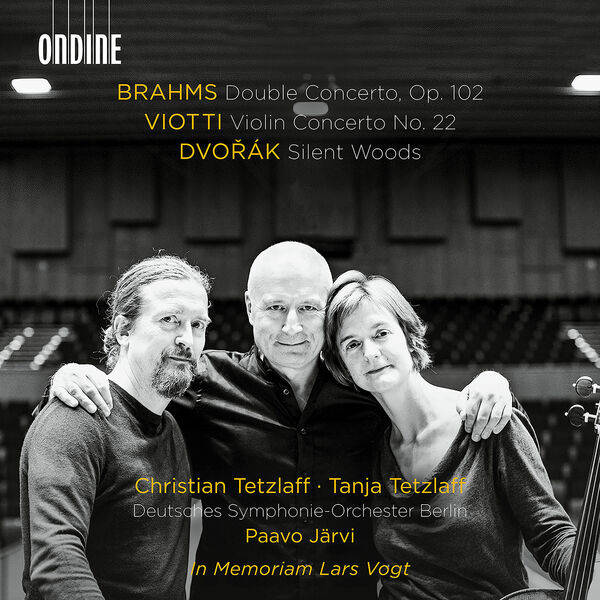
Brahms: Double Concerto, Op 192; Viotti: Violin Concerto No. 22; Dvorak: Silent Woods, Op.68/5. Christian Tetzlaff (violin), Tanja Tetzlaff (cello), Paavo Järvi/Symphonie-Orchester Berlin. Ondine ODE 1423-2. An extraordinarily touching memorial to a lost friend, the late pianist Lars Vogt. But don’t let the “in memoriam” aspect lower your expectations: the performance of the Brahms Double Concerto is a fine one, passionate but technically sound, while the Viotti Concerto is, if not music of the first rank, well worth hearing. And if the short Dvorak piece from Silent Woods doesn’t provoke a lump in your throat, you may need an emotion transplant.


Hyperion catalog on streaming services. No, this is not an individual recording. But for those of us who rely heavily on streaming, the availability of the Hyperion catalog on major streaming services is a cause for celebration. Note that Hyperion started releasing their existing catalog for streaming in batches starting in September; if your favorite title is not yet available, it will be soon. 2023 was a good year!


There we are. I didn’t set out to confine myself to composers whose names started with one of the first two letters of the alphabet, so I’ll try for more variety in 2024. Meanwhile, I hope that your listening is full of highlights every day.

Oct 18, 2023

In Memoriam: Lars Vogt (Streaming Review)

 by Bill Heck

Brahms: Double Concerto, Op 192; Viotti: Violin Concerto No. 22; Dvorak: Silent Woods, Op.68/5. Christian Tetzlaff (violin), Tanja Tetzlaff (cello), Paavo Järvi/Symphonie-Orchester Berlin. Ondine ODE 1423-2

In case the title of this album doesn’t make it clear, the heartfelt booklet notes, taken from conversations with Christian and Tonja Tetzlaff, explain that this recording is a memorial tribute to the late Lars Vogt, the pianist with whom both Tetzlaffs and Järvi recorded frequently and who passed away in September 2022, just before his 52nd birthday.

Brahms’s Double Concerto was chosen for this album in part for the obvious reason that it was written for violin, cello, and orchestra, thus involving all of these musicians. But the remaining reasons are related to the album’s reason for being: all of these musicians had recorded pieces by Brahms with Vogt and, as the notes explain, the work “…deals with friendship…as well as drama and life’s storms…music…that tells of dark things but always endeavors to offer consolation.”

The Tetzlaffs also tell us that Brahms had had a falling out with his violinist friend Joachim and this concerto was “…an olive branch….” This is not to imply (so far as I can tell) that Vogt had fallen out with any of our current players, only that it was an expression of deep friendship on Brahms’s part that was reflected in their friendship with Vogt.

Lars Vogt
By the way, for those readers who are not musicians, the bonds formed by making music with others can be amazingly deep. I’ve experienced this in a small way and have seen incredibly deep friendships formed and expressed, even (sadly) in situations very much like the one that we find here: fellow musicians in deep mourning over the early loss of a colleague.

As the Double Concerto is a well-known concert staple and has been recorded innumerable times, my remarks about this performance will be brief. With so many fine recordings available, it would be impossible to name the “best”, but I do hear this one as quite fine. Perhaps it’s just a matter of knowing the background, but the playing here seems particularly committed, even passionate, especially on the parts of the soloists. The orchestral contribution is well-played and superbly measured to compliment the solo instruments, keeping things grounded, as it were, without sounding detached. Even the third movement, played here in a particularly dance-like manner, seems to remember the joy of friendship, and the good times before the loss, certainly a fine way to memorialize a cherished friend.

The Viotti work is far less well-known than just about anything by Brahms. Giovanni Battista Viotti was born in in Italy in 1755; he grew to be a highly influential and well respected virtuoso violinist and an important composer, not to mention the owner of what became known as the Viotti Stradivarius. His life became, shall we say, colorful and intriguing when he moved to England, only to become entangled in European politics late in the 18th century. More to the current point, he wrote some 29 violin concertos, the most famous and popular of which, number 22, is the work heard here. He is said to have influenced Beethoven; Brahms wrote of number 22 in a letter to Clara Schumann that “the A minor Concerto by Viotti is my very special raptures… The very best things, that is, Mozart concertos, and the above one by Viotti.” These days, Viotti still is highly regardeded in Italy, where the Viotti International Music Competition has been held every year since 1950. (Ironically, the Competition is for pianists and vocalists in alternate years - but never for violinists.)

Giovanni Battista Viotti
Although this work, and indeed all Viotti’s violin concertos, have been recorded a few times, mostly by rather obscure violinists, modern audiences are not quite as impressed with his work as was Brahms. Nevertheless, the Concerto is a pleasant, good-natured work, certainly worth hearing in this very well done performance. The first movement kicks off in A minor (the same key as the Brahms piece), shortly popping into a major, then, as if remembering that it’s supposed to be serious, reverting to the minor. That darker mood just can’t be sustained, though, and the development spends most of its time in tuneful major key exuberance, returning to the minor for an energetic cadenza to conclude the movement. While that first movement was typically classical in form, the second, the Adagio, hints at the romantic era to come with a few harmonies that sound downright Brahmsian. Once again, the soloist takes us to the end of the movement: clearly this is a violinist's violin concerto. The third and final movement, marked Agitato Assai, once again starts a bit darkly in the minor, but just can’t resist the temptation to romp out into the sunshine for a happy conclusion.

Throughout all this, Christian Tetzlaff plays with energy and focus, while Järvi and his Berliners provide excellent support in what is, after all, a piece dominated by the soloist. Given the small number of available options, this recording is an obvious choice for anyone interested in hearing the work of a lesser but still engaging late classical composer.

Finally, Dvorak’s Silent Woods, the fifth movement of From the Bohemian Forest, is a lovely, elegiac choice that receives an appropriately lovely performance here. If there ever was a piece of music in which one can hear a goodbye bidden to a treasured friend, this is it.

Ondine’s recorded sound is excellent, providing clarity that makes it easy to follow the soloists and the orchestral parts, with the music emerging from a dead quiet background. I could quibble about a bit less depth than the best, but that would be a quibble indeed.

Judged solely on the quality of the music and the performances, without reference to its genesis, this is a fine release. The fact that it is a memorial to an excellent musician who will be missed is just icing on the cake.

Apr 2, 2023

Things Lived and Dreamt (CD Review)

 by Karl Nehring

Leoš Janáček (1828-1854): Sonata 1.X.1905 – Předtucha (Lepressentiment/ The Presentiment) Con moto; Smrt (La mort / The Death) Adagio; Josef Suk (1874–1935): Jaro (Printemps / Spring), Op. 22a, No.5 Vroztoužení (Ledésir/Longing) Allegro non troppo; Antonín Dvořák (1841–1904) Humoresques, Op. 101 (1894) -- No. 4, Poco andante, fa majeur/F Major; No.7, Poco lento e grazioso–sol bémol majeur/G-Flat Major; No.8, Poco andante–si bémol mineur/B-Flat Minor; Suk: Životem a snem (Things Lived and Dreamt), Op. 30 -- I Allegretto moderato – S humorem a ironií, místy rozdurděně (With humour and irony, agitated in places); II Allegro vivo – Neklidně a nesměle, bez silnějšího výrazu (Restless and somewhat timid, without strongly marked expression); III Andante sostenuto–Tajemně a velmi vzdušně (Mysterious and light and airy); IV Poco allegretto – Zamyšleně, později stále výbojněji (Contemplative, then increasingly resolute in mood); V Adagio – K uzdraveni mého syna (For my son’s recuperation) – Klidně, shlubokým citem (Calm, with deep feeling); VI Moderato quasi allegretto – S výrazem tiché, bezstarostné veselosti (With quiet, carefree cheer); VII Adagio non tanto – Jednoduše, později s výrazem drtivé moci (Forthright, later with the expression of overpowering force); VIII Vivace – Jemně, švitorně (Delicate, warbling); IX Poco Andante – Šepotavě a tajemně (Whispering and mysterious); X Adagio – Zapomenutým rovům v koutku hřbitova křečovického (Dedicated to forgotten graves in the Křečovice cemetary – Snivě (Dreamy); Vítězslava Kaprálová (1915–1940): Dubnová Preludia (Préludes d’avril / April Preludes), Op. 13 -- I Allegro ma non troppo; II Andante; III Andante semplice; IV Vivo; Bedřich Smetana (1824–1884): Czech Dances 1, JB 1: 107 – Polka No.2 en la mineur/in A Minor – Moderato. Francine Kay, piano. Analekta AN 2 9004


The Canadian pianist Francine Kay is currently on the faculty at Princeton University, plus she also does some teaching in at an institute in France. On this new album, however, her focus is on music by Czech composers. The album opens with music by Janáček, who the liner notes point out was the most widely performed Czech opera composer. His composition for piano on this album, Sonata 1.X.1905, was inspired by a tragic event of which the composer was an eyewitness, the killing of an unarmed demonstrator by a German soldier. The sonata was originally in three movements, but the composer discarded the third before the work was premiered. The remaining two as played here give off an underlying sense of uneasiness, yet with an undeniable lyrical appeal that Kay illuminates with a deft touch. Next up is the first of two compositions on the program by Josef Suk, who not only was a student of the famed Czech composer but was also in fact his son-in-law. Longing is a brief selection lasting just under four minutes, but it packs  plenty of lyricism into that brief span, sounding much like one of the more romantic pieces of Liszt. It is music imbued with tender emotion, this piece that was inspired by the birth of Suk’s son.


We next hear some of the most familiar music of all the piano music literature as Kay presents for us three Humoresques from Suk’s father-in-law, Antonín Dvořák, who despite being the best-known and well-loved Czech composer here in the USA, still sadly seems to be too little recognized (at least here) for composing much beyond his Symphony No. 9 and maybe his Cello Concerto – although I will admit that the opening measures of Humoresque No. 7will be familiar to many, even though they may have no idea that Dvořák was the composer. Following the three short, lighthearted Dvořák miniatures, Kay then turns her attention back to the music of Dvořák’s son-in-law, Suk. Please bear in mind that the previous Suk selection on this album, Longing, was a lyrical outpouring inspired by the birth of his son as you contemplate the following liner note introduction to the next composition, which happens to be the album’s title piece and central focus: “After his beloved wife, Otilie, died in 1905, Suk began to embrace contemporary European impulses in his work. His most demanding piano cycle, Things Lived and Dreamt), Op. 30 (1909)… can be described as a kind of artist’s diary. It is inspired by a variety of experiences and impressions and sings with a rich expressiveness… Surprising movements of voices and harmonies, impressionistic elements, unusual accents (e,g., in No. 1, an ironic caricature of a polka), free treatment of construction, and vibrant colours are among the inventive means employed by Suk.” The 10 movements with their wide variety of moods, tempi, and styles offer Kay the opportunity to demonstrate the depth of her ability to play with subtlety as well as power.

Then once again we get that rare treat of encountering music from a composer that most of us have most likely never heard of before. Vítězslava Kaprálová first studied with Vítězslav Novák in Prague, then went to Paris to further her music studies under the tutelage of the Czech composer Bohuslav Martinů (who himself had gone to Paris to study under Albert Roussel). Her brief but entertaining April Preludes, written when she was only 22, testify of her talent; sadly, however, she died a mere three years later from an acute illness in Montpelier, France, while fleeing the Nazi occupation. Kay then ends her program with what feels like an encore, an energetic and cheerful little polka by Smetana to bring this generously filled (74+ minutes) CD to its conclusion.


Mar 26, 2023

Connecting Cultures: Four hand music from around the world (CD Review)

 by Karl Nehring

Dvořák: Slavonic Dance, Op 46No. 8Slavonic Dance, Op. 72 No. 2; Mozart: Andante and Five Variations in G major, K. 501; Wang Jianzhong: Colorful Clouds Chasing the Moon; Gong Huahua: Mountain Harvest: Manuel de Falla: Two Spanish Dances from “La Vida Breve”; Amy Marcy Cheney Beach: Summer Dreams, Op. 47; Florence Beatrice Price: Three Negro Spirituals – I Couldn’t Hear Nobody PrayLord I Want to Be a ChristianEv’ry Time I Feel the Spirit; Gershwin: Rhapsody in Blue (arranged by Henry Levine). Deborah Moriarty and Zhihua Tang, piano. Blue Griffin BGR633


This is one of those releases about which I just wasn’t quite sure what to expect. The program looked to be a mix of composers both familiar and unknown, the performers were both unknown to me, and I wondered what the arrangements for piano four hands would sound like – especially Rhapsody in Blue. For piano four hands? Really?? But no matter what questions or doubts I or any potential listener might have about this or any other recording, the music itself is what actually counts, so I just popped the disc into the player, settled into my listening chair, grabbed the remote, and pushed the PLAY button.

 The familiar melodies of the two Dvořák Slavonic Dances open the program with energy and enthusiasm from the four busy hands at the keyboard, with the sound matching the performance, lively and assertive – just right for this music. The following Andante and Five Variations by Mozart are in a more stately, buttoned-down style, but they still have an element of the dance about them, which the two pianists clearly communicate. Colorful Clouds Chasing the Moon by Wang Jianzhong (1933–2016), turns out to be as perfectly pleasant as its title implies, with a rhythmic pulse beneath and some fluttering melodies in the upper registers. Mountain Harvest by Gong Huahua (b. 1978) makes a different impression with its more serious, slightly dissonant sound. That said, it is not a forbidding piece; if anything, it has moments of playfulness and mystery. Overall, it is an intriguing work, one that invites repeated listening. 


It's then back to more familiar names, although not all of the music will be familiar to most listeners. From Manuel de Falla we get Two Spanish Dances from his opera La Vida Breve, which as you might expect, receive a splashy, extroverted performance from the two pianists, who are both on the faculty at the Michigan State University College of Music. The two women pianists next bring us music by two distinguished  American women composers. Amy Beach (1867-1944) was the first American female composer to have a symphony performed by a major orchestra (the Boston Symphony Orchestra premiered her “Gaelic” Symphony in 1896), while Florence Beatrice Price (1887-1953) was the first African-American woman to have a composition performed by a major orchestra (the Chicago Symphony performed her Symphony in E Minor in 1933).  Beach’s Summer Dreams comprises a half-dozen short musical sketches titled The BrowniesRobin RedbreastTwilightKaty-didsElfin Tarantelle, and Good Night. The first (which is the longest at 3:46) is dance-like, the next four (none of which is lasts more than two minutes) are generally playful, and then Good Night (longer again at 2:59) is, as you might expect, calmer in mood. Price’s Three Negro Spirituals are simply her brief arrangements of three spirituals: I Couldn’t Hear Nobody Pray (1:53), Lord I Want to Be a Christian(4:03), and Ev’ry Time I Feel the Spirit (1:32). Hearing the first of these immediately brought to mind the gospel stylings of Keith Jarrett in some of his solo improvisations, such as in parts of his Köln Concert recording on ECM. The longest of these, Lord I Want to Be a Christian, is slower, more intense, and quite moving in its own way. 


The two pianists end their program with a rousing rendition of Gershwin’s Rhapsody in Blue. This is a piece that has been played and recorded aa a concert piece for piano and full orchestra, as a more jazz-oriented piece for piano and jazz band – but who would have thought it would work so well as played on one piano by two pianists? These two artists did, and they were right. This is a marvelous performance of the work, exciting and involving from start to finish. With more than 74 minutes of well-recorded music from around the world including this revelatory performance of Gershwin’s showstopper, Connecting Cultures is an exciting new release.

Nov 9, 2022

Piano Potpourri, No. 8 (CD Reviews)

By Karl W. Nehring

Dvorák: Poetic Tone Pictures Op. 85. Leif Ove Andsnes, piano. Sony Classics 19439912092.

For the majority of music lovers, piano music is probably not the first type of music that springs to mind when we think of Dvorák. In fact, it might not be the second – or even the third. My guess is that most of us would first think of the symphonies (especially the final three), then his cello or perhaps violin concerto, and then his chamber music (the “American” string quartet, the “Dumky” trio). And even if we did think of his piano music, chances are it was the familiar Humoresque, not the music that the Norwegian pianist Leif Ove Andsnes (b. 1970) brings to us here on this new disc from Sony Classics. On this release we once again encounter the tale of a musician using the break imposed by the COVID-19 pandemic to produce something positive – in tbis case, Andsnes dove into these solo piano works of Dvorák and studied them in depth, discovering that the composer had hoped that pianists would play them not just individually, but together. The end result is this recording, which is a sheer delight from start to finish. There are 13 pieces that make up the set, each given a brief descriptive title (e. g., “Twilight Way,” “Spring Song,” “On the Holy Mountain”). The liner notes offer a condensed overview of the set along with a few comments by Andsnes. The mood varies from piece to piece, but the overall feeling is tuneful and entertaining. This is one of the albums that it is simply difficult to imagine anyone not enjoying.   

Mozart: The Piano Sonatas. Robert Levin, fortepiano. ECM New Series 2710-16 (7 CDs).

Although Mozart’s piano sonatas are not – at least for me – not quite at the same exalted artistic level as those by Beethoven or Schubert, they are still wonderful works, full of marvelous melodies and a wide range of emotional expression. To have a complete set presented to us by an artist such as the American musicologist and pianist Robert Levin (b. 1947) is an occasion worth noting. Levin is well known in musicology circles for his studies of Mozart and his painstaking completions of some of Mozart’s fragmentary manuscripts. In this set, for example, he includes his completions of three sonata movement fragments in addition to a fantasia and tbe 18 complete sonatas, which he performs in order. There are extensive liner notes that discuss the music, including Levin’s reconstruction work, and the instrument.

Ah, the instrument… The album cover proclaims that the sonatas are performed “on Mozart’s fortepiano.” There is an essay discussing the construction, sound, and history of the instrument included in the liner notes, in which it is noted that Moaart himself did some of his composing on this instrument, which was later gifted to one of his sons, and that Mendelssohn once tickled its keys. Eventually it was given to a museum, and now through the efforts of ECM and no doubt in recognition of Levin’s world-class reputation as a Mozart scholar the instrument was made available for this recording. Of Levin’s profound knowledge of Mozart’s music and his ability to play it in an appropriate style there can be no doubt. Indeed, the music flows from his fingers with remarkable facility. For lovers of Mozart’s piano music, this set is going to be a must-have. The only reservation that keeps me from making an enthusiastic general recommendation. Is the sound of the instrument itself, a sound that is closer to that of a harpsichord than to a modern piano. For some, that will not be an issue, but for others, it might well be an insurmountable obstacle to their listening enjoyment. Still, everything about this release is first-class. The packaging, the liner notes, the performances, the engineering – this is truly an outstanding release.

Mozart: Complete Piano Sonatas Volume 1. No. 3 in B-flat Major K.281; No. 13 in B-flat Major K.333; No. 17 in B-flat Major K.570. Orli Shaham, piano. Canary Classics CC19.

Mozart: Complete Piano Sonatas Volumes 2 & 3. Vol. 1: No. 9 in A Minor K.310; No. 12 in F Major K.332; No. 18 in D Major K.576.  Vol. 2: No. 9 in A Minor K.310; No. 12 in F Major K.332; No. 18 in D Major K.576.  Orli Shaham, piano. Canary Classics CC21.

There are several contrasts between this set and the Levin set reviewed above. Most obviously, the Levin set is complete, while this new set by American pianist Orli Shaham (b. 1975) is ongoing (Vol. 1 was released in 2020, Vols. 2 & 3 in 2022, with Vols. 4 and 5 slated for release in the spring and summer of 2023, respectively). Another striking contrast is in the sound. While Levin recorded his set on “Mozart’s piano,” Shaham has chosen to record on a modern Steinway. As a further note about sound, the recording producer and editor for the series is the veteran Erica Brenner and the recording engineer for Vol. 1 and most of Vol. 2 was the late Michael Bishop (1951-2021), whom audiophiles may recognize as the engineer responsible for many of those spectacular Telarc recordings of days gone by. Following the loss of Bishop, engineering duties were taken over by Robert Friedrich, himself a top-rate engineer. Rest assured that Ms. Shaham – and your ears – have been afforded some state-of-the-art sonics.

Regarding the question of why do we need yet another recorded cycle of the Mozart piano sonatas, Shaham recognizes “that is the key question of the whole project… Part of the answer lies in then personal journey of discovery; part of it is in wanting to share with as many people as possible the results of what could so easily be a selfish process. I’ve found some very cool things along the way… I believe that most of us have understood during the Covid pandemic what performers have known for a long time: that there is no substitute for live music. Although these are recordings, I am trying here to capture then spontaneous feeling of live performance.”  In the liner notes for Vol. 1, she makes the interesting observation that “You don’t need to know anything about sonata form or the circumstances of Mozart’s life to love the opening melody of K. 333. The beauty of Mozart is that it communicates directly on that level. It’s clear to anyone who listens to his operas that K. 333 starts with a single melodic idea, not four separate motifs, which is perhaps how many pianists would think of it. I believe that contemplating things from the perspective of the voice is crucial for Mozart – very few of his lines in the piano sonatas and other instrumental works are not vocally inspired. Everything is singable; it’s rare to find intervals in Mozart’s music that are not. In so many ways, Mozart taught the keyboard to sing.” There is indeed a fluid, singing quality to Shaham’s playing that is engaging and pleasurable. Add to that the beautifully captured sound of her piano and you wind up with Mozart recordings that are well-nigh irresistible.

Dawn. Ola Gjeilo, piano. Decca Classics 4852954.

Norwegian-born composer and pianist Ola Gjeilo (b. 1978) lives in the United States. He has written for both choir and piano. My first exposure to his music was several years ago when I first heard his 2012 Chandos release Northern Lights, an album of choral music performed by the Phoenix Chorale that I found I utterly spellbinding. Looking to find more music by this fascinating composer, I discovered a 2016 release simply titled Ola Gjeilo, which featured Voces8, Tenebrae, and the Chamber Orchestra of London. It was a nice album, but some of the music was the same as on the earlier recording. I later purchased a couple of solo piano recordings he had made for a small label. Although there was nothing spectacular about them, they were interesting in their own way. This new one, however, is a disappointment, comprising as it does music that never seems to rise above the merely pleasant. For a composer with Gjeilo’s talents, merely pleasant is not nearly enough. As they say in the sports world, “c’mon man!” Perhaps it is time to for Gjeilo to get back to choral writing.

KWN

Meet the Staff

Meet the Staff
John J. Puccio, Founder and Contributor

Understand, I'm just an everyday guy reacting to something I love. And I've been doing it for a very long time, my appreciation for classical music starting with the musical excerpts on the Big Jon and Sparkie radio show in the early Fifties and the purchase of my first recording, The 101 Strings Play the Classics, around 1956. In the late Sixties I began teaching high school English and Film Studies as well as becoming interested in hi-fi, my audio ambitions graduating me from a pair of AR-3 speakers to the Fulton J's recommended by The Stereophile's J. Gordon Holt. In the early Seventies, I began writing for a number of audio magazines, including Audio Excellence, Audio Forum, The Boston Audio Society Speaker, The American Record Guide, and from 1976 until 2008, The $ensible Sound, for which I served as Classical Music Editor.

Today, I'm retired from teaching and use a pair of bi-amped VMPS RM40s loudspeakers for my listening. In addition to writing for the Classical Candor blog, I served as the Movie Review Editor for the Web site Movie Metropolis (formerly DVDTown) from 1997-2013. Music and movies. Life couldn't be better.

Karl Nehring, Editor and Contributor

For nearly 30 years I was the editor of The $ensible Sound magazine and a regular contributor to both its equipment and recordings review pages. I would not presume to present myself as some sort of expert on music, but I have a deep love for and appreciation of many types of music, "classical" especially, and have listened to thousands of recordings over the years, many of which still line the walls of my listening room (and occasionally spill onto the furniture and floor, much to the chagrin of my long-suffering wife). I have always taken the approach as a reviewer that what I am trying to do is simply to point out to readers that I have come across a recording that I have found of interest, a recording that I think they might appreciate my having pointed out to them. I suppose that sounds a bit simple-minded, but I know I appreciate reading reviews by others that do the same for me — point out recordings that they think I might enjoy.

For readers who might be wondering about what kind of system I am using to do my listening, I should probably point out that I do a LOT of music listening and employ a variety of means to do so in a variety of environments, as I would imagine many music lovers also do. Starting at the more grandiose end of the scale, the system in which I do my most serious listening comprises Marantz CD 6007 and Onkyo CD 7030 CD players, NAD C 658 streaming preamp/DAC, Legacy Audio PowerBloc2 amplifier, and a pair of Legacy Audio Focus SE loudspeakers. I occasionally do some listening through pair of Sennheiser 560S headphones. I miss the excellent ELS Studio sound system in our 2016 Acura RDX (now my wife's daily driver) on which I had ripped more than a hundred favorite CDs to the hard drive, so now when driving my 2024 Honda CRV Sport L Hybrid, I stream music from my phone through its adequate but hardly outstanding factory system. For more casual listening at home when I am not in my listening room, I often stream music through a Roku Streambar Pro system (soundbar plus four surround speakers and a 10" sealed subwoofer) that has surprisingly nice sound for such a diminutive physical presence and reasonable price. Finally, at the least grandiose end of the scale, I have an Ultimate Ears Wonderboom II Bluetooth speaker and a pair of Google Pro Earbuds for those occasions where I am somewhere by myself without a sound system but in desperate need of a musical fix. I just can’t imagine life without music and I am humbly grateful for the technologies that enable us to enjoy it in so many wonderful ways.

William (Bill) Heck, Webmaster and Contributor

Among my early childhood memories are those of listening to my mother playing records (some even 78 rpm ones!) of both classical music and jazz tunes. I suppose that her love of music was transmitted genetically, and my interest was sustained by years of playing in rock bands – until I realized that this was no way to make a living. The interest in classical music was rekindled in grad school when the university FM station serving as background music for studying happened to play the Brahms First Symphony. As the work came to an end, it struck me forcibly that this was the most beautiful thing I had ever heard, and from that point on, I never looked back. This revelation was to the detriment of my studies, as I subsequently spent way too much time simply listening, but music has remained a significant part of my life. These days, although I still can tell a trumpet from a bassoon and a quarter note from a treble clef, I have to admit that I remain a nonexpert. But I do love music in general and classical music in particular, and I enjoy sharing both information and opinions about it.

The audiophile bug bit about the same time that I returned to classical music. I’ve gone through plenty of equipment, brands from Audio Research to Yamaha, and the best of it has opened new audio insights. Along the way, I reviewed components, and occasionally recordings, for The $ensible Sound magazine. Most recently I’ve moved to my “ultimate system” consisting of a BlueSound Node streamer, an ancient Toshiba multi-format disk player serving as a CD transport, Legacy Wavelet II DAC/preamp/crossover, dual Legacy PowerBloc2 amps, and Legacy Signature SE speakers (biamped), all connected with decently made, no-frills cables. With the arrival of CD and higher resolution streaming, that is now the source for most of my listening.

Ryan Ross, Contributor

I started listening to and studying classical music in earnest nearly three decades ago. This interest grew naturally out of my training as a pianist. I am now a musicologist by profession, specializing in British and other symphonic music of the 19th and 20th centuries. My scholarly work has been published in major music journals, as well as in other outlets. Current research focuses include twentieth-century symphonic historiography, and the music of Jean Sibelius, Ralph Vaughan Williams, and Malcolm Arnold.

I am honored to contribute writings to Classical Candor. In an age where the classical recording industry is being subjected to such profound pressures and changes, it is more important than ever for those of us steeped in this cultural tradition to continue to foster its love and exposure. I hope that my readers can find value, no matter how modest, in what I offer here.


Bryan Geyer, Technical Analyst

I initially embraced classical music in 1954 when I mistuned my car radio and heard the Heifetz recording of Mendelssohn's Violin Concerto. That inspired me to board the new "hi-fi" DIY bandwagon. In 1957 I joined one of the pioneer semiconductor makers and spent the next 32 years marketing transistors and microcircuits to military contractors. Home audio DIY projects remained a personal passion until 1989 when we created our own new photography equipment company. I later (2012) revived my interest in two channel audio when we "downsized" our life and determined that mini-monitors + paired subwoofers were a great way to mate fine music with the space constraints of condo living.

Visitors that view my technical papers on this site may wonder why they appear here, rather than on a site that features audio equipment reviews. My reason is that I tried the latter, and prefer to publish for people who actually want to listen to music; not to equipment. My focus is in describing what's technically beneficial to assure that the sound of the system will accurately replicate the source input signal (i. e. exhibit high accuracy) without inordinate cost and complexity. Conversely, most of the audiophiles of today strive to achieve sound that's euphonic, i.e. be personally satisfying. In essence, audiophiles seek sound that's consistent with their desire; the music is simply a test signal.

Mission Statement

It is the goal of Classical Candor to promote the enjoyment of classical music. Other forms of music come and go--minuets, waltzes, ragtime, blues, jazz, bebop, country-western, rock-'n'-roll, heavy metal, rap, and the rest--but classical music has been around for hundreds of years and will continue to be around for hundreds more. It's no accident that every major city in the world has one or more symphony orchestras.

When I was young, I heard it said that only intellectuals could appreciate classical music, that it required dedicated concentration to appreciate. Nonsense. I'm no intellectual, and I've always loved classical music. Anyone who's ever seen and enjoyed Disney's Fantasia or a Looney Tunes cartoon playing Rossini's William Tell Overture or Liszt's Hungarian Rhapsody No. 2 can attest to the power and joy of classical music, and that's just about everybody.

So, if Classical Candor can expand one's awareness of classical music and bring more joy to one's life, more power to it. It's done its job. --John J. Puccio

Contact Information

Readers with polite, courteous, helpful letters may send them to classicalcandor@gmail.com

Readers with impolite, discourteous, bitchy, whining, complaining, nasty, mean-spirited, unhelpful letters may send them to classicalcandor@recycle.bin.

"Their Master's Voice" by Michael Sowa

"Their Master's Voice" by Michael Sowa