Showing posts with label Chausson. Show all posts

Aug 31, 2022

Secret Love Letters (CD review)

Franck: Sonata for Violin and Piano in A major FWV 8; Szymanowski: Concerto for Violin and Orchestra No.1 op. 35; Chausson: Poème op 25; Debussy: Beau soir. Lisa Batiashvili, violin; Giorgi Gigashvili, piano; Yannick Nézet-Séguin, The Philadelphia Orchestra. Deutsche Grammophon 486 0462.

By Karl W. Nehring

The Georgian-born German violinist Lisa Batiashvili (b.1979) has put together a program of musical works of various types that she finds tied together by the common theme of love, particularly in the two works for violin and orchestra by Szymanowski and Chausson.  As she comments in the liner notes, “we often define ourselves by the things we keep to ourselves in our minds and hearts. Music, just like art and literature, has always been the most amazing vehicle for artists to share secret messages and speak about their hidden loves and untold stories. This is such an intriguing and interesting part of human nature. The Szymanowski Concerto is a piece full of love and pain deriving from the restricted love of a man who was in love with another man at a time when this was outlawed both legally and morally. It is a dance between eroticism and compassion, between a dream world and tough reality. Chausson’s Poème is a powerful declaration of love with all of its nuances of loss and beauty hidden within each theme. I decided to pair these two works with music by Franck and Debussy, who himself was a messenger of the most magical atmosphere, fantasy and purity one can imagine.”

The program opens with the Sonata for Violin and Piano by the French composer Cesar Franck (1822-1890), which he wrote in 1886 at the age of 63 as a wedding present for the 28-year-old violin virtuoso Eugène Ysaÿe. It certainly seems appropriate for such an occasion, at least in temperament, for it is a piece imbued with passion and yearning, even desire. On the other hand, it is not the kind of piece you would expect actually to be played at a wedding, because it lasts well over 25 minutes and requires virtuosity not only from violinist but also from the pianist -- on this recording, the young Georgian pianist Giorgi Gigashvili (b. 2000). I was particularly struck on hearing this recording by the purity and sweetness of tone that Ms. Batiashvili brought to the sonata. I have heard renditions in the past that sounded heavy-handed or melodramatic, but her performance sounded just right. Brava! And, of course, kudos to Mr. Gigashvili.

Then on to the Violin Concerto No. 1 by the Polish composer Karl Szymanowski (1882-1937), which although billed as the centerpiece of the album, is actually shorter (its single movement comes in at 25:31) than the Franck Violin Sonata (its four movements total 27:25). The passion that was expressed in the Franck by just two instruments, violin and piano, is now channeled through a violin and an entire orchestra. There is a sense in which the listener can feel both the tension and anxiety of hidden love while at the same time sensing the sheer joy of being able to express that anxiety in music. There are moments when the sound of Ms. Batiashvili’s violin virtually takes wing, magically rising above the orchestra, leaving it to the listener to interpret whether representing joy or despair. My educated guess is that there are many music lovers reading this who are unfamiliar with this piece; my well-intended advice to these folks is that they give it a listen. It’s a stimulating 25 minutes.

Poor Ernest Chausson (1855-1899). This French composer lived a tragically short life and completed only 39 officially numbered works during his brief career, his Poème for violin and orchestra being one of the more often performed to this day. Although I would conjecture that although it is probably more familiar to readers of this review than is the Szymanowski, there are still most likely a good number of folks who are not well acquainted with the work. Once more, then, this recording would certainly be a good way for them to discover a work of great beauty. Chausson’s original French title for the piece translates into English as “The Song of Love Triumphant.” According to the liner notes essay by German music writer Wolgang Stähr, Chausson completed the piece in 1896 at the urging of Eugène Ysaÿe (there he is again…), but the name was first shortened to Poème symphonique and then finally to the name we know it by today, simply Poème. Ysaÿe was clearly a musician of great influence.

To quote Stähr: “Chausson’s exchange of ideas with Ysaÿe has left its unmistakable mark on the work, the solo writing in particular revealing the imprint of the Belgian violinist with its melodically intricate multi-stopping. In his masterclasses Ysaÿe even gave the impression that he had contributed the whole of tbe cadenza. The transcendental ending of the piece, conversely, where the violin melts away in a seemingly endless series of iridescent trills, is clearly modelled on the Poème élégiaque that Ysaÿe himself was completing at more or less the same time. Chausson certainly did not deny his debt of gratitude – far from it. Rather, he referred to the work as ‘mon-ton poème’ (‘my-your poem’) and, as such, as a product of their friendship.” 

Listening to Batiashvili play the violin part, you can well believe that a legendary violin virtuoso had a hand in its composition; however, the way the orchestra and violin work together make it clear that Poème was not intended primarily as a showpiece for hotshot violinists to showcase their virtuosity. Batiashvili and Nézet-Séguin clearly seem to be working together to present the piece as a concerto for violin AND orchestra, not just a showpiece for the solo violinist. As for as those “iridescent trills” at the end, I’ll quote Stähr quoting Debussy: “Nothing is more touching,” enthused Debussy in 1913, “than the gentle dreaminess at the end of this Poème, where, casting aside any ideas any ideas of description or narrative, the music itself is the sentiment that commands or feelings.” Okay, perhaps Debussy is a bit over the top here, but not by much.

Speaking of French composer Claude Debussy (1862-1918), he surely needs no introduction to followers of Classical Candor, n’cest-pas? The final piece on Secret Love Letters is brief (2:18) but oh so moving. Again to quote Stähr, “Debussy’s song Beau soir is a setting of a poem by Paul Bourget that tells of sunset, youth and a presentiment of death, and suggests nothing so much as an in memoriam written in honour of Chausson.” The song’s title translates as “beautiful evening,” and its brief text is a poetic reflection upon human mortality. (A translation can be found here: https://www.oxfordlieder.co.uk/song/2755. It was transcribed for violin by none other than the great Jascha Heifitz. Brief but beautiful, it is a fitting way to end the album, played tenderly but expressively by Ms. Batiashvili, accompanied once more by Maestro Nézet-Séguin, this time on the piano.

Overall, this is an excellent release. My only quibble might be to wish then liner notes were a bit more detailed, but that is a pretty minor gripe. DG has plenty of experience in recording the Philadelphia forces, so the engineering is on point for the two concertos, and the two chamber works sound just fine as well. It’s refreshing to see a new release from major artists on a major label that is not just the same old stuff; instead, Secret Love Letters offers some great music that is just slightly off the beaten path but well worth serious listening.

KWN

Aug 14, 2022

Chausson: Trio for Piano, Violin and Cello (CD review)

Also, Ysaye: Poeme Elegiaque and Meditation-Poeme. Bruno Monteiro, violin; Miguel Rocha, cello; Joao Paulo Santos, piano. Etcetera Records KTC 1729.

By John J. Puccio

Some of you may know the work of violinist Bruno Moneiro from his record albums, others from his many personal appearances, and yet a few more from my several reviews of his previous CD’s. For those who aren’t quite familiar with him yet, let me remind you. The weekly Expresso describes him as “one of today's most renowned Portuguese musicians.” He is internationally recognized as an eminent violinist.” Fanfare says he has a “burnished golden tone” and Strad comments on his having “a generous vibrato” producing radiant colors. Music Web International refers to his interpretations as producing a “vitality and an imagination that are looking unequivocally to the future” and that reach an “almost ideal balance between the expressive and the intellectual.” Gramophone praises his “unfailing assurance and eloquence,” and Strings Magazine notes that he is “a young chamber musician of extraordinary sensitivity." So, yes, he is very, very good.

Joining Mr. Monteiro on the present album is pianist Joao Paulo Santos and cellist Miguel Rocha. Together, they make some very, very good music.

The program begins with the Trio for Piano, Violin and Cello in G minor, Op. 3 by French composer Ernest Chausson (1855-1899). He wrote the piece early in his short career, while still in his mid twenties and just after studying music with Jules Massenet and Cesar Franck. Chausson did not produce an abundance of music during his brief lifetime--thirty-nine published works in all--but they were all imaginative, original, and enchanting. While he is probably best known for the Symphony in B-flat, the symphonic poem Viviane, and the Poème for violin and orchestra, his Trio is certainly another piece to be reckoned with. Indeed, it is considered by many listeners as one of Chausson’s best small-scale chamber works.

The Trio opens with a lyrical, gently rhythmic introduction before turning to a more-animated theme. The three players here maintain a strong chemistry, the violin taking the lead, with the accompanying piano and cello alternating and intertwining in cyclic variations or patterns of spirals. The performers are uniformly vibrant in their interpretation, with Monteiro’s violin an impressively solid mainstay throughout. The second movement also starts gently, then picks up a head of lighthearted steam as the instruments pursue one another around the score. It’s all quite delightful, actually, and leads into the third, slow movement. Here, it’s the piano that takes the forestage, with the violin and cello then joining in a plaintive call. It’s a lovely, poetic interlude that recalls the music of some of Chausson’s acquaintances--Massenet, Franck, and Faure in its graceful, flowing tones. It also displays the talents of Monteiro, Santos, and Rocha and their ability to smoothly meld into one. Then the Trio ends with a sprightly animated and playfully spontaneous finale that wraps up the whole work in fine fashion, the players ready to take their well-deserved bows.

Accompanying the Trio are two short pieces by one of Chausson’s contemporaries, Belgian violinist, conductor, and composer Eugene Ysaye (1858-1931). Fans called Ysaye “the king of the violin,” and, in fact, Chausson considered him to be the best interpreter of his work he’d ever heard. On the present album we have the Poeme Elegiaque for Violin and Piano, Op. 12 (later orchestrated but here done in its original form with Monteiro and Santos) and the Meditation-Poeme for Cello and Piano, Op. 16, with Rocha and Santos. They’re both sweet, enjoyable pieces, the Meditation a little more melancholy than the Elegy, and both played with a fine, delicate poise.

Producers Bruno Monteiro and Dirk De Greef and engineer Jose Fortes recorded the music at Igreja da Cartuxa, Caxias, Portugal in September 2021. As with most small-ensemble recordings, this one is relatively close, providing good, clear detail. Yet there is a mild hall resonance to add warmth to the sessions. As we might expect in the Violin Trio, the violin is the dominant but not overpowering sound.

JJP

Mar 9, 2022

Recent Releases, No. 25 (CD reviews)

By Karl W. Nehring

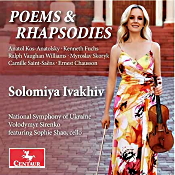
Poems & Rhapsodies
Saint-Saëns: La muse et le poète, Op. 132; Chausson: Poème symphonique, Op. 25; Vaughan Williams: The Lark Ascending; Anatoly Kos-Anatolsky: Poem for Violin and Orchestra in D Minor; Kenneth Fuchs: American Rhapsody (Romance for Violin and Orchestra); Myroslav Skoryk: Carpathian Rhapsody. Solomiya Ivakhiv, violin (all tracks); Sophie Shao, cello (Saint-Saëns); Volodomyr Sirenko, National Symphony Orchestra of Ukraine. Centaur CRC 3799.

On the morning that I discovered that the long-feared invasion of Ukraine by Russian forces had finally begun, I was so upset by the news that my immediate reaction was to find something to do to take my mind off the conflict. After a few brief moments of indecision, it suddenly hit me that the best thing to do would be to switch into reviewing mode: pop a CD into the player, settle down in the listening chair, do some serious listening, take some notes, and forget about the war in Ukraine, at least for a while. So, of course, the first CD I found waiting for me to audition was this one: Ukrainian musicians recording in Kyiv. Now I was pretty much just an emotional wreck, not fit for much of anything except a shower and then some calming conversation with my wife. Only then could I get back to life, the universe, and everything, including that ominous pile of what seem to be at least 42 CDs awaiting review, starting with this one.

The program is a mix of the familiar (The Lark Ascending, Poème symphonique), the relatively unfamiliar (American Rhapsody, La muse et le poète), and the truly unfamiliar (Poem for Violin and Orchestra,  Carpathian Rhapsody). A common thread among them is that they are all lyrically beautiful; moreover, they are presented with both skill and feeling by the assembled performers. At first I had some reservations about seeing The Lark Ascending in the list of titles (come on, Centaur, did we REALLY need yet another recording of RVW’s lovely piece to add to the umpteendiddlymillion already on the market), but this is a perfectly fine version that fits right in with the rest of the program and in the end I was grateful that it was included. (And, yes, Centaur, I guess we did, so thanks!). From beginning to end, this is just a splendid disc, starting with the interplay among violin, cello, and orchestra in the Saint-Saëns, which is just a lovely composition by that French master who seem to be so sadly underrated these days (and  I must confess that listening to Ivakhiv and Shao wend their way through La muse et le poète have brought me to the brink of repentance of that very sin –I shall be embarking on a Saint-Saëns spree post haste) all the way through the newly unearthed Carpathian Rhapsody by Myroslav Skoryk, a composer whose name is doubtless unfamiliar top all but a very few.

I also had wondered why the University of Connecticut had been involved in the recording; as it turns out, the featured violinist, Ukrainian-born Solomiya Ivakhiv, along with cellist Sophie Chao and composer Kenneth Fuchs, are all UConn faculty members. Along with Volodomyr Sirenko, National Symphony Orchestra of Ukraine, they recorded this program back in July, 2019, in Kyiv, but because of the COVID-19 pandemic, the recording was not released until late in 2021. The engineering is excellent, the liner notes give some background on both the music and the performers, and this is an excellent release all the way around. In addition, it is most generously filled, timing out at more than 78 minutes. I hope and pray for the safety of the members of the Ukrainian musicians and their families during this horrific ordeal,

Francesco Tristano: On Early Music
Tristano: Toccata; On Bull Galliard in D; Peter Philips:  Fantasia in D Minor; Tristano: Serpentina; John Bull: Let ons met herten reijne; Tristano: On Girolamo Frescobaldi's Quattro correnti; Girolamo Frescobaldi: Partita sopra l’Aria la folia; Tristano; Ritornello; On Cristobal de Morales Circumdederunt Me; Orlando Gibbons: Pavan; Air & Alman; Italian Ground; Ground; Tristano: Ciacona seconda; Frescobaldi:  Cento partite sopra passacaglie; Tristano: Aria for RS. Francesco Tristano, piano. Sony Classical 19439917392.

As I do with most recordings that I review, I start by listening. Yes, I look at the CD package front and back to see what I can glean about the musical program and the performer(s), but other than to extract the CD so I can pop it into one of my CD players, I try to avoid reading any of the information contained within. In this case, however, being completely unfamiliar with pianist Francesco Tristano,  and given that the scandalously skimpy liner insert (one sheet: the cover photo with brief notes on the reverse. Th-th-that’s all, folks), I had to turn to Wikipedia for more information to find that Francesco Tristano is the stage name of Luxembourg-born Franscesco Tristano Schlimé (b. 1981), who composes both classical and electronic music and also plays the clarinet. He is a Julilliard graduate who has gone on to study keyboard with Emile Naoumoff, Rosalyn Tureck, and Mikhail Pletnev. Well, that confirmed several things I had suspected from listening to the CD several times. First, that Tristano had some serious chops, along with a serious regard for and interest in early music. Also, that he must have some experience in the electronic manipulation of sound, of what could be done in a studio.

The musical program consists of Tristano originals written in the style of early music masters, Tristano’s “takes” on pieces by some of these masters, along with some more straightforward interpretations of their music. Although there is some variation in style and sonority, largely due to studio manipulation of the sonics and some generally subtle although occasionally surprising electronic effects, Tristano’s musical vision is coherent from beginning to end. Highlights include the persuasive dance rhythms Tristano creates in track 6, On Girolamo Frescobaldi's Quattro correnti, the mysterious but energetic atmosphere created by track 8, Ritornello, the stately elegance of Orlando Gibbons’s Italian Ground, and some of the surprising, presumably deeply personal sounds that Tristano has included in his closing track, Aria for RS, which is at times jolting, but only briefly, set against a backdrop of deep tenderness, a moving end to an musical program that was clearly labor of love.

The sonic perspective is very close to the piano. On the opening cut, for example, you can hear every little (and big!) sound of the Yamaha cfx. As the album continues, with its expanding sonic palette of acoustic sounds and electronic colorations, the engineering is up to the task of presenting every sonic hue and cue. I’ve not yet tried it on headphones but imagine it would be quite the experience… In any event, my only quibble with this truly remarkable release is the liner insert, which put me in a John McEnroe “You cannot be serious!” frame of mind. C’mon, Sony, surely you can do better than this! Or was this what Tristano wanted? In any event, the lack of any useful information about the music is a real disappointment.

I was going to hold off and include this review in my next installment of Piano Potpourri, but despite my reservation about the liner notes, this release is so musically appealing that I want to get the word out as quickly as possible. If you enjoy piano music – especially if you are a fan of Early/Baroque keyboard music – then this is a release you really ought to consider giving an audition. It’s a knockout both musically and sonically.

Saint-Georges: Symphonies concertantes
Symphonies conertantes, Op. 9; Symphonies concertantes, Op. 10*; Symphony in G major, Op. 11, No. 1. Yuri Revich, solo violin I; Libor Jezek, Solo violin II; *Pavla Honsová, solo viola; Michael Halász, Czech Chamber Philharmonic Orchestra Pardubice. Naxos 8.574306.

This CD is one of those that I picked up at the library on a whim. Although the music was not from an era that I usually gravitate toward, there were several things about the cover that grabbed my attention. First was the name of this composer, printed on the cover as “Joseph Boulogne, Chevalier de SAINT-GEORGES.” Quite a moniker, that. Then there was the cover portrait of a distinguished-looking Saint-Georges (1745-1799) holding what I at first glance took to be a conductor’s baton but then quickly realized was not a baton but rather a sword. I also noted that the picture of Saint-Georges revealed a man with large shoulders, arms, and hands, a dignified, confident countenance, and most likely some African ancestry. Flipping over the cover I quickly read that he was “a brilliant swordsman, athlete, violin virtuoso and gifted composer, with a claim to being the most talented figure in an age of remarkable individuals. He was an early exponent of the hybrid symphonie concertante – a genre that draws on both the symphony and concerto traditions ”    

Having discussed the composer (but more on him to come), it is time to consider his music as recorded here by these Czech musicians. It is fresh, lively, and vigorous. The two Symphonies Concertantes both feature prominent roles for the solo instruments, violins in Op. 9 and the violins being joined by a viola in Op. 10. Note that “Concertantes” is plural: both Op. 9 and Op. 10 consist of two parts. Op.9 No. 1 in C major has an Allegro and a Rondeau, as does No. 2, which is A major. Op. 10. No. 1 in F major varies the pattern by having two Allegros, but No. 2 in A major returns to the Allegro then Rondeau form. Both works are reminiscent of Mozart, and both sound as though they must have been fun for the musicians both in 18th century Paris as well as 21st century Pardubice. The program concludes with the brief Symphony in G major, which is three movements, each barely over four minutes long. Although it hardly strikes modern ears as weighty or profound, that is not what it was meant to be; it was meant to be entertaining and pleasant, and that it is in abundance.

Having greatly enjoyed the music on this release as well as the biographical information included in the liner notes, I decided to do a bit of quick research, so I turned to Wikipedia, where I found quite a wealth of information. Should anyone be interested, the entry on Chevalier de Saint-Georges is quite fascinating, but for  the sake of brevity, I will quote just a few sentences form Wikipedia’s account: Saint Georges “was a Guadeloupean Creole classical composer, virtuoso violinist, a conductor of the leading symphony orchestra in Paris, and a renowned champion fencer. Born in the then French colony of Guadeloupe, he was the son of Georges de Bologne Saint-Georges, a wealthy married planter, and Anne, dite (called) Nanon, an African slave woman of his wife. When he was young, his father took him to France, where he was educated. During the French Revolution, the younger Saint-Georges served as a colonel of the Légion St.-Georges, the first all-black regiment in Europe, fighting on the side of the Republic. Today the Chevalier de Saint-Georges is best remembered as the first known classical composer of African ancestry. He composed numerous string quartets and other instrumental pieces, Violin concertos as well as operas. He knew many composers including Salieri, Gossec, Gretry, Gluck and Mozart.” A remarkable man, about whom I must confess I was completely ignorant until that chance encounter with this Naxos CD in my public library. I now recommend that CD with enthusiasm to those who would like to learn more about the remarkable man and his enjoyable music.

KWN

May 19, 2021

Recent New Releases (CD mini-reviews)

By Karl W. Nehring

Hilary Hahn: Paris
Chausson: Poème; Prokofiev: Concerto for Violin and Orchestra No. 1; Rautavaara: Deux Sérénades. Hilary Hahn, violin; Mikko Franck, Orchestre Philharmonique de Radio France. Deutsche Grammophon  483 9847.

This new release from the talented American violinist Hilary Hahn is a delight from start to finish. Although the album title and orchestra might lead you to assume a program featuring all French composers, that is not the case here, for in addition to the French composer Ernest Chausson (1855-1899) we have also music by the Russian composer Sergei Prokofiev (1891-1953) and the Finnish composer Einojuhani Rautavaara (1928-2016). Hahn reveals her deep affection for and kinship with the City of Light in an essay in which she explains that in addition to her many other connections with Paris, her violin was made in Paris way back in 1865 by a famed luthier whose shop has in the 21st century been replaced by a convenience store. On a brighter note, she also reveals that she had long desired to record the Prokofiev, one of her favorite and most-performed pieces, but was waiting for the right combination of time, place, orchestra, and conductor, which she realized in Paris with Franck and the OPRF in June of 2019. The end result is truly lovely, well worth the wait both for her and for us. Those who might associate Prokofiev with spiky, boisterous music would do well to listen to this performance of his Violin Concerto No. 1, which is lyrical, lively, and lovely. Hahn describes the Chausson Poème with which she opens the program as “raw, lush, heartbreakingly beautiful… it takes my breath away.” Although I have in the past owned recordings of this piece, and enjoyed them, I had not heard the piece in many years until I auditioned this new recording, and yes, I found it to be much as she described. It truly is a marvelous work, well worth seeking out if you have not yet encountered it. The background story behind the Deux Sérénades by Rautavaara that complete this release is told in the liner notes, a tale that I will not relate here but will rather leave for those who might be interested to seek out for themselves. The music is quite enjoyable, but in truth, does not quite sound complete, which a reading of the liner notes will explain. All in all, Paris is a heartfelt and satisfying release from some consummate musicians.

Parallels: Shellac Reworks by Christian Löffler
Wagner: Parsifal: Closing Scene (Arr. for Orchestra). Max von Schillings, Staatskapelle Berlin (1926-27); Smetana: The Moldau (excerpt). Erich Kleiber, Staatskapelle Berlin (1928); J.S. Bach: Dir, dir Jehova, will ich singen BWV 452. Karl Straube, Thomanerchor Leipzig; Helmut Walcha, organ (1927); J.S. Bach: Gavotte from English Suite No. 6, BWV 811. Alfred Grunfeld, piano (1911); Chopin: Nocturne No. 2 in E flat Major Op. 9 No. 2 (arr. De Sarasate). Charles Cerne, piano; Vasa Prihoda, violin (1929); Bizet: Nadir’s Aria from Les pecheurs des perles. Koloman von Pataky, tenor; unknown orchestra (1928); excerpts from four works by Beethoven: Symphony No. 6. Hans Pfitzner, Staatskapelle Berlin (1930); Symphony No. 5, 2. Satz. Richard Strauss, Staatskapelle Berlin (1928); Egmont Overture. Otto Klemperer, Staatskapelle Berlin (1927); Symphony No. 3, 2. Marcia funebre. Hans Pfitzner, Berliner Philharmoniker (1929). Christian Löffler, electronics. Deutsche Grammophon 4839660.

This is a recording that truly blends the old and the new. Deutsche Grammophon has one of the oldest sound archives in the world, having taken great care to store their recorded material ever since the label’s foundation in 1898. Shellac discs (78s) that held about four minutes of music per side were the dominant recording format until the 1940s. A number of these historic recordings have now been digitized and restored, and DG recently teamed with German DJ and producer Christian Löffler, who hand-picked from this collection of digitized shellac recordings a set for modern reworking. Löffler is a self-taught musician whose productions combine elements of dancefloor techno and ambient electronica. He says that his music “is often described as nostalgic, it’s just part of my musical world. Sad music – if you want to call it that – has always been more appealing to me than happy music… I’m quite nerdy when it comes to trendy music production techniques. I’m very forward thinking and always interested in new technologies. But many of my trademark sounds come from vintage synthesizers and old effects devices. I’m just trying to catch the best of any time period to get the best possible result. My aspiration with this project was to handle the music with all due respect. That is something I always do when I work with other people’s music, be it a remix or collaboration. My aim for Parallels was to bring the soul of my own music into these original pieces. I also wanted to keep some parts of the original music almost untouched, to give the listener a better understanding of the original material in the context of its new ‘home’.” Yes, his description sounds a bit bizarre, but the end result is fascinating, hypnotic, and haunting. Electronic sounds, acoustic sounds, voices from nearly a century ago rising from the mix -- this is a recording that can be enjoyed both in casual and concentrated listening modes.

Refraction
Alexander Woods, violin; Rex Woods, piano; Aubrey Smith Woods, violin. MSR Classics MS 1689.

As you might guess from the names of the performers, this album of music for violin is a family affair, presented by violinist Alexander Woods along with his pianist father, Rex Woods, and his violinist wife, Aubrey Smith Woods. (Perhaps I am being overly sensitive, but I did find it rather odd that on both the front and back covers the three names are printed in three distinctly rank-ordered font styles: ALEXANDER WOODS, REX WOODS, Aubrey Smith Woods. Hmmmm…)  The four composers are a mix of the familiar and unfamiliar: Dvorak, Asplund, Mozart, and Thorndock. As the liner notes explain, “although the violin itself has remained virtually unchanged for centuries, music composed for the instrument has undergone numerous and vivid transformations, shaped and developed by varied circumstances, styles and innovations. Like a light beam passing through a prism. Works written for the violin have, over time, refracted into a broad stylistic array of vibrant compositional perspectives. This album mingles canonic violin works from the past with recent compositions that explore this variegated play, engaging with the rich history of violin music and performance through myriad lenses.” The album opens with Four Romantic Pieces from Dvorak for violin and piano, which are played here most romantically and enjoyably, a fine way to start the program. Unfortunately, the next composition, One Eternal Round for two violins by Canadian-American composer Christian Asplund (b. 1964), does not fall nearly as naturally on the ear as the others included in this set. Although it is not aggressively harsh or dissonant as some contemporary music can be, to these ears at least, it simply lacked any real appeal. YMMV. But then the players move back to familiar ground with Mozart’s Violin Sonata No. 26, a refreshing drink of cool, clear water after the dryness of the Asplund. The final composition, A Crust of Azure by American composer Neil Thorndock (b. 1977), is said in the liner notes to be “influenced by the impression of music coming down from the sky, ringing like reverberations from a bell tower. The evocative movement titles [I. Tremulous Whirl, II. Refraction of Sky, III. Lavender Shroud] allude to the atmospheric colors, light effects and sensations that descend from the sky’s ‘crust of azure.’”  It truly is a colorful piece, lively and imaginative, well worth an audition for fans of the violin who are seeking interesting new repertoire. With excellent engineering and helpful liner notes, MSR Classics has done a first-class job with this release.    

Max Richter: Voices 2
Max Richter, piano, keyboards, organ, synthesizer; Mari Samuelsson, solo violin; Ian Burdge, solo cello; Camilla Pay, harp; Robert Ziegler, conductor; Tenebrae Choir; various sopranos and altos plus a number of violin, viola, cello, and double bass players. Decca B00332480-02.

Although 
Richter’s previous release, Voices (reviewed ) spotlighted the Universal Declaration of Human Rights, including spoken recitations of the text, Voices 2 is exclusively musical, with no textual recitations. According to Richter, Voices 2 “opens up a meditative instrumental musical space to consider the ideas raised by the first record. The music is less about the world we know already and more about the hope for the future we have yet to write.” Those familiar with Richter’s music will know what to expect: music that is on the one hand relatively simple and straightforward in terms of its melodic, harmonic, and rhythmic construction, yet on the other hand, rich and evocative in terms of its instrumentation, sonority, and emotional resonance. There are some striking sounds to be heard from Richter’s various keyboard instruments both acoustic and electronic, plus some particularly notable musical contributions by Mari Samuelsson on violin and Ian Burdge on cello. And no, you need not have listened to Voices to enjoy its successor, which is quite enjoyable on its own terms. 

Lento Religioso
Berg: Piano Sonata op. 1 (arr. Wijnand van Klaveren); Korngold: Lento Religioso from Symphonic Serenade; Bruckner; Adagio from String Quintet; Bridge: Lament for string orchestra (for Catherine, aged 9, “Lusitania” 1915); Lekeu: Adagio pour quatuor d’orchestre; Wagner: Prelude from Tristan und Isolde; Strauss; Prelude from Capriccio. Candida Thompson, Amsterdam Sinfonietta. Channel Classics CCS 36620.

As a glance at the titles of the works included in this generously filled (77:41) disc should suggest, this release features music from the more serious, somber pages of the classical music catalog. That is not to say, however, that listening to it is an emotional downer, as this is music of great depth and exquisite beauty, played with sensitivity by this relatively small string orchestra. Some of the selections are scaled down (e.g., the Wagner), some are scaled up (e.g., the Berg and the Bruckner), and some were originally intended for an ensemble of about this size. The engineering is first-rate, with clean string tone and a believable soundfield. All in all, an interesting program of some works a bit off the beaten path that should be especially appealing to those who appreciate music of a serious, reflective, but nonetheless aesthetically engaging nature.

Lindberg: The Waves of Wollongong
Also, Liverpool Lullabies; 2017. The New Trombone Collective; Evelyn Glennie, percussion; Christian Lindberg, trombone and conductor, Antwerp Symphony Orchestra. BIS-2148 SACD.

If I had to come up with a one-word description of this release by the Swedish composer, trombonist, and conductor Christian Lindberg (b. 1958) it would be “robust.” Or maybe “outgoing.” Or possibly even “swaggering.” It most certainly would not be “reticent” or “tentative.” The opening piece, The Waves of Wollongong (the title refers to waves the composer had experienced in Wollongong, Australia) features the nine trombones (three each alto, tenor, and bass) of The New Trombone Collective making mighty waves of sound along with the orchestra, while the second piece, Liverpool Lullabies, seems hardly the sort of music to little ones to sleep as Lindberg on trombone and the amazing Ms. Glennie on percussion give off plenty of sparks with their energetic playing. The final piece, 2017, was composed by Lindberg during that turbulent, discouraging, frightening year as a reaction to the 2016 U.S. presidential election and its disturbing aftermath, and is dedicated to the journalist Rachel Maddow. Needless to say, it is not a cheerful piece, but it is musically engaging. As per their usual standard, the BIS engineering team has captured this robust music in robust, dynamic, swaggering sound that will tickle your tweeters and waggle your woofers.

Vaughan Williams: Symphonies Nos. 4 and 6
Sir Antonio Pappano, London Symphony Orchestra. LSO Live SACD LSO0867.

Vaughan Williams may well be the most underrated symphonic composer. For my money, his nine rank right up there with the best, and when it comes to the heart of his symphonic output, Symphonies Nos. 3, 4, 5, and 6, I can’t think of any composer whose 4-6 I would rate above RVW’s – not Mahler, not Bruckner, not Sibelius, and no, not even the immortal Beethoven. Of those four RVW symphonies, the odd-numbered are primarily lyrical and peaceful, while the two even-numbered symphonies, especially No.4, are much more brash and assertive. Pappano and the LSO hold nothing back, with the opening notes of No. 4 bursting forth with startling ferocity. This bold beginning sets the tone for the entire disc, which presents both symphonies forcefully and energetically. My only quibble is with some harshness in the upper strings; to be honest, I am not sure how much is the engineering or how much can be attributed to the vigor of the performance. My first choice in both symphonies has been the Slatkin recordings from his RCA boxed set (now distributed by Sony Music at a bargain price), but for those looking for a single disc of these two remarkable 20th century masterpieces, this new release from Pappano and the LSO is a top choice. Highly recommended.

KWN

Apr 5, 2020

Incantation (CD review)

Music of Bruch, Vitali, Saint-Saens, Tchaikovsky, Bloch, Chausson, and Umebayashi. Virgil Boutellis-Taft, violin; Jac Van Steen, Royal Philharmonic Orchestra. Aparte Music AP234.

Nobody tells me anything.

I learn about thousands of classical CD titles and listen to hundreds of classical recordings every year, but I still don't know who all the rising young classical artists are in the world. Take, for example, French violinist Virgil Boutellis-Taft. His biography reads, "Hailed by critics as an 'outstanding violinist,' 'of fiery temperament,' with 'intense, brilliant, sumptuous sound' and 'impressive virtuosity,' Virgil Boutellis-Taft performs as soloist and chamber musician in major international concert halls." From Wikipedia we learn that he "began studying violin and piano at the age of 6...and gave his first concerts at the age of 9."

Incantation is Boutellis-Taft's second record album, taking its title from the word meaning "the chanting or uttering of words purporting to have magical power; the formula employed; a spell or charm," according to Dictionary.com. The accompanying booklet notes that "'Incantation,' from the Latin word incantare, ranges in meaning from ordinary singing that is 'enchanting' to music in a religious context with a ritual function, as in Gregorian plainchant, then to the unsettling use of magic or demonic spells or charms." Apparently, Mr. Boutellis-Taft in this album is going for the "spiritual, magical, mesmerizing aspects of incantation."

I would have preferred he had just said, "Here are a few of my favorite short violin pieces that let me display my fiery temperament, brilliant sound, and impressive virtuosity." Whatever, the following is a list of what's on the album:

1. "Kol Nidrei" by Max Bruch
2. "Chaccone in G minor" by Tomaso Antonio Vitali
3. "Danse macabre" by Camile Saint-Saens
4. "Serenade melancolique" by Peter Tchaikovsky
5. "Nigun" by Ernest Bloch
6. "Poeme for violin and orchestra" by Ernest Chausson
7. "Yumeji's Theme" by Shigeru Umebayashi

Virgil Boutellis-Taft
The opening number, Kol Nidrei ("All Vows"), which German composer Max Bruch (1838-1920) wrote in 1880 is a good example of "incantation." It's a series of variations on mostly Jewish liturgical themes. It has a beautifully lyrical character, and Boutellis-Taft invests it with much personality. The piece is a plaintive expression of religious themes, originally intended for cello but here transcribed for violin. In addition, Boutellis-Taft has elected to omit the middle section, which gets a bit flowery Romantic, and instead repeats the central theme in keeping with the Jewish service it represents. The soloist creates a refreshing new look at an old favorite.

And so it goes, with Boutellis-Taft endowing each work with much expressive distinction and beauty. The Chaconne in G minor, ascribed to Italian composer and violist Tomaso Vitali (1663-1745), continues in that vein, making an almost seamless segue from the Bruch piece. Boutellis-Taft's playing is fluid, effortless, and eloquent, and the Royal Philharmonic's accompaniment sounds as rich as ever.

The Danse macabre (1874) by French composer Camille Saint-Saens (1835-1921) may seem like a giant leap from the preceding two more contemplative pieces, but, in fact, Boutellis-Taft makes the leap with consummate ease, taking the work a little less demonically than some interpreters do and filling it with much poetic beauty. I would note here, too, that Boutellis-Taft uses a new violin-and-orchestra rendering of the piece, not Saint-Saens's original orchestral version.

My own favorite among the seven selections was the Poeme pour violin et orchestre by French composer Ernest Chausson (1855-1899). Boutellis-Taft brings out all the exotic color of the work without resorting to any hint of over sentimentalizing or romanticizing. It's quite lovely.

Incantation lives up to its name, manifesting much magic, mystery, beauty, enchantment, and angelic intensity thanks to Boutellis-Taft's heartfelt execution. He is a performer to be reckoned with, and I expect we will be hearing more good things from him from here on out.

Producers Hugo Scremin and Nicolas Bartholomee and engineer Francois Eckert recorded the music at Henry Wood Hall, London in July 2019. The sound is very clean, if a bit one-dimensional. Definition is precise, and the violin appears well integrated with the orchestra, not too far in front yet not overpowered by the orchestral forces. The frequency response is nicely balanced as well, although the highest treble and deepest bass seem a tad lacking. Nevertheless, most listeners should find it more than satisfactory. Ditto for the dynamic range and impact. Very cleanly executed.

JJP

To listen to a brief excerpt from this album, click below:

Jun 4, 2013

Bruch: Violin Concerto (SACD review)

Also Korngold: Violin Concerto; Chausson:  Poeme.  Arabella Steinbacher, violin; Lawrence Foster, Orquestra Gulbenkian. PentaTone PTC 5186 503.

Arabella Steinbacher, for those who don’t know, is a German classical violinist who has won several important international prizes, recorded over half a dozen albums, and was a student of the Anne-Sophie Mutter Foundation “Circle of Friends.” On the present disc she puts her talents to work playing violin works by Bruch, Korngold, and Chausson.

First up is the Violin Concerto in D, Op. 35, by Austrian composer, conductor, and pianist Erich Wolfgang Korngold (1897-1957). Korngold wrote it in 1945, at the end of World War II, because he had vowed years earlier to continue writing only film music (think of Captain Blood, The Adventures of Robin Hood, and The Sea Hawk) until the Allies defeated Hitler. When that happened, he turned to the Violin Concerto and further work in the classical field. Needless to say, the Concerto became a hit with the public, probably for its combination of Romantic lyricism and lush melodies, although many critics couldn’t help thinking it sounding too much like the composer’s film music and dismissed it out of hand.

From the outset we can see that Ms. Steinbacher is going to be doing an all-out Romantic reading of the music, if one that is clean and free of excessive virtuosic baggage. It’s an appropriate reading, given that Korngold used material from some of his more exotic movie scores, like Another Dawn, Anthony Adverse, Juarez, and The Prince and the Pauper in the first movement alone. Not all critics may not take it seriously, but Ms. Steinbacher does. She infuses the piece with an earnest emotion, excellent structure, and superb craftsmanship that not even the copious eruptions of obvious cinematic references can diminish. Her violin tone is sweet and fluid, like the music, and the violin shimmers with delight in every phrase.

Next up is the little Poeme for Violin and Orchestra, Op. 25, by the French composer Ernest Chausson (1855-1899), a work he completed in 1896 and has since become one of his most-famous pieces of music. Almost every notable violinist of the past century has recorded it, so Ms. Steinbacher had her work cut out for her. Fortunately, the music sounds lovely in her hands, if not quite so emotionally charged as Perlman’s (EMI), which remains my favorite in this work. Nevertheless, Steinbacher brings a longing melancholy to the music and emphasizes the dark, brooding aspects of the Russian story Chausson used as a model for the piece.

The program concludes with the Violin Concerto No. 1 in G minor, Op. 26, by the German composer and conductor Max Bruch (1838-1920). He premiered his revised version in 1867, and it has since become one of the staples of the violin repertoire. It has a curious first movement, a Vorspiel (or Prelude) leading directly to the second movement. This Vorspiel is like a slow march, with some ornamental flourishes along the way. It is here that Ms. Steinbacher is especially at home with the overt Romanticism of the score. While she may not exude the dramatic intensity we find in Heifetz’s classic recording (RCA), she does convey a warm, rapturous feeling as the opening music builds to its conclusion.

The second-movement Adagio is beautifully melodious and forms the core of the work. Here we find a series of broadly sweeping themes, with the violin aided by a graceful orchestral accompaniment. In this section, Ms. Steinbacher takes a backseat to no one, the notes flowing lusciously from her violin in endless delight.

The Finale begins quietly until the violin opens up with a vivacious theme in the form of a dance, which along with its lyricism reminds us of its Romantic origins, and finishes in a grand climax. Ms. Steinbacher plays it in a thoroughly charming and sprightly fashion and closes things on a befittingly sunny note. For lovers of multichannel sound in particular, Ms. Steinbacher’s SACD presentation seems an easy recommendation.

The recording date was July, 2012, and the venue the Grande Auditorio of the Calouste Gulbenkian Foundation, Lisbon, Portugal. Although there is nothing spectacular about the two-channel SACD stereo mode of this hybrid disc (to which I listened), it is pleasantly natural and truthful. The violin sounds almost perfectly integrated with the orchestra, for example, not too far in front of it, not too recessed, and it appears most realistic in its tone. The orchestral sonics are also good:  ultrasmooth, slightly warm, nicely balanced, and lightly resonant. Orchestral depth is adequate, and left-to-right stereo spread is commendable, with the frequency extremes and dynamic impact modest yet comfortably lifelike.

To listen to a brief excerpt from this album, click here:

JJP

Meet the Staff

Meet the Staff
John J. Puccio, Founder and Contributor

Understand, I'm just an everyday guy reacting to something I love. And I've been doing it for a very long time, my appreciation for classical music starting with the musical excerpts on the Big Jon and Sparkie radio show in the early Fifties and the purchase of my first recording, The 101 Strings Play the Classics, around 1956. In the late Sixties I began teaching high school English and Film Studies as well as becoming interested in hi-fi, my audio ambitions graduating me from a pair of AR-3 speakers to the Fulton J's recommended by The Stereophile's J. Gordon Holt. In the early Seventies, I began writing for a number of audio magazines, including Audio Excellence, Audio Forum, The Boston Audio Society Speaker, The American Record Guide, and from 1976 until 2008, The $ensible Sound, for which I served as Classical Music Editor.

Today, I'm retired from teaching and use a pair of bi-amped VMPS RM40s loudspeakers for my listening. In addition to writing for the Classical Candor blog, I served as the Movie Review Editor for the Web site Movie Metropolis (formerly DVDTown) from 1997-2013. Music and movies. Life couldn't be better.

Karl Nehring, Editor and Contributor

For nearly 30 years I was the editor of The $ensible Sound magazine and a regular contributor to both its equipment and recordings review pages. I would not presume to present myself as some sort of expert on music, but I have a deep love for and appreciation of many types of music, "classical" especially, and have listened to thousands of recordings over the years, many of which still line the walls of my listening room (and occasionally spill onto the furniture and floor, much to the chagrin of my long-suffering wife). I have always taken the approach as a reviewer that what I am trying to do is simply to point out to readers that I have come across a recording that I have found of interest, a recording that I think they might appreciate my having pointed out to them. I suppose that sounds a bit simple-minded, but I know I appreciate reading reviews by others that do the same for me — point out recordings that they think I might enjoy.

For readers who might be wondering about what kind of system I am using to do my listening, I should probably point out that I do a LOT of music listening and employ a variety of means to do so in a variety of environments, as I would imagine many music lovers also do. Starting at the more grandiose end of the scale, the system in which I do my most serious listening comprises Marantz CD 6007 and Onkyo CD 7030 CD players, NAD C 658 streaming preamp/DAC, Legacy Audio PowerBloc2 amplifier, and a pair of Legacy Audio Focus SE loudspeakers. I occasionally do some listening through pair of Sennheiser 560S headphones. I miss the excellent ELS Studio sound system in our 2016 Acura RDX (now my wife's daily driver) on which I had ripped more than a hundred favorite CDs to the hard drive, so now when driving my 2024 Honda CRV Sport L Hybrid, I stream music from my phone through its adequate but hardly outstanding factory system. For more casual listening at home when I am not in my listening room, I often stream music through a Roku Streambar Pro system (soundbar plus four surround speakers and a 10" sealed subwoofer) that has surprisingly nice sound for such a diminutive physical presence and reasonable price. Finally, at the least grandiose end of the scale, I have an Ultimate Ears Wonderboom II Bluetooth speaker and a pair of Google Pro Earbuds for those occasions where I am somewhere by myself without a sound system but in desperate need of a musical fix. I just can’t imagine life without music and I am humbly grateful for the technologies that enable us to enjoy it in so many wonderful ways.

William (Bill) Heck, Webmaster and Contributor

Among my early childhood memories are those of listening to my mother playing records (some even 78 rpm ones!) of both classical music and jazz tunes. I suppose that her love of music was transmitted genetically, and my interest was sustained by years of playing in rock bands – until I realized that this was no way to make a living. The interest in classical music was rekindled in grad school when the university FM station serving as background music for studying happened to play the Brahms First Symphony. As the work came to an end, it struck me forcibly that this was the most beautiful thing I had ever heard, and from that point on, I never looked back. This revelation was to the detriment of my studies, as I subsequently spent way too much time simply listening, but music has remained a significant part of my life. These days, although I still can tell a trumpet from a bassoon and a quarter note from a treble clef, I have to admit that I remain a nonexpert. But I do love music in general and classical music in particular, and I enjoy sharing both information and opinions about it.

The audiophile bug bit about the same time that I returned to classical music. I’ve gone through plenty of equipment, brands from Audio Research to Yamaha, and the best of it has opened new audio insights. Along the way, I reviewed components, and occasionally recordings, for The $ensible Sound magazine. Most recently I’ve moved to my “ultimate system” consisting of a BlueSound Node streamer, an ancient Toshiba multi-format disk player serving as a CD transport, Legacy Wavelet II DAC/preamp/crossover, dual Legacy PowerBloc2 amps, and Legacy Signature SE speakers (biamped), all connected with decently made, no-frills cables. With the arrival of CD and higher resolution streaming, that is now the source for most of my listening.

Ryan Ross, Contributor

I started listening to and studying classical music in earnest nearly three decades ago. This interest grew naturally out of my training as a pianist. I am now a musicologist by profession, specializing in British and other symphonic music of the 19th and 20th centuries. My scholarly work has been published in major music journals, as well as in other outlets. Current research focuses include twentieth-century symphonic historiography, and the music of Jean Sibelius, Ralph Vaughan Williams, and Malcolm Arnold.

I am honored to contribute writings to Classical Candor. In an age where the classical recording industry is being subjected to such profound pressures and changes, it is more important than ever for those of us steeped in this cultural tradition to continue to foster its love and exposure. I hope that my readers can find value, no matter how modest, in what I offer here.


Bryan Geyer, Technical Analyst

I initially embraced classical music in 1954 when I mistuned my car radio and heard the Heifetz recording of Mendelssohn's Violin Concerto. That inspired me to board the new "hi-fi" DIY bandwagon. In 1957 I joined one of the pioneer semiconductor makers and spent the next 32 years marketing transistors and microcircuits to military contractors. Home audio DIY projects remained a personal passion until 1989 when we created our own new photography equipment company. I later (2012) revived my interest in two channel audio when we "downsized" our life and determined that mini-monitors + paired subwoofers were a great way to mate fine music with the space constraints of condo living.

Visitors that view my technical papers on this site may wonder why they appear here, rather than on a site that features audio equipment reviews. My reason is that I tried the latter, and prefer to publish for people who actually want to listen to music; not to equipment. My focus is in describing what's technically beneficial to assure that the sound of the system will accurately replicate the source input signal (i. e. exhibit high accuracy) without inordinate cost and complexity. Conversely, most of the audiophiles of today strive to achieve sound that's euphonic, i.e. be personally satisfying. In essence, audiophiles seek sound that's consistent with their desire; the music is simply a test signal.

Mission Statement

It is the goal of Classical Candor to promote the enjoyment of classical music. Other forms of music come and go--minuets, waltzes, ragtime, blues, jazz, bebop, country-western, rock-'n'-roll, heavy metal, rap, and the rest--but classical music has been around for hundreds of years and will continue to be around for hundreds more. It's no accident that every major city in the world has one or more symphony orchestras.

When I was young, I heard it said that only intellectuals could appreciate classical music, that it required dedicated concentration to appreciate. Nonsense. I'm no intellectual, and I've always loved classical music. Anyone who's ever seen and enjoyed Disney's Fantasia or a Looney Tunes cartoon playing Rossini's William Tell Overture or Liszt's Hungarian Rhapsody No. 2 can attest to the power and joy of classical music, and that's just about everybody.

So, if Classical Candor can expand one's awareness of classical music and bring more joy to one's life, more power to it. It's done its job. --John J. Puccio

Contact Information

Readers with polite, courteous, helpful letters may send them to classicalcandor@gmail.com

Readers with impolite, discourteous, bitchy, whining, complaining, nasty, mean-spirited, unhelpful letters may send them to classicalcandor@recycle.bin.

"Their Master's Voice" by Michael Sowa

"Their Master's Voice" by Michael Sowa