Showing posts with label Strauss.Richard. Show all posts

May 18, 2025

Two Box Sets and Two Sets in a Box (CD & Live Concert Reviews)

by Karl Nehring

Shostakovich: Symphonies-Concertos-Lady Macbeth. (CDs1-12) Symphonies 1-15; (CD 13) Incidental Music and Chamber Symphony; (CD 14) Piano Concertos Nos. 1 & 2; (CD 15) Violin Concertos Nos. 1 & 2; (CD 16) Cello Concertos Nos. 1 & 2; (CDs 17-19) Lady Macbeth of the Mtsensk District. Yuja Wang, piano; Baiba Skride, violin; Yo-Yo Ma, cello; Kristīne Opolais, soprano; Boston Symphony Orchestra; Andris Nelsons, conductor. Deutsche Grammophon 486 6849 


Back in 2015 the Boston Symphony Orchestra and its then newly appointed Music Director Andris Nelsons teamed up with Deutsche Grammophon and embarked on a project to record all 15 Shostakovich symphonies, starting with No. 10, which was reviewed soon after it release by our own John Puccio (you can find that review here). As the project continued, we reviewed a couple of the subsequent releases, including Nos. 4 & 11 in 2019 (review located here) and Nos. 1, 14. & 15 in 2021 (found here). Fast forward to 2025, which coincides with the 50th anniversary oh Shostakovich’s death, and DG has decided to gather all 15 symphony recordings into a box set – but wait, there’s more. In addition to the symphonies, we get the two piano concertos, two violin concerto, two cello concertos, a concert version of his opera Lady Macbeth of the Mtsensk District, and more. Nineteen discs in all, and no, we have not carefully auditioned them all. Too many discs, too little time. 

From our previous reviews, you will see that we were quite favorably impressed by their versions of Symphonies 10, 4, and 11, but less so by Nos. 1, 14, and 15. From this new set, our time spent listening to Wang’s performances of the piano concertos proved quite delightful (those performances have been released in a separate CD that Ryan Ross will be reviewing soon). We also gave a quick listen to Skride’s performances of the violin concertos and found them to be tenderly expressive but on the slow side – which may have added to the feeling of emotional resonance. Surely many listeners will already own favorite versions of several of these DSCH compositions; however, the outstanding playing of the BSO, the excellent sound quality, and the convenience of having all these works gathered into one collection combine to make this set an attractive collection for serious Shostakovich fans.


Lorin Maazel Conducts the Cleveland Orchestra: The Complete CBS Masterworks. (CD 1) Berlioz: Le carnaval romainH 95: Overture; Brahms: Academic Festival OvertureOp. 80; Barber: The School For ScandalOp. 5: Overture; Brahms: Symphony No. 1 in C Minor, Op. 68; (CD 2) R. Strauss: Ein Heldenleben, Op. 40; (CD 3) Beethoven: Symphony No. 1 in C Major, Op. 21Symphony No. 2 in D Major, Op. 36; (CD 4) Beethoven:Symphony No. 3 in E-Flat Major, Op. 55 "Eroica"; (CD 5) Beethoven: Symphony No. 4 in B-Flat Major, Op. 60Symphony No. 8 in F Major, Op. 93; (CD 6) Beethoven: Symphony No. 5 in C Minor, Op. 67Egmont Overture, Op. 84Leonore Overture No. 3, Op. 72; (CD 7) Beethoven: Symphony No. 6 in F Major, Op. 68 "Pastoral"; (CD 8) Beethoven: Symphony No. 7 in A Major, Op. 92Fidelio Overture, Op. 72; (CD 9) Beethoven: Symphony No. 9 in D Minor, Op. 125 "Choral"; (CD 10) Strauss: Don Juan, Op. 20Till Eulenspiegel's Merry Pranks, Op. 28Death and Transfiguration; (CD 11) Berlioz: Symphonie Fantastique, Op. 14; (CD 12) Serge Lama: Les P'tites Femmes de Pigalle; Chez Moi; Je t'aime à la folie; Je suis malade; L'esclave; La Chanteuse a vingt ans; La Salle de Bains; Ah!; L'enfant au piano; Femmes, Femmes, Femmes; L'enfant d'un autre; An old-fashioned Waltz; (CD 13) Tchaikovsky: Symphony No. 5 in E Minor, Op. 64; (CD 14) Tchaikovsky: Symphony No. 6 in B Minor, Op. 74 "Pathétique"; (CD 15) Tchaikovsky: Symphony No. 4 in F Minor, Op. 36. Cleveland Orchestra; Lorin Maazel, conductor. Sony Classical 19802819982


When music lovers talk of remarkable musical prodigies or notable conductors of the 20th century, how likely is Lorin Maazel (1930-2014) likely to be put forward as a candidate for consideration? Based on my experience at least, not very often, if at all. But Maazel’s story is a remarkable one: the man was a marvel. Maazel was born in Paris, but in 1932 his family moved to Los Angeles, where soon after they enrolled the youngster first in violin lessons and while still a young child, conducting lessons with the associate conductor of the Los Angeles Philharmonic. He was not yet 10 when he mounted the Pittsburgh Symphony’s podium and only 11 when he was invited by none other than Toscanini himself to conduct the NBC Symphony nationally broadcast concert.  By the time he reached 15, he was determined to get a university education and withdrew from conducting engagements to study languages and philosophy at the University of Pittsburgh – meanwhile also giving violin recitals and playing in the Pittsburgh SO and the Fine Arts Quartet. After graduation, a Fulbright Scholarship took him to Rome, and in 1953 he made his European debut, standing in for an indisposed conductor in Catania. By 1960 he had conducted some 300 concerts with more than 20 European orchestras and, aged 30, became the youngest conductor, the first American, and the first Jew since the fall of the Third Reich to appear at the Bayreuth Festival.

When music lovers talk of the Cleveland Orchestra, the conductor’s name that immediately pops up is that of George Szell (1897-1970), who led the orchestra from 1946 until his death in 1970. His name is still nearly synonymous with the orchestra; for example, Christoph von Dohnányi, who succeeded Maazel as Music Director in Cleveland, once quipped, “we give a great concert, and George Szell gets a great review.” But it was Maazel who faced the unenviable task of succeeding becoming Szell’s immediate successor, taking over as Music Director in 1972. Interestingly, although Maazel is sometimes thought of today as a bit stiff and literal in style, when he took over in Cleveland, there was grousing that his style was “too emotional” when compared to that of his legendary predecessor. For Maazel and/or Clevland Orchestra fans, this åcompetitive Beethoven symphony cycle and some fine Strauss. It also contains one of the stranger things I have heard in quite some time, Maazel’s own “symphonic realizations” of åviolin on a French TV show, Maazel hatched the idea of “lending Lama’s poetry a new, larger dimension.” Let’s just say it was not one of Maazel’s finest moments.


The booklet included in the box contains some background information on Maazel, some photographs, and reproductions of the original LP covers. For devoted Maazel fans, this box may well be an attractive package. 


Joel Ross’s Good Vibes (Joel Ross, vibraphone; Jeremy Corren, piano; Kanoa Mendenhall, bass; Maria Grand, tenor saxophone; Josh Johnson, alto saxophone; ​Jeremy Dutton, drums). Live set at the Performance Space in the Wexner Center for the Performing Arts at The Ohio State University, Columbus, OH. March 6, 2025.


The Performance Space at the Wexner Center at OSU offers a comfortable setting in which to enjoy a musical performance. In early March, the stage was occupied by the Chicago-born vibraphonist Joel Ross (b. 1995), who now operates out of Brooklyn, and his band, Good Vibes. Unlike many jazz vibes players, who use four mallets, two in each hand, Ross prefers to play with only one in each hand, because he says he does not want to dictate harmony. This manner of playing also lends clarity to his sound, putting the emphasis on melody and rhythm. This was evident as he began the set on his vibraphone, hammering out a solo. Ross had offered no spoken no introduction – neither of the band members, nor of the music; instead, the band walked on stage and Ross just started tapping on his vibes, playing for several minutes, establishing a pulse and a melody that was picked up by the rest of the group as they began to join in. 


What followed was an hour-long continuous stream of music. The music seemed to slowly mutate as it went along, with subtle shifts in tempo, melody, rhythm, and harmony. Phrases would appear, get passed around among the group, disappear, sometimes to reappear 10 or 15 minutes later in a subtly different form and tempo. From time to time there were solos; special mention must be made of the contributions of Maria Grand on tenor saxophone, who dazzled the crowd with a couple of incredible solos, especially when she explored the extreme treble range of which the instrument is capable. Overall, though, the most impressive thing about the show was seeing how these musicians could interact with each other over the span of an hour, delighting in the subtleties of musical creation and interaction. Although it features more structured tunes in a studio setting, Ross’s most recent album, nublues (Blue Note), is well worth a listen.


Joshua Redman Group (Joshua Redman, tenor saxophone; Gabrielle Cavassa, vocals; Paul Cornish, piano; Philip Norris, bass; Nazir Ebo, drums). Live set at the Performance Space in the Wexner Center for the Performing Arts at The Ohio State University, Columbus, OH. April 3, 2025.


In contrast to Joel Ross, who had barely interacted with the audience, saxophonist Joshua Redman (b. 1969) greeted the audience with enthusiasm and established an immediate rapport as he recalled previous shows in Columbus. Also in contrast to the Ross concert, which had been one continuous stream of music, Redman’s show was a set of tunes, many of them featuring vocals by the remarkable Gabrielle Cavassa, who offered powerful interpretations of such familiar standards such as By the Time I Get to PhoenixI Left My Heart in San Francisco, and Do You Know What It Means to Miss New Orleans?. Of course, there were also plenty of instrumental highlights along the way, with not only some blazing saxophone solos by Redman, of course, but also an energetic bass solo by Philip Norris that earned a rousing round of applause from the audience.


The group was on a tour showcasing their Blue Note album, Where Are We, which includes the tunes mentioned above. To close their live set, Cavassa sang another song from the album, Stars Fell on Alabama, after which Redman played an extended, impassioned solo on his saxophone that was simply heart-rending before the whole band joined in on John Coltrane's Alabama, capping off a night to remember. Redman has a new album coming out in June, Words Fall Short (Blue Note), that will include these musicians plus some guests, including the exciting young tenor saxophonist Melissa Aldana.

Sep 6, 2023

Richard Strauss: Also Sprach Zarathustra (Streaming review)

By Bill Heck

Richard Strauss: Also Sprach Zarathustra. Valdimir Jurowski, Rundfunk Sinfonieorchester Berlin. Pentatone

Back in the day, recordings of Strauss's sprawling tone poem, Also Sprach Zarathustra (hereinafter ASZ) were a favorite audiophile system test. Did the opening sustained bass note from the organ rattle the windows? Could the huge orchestral outbursts scare the cat? And let's not forget the tremendous boost in interest generated by the use of this music in Stanley Kubrick's classic film, 2001: A Space Odyssey. Often lost among those sorts of breathless queries were more mundane questions such as whether this was music worth hearing in the first place and, if so, what was the quality of the given performance?

Richard Strauss
These days, at least casual observation suggests that the music of Richard Strauss has dropped out of favor. I certainly don't recall seeing loads of new releases featuring his tone poems, especially this one. Perhaps our taste became more "sophisticated" as we concentrated on historically informed performances of the baroque and classical repertoire. (Surely even the most HIP-happy would not dream of applying its lessons to one of Strauss's tone poems!) But perhaps another reason was that classical music lovers just got tired of run-through performances designed for maximum sonic impact or lovely chords without much thought to capturing the expressiveness of the compositions, of treating them as serious music that should be played seriously.

That said, there’s certainly no shortage of recorded performances of ASZ, what with umpteen versions dating from the mid-1950’s onward. The best of these, from famous names such as Reiner and Karajan, reveal the glories of Strauss’s orchestration, often in remarkably good sound; Strauss fans surely had nothing to complain about. But – and I admit this only sheepishly, even though I know that I had a certain amount of company – some of us found even the most well-regarded recordings a little too much of a good thing. I (we) found ourselves losing focus halfway through, wandering off to attend to other chores before the final notes rang out, or perhaps even drifting off, although I (we) always blamed it on recent sleep deprivation rather than the music. At least for me, the result was that I had not listened to this work in many years.

Vladimir Jurowski
So I admit that I cranked up this performance from my streaming feed as a lark, not really expecting all that much, looking, I guess, for that little dose of audiophile oomph. But then something odd happened. I heard musicians playing as if they really meant it, a conductor bringing out moments of sheer beauty, not just for audio effect and not even just for the beauty alone, but as part of a unified narrative, the whole creating a musical experience that was not only impressive but was truly engaging.

I also heard one of the clearer recordings of an orchestra that has come through my system in some time. In my experience, an issue with orchestral recordings is that there is some level of congestion, making it difficult to hear all the details that would be apparent in the concert hall. Orchestral recordings also tend to overemphasize the violins and give them a steely tone. The Pentatone engineers have managed to overcome these problems. The smallest details emerge from the proverbial black (meaning silent) background, while the sound hangs together through the loudest climaxes. Add to that a nice wide stereo image and we have a winner.

It's all good, right? Well, I suppose that this version will not be everyone's cup of tea. What I hear, and appreciate, as keeping things moving and structured will strike some as lacking in emotion and not letting the music breathe. In fact, Jurowski does set some quickish tempo, especially right out of the gate: his opening prelude zips in at 1:22 instead of the more common two minutes or so. And yes, we could ask for more expansive views at certain points, such as in the Tanzlied (8th segment). But I appreciate the "let's get on with it" approach that helps to clarify the structure of the work (yes, there is some structure) and, frankly, keeps me awake. YMMV.

Moreover, I should add another cautionary note. The Rundfunk group plays well, but it just doesn't have quite the power of, say, its larger cousin in Berlin. That's not to say that the band sounds wimpy; this issue is evident only on direct comparison with performances by the truly big dogs. In any case, although I miss the last bit of orchestral might when I'm in comparative mode, if I just sit down to listen the sound is way more than adequate.

Finally, we need to clarify just what we have here in terms of a musical product. You’ll notice that the header says “Streaming review” and that, although the Pentatone label is given, there’s no catalog number. That’s because this release is not available as a physical product, but rather as a download directly from the Pentatone website, or as a stream, either from the Pentatone website or from a streaming service, e.g., Amazon, Apple, Idagio, Qobuz, etc. (Pentatone downloads are, in turn, available in “high Quality” – CD reolution– and two higher resolution versions.) Then again, if you really want a CD, the performance appears to be a re-release of one previously issued on a 2017 CD that also included two works by Mahler. That release included a useful booklet; the booklet is not included with the current streaming/download release. (However, the new release makes each movement a separate track; for some reason, the original CD did not.) The lack of a booklet is not because the streaming version couldn’t have one: my current streaming service (Qobuz) does provide PDF copies of booklets that accompany CDs when these are provided by the record label; in fact, I found booklets for every one of a quick sampling of ten or so recent Pentatone releases, meaning that the lack of a booklet in the current case is a Pentatone decision. I do wish that Pentatone had gone to the trouble of deleting unneeded pages from the booklet that accompanied that 2017 CD in order to give us something, but the lack of notes isn’t a dealbreaker.

Which brings us to a follow up question, not about Strauss, ASZ, Jurowski or the orchestra, but about the future of classical music recordings. When you think about it, the idea of releasing a given work, regardless of length, as one “thing” (download or stream) makes a lot of sense. Why couple, say, Strauss with Mahler other than to fill up a CD? OK, for recitals it might make sense, but couplings just for the sake of timing are, in the streaming/download world, a thoroughly obsolete notion. It’s a little premature to talk about this sort of thing now, as most labels are still issuing physical products and there still are music collectors buying CDs, not to mention LPs. But I wonder if, a few years from now, we’ll look back and laugh about the quaint idea of “filling a disk” with music just because the space was there to be used. I can only hope that when that day arrives, those often-excellent booklets will still accompany the music files.

And to return at long last to the release in question: if you are looking for a slightly different take on Strauss and ASZ, one that tightens up the sprawl, give this one a listen.

May 8, 2022

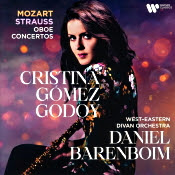
Mozart/Strauss: Oboe Concertos (CD review)

Cristina Gomez Godoy, oboe; Daniel Barenboim, West-Eastern Divan Orchestra. Warner Classics 0190295077600.

By John J. Puccio

It’s true the oboe takes something of a backseat when it comes to being the featured instrument in a concerto, but there have been a surprising number of such concertos since the introduction of the oboe in the mid seventeenth century. Composers like Albinoni, Bach, Handel, Scarlatti, Telemann, Vivaldi, Haydn, Mozart, Beethoven, Weber, R. Strauss, plus a perhaps surprising plethora of more-modern composers have all contributed to the genre. On the current disc, oboist Cristina Gomez Godoy, conductor Daniel Barenboim, and the West-Eastern Divan Orchestra offer two popular examples of their kind, one from Mozart and a later one from Richard Strauss.

First, though, a word about the performers. Ms. Godoy is a Spanish oboist who made her recital debut at Carnegie Hall, New York and Pierre Boulez Saal, Berlin in 2019. According to her Web site, “for the season 2020/21 she has been selected as ECHO Rising Star 2020/21 nominated by L’Auditori Barcelona, which will bring her to perform as a recitalist and chamber musician at the main European venues.” The present disc represents Ms. Godoy’s debut album for Warner Classics. Maestro Barenboim (b. 1943) hardly needs introduction. He is a concert pianist and conductor with citizenships in Argentina, Israel, Palestine, and Spain, with countless personal appearances and as many recordings. The West-Eastern Divan Orchestra is one that Barenboim and Edward Said founded in 1999 “to promote understanding between Israelis and Palestinians and pave the way for a peaceful and fair solution of the Arab–Israeli conflict.”

The first selection on the album is the earliest, the Oboe Concerto in C, K.314, written by a relatively young Mozart in 1777. Typical of the composer, it has an alert, bouncy style in the opening Allegro, a lovely Adagio, and a delightfully bouyant Rondo finale. This is met with some equally perky playing from Ms. Godoy and her partners. Mozart never seemed to run out of beguiling tunes, but if these particular melodies sound familiar, it’s because he used them again a year or so later in his Flute Concerto. Whatever, Ms. Godoy’s playing is sweet and light, charming throughout.

The second selection is the Concerto in D for Oboe and Small Orchestra, TrV 292, one of Richard Strauss’s last works, written in 1945. Now, you might think it odd to pair two such diverse composers as Mozart and Strauss on the same program, yet when you hear the two compositions for oboe side-by-side you can’t help hear the influence of the former on the latter. Of course, it’s  propitious that Ms. Godoy plays both of them with the same gentle, mellifluous touch. The honeyed charm of her instrument and the alluring fascination of her performances cannot help but persuade us like what she does.

Strauss may not have been in the modern fashion of the times with his throwback oboe concerto, but one cannot deny the appeal of Strauss’s Classical decisiveness and succinctness, along with the score’s Romantic flowering and emotionalism. The music spirals forward in each of tis traditional three movements from several tiny fragments in the beginning, culminating in a jazzy, snazzy final movement that Ms. Godoy seems to enjoy as much as the listener. Maestro Barenboim also appears to be as saucy in his direction of both the Mozart and Strauss as he was fifty-odd years earlier with the English Chamber Orchestra in some of the finest recordings of Mozart symphonies and piano concertos around. So, it’s a double pleasure to have a new, young friend with us in Ms. Godoy and an older friend back in such fine form.

Producer Friedemann Engelbrecht and engineer Julian Schwenkner recorded the concertos at Pierre Boulez Saal, Berlin, Germany in July and August 2019. The miking is slightly farther back than I’ve heard in a while, but it opens up the orchestra to some realistic depth and imaging. The tonal balance does tend to favor the top half of the spectrum over the bottom half, so it’s a bit bright on occasion.

JJP

Mar 6, 2022

Strauss, R.: The Happy Workshop (CD review)

Also, Serenade, Op. 7. George Vosburgh, Carnegie Mellon Wind Ensemble. Reference Recordings FR-745.

By John J. Puccio

The German composer Richard Strauss died in 1949. Among his last half dozen or so works was the
Sonatina No 2 in E-flat major, “The Happy Workshop,” written for 16 wind instruments. His publishers later changed the title to Symphony for Winds thinking that since it was fairly long and in several movements, it more closely resembled a symphony than a sonata. Or maybe they figured it would sell better if given the more imposing designation of “symphony.” Whatever, it also bears the listing “posthumous,” even though Strauss wrote it in 1945-46 and was very much alive (and in attendance) for its first public performance. Go figure.

In any case, Strauss is probably most famous today for his having written a whole string of Romantic tone poems (Don Juan, Death and Transfiguration, Till Eulenspiegel's Merry Pranks, Also sprach Zarathustra, Don Quixote, Ein Heldenleben, Symphonia Domestica, An Alpine Symphony), and then pretty much abandoning the genre for the last three or more decades of his life. After the tone poems, he shifted to operas, songs, concertos, and various short works in a more modern style. But “The Happy Workshop” was one of the exceptions, returning to his roots, so to speak. On the present disc, we find conductor and trumpeter George Vosburgh leading the Carnegie Mellon Wind Ensemble on a Reference Recordings CD.

So, why the subtitle “The Happy Workshop”? Strauss gives us a clue with his dedication on the work’s title page: “To the spirit of the divine Mozart at the end of a life full of gratitude.” Certainly, Strauss shows an allegiance to Mozart in references throughout the music and perhaps empathized with Mozart’s struggles toward the end of his life. Then, too, Strauss had spent the years before the composition living in Nazi Germany as a “non-person” and was ill for much of the time. The work preceding the “The Happy Workshop,” the Sonatina No. 1,  he had dubbed “From an Invalid’s Workshop.” Maybe feeling better physically and being out from under the yoke of Nazism prompted him to add the optimistic caption to the second work.

Anyway, the music opens with a fairly lengthy (about fifteen minutes)
Allegro con brio (quick, lively, with great energy). That’s followed by two relatively short middle sections (a little over four minutes each), an Andantino, sehr gemachlich (a little faster than an andante, but still slowly, leisurely); and a Minuet, etwas lebhaft (a stately court dance, in a lively fashion). The piece concludes with a movement he called Enlietung, (Andante) und Allegro, which begins somewhat gloomily but soon gives way to more energetic and hopeful themes.

Of course, the Carnegie Mellon players do the piece justice, as we might expect from an ensemble that has been around since 1908. Maestro Vosburgh has been their Director since 2011. They dance through the music with a smooth, graceful, subtle, yet expressive agility. It was fun listening to them move effortlessly from Strauss’s more serious passages to his light, witty ones. They handle the two, brief central movements especially well, too, the Andantino willowy and supple, with some charming little interludes, and the Minuet elegant and refined. The finale movement is a tad problematic, moving as it does from one mood swing to another, yet here they also manage the transition with the utmost poise, ending on the sweetest of notes.

Coupled with “The Happy Workshop” is the Serenade, Op. 7 (for 13 wind instruments), one of Strauss’s early works, written in 1882 when he was still in his teens. Strauss wrote a ton of music in his youth, only a few of which later got opus numbers, this one significantly. The album pairs the Serenade with the Sonatina No 2 as bookends to Strauss’s career, showing how in the composer’s later life he returned to his early, more Classical-Romantic origins. Under Maestro Vosburgh’s direction, the tone of the Serenade is remarkably similar to that of the “The Happy Workshop,” and it makes a fitting finale to the album.

Producers George Vosburgh and Stephen Story and engineers Sean Royce Martin, Keith O. Johnson, and Riccardo Schulz recorded the music a Kresge Theatre, Carnegie Mellon University, Pittsburgh, PA. Like most Reference Recordings, this one is quite natural, both in its perspective and its frequency balance. The room is always present in a medium-distanced miking scheme, with a fair amount of ambient bloom. The overall effect is warm and inviting, a touch soft, and always listenable.

JJP

To listen to a brief excerpt from this album, click below:

Oct 3, 2021

R. Strauss: Eine Alpensinfonie (SACD review)

Vladimir Jurowski, Rundfunk Sinfonieorchester Berlin. Pentatone PTC 5186 802.

By John J. Puccio

When German composer Richard Strauss (1864-1949) premiered Eine Alpensinfonie (“An Alpine Symphony”) in 1915, anticipation ran high among classical-music enthusiasts. After all, it was Richard Strauss who had almost single-handedly resurrected and then developed the genre of the tone poem with such profound works as Also Sprach Zarathustra, Death and Transfiguration, Ein Heldenleben, Symfonia Domestica, Don Juan, and Don Quixote. All the same, what audiences wanted and what they got turned out to be two different things, with some critics describing An Alpine Symphony as picture-postcard fluff and others as “cinema music.”

This has not stopped the greatest conductors of the modern era from recording Eine Alpensinfonie, though, with people like Karl Bohm, Dimitri Mitropoulos, Hans Knapperbusch, Evgeny Svetlanov, Yvgeny Mravinsky, Rudolf Kempe, Zubin Mehta, Georg Solti, Herbert von Karajan, Bernard Haitink, Herbert Blomstedt, Seiji Ozawa, Lorin Maazel, and a host of others giving it a shot. Still, the picture-postcard business remains stuck in people’s minds, so in the present recording Russian-British conductor Vladimir Jurowski aims to help people take it more seriously.

Why doesn’t everyone appreciate Strauss’s Alpine Symphony? Maybe because of the program notes the composer provided, which describe the score’s musical ascent of an alpine peak and down again, each segment a tiny musical picture of the journey. Here are Strauss’s program notes, from the opening pages to the closing: Night, Sunrise, The Ascent, Entry into the Forest, Wandering by the Brook, At the Waterfall, Apparition, On Flowering Meadows, On the Alpine Pasture, Through Thickets and Undergrowth on the Wrong Path, On the Glacier, Dangerous Moments, On the Summit, Vision, Mists Rise, The Sun Gradually Becomes Obscured, Elegy, Calm Before the Storm, Thunder and Tempest, Descent, Sunset, Quiet Settles, and Night.

Moreover, even though Strauss called it a “symphony,” it’s clearly not a symphony in the traditional sense. It’s more akin to the composer’s other big tone poems in being episodic and descriptive. I suppose Strauss’s aim was to follow the example of Beethoven’s “Pastoral” Symphony. Certainly, there was an effort to capture the beauty and importance of Nature in the music. Yet it wasn’t enough to satisfy every listener’s hunger for deep philosophical insights into the nature of Man.

For this new disc (the conductor’s second recording of The Alpine Symphony within a few years), Maestro Jurowski suggests that people got it all wrong. He tells us that, yes, the symphony does on the surface recall the climbing of a mountain but that it’s more than that. In a booklet note he explains that “...underneath that ‘structured but un-structural picture-postcard’ lie the deeper layers of a philosophical musical experiment.” He reminds us that “Strauss originally called the work ‘The Antichrist’ (after Nietzsche’s book of the same title), stating that it ‘represents moral purification through one’s own strength, liberation through work, (and) worship of eternal, magnificent nature.’”

Fair enough: Jurowski here attempts to return to Strauss’s original intentions, although I’m not entirely sure how he thought he was doing it. His is a big, bold, grand interpretation in the big, bold, grand tradition of Romantic music (Strauss’s score calls for something like 125 players), yet the result is not particularly revealing of any new or suppressed meaning. It’s impressive and highly suggestive of the segment titles without imparting much that we haven’t heard before. Which is not a bad thing, mind you; it’s a solid and satisfying rendition of the music. It’s just maybe that Jurowski’s reading doesn’t quite live up to the high expectations he sets up for himself.

Anyway, Jurowski starts us off on the right foot with a nicely hushed introduction leading to a well-judged ascent of the mountain. The “Entry into the Forest,” too, is well taken, providing a kind of fairy-tale quality to the music. Under Jurowski’s direction, the “Brook” and the “Waterfall” are appropriately picturesque and expressive, sections that probably gave rise to the “picture postcard” reproaches. Still, the conductor handles them with a serious composure, lending them added strength and credibility. By the time the protagonist crosses the glacier and reaches the mountain’s summit (and the score’s apex) in “Vision,” Jurowski is in complete command. The majesty of the music does, indeed, match the majesty of Nature.

It’s from this point on (down the mountain) that I found Jurowski losing intensity. It’s as though he had put everything into the climb up and wanted to slide back down as effortlessly as possible. Not even the storm comes off with as much tumult or turmoil as I’ve heard from other conductors. Frankly, it seemed a little hurried and the orchestra a little underpowered.

As Mark Twain wrote in “The Celebrated Jumping Frog of Calavaras Country”: “I don't see no p’ints about that frog that's any better'n any other frog.” Jurowski’s rendering of Strauss’s music is good, at least in the first half, but doesn’t displace my favored recordings, especially not the two made by Rudolf Kempe (RCA/Testament and EMI/JVC). I suppose a lot of folks will be tempted to buy the Pentatone album because it is presented in the SACD format, and that’s fine, too. They won’t be disappointed. However, I advise considering the alternatives as well.

Producers Florian B. Schmidt, Stefan Lang, and Renaud Loranger and engineers Jorg Peter Urbach and Calvin B. Cooper recorded the music live at the Konzerthaus Berlin in February 2019. They made it for hybrid SACD playback, a two-channel stereo and multichannel SACD layer playable only on an SACD player and a regular two-channel stereo layer playable on any regular CD player. I listened in two-channel SACD.

Despite its being recorded live, with an audience present, the sound is pretty good. It’s miked at a moderate distance rather than being too close up, and the perspective is realistic. The sound is not entirely transparent at this range, particularly with an audience to consider, but it is fairly lifelike, with just enough hall ambience to help it come alive in a warmly natural manner. Dynamics are also good, although because of the difference in volume between the softest and loudest levels, it does need a little gain boost at first. Nevertheless, the sonics still seemed a bit tame compared to several other ordinary stereo versions I own. Maybe I expected a bit too much of SACD, or maybe it only comes to full fruition in multichannel playback.

JJP

To listen to a brief excerpt from this album, click below:

Jun 27, 2021

R. Strauss: Ein Heldenleben (CD review)

Also, Burleske. Bertrand Chamayou, piano; Antonio Pappano, Orchestra dell’Accademia Nazionale di Santa Cecilia. Warner Classics 190295028459.

By John J. Puccio

Richard Strauss (1864-1949), the German composer and conductor of so many lengthy symphonic tone poems wrote Ein Heldenleben (“A Hero’s Life”) in 1898 or thereabouts as a tongue-in-cheek autobiography, a semi-serious portrait of himself. Strauss was only thirty-four years old at the time, so you can see what self-confidence he must have had by writing so whimsical a life story at so early an age. He seems to have written it primarily, though, to get in a few digs at his critics, whom he convincingly silences through the music. Antonio Pappano and the Orchestra dell’Accademia Nazionale di Santa Cecilia give it their all in a big, robustly imposing live performance.

Strauss divided Ein Heldenleben into seven parts that describe seven stages in the artist’s life. The first segment, “The Hero,” obviously describes Strauss himself and does so on a large, swashbuckling scale. Here, the music is dashing and needs to be presented with plenty of panache. Next, the music turns to “The Hero’s Adversaries,” his critics, where we hear them squabbling among themselves in amusing fashion, their trivialities, to be sure, yet their possibly sinister nature as well. Following that is “The Hero’s Companion,” his wife, whom the violinist sweetly defines in solo. Then in the ensuing “Love Scene” we find not only a loving, harmonious wife but an apparently complex one.

Maestro Pappano takes the big sections, like the opening, in a grand, full-blooded manner. It loses subtlety but makes up for it in grandeur. The Hero’s wife, played by solo violin, is nicely done, with fine inflection and feeling. While I’d like to single out this solo violinist, the booklet notes don’t indicate who it is. I will assume it was the concertmaster, Roberto Gonzalez-Monjas. Well done, sir.

“The Hero’s Battlefield” is the centerpiece of the work, where Strauss engages in all-out war with his critics, reminding them (musically) of his accomplishments with bits from his own Don Juan and Also sprach Zarathustra, as well as a few horns from Beethoven’s Eroica Symphony. It’s music filled with urgency and excitement but should not be hectic or bombastic. Here, I would have liked more impetus, even more energy from Pappano. Still, the recording makes up for any lack of muscularity in the performance with plenty of bite and impact in the sound.

“The Hero’s Works of Peace” is another slow movement, again a remembrance of the composer’s previous tone poems as an almost-final rebuke of his foes. After that, the work closes with “The Hero’s Retirement from the World and His Fulfillment,” the longest movement, a concluding note of possible contentment and repose for a life of art well spent. Remember, this is coming from a fellow who at the time was relatively young, so Strauss no doubt meant it more than a bit ironically, maybe sarcastically. I liked these final sections in Maestro Pappano’s hands more than I did his treatment of the first parts. He seems more in the spirit of the proceedings as things go along.

Coupled with Heldenleben Maestro Pappano has chosen another Strauss work, the shorter Burleske in D minor for piano and orchestra (1885-86), with pianist Bertrand Chamayou. It’s an early work, written by Strauss when he was twenty-one. Originally, Strauss had written it for pianist and conductor Hans von Bulow, who thought it a “complicated piece of nonsense,” with an unplayable piano part, and refused to perform it. Well, the title translates into “farce” or “mockery,” so what did he expect? It eventually became one of Strauss’s personal favorite works. Chamayou handles the solo piano with appropriate flair, and Pappano’s accompaniment follows in a like manner. The music is fun, and Chamayou and Pappano seem to be enjoying themselves.

Producer and engineer Giacomo De Caterini recorded Ein Heldenleben live at the Auditorium Parco della musica, Rome in January 2018 and Burleske in October 2020. Because the engineer recorded Heldenleben live, it’s rather close-up and without much orchestral depth. It also appears slightly dull for some reason. There are, however, compensating dynamic and frequency ranges of strength and width that help Strauss’s heroic music come alive. The Burleske comes off much better sonically. It sounds more robust and a little more dimensional.

JJP

To listen to a brief excerpt from this album, click below:

May 19, 2021

Recent New Releases (CD mini-reviews)

By Karl W. Nehring

Hilary Hahn: Paris
Chausson: Poème; Prokofiev: Concerto for Violin and Orchestra No. 1; Rautavaara: Deux Sérénades. Hilary Hahn, violin; Mikko Franck, Orchestre Philharmonique de Radio France. Deutsche Grammophon  483 9847.

This new release from the talented American violinist Hilary Hahn is a delight from start to finish. Although the album title and orchestra might lead you to assume a program featuring all French composers, that is not the case here, for in addition to the French composer Ernest Chausson (1855-1899) we have also music by the Russian composer Sergei Prokofiev (1891-1953) and the Finnish composer Einojuhani Rautavaara (1928-2016). Hahn reveals her deep affection for and kinship with the City of Light in an essay in which she explains that in addition to her many other connections with Paris, her violin was made in Paris way back in 1865 by a famed luthier whose shop has in the 21st century been replaced by a convenience store. On a brighter note, she also reveals that she had long desired to record the Prokofiev, one of her favorite and most-performed pieces, but was waiting for the right combination of time, place, orchestra, and conductor, which she realized in Paris with Franck and the OPRF in June of 2019. The end result is truly lovely, well worth the wait both for her and for us. Those who might associate Prokofiev with spiky, boisterous music would do well to listen to this performance of his Violin Concerto No. 1, which is lyrical, lively, and lovely. Hahn describes the Chausson Poème with which she opens the program as “raw, lush, heartbreakingly beautiful… it takes my breath away.” Although I have in the past owned recordings of this piece, and enjoyed them, I had not heard the piece in many years until I auditioned this new recording, and yes, I found it to be much as she described. It truly is a marvelous work, well worth seeking out if you have not yet encountered it. The background story behind the Deux Sérénades by Rautavaara that complete this release is told in the liner notes, a tale that I will not relate here but will rather leave for those who might be interested to seek out for themselves. The music is quite enjoyable, but in truth, does not quite sound complete, which a reading of the liner notes will explain. All in all, Paris is a heartfelt and satisfying release from some consummate musicians.

Parallels: Shellac Reworks by Christian Löffler
Wagner: Parsifal: Closing Scene (Arr. for Orchestra). Max von Schillings, Staatskapelle Berlin (1926-27); Smetana: The Moldau (excerpt). Erich Kleiber, Staatskapelle Berlin (1928); J.S. Bach: Dir, dir Jehova, will ich singen BWV 452. Karl Straube, Thomanerchor Leipzig; Helmut Walcha, organ (1927); J.S. Bach: Gavotte from English Suite No. 6, BWV 811. Alfred Grunfeld, piano (1911); Chopin: Nocturne No. 2 in E flat Major Op. 9 No. 2 (arr. De Sarasate). Charles Cerne, piano; Vasa Prihoda, violin (1929); Bizet: Nadir’s Aria from Les pecheurs des perles. Koloman von Pataky, tenor; unknown orchestra (1928); excerpts from four works by Beethoven: Symphony No. 6. Hans Pfitzner, Staatskapelle Berlin (1930); Symphony No. 5, 2. Satz. Richard Strauss, Staatskapelle Berlin (1928); Egmont Overture. Otto Klemperer, Staatskapelle Berlin (1927); Symphony No. 3, 2. Marcia funebre. Hans Pfitzner, Berliner Philharmoniker (1929). Christian Löffler, electronics. Deutsche Grammophon 4839660.

This is a recording that truly blends the old and the new. Deutsche Grammophon has one of the oldest sound archives in the world, having taken great care to store their recorded material ever since the label’s foundation in 1898. Shellac discs (78s) that held about four minutes of music per side were the dominant recording format until the 1940s. A number of these historic recordings have now been digitized and restored, and DG recently teamed with German DJ and producer Christian Löffler, who hand-picked from this collection of digitized shellac recordings a set for modern reworking. Löffler is a self-taught musician whose productions combine elements of dancefloor techno and ambient electronica. He says that his music “is often described as nostalgic, it’s just part of my musical world. Sad music – if you want to call it that – has always been more appealing to me than happy music… I’m quite nerdy when it comes to trendy music production techniques. I’m very forward thinking and always interested in new technologies. But many of my trademark sounds come from vintage synthesizers and old effects devices. I’m just trying to catch the best of any time period to get the best possible result. My aspiration with this project was to handle the music with all due respect. That is something I always do when I work with other people’s music, be it a remix or collaboration. My aim for Parallels was to bring the soul of my own music into these original pieces. I also wanted to keep some parts of the original music almost untouched, to give the listener a better understanding of the original material in the context of its new ‘home’.” Yes, his description sounds a bit bizarre, but the end result is fascinating, hypnotic, and haunting. Electronic sounds, acoustic sounds, voices from nearly a century ago rising from the mix -- this is a recording that can be enjoyed both in casual and concentrated listening modes.

Refraction
Alexander Woods, violin; Rex Woods, piano; Aubrey Smith Woods, violin. MSR Classics MS 1689.

As you might guess from the names of the performers, this album of music for violin is a family affair, presented by violinist Alexander Woods along with his pianist father, Rex Woods, and his violinist wife, Aubrey Smith Woods. (Perhaps I am being overly sensitive, but I did find it rather odd that on both the front and back covers the three names are printed in three distinctly rank-ordered font styles: ALEXANDER WOODS, REX WOODS, Aubrey Smith Woods. Hmmmm…)  The four composers are a mix of the familiar and unfamiliar: Dvorak, Asplund, Mozart, and Thorndock. As the liner notes explain, “although the violin itself has remained virtually unchanged for centuries, music composed for the instrument has undergone numerous and vivid transformations, shaped and developed by varied circumstances, styles and innovations. Like a light beam passing through a prism. Works written for the violin have, over time, refracted into a broad stylistic array of vibrant compositional perspectives. This album mingles canonic violin works from the past with recent compositions that explore this variegated play, engaging with the rich history of violin music and performance through myriad lenses.” The album opens with Four Romantic Pieces from Dvorak for violin and piano, which are played here most romantically and enjoyably, a fine way to start the program. Unfortunately, the next composition, One Eternal Round for two violins by Canadian-American composer Christian Asplund (b. 1964), does not fall nearly as naturally on the ear as the others included in this set. Although it is not aggressively harsh or dissonant as some contemporary music can be, to these ears at least, it simply lacked any real appeal. YMMV. But then the players move back to familiar ground with Mozart’s Violin Sonata No. 26, a refreshing drink of cool, clear water after the dryness of the Asplund. The final composition, A Crust of Azure by American composer Neil Thorndock (b. 1977), is said in the liner notes to be “influenced by the impression of music coming down from the sky, ringing like reverberations from a bell tower. The evocative movement titles [I. Tremulous Whirl, II. Refraction of Sky, III. Lavender Shroud] allude to the atmospheric colors, light effects and sensations that descend from the sky’s ‘crust of azure.’”  It truly is a colorful piece, lively and imaginative, well worth an audition for fans of the violin who are seeking interesting new repertoire. With excellent engineering and helpful liner notes, MSR Classics has done a first-class job with this release.    

Max Richter: Voices 2
Max Richter, piano, keyboards, organ, synthesizer; Mari Samuelsson, solo violin; Ian Burdge, solo cello; Camilla Pay, harp; Robert Ziegler, conductor; Tenebrae Choir; various sopranos and altos plus a number of violin, viola, cello, and double bass players. Decca B00332480-02.

Although 
Richter’s previous release, Voices (reviewed ) spotlighted the Universal Declaration of Human Rights, including spoken recitations of the text, Voices 2 is exclusively musical, with no textual recitations. According to Richter, Voices 2 “opens up a meditative instrumental musical space to consider the ideas raised by the first record. The music is less about the world we know already and more about the hope for the future we have yet to write.” Those familiar with Richter’s music will know what to expect: music that is on the one hand relatively simple and straightforward in terms of its melodic, harmonic, and rhythmic construction, yet on the other hand, rich and evocative in terms of its instrumentation, sonority, and emotional resonance. There are some striking sounds to be heard from Richter’s various keyboard instruments both acoustic and electronic, plus some particularly notable musical contributions by Mari Samuelsson on violin and Ian Burdge on cello. And no, you need not have listened to Voices to enjoy its successor, which is quite enjoyable on its own terms. 

Lento Religioso
Berg: Piano Sonata op. 1 (arr. Wijnand van Klaveren); Korngold: Lento Religioso from Symphonic Serenade; Bruckner; Adagio from String Quintet; Bridge: Lament for string orchestra (for Catherine, aged 9, “Lusitania” 1915); Lekeu: Adagio pour quatuor d’orchestre; Wagner: Prelude from Tristan und Isolde; Strauss; Prelude from Capriccio. Candida Thompson, Amsterdam Sinfonietta. Channel Classics CCS 36620.

As a glance at the titles of the works included in this generously filled (77:41) disc should suggest, this release features music from the more serious, somber pages of the classical music catalog. That is not to say, however, that listening to it is an emotional downer, as this is music of great depth and exquisite beauty, played with sensitivity by this relatively small string orchestra. Some of the selections are scaled down (e.g., the Wagner), some are scaled up (e.g., the Berg and the Bruckner), and some were originally intended for an ensemble of about this size. The engineering is first-rate, with clean string tone and a believable soundfield. All in all, an interesting program of some works a bit off the beaten path that should be especially appealing to those who appreciate music of a serious, reflective, but nonetheless aesthetically engaging nature.

Lindberg: The Waves of Wollongong
Also, Liverpool Lullabies; 2017. The New Trombone Collective; Evelyn Glennie, percussion; Christian Lindberg, trombone and conductor, Antwerp Symphony Orchestra. BIS-2148 SACD.

If I had to come up with a one-word description of this release by the Swedish composer, trombonist, and conductor Christian Lindberg (b. 1958) it would be “robust.” Or maybe “outgoing.” Or possibly even “swaggering.” It most certainly would not be “reticent” or “tentative.” The opening piece, The Waves of Wollongong (the title refers to waves the composer had experienced in Wollongong, Australia) features the nine trombones (three each alto, tenor, and bass) of The New Trombone Collective making mighty waves of sound along with the orchestra, while the second piece, Liverpool Lullabies, seems hardly the sort of music to little ones to sleep as Lindberg on trombone and the amazing Ms. Glennie on percussion give off plenty of sparks with their energetic playing. The final piece, 2017, was composed by Lindberg during that turbulent, discouraging, frightening year as a reaction to the 2016 U.S. presidential election and its disturbing aftermath, and is dedicated to the journalist Rachel Maddow. Needless to say, it is not a cheerful piece, but it is musically engaging. As per their usual standard, the BIS engineering team has captured this robust music in robust, dynamic, swaggering sound that will tickle your tweeters and waggle your woofers.

Vaughan Williams: Symphonies Nos. 4 and 6
Sir Antonio Pappano, London Symphony Orchestra. LSO Live SACD LSO0867.

Vaughan Williams may well be the most underrated symphonic composer. For my money, his nine rank right up there with the best, and when it comes to the heart of his symphonic output, Symphonies Nos. 3, 4, 5, and 6, I can’t think of any composer whose 4-6 I would rate above RVW’s – not Mahler, not Bruckner, not Sibelius, and no, not even the immortal Beethoven. Of those four RVW symphonies, the odd-numbered are primarily lyrical and peaceful, while the two even-numbered symphonies, especially No.4, are much more brash and assertive. Pappano and the LSO hold nothing back, with the opening notes of No. 4 bursting forth with startling ferocity. This bold beginning sets the tone for the entire disc, which presents both symphonies forcefully and energetically. My only quibble is with some harshness in the upper strings; to be honest, I am not sure how much is the engineering or how much can be attributed to the vigor of the performance. My first choice in both symphonies has been the Slatkin recordings from his RCA boxed set (now distributed by Sony Music at a bargain price), but for those looking for a single disc of these two remarkable 20th century masterpieces, this new release from Pappano and the LSO is a top choice. Highly recommended.

KWN

Feb 20, 2019

Strauss, R.: Thus Spake Zarathustra (CD review)

Also Holst: The Planets. Andrew Litton, Dallas Symphony Orchestra. Delos DE 3225 (2-disc set).

This double album is titled "Dallas Space Spectacular," a designation based on a tenuous connection between Richard Strauss's Thus Spake Zarathustra and the film 2001: A Space Odyssey. Because director Stanley Kubrick used Strauss's "Sunrise" Introduction to Zarathustra several times in his 1968 film, I suppose the piece will forevermore be referred to by the general public as "space" music. So be it.

In any event, on the set under review I preferred Andrew Litton's interpretation of Zarathustra to his more hurried performance of Gustav Holst's The Planets. His Zarathustra has real weight and body to it, with the big dramatic climaxes resounding with emotion. Most of Litton's Planets, however, seem like they're spinning crazily out of orbit. Maybe they're rushing to face some unknown cosmic appointment that we don't know about, or maybe Litton himself was rushing to keep a dinner date.

Andrew Litton
Delos recorded the sound in what they called at the time (1998) "Virtual Reality," actually Dolby Pro Logic. It sounds just fine in normal two-channel stereo, but played over a surround-sound system with a center and rear speakers, it is supposed to exhibit enhanced spatial qualities. I tried it in both of my sound systems--in my main, living room system, which uses two, large bi-amplified speakers and in my home theater system located in an adjacent room, which uses seven smaller speakers, a bass woofer, and a Denon 7.1 receiver. The recording sounded best in two channel, not just because the living room speakers are better but because with 7.1 speakers the Dolby Pro Logic matrix fed too much information to the center and rear channels. Frankly, I wasn't about to readjust the levels of the center and rear speakers to accommodate the recording, as a matter of principle. I have yet to hear one of these surround-sound recordings that didn't need some sort of volume adjustment in one or more speakers, and even then I have never been fully satisfied with the sound. I know some people say that Pro Logic was meant only for movie soundtracks, not for the reproduction of music, and I see their point.

Anyway, in two-channel, as I say, it sounded fine. Compared to several other Zarathustra recordings (EMI, Newport Classic Auricle, Philips, DG, and JVC/RCA), however, the Delos sound had less depth, less transparency, and less deep bass. My reference Planets (Hi-Q/EMI), also sounded better than the Delos, with greater depth and clarity. My conclusion, therefore, is that the comparison recordings are better, even if a couple of them are costlier.

Still, you will find nothing to dislike about Delos's sound, either, and Litton's performance of The Planets may even grow on you. So if the set's combination of titles appeals you, there is no serious need to hesitate.

JJP

To listen to a brief excerpt from this album, click below:


Nov 18, 2018

Strauss, R.: Don Quixote (CD review)

Also, works for cello. Ophelie Gaillard, cello; Julien Masmondet, Czech National Symphony Orchestra. Aparte Music AP174.

Quixote. You remember him: the guy with the impossible dream.

Long before the stage musical and film Man of La Mancha, Spanish writer Miguel de Cervantes (1547-1616) created Don Quixote, the famous elderly gentleman who fancied himself a knight of high ideals, and his sidekick Sancho Panza. Then came German composer Richard Strauss (1864-1949) with his tone poem describing some of Quixote's adventures. Strauss composed the piece in 1896, just a couple of years after Also Sprach Zarathustra and while he was making a name for himself with his highly descriptive, impressionistic musical sketches.

Strauss's Don Quixote is a work for cello, viola, and orchestra. He subtitled it "Phantastische Variationen über ein Thema ritterlichen Charakters" ("Fantastic Variations on a Theme of Knightly Character") and based the music on episodes from Cervantes's novel Don Quixote de la Mancha. Strauss wrote the score in the form of a theme and variations, with a solo cello depicting Don Quixote, and a solo viola, among other instruments, portraying his squire Sancho Panza. Of the ten variations within the piece, perhaps the most famous is the first one, the Don's "Adventures at the Windmill." The second variation, too, is quite evocative, a section in which Quixote encounters a herd of sheep and sees them as an approaching army. Here, Strauss uses a flutter-tonguing in the brass to represent the bleating of the sheep. It's all quite colorful and fun.

Of course, the question with any new recording of a well-known and oft-recorded piece of music is how well it compares to older, favored performances. For me, some old favorites would include Herbert von Karajan's lush, ripe presentation with Mstislav Rostropovich and the Berlin Philharmonic (EMI); Rudolf Kempe's leaner, tauter interpretation with Paul Tortelier and the Dresden Staatskapelle (EMI); Fritz Reiner's more energetic reading with Antonio Janigro and the Chicago Symphony Orchestra (RCA); and Andre Previn's better recorded but more straightforward account with Franz Bartolomey the Vienna Philharmonic (Telarc). The answer to whether this new Aparte recording with Maestro Julien Masmondet, Ms. Ophelie Gaillard, and the Czech National Symphony is any better than the rest is a definite sort of, or maybe, or maybe not.

Ophelie Gaillard
The reason I can't be more enthusiastic about the soloist or interpretation is that it never struck me as being as colorful as it could be. Certainly, Ms. Gaillard's playing is technically beyond reproach, as is the violin work by Alexandra Conunova and the expertise of the Czech orchestra. But the performance itself seems rather reticent. I don't hear much of the old Don's eccentricities, and his adventures seem more than a little mundane rather than sad, humorous, peculiar, stimulating, pathetic, satiric, biting, or inspiring. In other words, I wasn't sure just how Ms. Gaillard and company wanted to represent their Quixote.

I'm sure Strauss intended his musical depiction of the addled old Don to offer some particular point of view on him without actually specifying that point of view, so the choices of approach are boundless. Nevertheless, under the direction of Masmondet and playing of Gaillard, the music simply appears beautiful and well performed, with a little less in the way of secondary responses than one might expect.

Regardless, there's a lot to be said for the beauty of Ms. Gaillard's playing, and the performance makes a charming listening experience. She is especially effectual in the softer, more introspective, more melancholy moments of the score, and one can hardly complain about the serenity of some sections.

Coupled with the main tone poem we find three additional Strauss pieces for cello: the Sonata for Cello and Piano, Op. 6, with Vassilis Varvaresos, piano; the Romance for Cello and Orchestra, Op. 13; and "Morgan," the final section of Four Songs, Op. 27, arranged for cello, piano, and soprano, with Beatrice Uria Monzon, soprano. Because Strauss probably didn't mean for the listener to ascribe too much literal meaning to these pieces, I found them more effective as pure music.

Artistic Director Nicolas Bartholomee and engineers Nicolas Bartholomee, Maximilien Ciup, and Clement Rousset in conjunction with Little Tribeca recorded the music at the studio of the Czech National Symphony Orchestra, Prague in 2017 and in Paris, January 2018. The sound they obtained is as good as almost anything I've heard for a while. The solo cello is fairly well balanced with the orchestra; the stereo spread is wide; the highs are sparkling; the dynamic range is strong without being overwhelming, and the impact is good. What's more, the clarity and detailing are very fine, indeed.

My only minor caveats with the sound are that it's a tad closer than I usually like; it doesn't provide a lot of depth, front-to-back perspective; and there is some spotlighting of instruments, with the cello and violin in particular seeming to move closer to the audience at times and then recede into the distance. Fortunately, these issues are relatively small and should not distract most listeners from enjoying the sonics.

JJP

To listen to a brief excerpt from this album, click below:


Nov 4, 2018

Beethoven: Symphony No. 3 "Eroica" (SACD review)

Also, Richard Strauss: Horn Concerto No. 1. William Caballero, horn; Manfred Honeck, Pittsburgh Symphony Orchestra. Reference Recordings FR-728SACD.

Dynamic. That's the best word to describe Manfred Honeck's performance of the Beethoven Third. It's dynamic in terms of Honeck's interpretation and in terms of Soundmirror/Reference Recordings' sonics. Of course, if "dynamic" is not the first thing you want from a Beethoven symphony, you might not appreciate Honeck's way with it. But there is no questioning the excitement the recording generates.

Anyway, you'll recall that in 1804 Beethoven originally wrote his Symphony No. 3 "Eroica" to honor Napoleon Bonaparte, whom the composer greatly admired. However, just before Beethoven premiered the piece in 1805, he learned that Bonaparte had declared himself "Emperor," corrupting the ideals of the French Revolution, so he removed the man's name from the manuscript, inscribing it, instead, "to celebrate the memory of a great man." More important, the symphony marked a turning point in Beethoven's artistic output with its daring length, range, and emotional commitment, marking something of a new beginning in the development of symphonic structure and prompting endless discussions among critics about what it all meant.

The first movement Allegro con brio contains the usual complement of rhythms and harmonies we expect of Beethoven. The opening chords set the tone. Under Honeck, they are decisive, forceful, impactful. However, this is not to suggest that Maestro Honeck takes anything too fast. The speeds may sometimes be brisk, sometimes less so, but they are pretty well judged, the rhythms firm but not erratic. So it's a movement of considerable shifts in emphasis--from heroic to downhearted--just as the composer no doubt intended.

Nevertheless, it is in the second-movement funeral march that conductors must prove their worth. Too slow and it becomes a monumental drag; too fast and it no longer sounds like a funeral march. Here, Honeck adopts a pace about midway between the extremes. He doesn't follow Beethoven's original crazy-fast tempo markings (as most period-instrument and historically informed performances do) nor does he allow it to drag on endlessly. Instead, it sounds appropriately solemn and elegiac, opening up beautifully in the second half with dauntless propulsion before returning to earth.

The third-movement Scherzo is quite lively, even by Beethoven's standards. Honeck attacks it with vigor, in truth outpacing Roger Norrington in his period performance. However, I found it a little too relentless and without much requisite charm.

Manfred Honeck
As a conclusion, Beethoven's Finale is both regal and triumphant, a folklike summing up of the whole piece. Honeck begins with a tremendous flourish of passion before settling into Beethoven's joyous cadences. Again, though, Honeck's relentlessly forward momentum almost does him in, the music seeming in parts almost chaotic rather than flowing.

So, what we get from Maestro Honeck is a performance that stresses what the conductor calls "the novelties" of the symphony. It is certainly not a traditional approach, and it is one that a listener might find taking a little getting used to. Yet it is not so out of the mainstream that one could call it eccentric. Given the quality of the Pittsburgh Symphony's playing as an added bonus, I have a feeling most listeners will enjoy it.

As a coupling, Honeck offers Richard Strauss's Horn Concerto No. 1, Op. 11, with William Caballero, horn. Strauss was only eighteen when he wrote it in 1882-83 while a philosophy student at Munich University. It has since become one of the most-popular horn concertos in the classical repertoire, an interesting feat considering the range (and difficulty) of the piece. I suspect the conductor chose it to accompany the Beethoven because it is more directly related to the earlier composer than to Strauss's own later work. Honeck, Caballero, and the Pittsburgh players give it a good workout.

Producer Dirk Sobotka and engineers Mark Donahue (Beethoven) and John Newton (Strauss) of Soundmirror, Boston recorded the music live at Heinz Hall for the Performing Arts, Pittsburgh, PA in October 2017 (Beethoven) and September 2012 (Strauss). They present the recordings on disc in hybrid SACD, meaning you can play it in 5.0 multichannel sound or 2.0 stereo from an SACD player or 2.0 stereo from a regular CD player. I listened in 2-channel stereo from the SACD layer.

Despite its being a live recording, the sound in the Beethoven is not as close-up as it is in most such enterprises, thus ensuring a fairly natural perspective. The Strauss, recorded some five years earlier appears slightly closer but is still good. There is a nice ambient glow around the instruments in the Beethoven, too, and a realistic sense of the concert hall. There is a mild background noise, but it is hardly troubling, and, of course, the dynamic range and impact are excellent. The overall sonic effect is warm, smooth, and comfortable. The producers have thankfully removed all traces of applause.

JJP

To listen to a brief excerpt from this album, click below:


Meet the Staff

Meet the Staff
John J. Puccio, Founder and Contributor

Understand, I'm just an everyday guy reacting to something I love. And I've been doing it for a very long time, my appreciation for classical music starting with the musical excerpts on the Big Jon and Sparkie radio show in the early Fifties and the purchase of my first recording, The 101 Strings Play the Classics, around 1956. In the late Sixties I began teaching high school English and Film Studies as well as becoming interested in hi-fi, my audio ambitions graduating me from a pair of AR-3 speakers to the Fulton J's recommended by The Stereophile's J. Gordon Holt. In the early Seventies, I began writing for a number of audio magazines, including Audio Excellence, Audio Forum, The Boston Audio Society Speaker, The American Record Guide, and from 1976 until 2008, The $ensible Sound, for which I served as Classical Music Editor.

Today, I'm retired from teaching and use a pair of bi-amped VMPS RM40s loudspeakers for my listening. In addition to writing for the Classical Candor blog, I served as the Movie Review Editor for the Web site Movie Metropolis (formerly DVDTown) from 1997-2013. Music and movies. Life couldn't be better.

Karl Nehring, Editor and Contributor

For nearly 30 years I was the editor of The $ensible Sound magazine and a regular contributor to both its equipment and recordings review pages. I would not presume to present myself as some sort of expert on music, but I have a deep love for and appreciation of many types of music, "classical" especially, and have listened to thousands of recordings over the years, many of which still line the walls of my listening room (and occasionally spill onto the furniture and floor, much to the chagrin of my long-suffering wife). I have always taken the approach as a reviewer that what I am trying to do is simply to point out to readers that I have come across a recording that I have found of interest, a recording that I think they might appreciate my having pointed out to them. I suppose that sounds a bit simple-minded, but I know I appreciate reading reviews by others that do the same for me — point out recordings that they think I might enjoy.

For readers who might be wondering about what kind of system I am using to do my listening, I should probably point out that I do a LOT of music listening and employ a variety of means to do so in a variety of environments, as I would imagine many music lovers also do. Starting at the more grandiose end of the scale, the system in which I do my most serious listening comprises Marantz CD 6007 and Onkyo CD 7030 CD players, NAD C 658 streaming preamp/DAC, Legacy Audio PowerBloc2 amplifier, and a pair of Legacy Audio Focus SE loudspeakers. I occasionally do some listening through pair of Sennheiser 560S headphones. I miss the excellent ELS Studio sound system in our 2016 Acura RDX (now my wife's daily driver) on which I had ripped more than a hundred favorite CDs to the hard drive, so now when driving my 2024 Honda CRV Sport L Hybrid, I stream music from my phone through its adequate but hardly outstanding factory system. For more casual listening at home when I am not in my listening room, I often stream music through a Roku Streambar Pro system (soundbar plus four surround speakers and a 10" sealed subwoofer) that has surprisingly nice sound for such a diminutive physical presence and reasonable price. Finally, at the least grandiose end of the scale, I have an Ultimate Ears Wonderboom II Bluetooth speaker and a pair of Google Pro Earbuds for those occasions where I am somewhere by myself without a sound system but in desperate need of a musical fix. I just can’t imagine life without music and I am humbly grateful for the technologies that enable us to enjoy it in so many wonderful ways.

William (Bill) Heck, Webmaster and Contributor

Among my early childhood memories are those of listening to my mother playing records (some even 78 rpm ones!) of both classical music and jazz tunes. I suppose that her love of music was transmitted genetically, and my interest was sustained by years of playing in rock bands – until I realized that this was no way to make a living. The interest in classical music was rekindled in grad school when the university FM station serving as background music for studying happened to play the Brahms First Symphony. As the work came to an end, it struck me forcibly that this was the most beautiful thing I had ever heard, and from that point on, I never looked back. This revelation was to the detriment of my studies, as I subsequently spent way too much time simply listening, but music has remained a significant part of my life. These days, although I still can tell a trumpet from a bassoon and a quarter note from a treble clef, I have to admit that I remain a nonexpert. But I do love music in general and classical music in particular, and I enjoy sharing both information and opinions about it.

The audiophile bug bit about the same time that I returned to classical music. I’ve gone through plenty of equipment, brands from Audio Research to Yamaha, and the best of it has opened new audio insights. Along the way, I reviewed components, and occasionally recordings, for The $ensible Sound magazine. Most recently I’ve moved to my “ultimate system” consisting of a BlueSound Node streamer, an ancient Toshiba multi-format disk player serving as a CD transport, Legacy Wavelet II DAC/preamp/crossover, dual Legacy PowerBloc2 amps, and Legacy Signature SE speakers (biamped), all connected with decently made, no-frills cables. With the arrival of CD and higher resolution streaming, that is now the source for most of my listening.

Ryan Ross, Contributor

I started listening to and studying classical music in earnest nearly three decades ago. This interest grew naturally out of my training as a pianist. I am now a musicologist by profession, specializing in British and other symphonic music of the 19th and 20th centuries. My scholarly work has been published in major music journals, as well as in other outlets. Current research focuses include twentieth-century symphonic historiography, and the music of Jean Sibelius, Ralph Vaughan Williams, and Malcolm Arnold.

I am honored to contribute writings to Classical Candor. In an age where the classical recording industry is being subjected to such profound pressures and changes, it is more important than ever for those of us steeped in this cultural tradition to continue to foster its love and exposure. I hope that my readers can find value, no matter how modest, in what I offer here.


Bryan Geyer, Technical Analyst

I initially embraced classical music in 1954 when I mistuned my car radio and heard the Heifetz recording of Mendelssohn's Violin Concerto. That inspired me to board the new "hi-fi" DIY bandwagon. In 1957 I joined one of the pioneer semiconductor makers and spent the next 32 years marketing transistors and microcircuits to military contractors. Home audio DIY projects remained a personal passion until 1989 when we created our own new photography equipment company. I later (2012) revived my interest in two channel audio when we "downsized" our life and determined that mini-monitors + paired subwoofers were a great way to mate fine music with the space constraints of condo living.

Visitors that view my technical papers on this site may wonder why they appear here, rather than on a site that features audio equipment reviews. My reason is that I tried the latter, and prefer to publish for people who actually want to listen to music; not to equipment. My focus is in describing what's technically beneficial to assure that the sound of the system will accurately replicate the source input signal (i. e. exhibit high accuracy) without inordinate cost and complexity. Conversely, most of the audiophiles of today strive to achieve sound that's euphonic, i.e. be personally satisfying. In essence, audiophiles seek sound that's consistent with their desire; the music is simply a test signal.

Mission Statement

It is the goal of Classical Candor to promote the enjoyment of classical music. Other forms of music come and go--minuets, waltzes, ragtime, blues, jazz, bebop, country-western, rock-'n'-roll, heavy metal, rap, and the rest--but classical music has been around for hundreds of years and will continue to be around for hundreds more. It's no accident that every major city in the world has one or more symphony orchestras.

When I was young, I heard it said that only intellectuals could appreciate classical music, that it required dedicated concentration to appreciate. Nonsense. I'm no intellectual, and I've always loved classical music. Anyone who's ever seen and enjoyed Disney's Fantasia or a Looney Tunes cartoon playing Rossini's William Tell Overture or Liszt's Hungarian Rhapsody No. 2 can attest to the power and joy of classical music, and that's just about everybody.

So, if Classical Candor can expand one's awareness of classical music and bring more joy to one's life, more power to it. It's done its job. --John J. Puccio

Contact Information

Readers with polite, courteous, helpful letters may send them to classicalcandor@gmail.com

Readers with impolite, discourteous, bitchy, whining, complaining, nasty, mean-spirited, unhelpful letters may send them to classicalcandor@recycle.bin.

"Their Master's Voice" by Michael Sowa

"Their Master's Voice" by Michael Sowa