Apr 30, 2023

Recent Releases No. 50 (CD Reviews)

by Karl Nehring

György Ligeti: Complete Works for a cappella Choir. (CD1) Hey, Youth!Mrs. PápaiCouple Dances from KállôSongs from MàtraszentimreSolitudeEjszaka – ReggelEasterThe Three Kings of BethlehemChoir Song after GoetheChoralThe SeamstressesIn a Strange LandThe FugitiveOn the Side of a High CliffFour Wedding DancesWedding SongSongs from Inakttelke; (CD2) HartobàgyBurial at SeaDawnBuryat Harvest SongGreat TimesDawn Is BreakingWinterTwo Choirs on Poems by Bàlint BalassaOrbànThe Woman and the SoldierTwo CanonsLux AeternaHungarian Etudes after Poems by Sàndor WeöresThree Fantasies after Friedrich Holderlin. Yuval Weinberg, SWR Vokalensemble. SWR Classic SWR1912BCD


The late Hungarian composer György Ligeti (1923-2006) is probably most remembered for his contribution to the soundtrack of Stanley Kubrick’s film 2001: A Space Odyssey, which used his choral piece Lux Aeterna to great effect to give a sense of the spiritual dimension of the cosmos. Interestingly, DG once followed a similar idea when they released a recording in which William Steinberg’s scintillating performance of Holst’s The Planets was followed by Lux Aeterna. As Buzz Lightyear would say, “to infinity and beyond!” If, like me, you are most familiar with the music of Ligeti primarily from his instrumental work, perhaps from one of the box sets such as Clear and Cloudy from DG or The Ligeti Project from Teldec, and especially if like me your exposure to Ligeti’s choral music has been confined to Lux Aeterna, you might view the prospect of a two-CD set of Ligeti choral works with some sense of trepidation, wondering what kind of strange harmonies and dissonances you might run into over the next couple of hours or so. Not really knowing what to expect when I popped the first of the two CDs into the drawer of my player and hit the PLAY button. However, it was a bit of an anticlimax a few seconds later when the sounds that came out of my speakers were “normal” choral sounds – no dissonances or other otherworldly sounding vocal effects; instead, Hey Youth! the first track, turned out to be a lively, energetic piece that was immediately appealing and attractive. And so it continued throughout most of both discs, with Lux Aeterna itself being the only real outlier, the rest of the program, although varied in harmony and rhythm, sounding much more conventional than avant-garde (although the Hölderlin Fantasiesdo get bit harmonically adventurous in spots).

The liner notes point out that “with the exception of the Latin “Lux aeterna” (1966) and “Three fantasias based on Friedrich Hölderlin” (1982) Ligeti exclusively on setting Hungarian poetry to music… Ligeti did not only realise the respective contents programmatically but focussed especially on particular phonetic sound sequences, rhythms, intonations and accentuations of the Hungarian language… you do not have to understand the words in order to experience the choral works as music that is rich in tone colours, rhythmically concise and extremely expressive.” To that list of adjectives I would add “entertaining,” which this release certainly is. The mathematically inclined have no doubt deduced that 2023 marks the 100th anniversary of Ligeti’s birth. This noteworthy release is a fine way to honor that occasion; let’s hope for more Ligeti as the year rolls on.


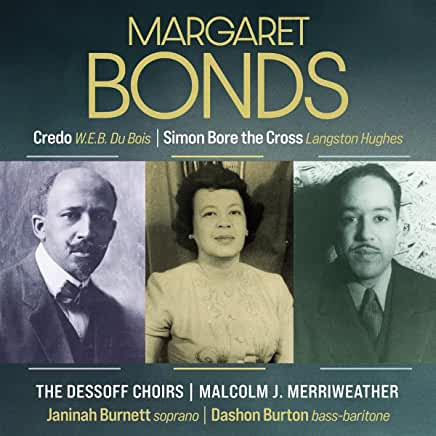
Margaret Bonds: Credo (text: W.E.B. Du Bois, ed. Rollo Dilworth); Simon Bore the Cross (text: Langston Hughes, ed. & arr. Malcolm J. Merriweather). Janinah Burnett, soprano; Dashon Burton, bass-baritone; The Dessoff Choirs and Orchestra; Malcolm J. Merriweather, conductor. AVIE AV2589
 

It is always interesting to come across music by a composer previously unknown to you. Composer and pianist Margaret Bonds (1913-1972) grew up in a musically rich environment in Chicago. In fact, in high school she studied piano and composition under the tutelage of Florence Price (1857-1953), another female African-American composer who has recently begun to be recognized. In 1934, Bonds became the first Black soloist to play with the Chicago Symphony Orchestra, performing – what else? – Price’s Piano Concerto in D Minor. However, because of her race, life was not easy for her. Although she was able to earn her B.M. and M.M. degrees from Northwestern University, she was not allowed to live on campus. After unsuccessfully trying to start a music academy in Chicago, she moved to New York in 1939, where she worked in musical theater. Here, she immersed herself in the world of musical theatre and became an important figure in the Harlem Renaissance. She also wrote song for singers such as Leontyne Price and Betty Allen, then most famous being the spiritual, “He’s Got the Whole World in His Hand” for Ms. Price. Having been inspired by a Langton Hughes poem during her time at Northwestern, she was able to meet and strike up a close friendship with the poet during her time in New York. After Hughes’s death, Bonds moved to Los Angeles in 1967. During her lifetime she wrote over 200 compositions, but of these, only 75 scores survive; furthermore, only 47 were published during her lifetime.

The two works on this recording both date from the final decade of her life, and neither was performed in its entirety during her lifetime. She had premiered a piano/vocal version of Credo in in 1967, but then Hughes died, she moved to California, and it was not until a year after her death that excerpts of an orchestrated version were performed by the Los Angeles Philharmonic under Zubin Mehta, with a complete performance following a year later. We now have this impassioned performance by New York’s Dessoff Choirs and Orchestra with soloists Janinah Burnett and Dashon Burton, all under the direction of conductor Malcolm J. Merriweather. The text by W.E.B. Du Bois is straightforward and forceful. It makes a plea for freedom and dignity that is if anything – sadly enough – even more relevant today than it was when first written. Powerful words, powerful music, given an appropriately robust performance and recording. It is hard to imagine anyone listening to this music and not being moved. Simon Bore the Cross is also powerful in its musical appeal, although its text, based on Passion poetry by Langston Hughes, may not have quite the impact for some people that Credo carries. Still, it is an impressive performance. Kudos to AVIE for including full texts of both compositions; photos of Price, Du Bois, and Hughes; and information about the performers. In all aspects, this is an admirable, recommendable release. 


Apr 26, 2023

Home. Eric Whitacre/VOCES8 (CD Review)

by Karl Nehring

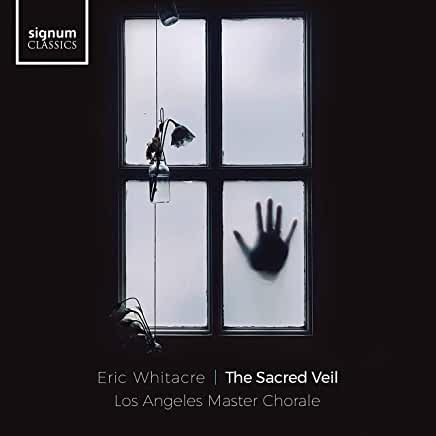
Whitacre: Go, Lovely RoseThe Seal LullabySing GentlyAll Seems Beautiful to MeThe Sacred Veil. VOCES8 (Andrea Haines, Molly Noon, soprano; Katie Jeffries-Harris, Barnaby Smith [Artistic Director], alto; Blake Morgan, Evan Williamson, tenor; Sam Poppleton - except [*], Christopher Moore, baritone; Jonathan Pacey, bass); Emma Denton, cello; Christopher Glenn, piano; Eric Whitacre, conductor. Decca 483 3970


The American composer and conductor Eric Whitacre (b. 1970) is one of those musicians whose work always seems to be overflowing with energy, imagination, and beauty. His style is a blending of the simple and the complex, with melodies and harmonies that are often beguiling and straightforward on the surface but then as the music continues, reveal depth and breadth express of both harmony and melody that extend deep, wide, and high. His energy does not confine itself to his composing, as he also is active as a conductor. With the advent of the internet and technologies for interacting electronically, he has been active in assembling “virtual choirs” that feature singers from throughout the world joyfully blending their voices under his direction and stewardship, an effort that paid has great artistic and cultural dividends by creating new friendships as well as beautiful music. VOCES8 is an English vocal octet originally founded in 2003. They have had numerous personnel changes over the years, but have remained consistent in their overall sound. They have appeared on numerous recordings over the past couple of decades, not only in supporting roles, as on composer Christopher Tin’s The Lost Birds (reviewed here), but also as featured performers, such as their 2021 Decca release, Infinity (reviewed here). 


On this new Decca release, Whitacre and VOCES8 have joined together to present several of the composer’s works. Their mutual admiration is evident in the liner notes. “It is one thing to spend years savoring the immaculate recordings of one of your all-time favorite vocal groups. It is quite another thin g to be standing in. front of them, making music together in the same room. There is, of course, that legendary VOCES8 sound. Glassy and pure, like spun honey. It’s overwhelming at first, because the way they sing together is so beautiful, so blended,” writes Whitacre. “We are delighted we had the chance to work with Eric on this album,” writes Barnaby Smith (Artistic Director of VOCES8). “To welcome him to the VOCES8 Centre in London to direct his music in what was both a relaxed, but intensely artistically and emotionally charged atmosphere was something very special.” 


The album begins with four brief pieces, all of which are under five minutes in length, beginning with Go, Lovely Rose, Whitacre’s first composition, followed by one of his most frequently performed pieces, The Seal Lullaby, which was written to accompany an animated film that never actually got produced – but the lovely music lives on. The next song, Sing Gently was composed during COVID-19 lockdown specially for Whitacre’s Virtual Choir, made up of more than 17,500 singers from 124 different countries. The fourth work on the album is Whitacre’s most recent composition, All Seems Beautiful to Me, based on a poem by Walt Whitman (from Song of the Open Road) celebrating the human spirit’s capacity for generosity and growth. It was commissioned by the United States Air Force Band and here receives its world premiere recording. We then arrive at the album’s main attraction, The Sacred Veil, which Whitacre composed along with his friend and frequent collaborator Charles Anthony Silvestri, who wrote most of the lyrics, which revolve around the death from cancer of his late wife, Julia Lawrence Silvestri (the remainder of the lyrics were written by Whitacre and Ms. Silvestri before her passing). As you might surmise from those circumstances, The Sacred Veil is an intensely personal, deeply moving composition. 

One of the interesting qualities of The Sacred Veil is the way it balances intimacy with expression. The lyrics focus on the deeply private and personal story of Julia’s passing, told from the perspective of her husband, Charles. At the same time, the lyrics are used to evoke Silvestri’s concept of a thin veil that separates the past from the future, the living from the dead, the temporal from the eternal. This idea of the veil may be a fairly straightforward concept intellectually, but as a central part of a lived experience, it is complex and mysterious. Whitacre’s musical setting of the lyrics uses simple melodies played by the piano and the cello to provide a ground for the sometimes straightforward, sometimes highly complex choral parts. Just listen to the opening measures, with a simple melody on the piano soon joined by a tone from the cello, the voices then joining in with some exquisite harmonizing that draws the listener right into the lyrics and thus into the story. By the time the final movements arrive, the vocal harmonies have become more layered, more complex, but the piano and cello still are there to provide a solid foundation for the harmonic structure of the voices. A particularly moving choral device that Whitacre uses to great effect is sliding harmonies in the voices as the lyrics reflect Silvestri’s thoughts and emotions in the immediate aftermath of his wife’s passing in the penultimate movement, “You Rise, I Fall,” an incredibly moving portrait of grief, built upon love and hope.


The liner notes reveal a wrinkle about this recording that is worth noting. “Much of Eric’s music had been conceived for larger forces than an eight-voiced vocal group,” notes Barnaby Smith, “so to work with the composer to find the best way to present the scores in this chamber environment was an engaging and invigorating part of our process.” And there you have it – The Sacred Veil was originally conceived for a larger choir. In fact, the first recording of it, which Whitacre himself conducted (reviewed here), featured the larger forces of the Los Angeles Master Chorale. So what we have here in this Decca release is in essence a chamber version of the work. That is not to diminish its value, for VOCES8 does a beautiful job. Comparing the two versions directly, I enjoy the greater warmth and humanity that comes through in the earlier (Los Angeles) version, but there is something to be said for the intimacy and purity of sound of the VOCES8 version, although the voices of the sopranos can be overpowering at times (something I have noted on previous VOCES8 recordings). Both are very well recorded. In all honesty, I find The Sacred Veil to be one of the most moving musical works of the 21st century, and I highly recommend this new recording. Indeed, I highly recommend both of Whitacre’s recordings of The Sacred Veil.


Apr 23, 2023

Clara & Robert Schumann: Piano Concertos

by Bill Heck

Clara Wieck-Schumann: Piano Concerto 1 in A minor; Robert Schumann: Piano Concerto in A minor, Widmung. (Beatrice Rana, piano; Yannick Nézet-Séguin, Chamber Orchestra of Europe). Warner Classcs B0BLGH14M1.

Yannick Nézet-Séguin seems to be showing up in recordings everywhere these days, and this time he teams up with Beatrice Rana – or should I say that she teams up with him? – to produce an enjoyable disk featuring the piano concertos by what must be the most famous musical couple of the Romantic era, Clara and Robert Schumann. Robert’s piano concerto is well-known to modern audiences; Clara’s, actually written first, has been little-known. Recently, though, Clara’s music seems to be staging a mini-revival.  

Given the dates of composition, it is appropriate that Clara Schumann's concerto appears first on the disk. Considering her age when she composed it (14!), the work is remarkably sophisticated and mature, easily mistaken for the effort of a much older and more experienced composer. For those unfamiliar with the composition (and until very recently that included me and, I’m sure, many readers of Classical Candor), here’s a capsule summary:

The first movement begins with a flourish in the home key of A minor, a theme that is a bit foreboding, followed by both orchestral and pianistic flourishes. There's plenty of drama here, with quiet piano passages alternating with full-throated combinations of the solo instrument and the orchestra. One might even be reminded of an early Beethoven concerto, at least in general outline, if not in clear structural integrity. Toward the end of movement, the sun breaks through and a series of ascending lines take us to a major key.

Interestingly, Clara Schumann dares to tie the first movement directly to the second, a device that, although hardly unprecedented, must have seen quite daring its day, especially for a young, female composer. This second movement is a "romance", with a stretch of piano work that turns into a duet between piano and cello, with additional strings gradually adding harmony. By the way, the device of giving the melodic line in the slow movement to the cello shows up again in Brahms’s second piano concerto. Given the relationship between Brahms and the Schumanns, that seems more than coincidental -- just sayin'. In any case, as with the transition from the first to second movements, the second moves directly into the third.

The third movement, about the length of the first two put together, is more dramatic and initially restless, primarily staying in the minor key. Soon along comes a more joyful melody, which in turn gives way to solo passages in a more introspective mood. But restlessness moves us on, moving through several moods until, as we near the end, the piano gallops off with the orchestra coming along in full stride, ending back in the minor key again: another innovative move, as it was quite unusual at the time to end such a major showpiece work in a minor key.

The playing is both enthusiastic and more than competent: if hearing is believing, I’m certainly convinced that Rana truly enjoys playing this work. The recorded sound is very good: after several listens, I realized that the projected sound of the piano was a little too wide, but the Warner engineers had balanced the piano and orchestra so nicely that this was not bothersome.

Clara and Robert Schumann
Moving on to the next work, the coupling with Robert’s concerto is, at first glance, an obvious one. Both are in A minor, so they must be related, right? In fact, they are not particularly related, other than by key. Sure, there are a few passages that share some similarities, but in the main these are quite different works, and I needn’t go into details about Robert’s concerto, as it is a mainstay of the repertoire. Rana brings much the same energy and vitality to Robert's composition as we just heard in Clara’s; a few passages that struck me as slight missteps don’t detract from a first-rate effort. The story is much the same with the orchestra: intelligent phrasing, very good playing. I can summarize quickly by saying that the performance here is quite nice, as is the sound, although to my ears neither aspect is so spectacular as to displace any other favorites that you might have. I don’t mean to damn with faint praise; if you are looking for a very good performance of Robert Schumann’s concerto in modern sound, this will do nicely.

But, but….at this point, the astute reader may wonder about my attitude here. Well, I am a little disappointed. It’s not because there’s anything wrong with what we hear here. I just wish that we could have had more innovative (might I even say more daring?) programming.

As I mentioned earlier, Clara Schumann's compositions mostly languished in obscurity until recently. We can be glad that they now are played more often, as they truly deserve to be. We can be especially happy that the piano concerto has received such a fine recording as this one. However, I would be remiss if I did not point out that the concerto, although an amazing work for one of her age at the time of composition and signaling and extraordinary talent, still ends up being the work of youth. While it's certainly worth hearing, it only foreshadows some of Clara's more interesting later works. 

Sadly, Clara composed relatively little throughout her life: given the demands of caring for Robert through his increasing mental illness and eventual death, raising a passel of children, enduring a crushing travel and performance schedule, and (in her spare time, one supposes) dealing with a tricky relationship with Brahms, it’s a miracle that she found any time at all for composition. It seems that there were a couple of minor orchestral pieces that are now lost, and she did work on a second concerto that was never finished; so much for orchestral output.  But she managed to create several pieces of chamber music and even more for solo piano. So wouldn’t it have been nice if, on this disk, the concerto had been followed by a few of those latter piano compositions? I’m drooling (metaphorically anyway) at the thought of hearing Rana have a go at some of those.

Oh well, given the realities of marketing and contracts, perhaps a concerto/solo works program wasn’t feasible. And maybe Rana is already hard at work on another album of Clara Schumann’s compositions – or so we can hope!

By the way, there's a nicely-done video about the album and the Schumanns on the Warner Classics channel on YouTube, part of which is transcribed in the liner notes for the disk.

Meet the Staff

Meet the Staff
John J. Puccio, Founder and Contributor

Understand, I'm just an everyday guy reacting to something I love. And I've been doing it for a very long time, my appreciation for classical music starting with the musical excerpts on the Big Jon and Sparkie radio show in the early Fifties and the purchase of my first recording, The 101 Strings Play the Classics, around 1956. In the late Sixties I began teaching high school English and Film Studies as well as becoming interested in hi-fi, my audio ambitions graduating me from a pair of AR-3 speakers to the Fulton J's recommended by The Stereophile's J. Gordon Holt. In the early Seventies, I began writing for a number of audio magazines, including Audio Excellence, Audio Forum, The Boston Audio Society Speaker, The American Record Guide, and from 1976 until 2008, The $ensible Sound, for which I served as Classical Music Editor.

Today, I'm retired from teaching and use a pair of bi-amped VMPS RM40s loudspeakers for my listening. In addition to writing for the Classical Candor blog, I served as the Movie Review Editor for the Web site Movie Metropolis (formerly DVDTown) from 1997-2013. Music and movies. Life couldn't be better.

Karl Nehring, Editor and Contributor

For nearly 30 years I was the editor of The $ensible Sound magazine and a regular contributor to both its equipment and recordings review pages. I would not presume to present myself as some sort of expert on music, but I have a deep love for and appreciation of many types of music, "classical" especially, and have listened to thousands of recordings over the years, many of which still line the walls of my listening room (and occasionally spill onto the furniture and floor, much to the chagrin of my long-suffering wife). I have always taken the approach as a reviewer that what I am trying to do is simply to point out to readers that I have come across a recording that I have found of interest, a recording that I think they might appreciate my having pointed out to them. I suppose that sounds a bit simple-minded, but I know I appreciate reading reviews by others that do the same for me — point out recordings that they think I might enjoy.

For readers who might be wondering about what kind of system I am using to do my listening, I should probably point out that I do a LOT of music listening and employ a variety of means to do so in a variety of environments, as I would imagine many music lovers also do. Starting at the more grandiose end of the scale, the system in which I do my most serious listening comprises Marantz CD 6007 and Onkyo CD 7030 CD players, NAD C 658 streaming preamp/DAC, Legacy Audio PowerBloc2 amplifier, and a pair of Legacy Audio Focus SE loudspeakers. I occasionally do some listening through pair of Sennheiser 560S headphones. I miss the excellent ELS Studio sound system in our 2016 Acura RDX (now my wife's daily driver) on which I had ripped more than a hundred favorite CDs to the hard drive, so now when driving my 2024 Honda CRV Sport L Hybrid, I stream music from my phone through its adequate but hardly outstanding factory system. For more casual listening at home when I am not in my listening room, I often stream music through a Roku Streambar Pro system (soundbar plus four surround speakers and a 10" sealed subwoofer) that has surprisingly nice sound for such a diminutive physical presence and reasonable price. Finally, at the least grandiose end of the scale, I have an Ultimate Ears Wonderboom II Bluetooth speaker and a pair of Google Pro Earbuds for those occasions where I am somewhere by myself without a sound system but in desperate need of a musical fix. I just can’t imagine life without music and I am humbly grateful for the technologies that enable us to enjoy it in so many wonderful ways.

William (Bill) Heck, Webmaster and Contributor

Among my early childhood memories are those of listening to my mother playing records (some even 78 rpm ones!) of both classical music and jazz tunes. I suppose that her love of music was transmitted genetically, and my interest was sustained by years of playing in rock bands – until I realized that this was no way to make a living. The interest in classical music was rekindled in grad school when the university FM station serving as background music for studying happened to play the Brahms First Symphony. As the work came to an end, it struck me forcibly that this was the most beautiful thing I had ever heard, and from that point on, I never looked back. This revelation was to the detriment of my studies, as I subsequently spent way too much time simply listening, but music has remained a significant part of my life. These days, although I still can tell a trumpet from a bassoon and a quarter note from a treble clef, I have to admit that I remain a nonexpert. But I do love music in general and classical music in particular, and I enjoy sharing both information and opinions about it.

The audiophile bug bit about the same time that I returned to classical music. I’ve gone through plenty of equipment, brands from Audio Research to Yamaha, and the best of it has opened new audio insights. Along the way, I reviewed components, and occasionally recordings, for The $ensible Sound magazine. Most recently I’ve moved to my “ultimate system” consisting of a BlueSound Node streamer, an ancient Toshiba multi-format disk player serving as a CD transport, Legacy Wavelet II DAC/preamp/crossover, dual Legacy PowerBloc2 amps, and Legacy Signature SE speakers (biamped), all connected with decently made, no-frills cables. With the arrival of CD and higher resolution streaming, that is now the source for most of my listening.

Ryan Ross, Contributor

I started listening to and studying classical music in earnest nearly three decades ago. This interest grew naturally out of my training as a pianist. I am now a musicologist by profession, specializing in British and other symphonic music of the 19th and 20th centuries. My scholarly work has been published in major music journals, as well as in other outlets. Current research focuses include twentieth-century symphonic historiography, and the music of Jean Sibelius, Ralph Vaughan Williams, and Malcolm Arnold.

I am honored to contribute writings to Classical Candor. In an age where the classical recording industry is being subjected to such profound pressures and changes, it is more important than ever for those of us steeped in this cultural tradition to continue to foster its love and exposure. I hope that my readers can find value, no matter how modest, in what I offer here.


Bryan Geyer, Technical Analyst

I initially embraced classical music in 1954 when I mistuned my car radio and heard the Heifetz recording of Mendelssohn's Violin Concerto. That inspired me to board the new "hi-fi" DIY bandwagon. In 1957 I joined one of the pioneer semiconductor makers and spent the next 32 years marketing transistors and microcircuits to military contractors. Home audio DIY projects remained a personal passion until 1989 when we created our own new photography equipment company. I later (2012) revived my interest in two channel audio when we "downsized" our life and determined that mini-monitors + paired subwoofers were a great way to mate fine music with the space constraints of condo living.

Visitors that view my technical papers on this site may wonder why they appear here, rather than on a site that features audio equipment reviews. My reason is that I tried the latter, and prefer to publish for people who actually want to listen to music; not to equipment. My focus is in describing what's technically beneficial to assure that the sound of the system will accurately replicate the source input signal (i. e. exhibit high accuracy) without inordinate cost and complexity. Conversely, most of the audiophiles of today strive to achieve sound that's euphonic, i.e. be personally satisfying. In essence, audiophiles seek sound that's consistent with their desire; the music is simply a test signal.

Mission Statement

It is the goal of Classical Candor to promote the enjoyment of classical music. Other forms of music come and go--minuets, waltzes, ragtime, blues, jazz, bebop, country-western, rock-'n'-roll, heavy metal, rap, and the rest--but classical music has been around for hundreds of years and will continue to be around for hundreds more. It's no accident that every major city in the world has one or more symphony orchestras.

When I was young, I heard it said that only intellectuals could appreciate classical music, that it required dedicated concentration to appreciate. Nonsense. I'm no intellectual, and I've always loved classical music. Anyone who's ever seen and enjoyed Disney's Fantasia or a Looney Tunes cartoon playing Rossini's William Tell Overture or Liszt's Hungarian Rhapsody No. 2 can attest to the power and joy of classical music, and that's just about everybody.

So, if Classical Candor can expand one's awareness of classical music and bring more joy to one's life, more power to it. It's done its job. --John J. Puccio

Contact Information

Readers with polite, courteous, helpful letters may send them to classicalcandor@gmail.com

Readers with impolite, discourteous, bitchy, whining, complaining, nasty, mean-spirited, unhelpful letters may send them to classicalcandor@recycle.bin.

"Their Master's Voice" by Michael Sowa

"Their Master's Voice" by Michael Sowa