Showing posts with label Bolcom. Show all posts

Jul 27, 2022

Piano Potpourri, No. 7 (CD reviews)

William Bolcom: The Complete Rags. Marc-André Hamelin, piano. Hyperion CDA683991/2.

By Karl W. Nehring

Many older listeners were likely first exposed to ragtime music by Marvin Hamlisch’s performance of Scott Joplin’s “The Entertainer” piano rag from the soundtrack to the 1973 hit film The Sting. Hamlisch’s performance was released as a single and became a radio hit; suddenly ragtime music was “in” and veteran ragtime piano players such as the late, legendary “Eubie” Blake enjoyed a sudden surge in media popularity. It turns out that American composer William Bolcom (b. 1938) had developed an interest in piano rags pre-The Sting, studying the rags of Scott Joplin in the late 1960s and trying his hand at writing some rags of his own.

“My growing familiarity around 1967 with Scott Joplin’s opera Treemonisha inspired my very first rag, Glad Rag, which quotes that opera in a transitional passage,” he recounts in his helpful, in-depth liner notes. “A very personal rag, Lost Lady is a lament for a failed marriage. But a real epiphany for me soon after that break-up was meeting James Hubert ‘Eubie’ Blake in 1966—at eighty-six, he was one of the few still-performing practitioners of the urbanized ragtime (called ‘stride piano’) of James P. Johnson and Thomas ‘Fats’ Waller. Bolcom goes on to recount that “Eubie and I became friends and gave concerts together frequently. (Purely by example Eubie was showing me how artificial was the division between composing and performing, which had become de rigueur in music; I consider him my last great teacher).”

Canadian pianist and composer Marc-André Hamelin (b. 1961) is widely known for his technical prowess and willingness to perform and record music outside the classical keyboard mainstream. Those qualities serve him – and us – well as he turns his attention in this release to the complete collection of Bolcom’s piano rags (27 in all, seven of which Bolcom wrote in collaboration with his friend William Albright) on this two-disc set. If this review communicates nothing else, let it get across these two points: First, this is serious music, written by a serious composer and played by a serious, gifted pianist. Not in any way is this some sort of novelty or crossover album. Second, this is an album of entertaining music that is entertaining precisely because it has been composed, performed, and recorded by serious professionals and can easily withstand the rigors of repeated listening. The album includes rags that will appeal to a broad spectrum of attitudes and emotions, from sad to glad and trad to rad and plenty of shades in between. Even for those unfamiliar with ragtime or stride piano, the piano rags of Bolcom as played by Hamelin and recorded by Judith Sherman and crew would be a great place to start.  

Beethoven: 33 Variations Op. 120 on a Waltz by Diabelli. Mitsuko Uchida, piano. Decca 485 2731.

Last week’s New Releases No. 33 included a review of an ECM New Series CD by the Danish String Quartet that featured a performance of one of Beethoven’s late quartets. If you are familiar with those works, you know that they are both beautiful and sublime, at times seeming to originate from some realm almost beyond human comprehension, a world of timeless beauty with which Beethoven was somehow able to communicate. His late piano works, especially his final sonata, Op. 111, also have that sense of other-worldly beauty, a great performance evoking in the listener a sense of the transcendent.

Sometimes overlooked in the catalog of Beethoven’s late works for piano is his Diabelli Variations, a composition that was actually his final large-scale work for solo piano. The story behind the piece is a convoluted one. In brief, the composer and publisher Anton Diabelli had entered into a partnership in 1918 with an art dealer named Pietro Cappi. To call attention to their Vienna business, they hit upon the scheme of asking 50 notable musicians form throughout the Austro-Hungarian empire to provide a brief variation on a simple waltz tune that Diabelli had composed. The project wound up taking several years to pull together (no fax machines, no cell phones, no internet…), so the final version did not appear until 1824, in a printed volume that featured variations by the 50 composers, who were presented in alphabetical order. The variations included were of little lasting musical value, with the exception of a waltz by Schubert. Along with the volume containing the 50 variations, Cappi and Diabelli also published a companion volume: a reissued collection of Beethoven’s 33 variations of Diabelli’s waltz.

Wait, what? Reissued? Well, it seems that Beethoven thought the 50-composer idea was not something he wanted to be involved with, so he dismissed the idea of submitting a single variation out of hand. However, according to the liner notes, “Beethoven had in any case always been attracted by the challenge of building large edifices out of less than first-rate material, and he found Diabelli’s waltz a rich source for elaboration, setting to work on it almost as soon as he received it. Approximately two-thirds of the ‘Diabelli’ variations were written in 1819, before he laid the project aside in order to begin work on his Missa solemnis. By the time he returned to the variations, towards the end of 1822, Beethoven had not only finished the Mass, but had also composed his last three piano sonatas, Opp. 109, 110 & 111. The experience of the late sonatas clearly left its mark on those portions of the ‘Diabelli’ Variations that came after them. But more than that, the journey from the mundane to the sublime may be shorter than we imagine, and Diabelli’s innocuous little waltz tune, with its simple tonic-dominant harmony and its bass line giving out the falling interval of a fourth, from C to G, and then a fifth, D to G, is first cousin to the wonderfully serene ‘Arietta’ on which the finale of Beethoven’s last sonata, Op. 111, is based.” Cappi and Diabelli had received far more than they had requested from Beethoven, so in June of 1823 they published an advertisement for the score in the Weiner Zeitung (founded in 1703, still being published, one of the oldest newspapers in the world) that heralded:

We present here to the world variations of no ordinary sort, but a grand and important masterpiece, worthy of being added to the immortal creations of the old Classics, and in a manner that only Beethoven, the greatest living representative of true art, can supply. The most original structures and ideas, the boldest musical transformations and harmonies are here exhausted, every pianoforte effect based on a solid technique is employed; and this work is all the more interesting through the circumstance that it is elicited from a theme which no one would otherwise have supposed capable of a working-out of in the manner in which our exalted Master stands alone among his contemporaries. The splendid fugues, Nos. 24 and 32, will astonish all friends and connoisseurs of serious style, as will Nos. 2, 6, 16, 17, 23, etc. the brilliant players; and altogether all these variations, through the novelty of their ideas, care in working out, and beauty in the most artful of their transitions, will entitle the work to a place beside Sebastian Bach's famous masterpiece in the same form. [The Goldberg Variations]

Japanese-born British pianist Mitsuko Uchida (b. 1948) has long been one of my favorite musicians. Not only does she play wonderfully, but her modesty and charm are world-class, as you can see for yourself in this video from 2012 on the occasion of her being presented an award from the UK’s Royal Philharmonic Society: https://www.youtube.com/watch?v=zHh7pDApfCA. Perhaps even more indicative of her modesty and charm is this promotional video for her new recording of the Diabelli Variations: https://www.youtube.com/watch?v=z38Y8LfJHXY. Despite a long career throughout which she has been known primarily as a specialist in the Viennese masters who has won wide acclaim for her performances and recordings of Mozart, Schubert, and Beethoven, this new Decca release is Dame Mitsuko’s first recording of the Diabelli Variations. Her performance comes across as thoughtfully balanced, able to express depths of emotion without ever sounding forced; neither too excitable or rushed in the lighter moments nor overly drawn-out and melodramatic in the softer, more reflective passages. Particularly noteworthy is the way the recording closes out, Variations XXIX-XXXIII. These variations have a little bit of everytbing, blessed with some of the most sublime soft and slow passages extant. (unless you are perhaps quite young, XXXI will likely have you reflecting on mortality), culminating with Variation XXXIII, marked Tempo di Minuetto, moderato, and sounding like one final farewell dance. This is a truly first-rate recording of a sometimes-overlooked masterpiece.

Reynaldo Hahn: Poèmes & Valses. Contains selections from Le Rossignol Éperdu (53 Poèmes pour Piano) and Premières Valses. Pavel Kolesnikov, piano. Hyperion CDA68383.

Not having heard of either the composer or the performer before receiving this release for review, I really had no idea what to expect, but once again this is one of those cases of being most pleasantly surprised by what awaited me when I finally got around to giving this CD an audition. It turns out that Reynaldo Hahn (1874-1947) was born in Venezuela but his family moved to Paris when he was a child and he wound up spending most of his life in the City of Light. According to Wikipedia he was a composer, conductor, music critic, and singer who was most well-known during his lifetime for his songs, of which he composed more than 100. His portrait in the CD booklet bears a remarkable resemblance, at least to these eyes, to some I have seen of the famous French composer Claude Debussy.

As for the performer, Russian pianist Pavel Kolesnikov (b. 1989), a bit of digging around on my part quickly revealed that he has been gaining a reputation as a remarkable young pianist of exceptional sensitivity and touch, with an ability to tease out the poetry woven into the printed score. Although the Tchaikovsky concerto certainly is far different from Hahn’s music for solo piano, this brief video clip offers some insight into who Kolesnikov is both as a musician and as a person: https://www.youtube.com/watch?v=DkyPk6DHOX8.

Kolesnikov says that although at first he struggled to understand Hahn’s works, to get below the surface. It was the piece Éros cache dans les bois (“Eros hides in the woods”) that suddenly sparked his interest. “Gone were my initial reservation about these works; I surrendered myself to the music, which in itself is at once uncertain and precise, and was won over.” As he began to comb through Hahn’s piano pieces, finding that “some of the works left me unmoved, but others {a lot of them} took me back to those first impressions of mystery and apprehension, in which the listener is situated at the boundaries of familiarity” the COVID-19 lockdown suddenly hit, which for the pianist “seemed like the ideal moment to get started… After a few days of procrastination, I found the resolve to start conceiving this recording… for this recording I used a Yamaha CFX, whose sound is less textured than the usual concert Steinway. I specified that the piano be tuned in such a way as to maximize the extreme sensitivity of the keys, with closely positioned microphones. This serves to highlight a flurry of detail; but one has to be extremely attentive, for the downside of this placement is that it accentuates absolutely all the weaknesses, albeit microscopic.”

Hahn’s music is hard to pin down. It definitely sounds French, something like a mix of Satie, Debussy, perhaps Ravel – but not really just like any of those more familiar names. And when I say “Hahn’s music,” I need to point out that as you can see from the header above, the selections on this recording are taken from two different collections, the 53 Poèmes of Le Rossignol Éperdu (“The Bewildered/Distracted/Distraught/Ecstatic Nightingale”) and the Premières Valses (“First Waltzes”). There are 25 tracks in all: 9 Poèmes, 6 Valses, followed by 10 more Poèmes. The Poèmes have a more airy, other-worldly feel to them than do the Valses, which are livelier and more grounded, although still unmistakably French in character. Moreover, the Poèmes that Kolesnikov has chosen for the closing portion of the program are generally longer than those that he chose to open the program. Despite my clumsy attempts at describing it, this really is delightful music. If you like the piano music of Ravel, Satie, or Debussy, then I believe there is a good chance that you will find this music enjoyable. Kolesnikov is an impressive young pianist from whom I expect to we shall hear more from in the future. For now, we have this recording to savor.

KWN

May 15, 2022

When There Are No Words... (CD review)

Revolutionary Works for Oboe and Piano by Hindemith, Haas, Bolcom, Britten, Siqueira, and Slavicky. Alex Klein, oboe; Phillip Bush, piano. Cedille CDR 90000 208.

By John J. Puccio

Are we experiencing an oboe renaissance? Seems that way, given the number of new, classical oboe recordings I’m seeing: concertos, sonatas, solos, you name it. I’m not complaining, mind you. The oboe will never compete with the violin or piano in terms of featured musical instruments, but the oboe deserves its place in the sun. Power to the oboe!

More important, the works on the present album express the musical views of five composers who faced the realities of war, hate, and exile. The music represents their frustrations and grievances towards a world gone mad. They attempted to express in music what words alone could not.

On this Cedille disc, oboist Alex Klein and pianist Phillip Bush provide us with six oboe and piano compositions, and they do them up in accomplished style. First, though, a word about the players. Klein (b. 1964) began playing the oboe at the age of nine in his native Brazil and made his solo orchestral debut a year later. By the time he was eleven he joined one of Brazil’s foremost chamber ensembles, the Camerata Antigua. In his teens he performed as a soloist with several orchestras in Brazil and then studied at the Oberlin Conservatory of Music. He went on to win numerous awards before becoming an Assistant Professor of Music at the University of Washington and joined the Chicago Symphony Orchestra in 1995 as principal oboe. Since then, he has performed as soloist with the Chicago Symphony, Philadelphia Orchestra, the Orchestre de la Suisse Romande, and the Chicago Sinfonietta. His partner on the current album, Phillip Bush (b. 1961), is an American concert pianist whose career has largely focused on chamber and contemporary works.

First up on the program is the Sonata for Oboe and Piano, written in 1938 by the German composer Paul Hindemith (1895-1963). The sonata expresses the composer’s anxiety over a Germany obsessed with hatred. The first of two movements is actively rhythmic in the manner of slightly askew military march; the second is mournful, drawing on long, intense, soulful passages. The players do it up in a forthright manner, amply conveying the melancholy of loss and impending doom.

Next is the three-movement Suite for Oboe and Piano, written in 1939 by the Czech composer Pavel Haas (1899-1944). He, too, faced a world haunted by fear, anger, and hostility. The music is both discomforting and uplifting by turns, and Klein and Bush make the most of its pulsating beat, its dramatic pauses, its woeful, sometimes fearful tone, and its inspiring emotion. The oboe seems a most-appropriate instrument for this type of music, and Klein proves an expert practitioner at drawing from it the most expressive elements.

The central work on the disc is titled Aubade--for the Continuation of Life, written in 1980 by the American composer and pianist William Bolcom (b. 1938). An “aubade” is a poem written to greet the dawn, a morning song, only here Bolcom is more concerned with that dawn possibly never happening at all. The world looked on as the U.S. and Europe engaged in a Cold War with the Soviet Union, and the chance of a nuclear war was ever present. It’s a frankly gloomy piece, grounded in loneliness and a sense of hopelessness, moods well captured by the tone of the oboe.

After that is Temporal Variations, written in 1936 by the English composer, conductor, and pianist Benjamin Britten (1913-1976). He intended it as an antiwar statement when the threat of war with Germany loomed ever closer. It’s in nine brief movements, each a variation of a two-note, two-syllable theme that seems to repeat “enough.” It’s probably the most interesting item on the agenda, the most urgent in its thoughts, the most musically variable and insightful. Klein and Bush are at their best here, too, shaping each short proclamation as an independent thought yet keeping everything together as a cohesive whole.

The penultimate item is Three Etudes for Oboe with Piano Accompaniment, published in 1969 by the Brazilian composer, conductor, and musicologist Jose Siqueira (1907-1985). He was forcibly expelled from his native country and wrote music to convey his feelings. These are somewhat nostalgic, evocative melodies, more lyrical than those of the other composers on the program, the Etudes featuring a central, dance-like scherzo. Above all, the performers bring out the colorful language of the piece, capturing the spirit, grace, and beauty of Siqueira’s homeland.

Concluding the album we find the Suite for Oboe and Piano, written in 1960 by Czech composer Klement Slavicky (1910-1999). Like Siqueira, Slavicky was expressing in music his regret at what was happening in his country, in this case under the Soviet regime. It alternates bright, positive accents with doleful, ominous ones, the oboe capturing the wistful, introspective nature of the music, with the piano in complete sympathy.

Producer James Ginsburg and engineer Bill Maylone recorded the music at Gannon Hall, DePaul University, Chicago, Illinois in July, 2021. As we expect from Cedille and its chief engineer, the sound is as realistic as being in the room with the players. Both the oboe and piano are clear and natural, with no edginess, no dullness, no oddities whatsoever. It’s just good, pure sound.

JJP

Jan 12, 2022

Piano Potpourri, No. 4 (CD reviews)

By Karl W. Nehring

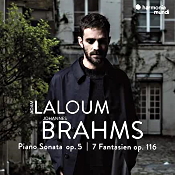
Brahms: Piano Sonata No. 3 in F minor, op. 5; 7 Fantasien, op. 116. Adam Laloum, piano. Harmonia Mundi HMM 902666. 

French pianist Adam Laloum (b.1987) brings us works from the early and late periods of Brahms’s writings for the keyboard. The composer produced his Piano Sonata No. 3 when he was only 20 years old. The liner notes marvel of the young Brahms that “even if his constricted, lower-middle-class family environment was not as miserable as frequently related, it remains incomprehensible how an eighteen-year-old buried entirely in his romantic dream world who had no contact at all to this ‘musical world,’ could invent at the kitchen table in his home, piano music that would astound Europe. And how it became known to the public is no less miraculous. As a nobody, he embarked in the spring of 1853 upon a journey that was supposed to be hardly more than a little concert tour, and ended it as an acclaimed ‘genius’ with the first printed works in his luggage. On this trip, which rather unexpectedly carried him to its turning point, the encounter with the Schumann family, the twenty-year-old Brahms wrote his Third Piano Sonata, which was to be his premature parting from this genre. This aspect, too, is mysterious.”

The sonata is a grand composition in five movements, spanning a total of nearly 40 minutes, with all the musical depth and complexity of a symphony. Speaking of symphonies, the attentive listener will hear occasional echoes of Beethoven’s Fifth as the sonata unfolds, that da-da-da-dum showing up every once in a while, almost spectrally in the opening movement, more forcefully in the fourth. This is truly a grand and glorious work, and Laloum plays it with both power and subtlety. Strangely and sadly enough, given the power and deep beauty of this grand sonata, it proved to be Brahms’s final composition in this genre.

However, Brahms did not abandon composing for the piano altogether; rather, he went on to compose other works for the keyboard, just no more sonatas. He completed his 7 Fantasien in 1892, nearly 40 years after composing his final sonata. They are much smaller in scale, the longest coming in at 4:34, the shortest at a mere 2:23. Four of the seven selections are intermezzi, which are especially lyrical, reflective, and calmingly beautiful (Bill Heck offers some insights about intermezzi in his review of a Brahms piano recording devoted to the genre: https://classicalcandor.blogspot.com/2021/04/brahms-intermezzi-cd-review.html); the other three are cappriccios, which are more, well, capricious. In both genres, Laloum;’ expressive playing is well-framed by the recorded sound, which is clear and full-bodied. All in all, this is a truly rewarding release that would serve as a fine introduction to the piano music of the amazing Johannes Brahms both the younger and the elder.

Vers Le Silence. Chopin: Polonaise in C minor, Op 40 No. 2; Bolcom: Twelve New Etudes for Piano, Book I - No. 1. Fast, furious | No. 2. Récitatif | No. 3. Mirrors; Chopin: Mazurka in C Major, Op. 68 No. 1; Mazurka in G minor, Op. 67 No. 2; Mazurka in A minor, “Emile Gaillard”; Bolcom: Twelve New Etudes for Piano Book II - No. 4. Scène d’opéra | No. 5. Butterflies, hummingbirds | Nocturne; Chopin: Waltz in B minor, Op. 69 No. 2; Waltz in A-flat Major, Op. 42; Bolcom: Twelve New Etudes for Piano, Book III - No. 7. Premonitions | No. 8. Rag infernal (Syncopes apocalyptiques) | No. 9. Invention; Chopin: Polonaise in A-flat Major, Op. 53; Bolcom: Twelve New Etudes for Piano, Book IV - No. 10. Vers le silence | No. 11. Hi-jinks | No. 12. Hymne à l’amour; Chopin: Mazurka in F minor, Op. 68 No. 4. Ran Dank, piano. AVIE Records AV2475. 

With this release we have releases by composers that most classical music fans would not be inclined to think of together, if for no other reason that they are far separated in time, but also because one is quite famous, especially for his piano music, while the other is, although certainly not obscure, far from widely known. As the Israeli-born (now residing in the United States) pianist Ran Dank (b. 1982) puts it, “At first glance, the musical worlds of Frédéric Chopin (1810-1849 and William Bolcom (b. 1938) seem disparate. The former, the national composer of Poland, who spent the lion’s share of his adult life in exile in the country of France, is one of classical music's most well-known and often-played composers, His writing style has become synonymous with pianistic elan and panache, with lush melodic lines in the bel canto style and brilliant bravura passage-work – all ensconced in sumptuous, romantic harmonies. The latter, a Seattle-born American composer, has become one of contemporary music’s most defining voices through boldness of invention and a nonpareil synthesis of musical languages and idioms that encompass the range of 20th-century music. As pianist-composers, they both share a perfect understanding of the human hand and the ability to use the piano to its full extent. They also possess an extraordinary ear for sounds and a keen sense of structure. All of these commonalities begin to unveil themselves when listening to these works side by side.”

As you can see from the track listing, Dank has chosen to intersperse selections of various types from Chopin’s catalog, including two Polonaises, four Mazurkas, and two Waltzes, amongst Bolcom’s 12 New Etudes for Piano. Bolcom began working on the Etudes in 1977, but put them aside when pianist Paul Jacobs, to whom they had been dedicated, passed away in 1983. However, Bolcom was persuaded to complete the work by pianists John Musto (b. 1954) and Marc-Andre Hamelin (b. 1961), so Bolcom set back to work and completed the set in 1986, expanding the dedication to include all three pianists. Although Dank opens and closes his program with Chopin, and devotes considerably more space in his liner note essay discussing the Chopin pieces he has chosen to include, he also writes, “At the core of this recording lie the Twelve New Etudes… The etudes as a whole exhibit all the traits of Bolcom’s writing: wonderfully eclectic, effortlessly moving between one musical idiom and another with seemingly endless ingenuity. The complete set won the Pulitzer Prize in 1988 and is one of the great etude sets in the pianistic repertoire… I would like to close with a few personal notes. With this debut recording, I have chosen to concentrate on two composers who have shaped my trajectory as a pianist and musician. The music of Chopin was, quite literally, the reason I began playing the piano. The waltzes of Chopin were the first musical pieces I remember hearing, and it was a recording of them that had me mesmerized by the age of 3. As a child of two Polish parents, the music of Chopin played a huge part in my upbringing, and every note of it resonates with me on an extremely personal level. Bolcom’s music was a much later discovery, but one that was equally valuable. Indeed, after having learned this set of etudes, I was so fascinated by it that I decided to write my doctoral dissertation on it. I have spent countless hours both playing, studying, and analyzing this text, and I hope to be able to impart some of my musical insights to the listener.”

It seems clear, then, that the primary purpose of the album is to present the Bolcom set, with the Chopin pieces being added for two main reasons: as a musical complement to the Bolcom based on Dank’s deep regard for both composers and to make the album easier to market and sell. Some might find the latter reason less than noble – either on my part for suggesting it or on the part of the producers for implementing it, if that is indeed the case. In any event, whatever the motivation, the end result is an entertaining album that succeeds in exposing music lovers to some music that they might otherwise might not ever have auditioned. The Bolcom Etudes are not going to be to everyone’s taste, but what music truly is? However, they are colorful, brief, spirited, imaginative, and varied. I will admit that they put me off a bit at first, but the more I listened, the more I came to enjoy them, and the more I came to appreciate Bolcom’s fascination with them. From the first of the dozen, titled “Fast, Furious,” which is just that, a shot of caffeinated keyboard adrenaline, we then go to “Recitatif,” a welcome island of calm. Another highlight is “Scene d’opera,” like some fantastic opera scene recalled in a dream. And so the Etudes continue, imaginative pianistic sketches, capturing moods and mental images, ending with the peaceful, reflective, perhaps resigned “”Hymne a l’amour” that completes the set. Dank then follows with a gentle performance of Chopin’s Mazurka in F Minor, op. 64, ending the album in a similar tone but offering a glimpse of hope, some light shining through the cracks. The engineering is by veteran engineer Judith Sherman, so the sound is first-rate, as you might expect. An unusual but rewarding release – try it, you might like it.

Nik Bärtsch: Entendre. Modul 58_12; Modul 55; Modul 26; Modul 13; Modul 5; Dejã-vu,Vienna. Nik Bartsch, piano. ECM 2703. 

Swiss pianist Nik Bartsch (b. 1971) has created an album of solo piano music that defies easy categorization. Although Bartach has led jazz groups that play music of a similar overall feel, the music on Entendre is not jazz; although it tends toward having a rhythmic pulse and a sense of repetitive buildup, it is not merely minimalism; and although it is in a sense composed and has titles (some of which have been played performed previously by his jazz groups), it is music that is not fully composed nor is it fully improvised. The music just seems to unfold as Bartsch plays patterns and then plays with those patterns, keeping a steady pulse but shifting accents, chords, riffs, finding “freedom in the groove” as he taps into the potential energy of the keyboard (and occasionally behind the keyboard) and channels it into kinetic energy that seems to chant and dance as it ebbs and flows. This is energetic music with an underlying sense of calm, music that can either stimulate or soothe, depending on the mood the listener brings to it. Something like a mash up of Philip Glass with Keith Jarretts Koln Concert, if that makes any sense to anyone besides me. Great driving music!

KWN

Dec 1, 2021

Piano Potpourri, No. 3 (CD reviews)

Echoes of Life. IN THE BEGINNING WAS | Francesco Tristano: In the Beginning Was; Chopin: Preludes op. 28: Nos. 1-4: INFANT REBELLION | Ligeti: Musica ricercata I; Chopin: Preludes op. 28. Nos. 5-9; WHEN THE GRASS WAS GREENER | Nino Rota: Valzer; Chopin: Preludes op. 28: Nos. 10-15; NO ROADMAP TO ADULTHOOD | Chilly Gonzales: Prelude in C sharp major; Chopin: Preludes op. 28: Nos. 16-18; IDENTITY | Takemitsu; Litany I; Chopin: Preludes op. 28: Nos. 19-20; A PATH TO WHERE | Arvo Pärt: Für Alina; Chopin: Preludes op. 28: Nos. 21-24; LULLABY TO ETERNITY | Alice Sara Ott: Lullaby to Eternity. Alice Sara Ott. Piano. Deutsche Grammophon 486 0474.

By Karl W. Nehring

With so much of recorded music trending toward the “song” as the fundamental commodity, and with even classical music labels such as, yes, Deutsche Grammophon releasing individual digital tracks as singles, it is encouraging to see that the concept of the album is still alive and well; moreover, what we have here is not just an album, but by golly, a concept album. Not just a collection of pieces, but a collection assembled in an attempt to tell some sort of story, augmented by the liner notes and art. You have probably already noticed the all-caps interjections in the list of compositions above, which are taken directly from the back cover of the CD digipack. As the German pianist Alice Sara Ott (b. 1988) explains it, “Echoes of Life is a personal reflection on the thoughts and moments that influence and change our lives. It also portrays the journey and transformation I took to become the person and artist I see myself as today. In interpreting music from composers who, in their own time, challenged the system and redefined music, I see it as my role as a classical musician to carry this spirit forward by not insisting on reproducing bygone traditions and limitations… With his Preludes op. 28, Frédéric Chopin composed a collection of individual character pieces – very different from each other and yet all connected in some way. They remind me of life. I have chosen seven contemporary works to intersperse the Preludes and, while they echo some of my most personal and vulnerable experiences, they also conform how modern, provocative, and timeless Chopin’s music is.”  

The end result is a musical delight, as Ott mingles stimulating newer music together with the music of Chopin to create a program that flows smoothly and draws the listener in. You really don’t get the sense that you are jumping back and forth in time or making abrupt shifts in style. Yes, the Ligeti piece has a fierceness about it, but not overwhelmingly so, and yes, when you think about it, Chopin’s music has energy in abundance also. And so it goes with Takemitsu and Chopin, and Pärt and Chopin; in the hands of Alice Sara Ott, this music all makes sense together. The engineering is also first-rate, with a coherent piano sound. This truly is a splendid release.

When Do We Dance? George Gershwin: When Do We Dance?; Art Tatum: Tea for Two; William Bolcom; Graceful Ghost Rag; Fats Waller: Vipers Drag; Astor Piazzolla: Libertango; Alberto Ginastera: Argentine Dances No. 2; Manuel de Falla: Ritual Fire Dance; Maurice Ravel: Valses Nobles et Sentimentales; Camille Saint-Saëns: Étude en Forme de Valse; Béla Bartók: Romanian Folk Dances; Igor Stravinsky: Tango; Alexander Scriabin: Waltz in A flat Major; Rachmaninoff: Polka Italienne. Lise de la Salle, piano. Naïve V 5468.

As you can readily infer from the selections on this release from French pianist Lise de la Salle (b. 1988), the emphasis here is on dance music. As the pianist explains, “With so many dances and so much music to play, I could take ten albums to tell this whole story. So, I decided to focus on one century (1850-1950) but travel the world. I believe this is the most fascinating period in the history of all the arts, alive with new rules and techniques, and an explosion of potential – not just in music but also in literature, painting and dance. It all explodes, and the twentieth century opens up to a new modern world. This gives rise to new emotions of incredible depth. When Do We Dance? is a journey through this century to explore the different ways in which dance takes possession of the body: with an amazing swing in North America, developing a  strong sensuality in South America and Spain, with reserve, elegance and sophistication in France, or through the expression of a late, sentimental romanticism in eastern Europe and Russia.”

What is particularly rewarding about the program she has chosen is to see the names of Art Tatum, Fats Waller, and Astor Piazzolla in there along with more recognizable names from the classical music world. De la Salle obviously loves music, loves dance (which she has studied), and knows how to play dance music in a way that does it justice – that lets it swing and sway; however, she never lets herself get carried away, she never takes it over the top. From Tatum to Ravel to Stravinsky, she lets the music dance. My only reservation about this release is the engineering. Although the sound of the piano is clean and clear, the stereo imaging is a bit odd, with the piano seeming too wide and not quite coherent. If your system has a mono setting, that might be the best. Really, the sound is not at all a deal-breaker, and many listeners will find it just fine, so don’t let my sonic quibbles dissuade you from listening to this energetic collection, which Ms. de la Salle characterizes as “a journey to explore the different ways in which dance takes possession of the body.”

Northscapes. Lasse Thoresen: Invocation of Pristine Light Op. 52, No. 1; Anna Thorvaldsdottir: Scape; Bent Sorensen: (from 12 Nocturnes) I: Mignon - Und die Sonne geht Unter; III: Nachtlicher Fluss; VII: Mitternacht mit Mignon; Kaija Saariaho: Prelude; Raminta Serksnyte: Fantasia; Peteris Vasks: Music for a Summer Evening; Lasse Thoresen: Invocation of Rising Air, Op. 52, No. 2. Ieva Jokubaviciute, piano. Sono Luminus DSL-92251.

Although I was not quite sure what to expect from this release, I certainly looked forward to auditioning it. As for as the composers, I was quite familiar with the orchestral music of Vasks, but had never heard any of his piano music; had heard some orchestral music by Saariaho but none of her piano music; some chamber music by Thorvaldsdottir but no piano music; and nothing at all by any of the other composers or the pianist. So why did I look forward to auditioning it? Because I knew that Sono Luminus had great sound and because the program looked intriguing indeed. I knew I had to give it a listen.

I’m glad I did so, for I was richly rewarded. Lithuanian pianist Ieva Jokubaviciute is able to draw astonishing sounds from the piano, both form the keyboard and from “under the hood” if so requested by the composer; and Sono Luminus has captured in all in gloriously realistic sound quality. Particularly impressive are the two contributions by Norwegian composer Lasse Thoresen, which open and close the program. Invocation of Pristine Light really does evoke a feeling of illumination, a sense of wonder, discovery, and joy. Although of course I have never heard anyone else interpret this piece before, it is hard to imagine anyone bringing any more sensitivity to it than Ms. Jokubaviciute. The closing Invocation of Rising Air has a contrasting energy to it, more subdued, but still imbued with wonder. Thorvaldsdottir’s Scape finds the pianist drawing some unusual sounds from her instrument. As the liner notes explain, Scape “calls for the piano to be prepared with screws placed between certain strings, for the use of a thimble, and for the application of an e-bow. Already, we have here the composer asking the performer to coax a host of sounds and gestures from inside the piano beyond hammers striking strings. The preparation of the piano and the use of extended techniques unleash sounds inherent to the instrument yet repressed by the mechanisms of the tradition.”  One of the liner note photos depicts Ms. Jokubaviciute manipulating the strings inside the piano. Although to read of these techniques might lead one to believe that the music must sound hostile and unlistenable, the end result is far from that. Strange, perhaps, but compelling – musically compelling at that. And so the rest of the album goes, fresh, bracing new sounds, expertly played and magnificently recorded. If you are a fan of piano music and have at least a modicum of musical adventurousness in your soul, Northscapes belongs on your audition list.

Bonus Recommendations:

Puerta. Jorge Rossy, vibraphone, marimba; Robert Landfermann, double bass; Jeff Ballard, drums, percussion. ECM 2661 382 2596.

There is an interesting backstory here. Jorge Rossy was for a time the drummer in the Brad Mehldau Trio, but left that group to return to his native Spain and concentrate on his piano playing. He was replaced in Mehldau’s piano trio by the American drummer Jeff Ballard. And now we have here Rossy on neither drums nor piano, but rather on vibes and marimba, recording an album of mostly his own compositions supported by Ballard on drums and German bassist Landfermann. Most of the tunes have a relatively easygoing feel to them, medium tempos, minimum flash, with the musicians more interested in communicating with the listener than showing off their chops. It is fascinating to hear the sonic interplay between the drums and the vibes. Both involve instruments that are struck with sticks/mallets; both are being played by musicians who are experienced drummers. The crystal clear ECM sound allows you to really focus on their interaction, which is fascinating, and of course you also have the underlying plucking support of the double bass, which at times steps out into the foreground, occasionally bowed rather than plucked, marimba sometimes ringing…  Amazing now instruments that are struck and plucked can sound so soothing, yet while sounding so soothing still hold our attention.  

Mozart in the Jungle: Sex, Drugs, and Classical Music. Tindall, Blair. Grove Press (2005).

Although this book covers the classical music world of several decades ago, many of the issues that Blair Tindall brings up regarding the financial and management practices within the industry are still relevant today. In addition, many of the personalities she discusses involve names that would be recognizable to most fans of classical music. Yes, there are some salacious details involving sex and drugs that could well have been left out, some of those salacious details do serve to give readers a perspective on the world of classical music they might otherwise never have been afforded. As a quick example, I recall attending a performance by the famed violinist Ihtzak Perlman, who was accompanied on piano by Samuel Sanders, back in the early 1980s. According to Tindall, who came to know Sanders very well, Perlman was making around $33,000 for such appearances at that time, and paying Sanders all of $1,000. Interesting… Tindall also writes of how as orchestras came to get money from corporations and other donors, they tended to increase their spending; in fact, the more donations the received, the larger their debt became. There are also some interesting character sketches in this memoir; unfortunately, some of them turn out to have sad endings as some individuals fall prey to drugs, alcohol, disease, or despair. Tindall was one of the fortunate few, able to escape the classical music world she felt trapped in by discovering she had a talent for writing and actually earning a scholarship to Stanford and starting a second career in journalism, and eventually writing her book. It is not a volume I would recommend to everyone, but it is worth at least a skim through if you are interested in gaining another perspective on classical music – sex, drugs, money, and all the rest that goes with it.

KWN

Aug 12, 2018

Ragtime in Washington (CD review)

Michael Adcock, piano. Centaur Records CRC 3639.

First, it might prove helpful to hear an authoritative definition of the musical genre known as ragtime, so here is what the Encyclopedia Britannica says about the subject: Ragtime is a "propulsively syncopated musical style, one forerunner of jazz and the predominant style of American popular music from about 1899 to 1917. Ragtime evolved in the playing of honky-tonk pianists along the Mississippi and Missouri rivers in the last decades of the 19th century. It was influenced by minstrel-show songs, blacks' banjo styles, and syncopated (off-beat) dance rhythms of the cakewalk, and also elements of European music. Ragtime found its characteristic expression in formally structured piano compositions. The regularly accented left-hand beat, in 4/4 or 2/4 time, was opposed in the right hand by a fast, bouncingly syncopated melody that gave the music its powerful forward impetus.

"Scott Joplin, called 'King of Ragtime,' published the most successful of the early rags, 'The Maple Leaf Rag,' in 1899. Joplin, who considered ragtime a permanent and serious branch of classical music, composed hundreds of short pieces, a set of études, and operas in the style. Other important performers were, in St. Louis, Louis Chauvin and Thomas M. Turpin (father of St. Louis ragtime) and, in New Orleans, Tony Jackson."

On the present recording, pianist Michael Adcock plays a wide-ranging assortment of ragtime tunes, from Scott Joplin to William Bolcom and John Musto. Mr. Adcock's Web site describes him as follows: "Hailed for his prodigious technique and praised by the Washington Post for an 'unusually fresh and arresting approach to the piano,' pianist Michael Adcock has cultivated a versatile career as soloist, chamber musician and pre-concert lecturer. Recipient of the 1998 Lili Boulanger Memorial Award, Mr. Adcock was also a prizewinner in the 1996 Washington International Competition and the Kosciuszko Foundation Chopin Competitions in Chicago and New York. Mr. Adcock gave his Carnegie Weill Recital Hall debut in December of 1998. Mr. Adcock earned Master's, Artist Diploma and Doctoral degrees from Peabody Conservatory, where he studied with Leon Fleisher and Ellen Mack, and was adjunct faculty in theory and chamber music. Mr. Adcock took his Bachelor's degree from Oberlin College-Conservatory and attended secondary school at North Carolina School of the Arts."

Because Scott Joplin considered ragtime a form of classical music and because Mr. Adcock is primarily a classical pianist, it is no wonder that Adcock takes a kind of classical approach to the music. His playing is more subtle, more reserved, more intimate than most other performers I've heard in this genre. It's quite beautiful, but it is also a bit different and, at the same time, refreshing.

The selections on the album:
  1. Scott Joplin (1868-1917): Bethena (A Concert Waltz)
  2. Henry Lodge (1885-1933): Red Pepper Rag
  3. Scott Joplin: The Easy Winners
  4. George Gershwin (1898-1937) and Will Donaldson (1891-1954): Rialto Ripples
  5. Scott Joplin: Palm Leaf Rag
  6. Thomas Benjamin (b. 1940): That Old Second-Viennese-School Rag
  7. William Albright (1944-1998): Sleepwalker's Shuffle
  8. William Albright: Scott Joplin's Victory
  9. William Bolcom (b. 1938): Incinerator Rag
10. William Bolcom: The Brooklyn Dodge
11. William Bolcom: Last Rag
12. William Bolcom: Fields of Flowers
13. John Musto (b. 1954): Recollections
14. John Musto: In Stride
15. Jelly Roll Morton (1890-1941): Grandpa's Spells
16. Bob Zurke (1912-1944): Old Tom-Cat on the Keys
17. Scott Joplin: Solace

Michael Adcock
Interestingly, the popularity of ragtime has ebbed and flowed. As the encyclopedia mentioned, its height of favor was from about 1899 to about 1917, the end of the First World War. Then it got pretty much shoved aside by various other kinds of jazz. However, a revival occurred in 1973, thanks to the film The Sting, with Marvin Hamlisch arranging and playing Joplin's music. Hamlisch's single from the soundtrack, "The Entertainer," even became a top-ten hit. The irony is that the movie's time setting was 1936, well after the heyday of ragtime; but it didn't matter. For a while, ragtime was back in the public eye. And then, well, the music sort of faded into obscurity again, so it's good to have Mr. Adcock's new album.

Favorites on the disc? Of course. Since "Bethena" has been well liked for over a century, Adcock leads with it. He presents it in an attractively gentle manner, bringing out the more-plaintive, lyrical waltz characteristics of the music. Likewise is Adcock's handling of the crowd-pleasing "The Easy Winners" takes on a sweeter quality than usual. Then he follows with the more upbeat "Red Pepper Rag," which like Gershwin's "Rialto Ripples" gives the pianist room to rock.

Still, as I say, Adcock's classical leanings may be more than a bit disconcerting to people more attuned to traditionally hell-bent interpretations. For the rest of us, the playing is superb and the renditions charming and affectionate. That's doubly the case for Adcock's reading of Thomas Benjamin's delightful lampoon of Arnold Schonberg via Scott Joplin in "That Old Second-Viennese-School Rag." So, even the modern things from Benjamin, Bolcom, Albright, and Musto come off well. Joplin's "Solace" brings the program to an appropriately tranquil and comforting end.

It's all highly entertaining (and not a little enlightening), which is the whole point of music.

Producer Michael Adcock and engineer David Shoemaker recorded the music at Calvary United Methodist Church, Frederick, Maryland in May 2017. The results are quite good.

First, however, a digression. Many years ago (1982 to be exact), the late Dave Wilson of Wilson Audio had just recorded a pair of albums he called "Ragtime Razzmatazz" with pianist Mark P. Wetch. Dave invited me to listen to the actual piano in the actual location he recorded the albums and then to hear the music in his living room through his big WAMM (Wilson Audio Modular Monitor) super speakers. With my eyes closed, the sound of the real thing and the sound of the recording were pretty much alike, especially as Dave had recorded the piano very close, and when we were listening to the real thing, we were sitting very close.

Now, I mention this because there are similarities between Dave's recording and this newer one from Centaur. Both are fairly close up, and both capture the sound of the instrument in a similar fashion. Dave's recording, though, used a huge, Kroeger "hard-tuned" honky-tonk-sounding upright piano. Mr. Adcock plays a fully restored New York Steinway D from PianoCraft. Big difference. So, yes, Adcock's piano has less obvious ring and reverberation, a softer, mellower, and more precise sound, nicely captured by the sound engineer in a modestly reverberant setting, with a mild fuzz or buzz around the strings. Dave went for an authentic saloon sound; Centaur projects a more classical concert-hall presentation. Both are worthy of the music, which works so well in both mediums.

JJP

To listen to a brief excerpt from this album, click below:


Meet the Staff

Meet the Staff
John J. Puccio, Founder and Contributor

Understand, I'm just an everyday guy reacting to something I love. And I've been doing it for a very long time, my appreciation for classical music starting with the musical excerpts on the Big Jon and Sparkie radio show in the early Fifties and the purchase of my first recording, The 101 Strings Play the Classics, around 1956. In the late Sixties I began teaching high school English and Film Studies as well as becoming interested in hi-fi, my audio ambitions graduating me from a pair of AR-3 speakers to the Fulton J's recommended by The Stereophile's J. Gordon Holt. In the early Seventies, I began writing for a number of audio magazines, including Audio Excellence, Audio Forum, The Boston Audio Society Speaker, The American Record Guide, and from 1976 until 2008, The $ensible Sound, for which I served as Classical Music Editor.

Today, I'm retired from teaching and use a pair of bi-amped VMPS RM40s loudspeakers for my listening. In addition to writing for the Classical Candor blog, I served as the Movie Review Editor for the Web site Movie Metropolis (formerly DVDTown) from 1997-2013. Music and movies. Life couldn't be better.

Karl Nehring, Editor and Contributor

For nearly 30 years I was the editor of The $ensible Sound magazine and a regular contributor to both its equipment and recordings review pages. I would not presume to present myself as some sort of expert on music, but I have a deep love for and appreciation of many types of music, "classical" especially, and have listened to thousands of recordings over the years, many of which still line the walls of my listening room (and occasionally spill onto the furniture and floor, much to the chagrin of my long-suffering wife). I have always taken the approach as a reviewer that what I am trying to do is simply to point out to readers that I have come across a recording that I have found of interest, a recording that I think they might appreciate my having pointed out to them. I suppose that sounds a bit simple-minded, but I know I appreciate reading reviews by others that do the same for me — point out recordings that they think I might enjoy.

For readers who might be wondering about what kind of system I am using to do my listening, I should probably point out that I do a LOT of music listening and employ a variety of means to do so in a variety of environments, as I would imagine many music lovers also do. Starting at the more grandiose end of the scale, the system in which I do my most serious listening comprises Marantz CD 6007 and Onkyo CD 7030 CD players, NAD C 658 streaming preamp/DAC, Legacy Audio PowerBloc2 amplifier, and a pair of Legacy Audio Focus SE loudspeakers. I occasionally do some listening through pair of Sennheiser 560S headphones. I miss the excellent ELS Studio sound system in our 2016 Acura RDX (now my wife's daily driver) on which I had ripped more than a hundred favorite CDs to the hard drive, so now when driving my 2024 Honda CRV Sport L Hybrid, I stream music from my phone through its adequate but hardly outstanding factory system. For more casual listening at home when I am not in my listening room, I often stream music through a Roku Streambar Pro system (soundbar plus four surround speakers and a 10" sealed subwoofer) that has surprisingly nice sound for such a diminutive physical presence and reasonable price. Finally, at the least grandiose end of the scale, I have an Ultimate Ears Wonderboom II Bluetooth speaker and a pair of Google Pro Earbuds for those occasions where I am somewhere by myself without a sound system but in desperate need of a musical fix. I just can’t imagine life without music and I am humbly grateful for the technologies that enable us to enjoy it in so many wonderful ways.

William (Bill) Heck, Webmaster and Contributor

Among my early childhood memories are those of listening to my mother playing records (some even 78 rpm ones!) of both classical music and jazz tunes. I suppose that her love of music was transmitted genetically, and my interest was sustained by years of playing in rock bands – until I realized that this was no way to make a living. The interest in classical music was rekindled in grad school when the university FM station serving as background music for studying happened to play the Brahms First Symphony. As the work came to an end, it struck me forcibly that this was the most beautiful thing I had ever heard, and from that point on, I never looked back. This revelation was to the detriment of my studies, as I subsequently spent way too much time simply listening, but music has remained a significant part of my life. These days, although I still can tell a trumpet from a bassoon and a quarter note from a treble clef, I have to admit that I remain a nonexpert. But I do love music in general and classical music in particular, and I enjoy sharing both information and opinions about it.

The audiophile bug bit about the same time that I returned to classical music. I’ve gone through plenty of equipment, brands from Audio Research to Yamaha, and the best of it has opened new audio insights. Along the way, I reviewed components, and occasionally recordings, for The $ensible Sound magazine. Most recently I’ve moved to my “ultimate system” consisting of a BlueSound Node streamer, an ancient Toshiba multi-format disk player serving as a CD transport, Legacy Wavelet II DAC/preamp/crossover, dual Legacy PowerBloc2 amps, and Legacy Signature SE speakers (biamped), all connected with decently made, no-frills cables. With the arrival of CD and higher resolution streaming, that is now the source for most of my listening.

Ryan Ross, Contributor

I started listening to and studying classical music in earnest nearly three decades ago. This interest grew naturally out of my training as a pianist. I am now a musicologist by profession, specializing in British and other symphonic music of the 19th and 20th centuries. My scholarly work has been published in major music journals, as well as in other outlets. Current research focuses include twentieth-century symphonic historiography, and the music of Jean Sibelius, Ralph Vaughan Williams, and Malcolm Arnold.

I am honored to contribute writings to Classical Candor. In an age where the classical recording industry is being subjected to such profound pressures and changes, it is more important than ever for those of us steeped in this cultural tradition to continue to foster its love and exposure. I hope that my readers can find value, no matter how modest, in what I offer here.


Bryan Geyer, Technical Analyst

I initially embraced classical music in 1954 when I mistuned my car radio and heard the Heifetz recording of Mendelssohn's Violin Concerto. That inspired me to board the new "hi-fi" DIY bandwagon. In 1957 I joined one of the pioneer semiconductor makers and spent the next 32 years marketing transistors and microcircuits to military contractors. Home audio DIY projects remained a personal passion until 1989 when we created our own new photography equipment company. I later (2012) revived my interest in two channel audio when we "downsized" our life and determined that mini-monitors + paired subwoofers were a great way to mate fine music with the space constraints of condo living.

Visitors that view my technical papers on this site may wonder why they appear here, rather than on a site that features audio equipment reviews. My reason is that I tried the latter, and prefer to publish for people who actually want to listen to music; not to equipment. My focus is in describing what's technically beneficial to assure that the sound of the system will accurately replicate the source input signal (i. e. exhibit high accuracy) without inordinate cost and complexity. Conversely, most of the audiophiles of today strive to achieve sound that's euphonic, i.e. be personally satisfying. In essence, audiophiles seek sound that's consistent with their desire; the music is simply a test signal.

Mission Statement

It is the goal of Classical Candor to promote the enjoyment of classical music. Other forms of music come and go--minuets, waltzes, ragtime, blues, jazz, bebop, country-western, rock-'n'-roll, heavy metal, rap, and the rest--but classical music has been around for hundreds of years and will continue to be around for hundreds more. It's no accident that every major city in the world has one or more symphony orchestras.

When I was young, I heard it said that only intellectuals could appreciate classical music, that it required dedicated concentration to appreciate. Nonsense. I'm no intellectual, and I've always loved classical music. Anyone who's ever seen and enjoyed Disney's Fantasia or a Looney Tunes cartoon playing Rossini's William Tell Overture or Liszt's Hungarian Rhapsody No. 2 can attest to the power and joy of classical music, and that's just about everybody.

So, if Classical Candor can expand one's awareness of classical music and bring more joy to one's life, more power to it. It's done its job. --John J. Puccio

Contact Information

Readers with polite, courteous, helpful letters may send them to classicalcandor@gmail.com

Readers with impolite, discourteous, bitchy, whining, complaining, nasty, mean-spirited, unhelpful letters may send them to classicalcandor@recycle.bin.

"Their Master's Voice" by Michael Sowa

"Their Master's Voice" by Michael Sowa