Showing posts with label Sibelius. Show all posts

May 5, 2026

Sibelius: Orchestral Works (CD Review)

by Ryan Ross


Sibelius: Lemminkäinen Suite, Op. 22; Violin Concerto in D Minor, Op. 47. Santtu-Matias Rouvali, conductor; Ava Bahari, violinist; Gothenburg Symphony Orchestra. Alpha Classics 1215

In a CD review for an academic journal last year, I quoted a line from G. K. Chesterton’s great apologetic The Everlasting Man. The same words kept going through my mind as I listened to this recording, so I am going to share them again here: “When the Professor is told by the Polynesian that once there was nothing except a great feathered serpent, unless the learned man feels a thrill and a half temptation to wish it were true, he is no judge of such things at all.” I don’t know what Santtu-Matias Rouvali feels when he reads the Kalevala’s vivid stories of Lemminkäinen. But I feel that his performance of Sibelius’s Lemminkäinen Suite with the Gothenburg Symphony Orchestra misses Chesterton’s standard of conviction. 


What the attuned listener needs for this music are two things: a keen grasp of the legendary, and a willingness to fully bring Lemminkäinen’s unbridled virility to life. The best performances capture the sense that these stories might actually be distant memories from a lost age, in which magic was still possible and events unfolded with a fairy tale’s inexorable destiny. We should almost remember being there, something akin to what Vaughan Williams expressed about seeing Stonehenge for the first time – that he’d somehow always known it. Additionally, at least in the first number there should be an atmosphere charged with overt eroticism. This is tied to Lemminkäinen’s specific characterization in Canto 29 of the Kalevala as a swaggering, womanizing “wanton.” (Consider, too, how Sibelius himself behaved when he traveled abroad with his cohorts or embarked upon Symposium benders. “Every note should be experienced,” he once advised young composers.) 


Rouvali is a fine musician, but he disappoints on both of these crucial levels. His biggest letdown is in failing to capture the sheer passion of Lemminkäinen’s romp with the maidens of Saari. We need a vibe akin to a young man freshly dropped off at college who is away from his parents for the first time, surrounded by beautiful women and possibilities. But Rouvali leads more in the direction of the geeky reject who withdraws alone into his dorm room to play Minecraft. Musically the biggest culprit is that he doesn’t lean into the expressive passages enough. The fervent tunes and running figures need more lustiness. Mere precision is a secondary concern. Ditto the woodwind motives making up the main theme and restated in the aftermath of the climax. They’re too “brought to heel” in this performance. Crassness should be avoided but these call for ardency. My favorite recording (Saraste with the Toronto Symphony) at times feels like its wheels are about to spin off. Never mind; those folks absolutely nail the mood. 


Related issues plague the remaining parts of the suite, albeit to a lesser degree. The famous Swan of Tuonela is skillfully rendered but tonally off. Once again Rouvali’s allergy to lushness dampens the proceedings. His strings supply a steely brilliance where softer resplendence is preferable. The last two pieces, Lemminkäinen in Tuonela and Lemminkäinen’s Return are markedly better, but they still lack the voltage of elite accounts. It’s not so much that Rouvali changes his approach here as he’s let off the hook by reduced lyrical demands. But even under these propitious conditions we still lack the high drama supplied by Eugene Ormandy and the Philadelphia Orchestra, or by Leif Segerstam and the Helsinki Philharmonic. Lemminkäinen’s Return is the high point here and it’s middling. There’s plenty of pep, but we need a touch more atmosphere. Furthermore, Rouvali duplicates an unfortunate misstep that mars many other accounts: he directs his flutists to underplay an already piano dynamic when their “calls” enter at Rehearsal 6 and expand in subsequent measures. Following score directions is good, but not to the point where it’s difficult to hear principal motives. This material, while fleeting, is an important part of the musical narrative. 


Finally we come to the Violin Concerto, and I’m afraid this take just pushes average. It’s not for a lack of soloist ability. Ava Bahari has an uncommonly warm tone and excels in the passages that call for it. She’s also no slouch as a virtuoso, as this finale demonstrates. While I think she could use more rhythmic snap at times (especially in her exposed passages at the beginning), mostly she’s just contained by a reticent supporting cast. One example is paradigmatic: the Largamente theme following Rehearsal 3 in the opening movement. This melodic stretch is Sibelian GOLD – one of the signature moments in all of his output. But Rouvali practically bails on Bahari! There must be robust string section support and he ducks it. Sibelius indicated espressivo and affettuoso. What more did he need to do for performers to bare their hearts here?


I don’t know Maestro Rouvali, so I won’t ascribe motivations to him. But I hope he isn’t one of those post-Sibelian Finnish artists who is embarrassed by frank displays of sentiment and nationalism. If he isn’t, someone he trusts should nudge him toward a better contrary impression. If he is, I would gently tell him that some of the very things modernist snobs consider backward or hokey about his national heritage are precisely what many of us abroad love about it. We may not all have prominent positions at London publications, nor frequent the proverbial cocktail parties, but we listen eagerly and from the gut. When someone conducts Sibelius like he’d rather be conducting Stravinsky, we notice. So embrace the feathered serpents, Maestro, and the flawed heroes from your glorious folklore. They’re not a bad look. 

Nov 11, 2025

Recent Releases No.78 (CD Reviews)

by Karl Nehring

Abstractions. Anna Clyne: Within Her ArmsAbstractions – I. Marble Moon II. Auguries III. Seascape IV. River V. ThreeRestless OceansColor Field – I. Yellow II. Red III. Orange. Baltimore Symphony Orchestra; Marin Alsop, conductor. Naxos 8.574620


I first became aware of the London-born composer Anna Clyne (b. 1980) back in 2020 when I came across her name somewhere on social media. I mentioned it to my good friend and fellow Classical Candor contributor Bill Heck, who related with considerable enthusiasm how he had recently enjoyed a concert performance of one of her works by members of the Pro Musica Chamber Orchestra in Columbus, Ohio. The work Bill and his wife had enjoyed that night was Within Her Arms, the piece that opens the program on this new Naxos CD. Not long after that 2020 conversation with Bill, we published our first review of a Clyne composition, which was a five-movement work for cello and orchestra titled Dance, with soloist Inbal Segev and the London Philharmonic Orchestra conducted by Marin Alsop (you can find that review here). That CD also included the Elgar concerto, but since then, we have published two reviews of CDs featuring music entirely by Clyne, who now resides in the Hudson Valley region of New York. You can read the review of Mythologies here and Shorthand here. Clyne wrote the deeply moving elegy Within Her Arms, which is set for an ensemble of 15 strings, shortly after the death of her mother in 2008. The remaining compositions are scored for full orchestra, showcasing both the rich imagination of the composer and the deft playing of the Baltimore players. Although the music is not particularly tuneful, neither is it overly abstract; rather, it is engaging and entertaining, with many striking effects. It is music that makes you want to listen to it again, and then again, which is the mark of an excellent composer.


Sibelius: Symphony No. 6 in D Minor, Op. 104; Symphony No. 7 in C Major, Op. 105; Tapiola, Op. 12. English Symphony Orchestra; Kenneth Woods, conductor. ESO Records ESO2502


I believe my first encounter with a recording featuring the conductor Kenneth Woods, originally from Madison, Wisconsin, but currently residing in Wales, was a Nimbus release of symphonic music by a contemporary English composer previously unknown to me, Matthew Taylor (b.1964), a review you can find here. Since then, I have gone on to review other recordings conducted by Maestro Woods, who leads not only the English Symphony Orchestra featured on the present recording but also serves as Musical Director of the world-famous Colorado Mahlerfest; in addition, John Puccio has reviewed numerous recordings led by Maestro Woods in past installments of Classical Candor. On this present Sibelius release, the ESO under Woods acquit themselves admirably. It is hard to think of a more satisfying musical program than that presented here, the final two symphonies by the Finnish master plus his magical tone poem, Tapiola. There is something magical about the way in which the opening notes of the Sixth Symphony blissfully arise from silence; we suddenly find ourselves in a wondrous world of sound and shadow that Woods and the ESO bring to life with a deft touch. The overall sound seems just right for Sibelius – not too heavy, but not too light. The recorded sound is clean and open, and there are informative liner notes by composer and critic Guy Rickards. All in all, this is a highly recommendable release.

Sep 10, 2025

Pictures from Finland (CD Review)

by Ryan Ross

Rumon Gamba, conductor; Oulu Sinfonia. Chandos CHAN 20401

It’s been almost two years since I reviewed Overtures from Finland here at Classical Candor. That recording was an earlier offering on Chandos by the selfsame Rumon Gamba and the Oulu Sinfonia. While not every work on it was actually titled an overture (there were a couple of “preludes”), the project at least had a tidy overarching theme for its mostly welcome discoveries. That disc remains one of my favorite new releases from the label. It’s as fun to revisit as it was to first encounter.

Pictures from Finland is, on the whole, neither quite as fun nor quite as tidy, though it does feature some of the same composers. It presents a somewhat more motley assortment of offerings in terms of taxonomy and quality. The title “Music from Finland” would be more fitting, if also more pedestrian. Some of the included works definitely are picturesque, but it is not immediately clear that Robert Kajanus’s more plainly named Adagietto or even Finnish Rhapsody No. 2, for example, fit the bill. I guess Leevi Madetoja’s short Stabat Mater could be considered picturesque, but it is also not clear why this work especially belongs on an album extolling Finnish images and featuring no other sung selections.


In truth, I would take this all completely in stride if I found more of the music here particularly compelling. As I did in 2023, I’m going to single out Kajanus. One “dud” (as I called it then) was not enough to substantially detract from the otherwise winning album I found Overtures from Finland to be. But now we get TWO helpings of his music on Pictures from Finland, which for me all the more dampen a project that could have been better conceived. When these works are not simply bland they’re the musical equivalent of Wagner fanfic, which might be worse than bland. The Finnish Rhapsody is oddly named, at least insofar as the climatic passages toward the end sound like re-microwaved Tannhäuser. Crucial for the emergence of Finnish national music (and especially Sibelius’s career) Kajanus may have been, but his own compositional voice leaves much to be desired.

Less annoyingly derivative are the two included works by Väinö Raitio. But what they avoid in overt mimicry they nearly make up for in being unassuming. The Idyll and “Domestic Cat” Scherzo are nice enough, but hardly do they lend any strong Finnish identity to a recording branding itself as such. Daniel M. Grimley’s liner notes mention Scriabin’s influence in the latter work, and its “almost Stravinskian humour.” I guess this is great if you like a heavy dose of cosmopolitanism with your Pictures from Finland.


Things improve with the remaining repertoire. Little need be said of the obligatory Sibelius piece, the “Scene with Cranes” from his Kuolema music. It’s well performed and adds much-needed picturesqueness to some of its surroundings. Welcome, too, is the Suite Pastorale by Madetoja. An orchestration of some earlier piano pieces, most of this music is of admittedly mild flavor. The best part is the “Legend” movement, which hits harder emotionally than its brethren. 


This album ostensibly gets its title from Selim Palmgren’s Aus Finnland, subtitled “Pictures from Finland.” If we don’t count the Sibelius, this is easily the best music included. Vivid and tuneful, it is not only the namesake of the recording but also almost singlehandedly shoulders its promise. It sounds more Finnish than almost everything else on the disc, what with its folk- and modal- flavored melodies and harmonies. It also recalls this composer’s first two piano concerti in its sheer capacity to evoke northern scenes. I would pay to hear this composition again in the concert hall far more readily than the other works here that I did not know beforehand.


As far as I can tell, Gamba and company perform everything well. The sound is wonderful, and the overall product gives off Chandos’s customary shine. In terms of content, I can give a mild recommendation on the strength of the Palmgren, the Sibelius, and a few other favorable points. These would just add up to me buying the disc. But if you’re not the Scandinavian music lover that I am, your mileage may vary. 

Jul 21, 2025

Sibelius Orchestral Works (CD Review)

by Ryan Ross

Symphony No. 5, Op. 82; Two Serenades, Op. 69; Two Serious Melodies, Op. 77; Suite from Swanwhite, Op. 54. Christian Tetzlaff, violinist; Nicholas Collon, conductor; Finnish Radio Symphony Orchestra. Ondine ODE 1468-2

Antti Häyrynen’s liner notes describe the overall mood of Sibelius’s Fifth Symphony as “lucid, diatonic.” Whether or not one fully agrees, his remark is at least a very good clue to this new performance. On one level it is easy to admire the precision and clarity achieved by Nicholas Collin and the FRSO, particularly compared to other recent interpretations that I won’t mention here. There is definitely some “snap” to this Sibelius 5, with particularly exciting stretches at the end of the first movement and the famous beginning of the finale. (The former made me want to cheer during my first listen-through!) 

And yet, good as it undeniably is, there is something missing. Just what that something may be is not easy to explain past a certain point. I guess I’ll come at this from another side and confess that I have been reading (and re-reading) a great deal of musicological literature on Sibelius and his music during the past year or more. Much of this literature presents the academic view that Sibelius, far from being merely a nationalist curiosity, was as good at creating integrated musical structures as anyone, and deserves more credit for doing so. Put another way, a certain kind of scholar always seems to be looking for ways to emphasize Sibelius’s formalist credentials. Labels such as “classical” and even “modernist” are frequently wielded in such discourse. 

Why do I mention this, and what does it have to do with the present recording? I’ll be blunt: I think Collon and the FRSO undersell Sibelius’s Romantic spirit, much like the music scholars who tend to downplay it in the Finnish Master’s later works. I don’t think Sibelius ever lost his strong Romantic sensibility, even in his most concentrated formal experiments. I’m reminded of a remark he made about his Sixth Symphony: “You may analyze it and explain it theoretically. You may find that there are several interesting things going on. But most people forget that it is, after all, a poem.” What I’m missing in this Fifth, then, is more feeling for the poetic. I can hear everything in a wonderfully clear way, and I am more aware of the moving parts than in most other performances. But in terms of the work’s famous grandeur, I’m often a touch (or more) underwhelmed. 

One of the ways in which this is most tangible lies with the execution of ostinati and other repeated-figure passages. Again, these are wonderfully transparent and precise, but perhaps to the degree of sounding mechanical at times. The problem is even more noticeable in the Swanwhite Suite, one of Sibelius’s most magical scores. Collon and Company perform the opening number (“The Peacock”) very slowly, and with the repeated string figures sounding too “chugga chugga”-like (if my readers will forgive the crude descriptor). The other movements fare a bit better, but I am still missing a sense of fantasy and fairy tale, especially in “The Harp.” While I consider the Fifth Symphony performance here to be good despite my misgivings, I suggest with some sense of urgency that newcomers opt for a more ideal Swanwhite Suite. They might start with the old standby of Järvi and the Gothenburg Symphony (BIS CD-359). 

 The best-rendered items on this recording are for me easily the Two Serenades and Two Serious Melodies, offered up with solo violinist Christian Tetzlaff. Here Collon and Co.’s predilection for lucidity as an aesthetic virtue meshes well with Tetzlaff’s gentle expressiveness. This is an ideal combination that stands up well against any of the competition I have heard. In sum, we have a very good Fifth Symphony (even if it isn’t quite my ideal Fifth), excellent miniatures, and a Swanwhite Suite I feel is bettered elsewhere. Worth buying? On balance, yes.

Jun 23, 2024

Sibelius 2 & 5 from Montreal (CD Review)

by Ryan Ross 

Sibelius: Symphony No. 2 in D, Op. 43Symphony No. 5 in E-Flat, Op. 82. Yannick Nézet-Séguin, conductor; Orchestre Métropolitain de Montréal. ATMA Classique ACD 22453. 

If I am counting correctly, this is the third release in Yannick Nézet-Séguin’s and the Orchestre Métropolitain de Montréal’s Sibelius symphony cycle on the ATMA Classique label. Presumably it is also the penultimate one, with just the Sixth and the Seventh left of the Finnish master’s numbered symphonies to fill the final entry. (This is assuming, of course, that the Kullervo Symphony won’t be included.) To be honest, I was disappointed with the previous outings, which included the First Symphony (ACD 22452), and the Third and Fourth coupled together (ACD 22454). I thought the Fourth better than the other two, but every one of these performances is dogged by issues of balance, tempo, and interpretive direction. While I am happy to report that this latest disc is an overall improvement, these issues remain to varying degrees, with the Fifth less affected by them overall than the Second. 

We’ll save the best for last and start with the Second Symphony. The good news is that Nézet-Séguin has a better sense of architecture and climactic arrival here than in the previous symphonies, though some musical summits are still a touch sluggish and pallid. The changes of tempo, too, are less pronounced than before, though pauses between phrases, sections, and changes of tempo can be noticeably labored. For instance, take the material directly after the opening figure’s statement, or the slowdown at Rehearsal H in the same movement. Nézet-Séguin is overly fond of rubato. This works in some of the more effusive Romantic repertoire, such as that by Tchaikovsky or Mahler, but it can easily be overdone even in early Sibelius. Luckily, the more sectional/non-sonata structures of the remaining movements conceal such momentum issues better, though the lunga at about three measures before Rehearsal E in the second movement is noticeably over-milked. 


A problem equally present throughout is that of balance. Usually this comes in the form of the strings overpowering the woodwinds when both are present, as in the “development” section of the first movement. But the opposite happens in the second movement, again at Rehearsal E where the string melody needs to be better projected. Most seriously, while the string playing is generally of high quality, I discern occasional instances where the woodwinds do not quite play sharply or together. Such spots include their sounding slightly out of sync three measures before Rehearsal D in the second movement, and at Rehearsal B in the finale. Leading up to the latter point, the timpani is much too abrasive at the poco forte. (I don’t hear much “poco!”) All in all, however, this performance is a definite advance beyond the same musicians’ Sibelius First. 


At the risk of eating my words after the next release, Nézet-Séguin seems to have a better feeling for later Sibelius. This Fifth is the best-performed symphony of the cycle so far, and the first one I can fully get behind. Here the tempo issues that bothered me so much elsewhere seem to have resolved. It was a nice surprise to have everything on this front be well judged. Minor issues of balance (for instance, overpowering strings preceding Rehearsal G in the first movement) and articulation (the winds again in just a few places, mostly during the first and second movements) do not significantly mar a solid performance. The finale is especially good, with a great opening tempo, subtly layered dynamics, and a generally firm grip on the musical action. Balance problems in this interpretation recede into insignificance, with an excellent string-woodwind dynamic at Rehearsal N particularly worthy of mention. The long, drawn-out ending is delivered convincingly. I hope this performance’s success is a harbinger of what’s yet to come. 


So what we have here is an okay Second Symphony and a good Fifth. Does this add up to a firm recommendation? I would have to say no. While it’s the best yet of Nézet-Séguins’s and the OMM’s Sibelius symphony cycle, this recording still comes up short of what I would consider to be the top-tier choices for Nos. 2 and 5. Likewise, the upcoming release of the Seventh will have to be fabulous indeed to enter this category. The good news is that there are relatively few great performances of the Sixth Symphony, which so many conductors seem to not “get” very well. A stellar showing in that work could do much to distinguish a cycle that for me is otherwise shaping up to be unremarkable.

Feb 28, 2024

Susanna Mälkki conducts Sibelius (CD Review)

by Ryan Ross

Sibelius: Karelia Suite, Op. 11Rakastava, Op. 14Lemminkäinen, Op. 22. Susanna Mälkki, conductor; Helsinki Philharmonic Orchestra. BIS-2638

Anyone who has heard Susanna Mälkki’s performances knows that she approaches conducting with admirable precision and sensitivity. In settings where the music is especially enhanced by these attributes, she’s absolutely first-rate. In situations that call for unbridled passion, however, I’m sometimes left wanting more. This dichotomy plays out across BIS’s new disc of nationally-inflected orchestral fare by Jean Sibelius. By now all of these works have plenty of recordings in the classical catalogue, especially the Karelia Suite and Lemminkäinen Legends (or “Suite,” as it’s often called). The field isn’t nearly Beethoven Fifth-level crowded, but the bar is not exactly low either. In the music here that plays to her strengths, Mälkki and the HPO give wonderful performances. But there are parts that do not always align with her predisposition, and these (for my taste) lead to middling ventures. 

The opening Karelia Suite is a good case in point. All of the ingredients would appear to be here for a splendid interpretation. And yet, I’m missing a little extra something that might be called “gusto” or “absolute conviction.” In the first movement (and beyond) we witness Mälkki’s skillfully balanced voices and colors. But perhaps the busy timpani are a bit too soft, the strings too crystalline. The tempo in the Ballade is a touch on the deliberate side, which is fine. But here again the punctuating element is dimmed, this time in the pizzicato second violin chords accompanying the dream-like secondary theme’s undulating cello line. To my ears, the finale simply sounds too graceful for an “Alla marcia,” particularly with the knowledge that this music was originally conceived to accompany a tableaux depicting military conquest. Overall, the gestures are too delicate and rounded and the mood overly restrained. I would suggest the wonderful performance by Okko Kamu and the Helsinki Radio Symphony Orchestra (found on Deutsche Grammophon 427 204-2) as an illustrative point of comparison. While lacking Mälkki and the HPO’s finesse, its spirit is unimpeachable.


The Lemminkӓinen Legends present a somewhat mixed bag. We’ll start with the good: these performances of The Swan of Tuonela and Lemminkӓinen in Tuonela are among the very best. This is because these movements call more for nuance and contemplation than they do for the kind of virile passion depicted with the eponymous character elsewhere. I don’t know whether I have ever heard a Swan more radiant and mysterious than Mälkki’s, or one that more completely exploits instrumental timbre to such breathtaking effect. Likewise, she pulls off the knotty Lemminkӓinen in Tuonela more convincingly than I have ever heard it done before, owing (again) to her keen grasp of color in addition to her ability make the wispy melodic content cohere sufficiently throughout. (This is NOT easy to do.) But with Lemminkӓinen and the Maidens of the Island we’re back in a world too lusty for Mälkki’s emotional restraint. This is rousing stuff requiring a certain sympathetic investment to bring off the points of ecstasy that can make the music so irresistible. One such juncture is the exhilarating return of the main theme after many measures of running-strings buildup. To be fair, Mälkki is far from alone in not doing this crucial passage justice. But next to, for example, Jukka-Pekka Saraste’s and the Toronto Symphony’s stupendous romp through the juncture in question (see Finlandia 3984-27890-2), any tepid arrival just won’t do. 

With Lemminkӓinen’s Return the results are better, if not top-tier. The tempo is suitably brisk and the playing very well controlled. But once again I’m missing just a touch of legendary magic that characterizes the best options. (I simply do not understand why so many performances of this piece insist upon ppp, instead of p, statements in important upper woodwind figures, such as those at Rehearsal F. These need to be heard!) On balance, then, this performance of the Lemminkӓinen Legends is a decent option, weighing two distinguished entries against lackluster and average ones. My top choices for this set of pieces are still Leif Segerstam and the HPO (Ondine ODE852-2), and Neeme Järvi and the Gothenburg Symphony Orchestra (BIS CD-294). These may cede some ground to Mälkki and the HPO in the inner movements, but they are more aesthetically consistent. 


I am happy to recommend the Rakastava performance without reservation. Mälkki finds a congenial match for her talents in this tender, plaintive work. It will probably never be among Sibelius’s most loved compositions, but it deserves exposure. We can only hope that this interpretation sparks further interest. Any subsequent recordings will have to be good indeed to merit preference over this one. 


While I cannot give every effort here full-throated recommendation, I do heartily suggest buying this recording. Susanna Mälkki may not always be my ideal match for what she conducts, but she comes across as a highly intelligent musician who brings an impressive toolkit to her various tasks. She seems more at home in the “modernist” repertoire, but the occasions here when her conducting astounds make me interested in what she has to offer elsewhere. This is a release that enriches the catalogue, whatever else might be said.

Dec 17, 2023

KN's Favorite Recordings of 2023

by Karl Nehring

In looking back over the releases that I reviewed during this past year, it strikes me that there were fewer of the symphonic works that I usually enjoy. I’m not sure whether that is the result of fewer symphony recordings being released or my lack of enthusiasm for reviewing yet another recording of Mahler or Bruckner (I dread 2024, Bruckner’s bicentennial year, which will no doubt herald no end of both rereleases and new recordings of his symphonies – of every edition and her sister by all manner of conductors and orchestras). Whatever the reason, my list of favorites strikes me as a bit unusual this year; however, there’s some darn good music to be found in this list of a dozen of my favorite recordings from 2023, which I present to you just in time for your last-minute holiday shopping. 

Beethoven: The Late Quartets. Calidore String Quartet. Signum Classics SIGCD733. It is certainly natural to be skeptical when encountering yet another boxed set of the late Beethoven quartets; however, this is a fine set indeed, one worthy in both musical and sonic terms to be a first choice for someone looking to acquire a set of these incomparable string quartets. Sonically, in fact, this may well be the finest set of all the many I have ever heard. The natural warmth of the recorded string tone combined with the realistic sense of space makes it especially easy to be drawn into the fascinating music. To be skeptical means to be inclined to look -- or in this case, listen -- quite closely. Those who listen closely to this set will be well rewarded both musically and sonically. 


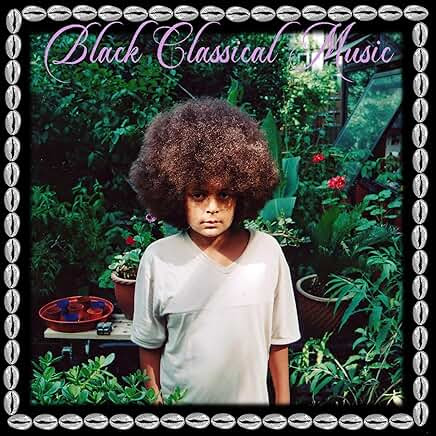
Yussef Dayes: Black Classical Music.  Ravenswood Recordings (UK) – Nonesuch (USA). As evidenced by the title of his new album, London-born drummer and composer Yussef Dayes (b. 1993) has a high regard for the history and heritage of jazz. "What is jazz?” asks the young drummer. “Birthed in New Orleans, born in the belly of the Mississippi River, rooted in the gumbo pot of the Caribbean, South American culture, and African rituals. Continuing a lineage of Miles Davis, Rahsaan Roland Kirk, Nina Simone, John Coltrane, Louis Armstrong -- music that is forever evolving limitless in its potential… Chasing the rhythm of drums that imitated one's heartbeat, the melodies for the mind and spirit, the bass for the core. A regal sound for this body of music." And that is what you hear throughout the 74 minutes of this eclectic, energetic, enthusiastic album. This is optimistic music that can’t help but lift your spirits. Even if you don’t consider yourself a jazz fan, you just might want to give Black Classical Music a listen.


Fauré: Nocturnes and Barcarolles. Marc-Andre Hamelin, piano. Hyperion CDA 68331/2. The French composer Gabriel Fauré (1845-1924) is a composer who, although relatively well known to most classical music lovers, nevertheless seems to be under-appreciated. Perhaps he needed to write some symphonies; whatever the reason, he certainly was a marvelous composer who created music of great beauty and refinement. The piano music of Fauré is certainly far less frequently recorded than that of Beethoven, Chopin, or some of the other usual suspects, so I think we can applaud Hamelin and Hyperion for bringing us such a fine collection. As we have come to expect from Hyperion, everything about this release is first class. The cover features some beautiful art by Monet, the booklet presents useful information about every individual track on the two CDs as well as some biographical information about the artists, and the engineering is excellent. For those who enjoy piano music, this new release is one that you really ought to hear, especially if you have not yet experienced the magical music of that underappreciated master, Gabriel Fauré.   


Nitai Hershkovits: Call on the Old Wise. Nitai Hershkovits, piano. ECM 2779 551 5448

The music on Call on the Old Wise has for the most part a low-key, almost conversational feel to it. There is no banging on the keys, no breakneck tempi, no dissonant tone clusters. That said, the improvisatory nature of much of the music is always evident, but comes across to the listener more as directed and creative, a balanced combination of preparation and inspiration. Hershkovits draws from influences, ranging from his work in jazz contexts to his background in classical music. From track to track, the music varies, but never loses its listenable, playful, charming, quality. Hershkovits credits inspirations as seemingly disparate as the late jazz piano jazz legend Chick Corea and Russian composers Rachmaninoff and Scriabin as prominent influences. With no liner notes but beautiful ECM sound, Call on the Old Wise is an unexpected jewel of a piano recording.


Stephan Micus: Thunder. ECM 2757. German-born Stephan Micus (b. 1953) is a unique musician and composer who has recorded nearly 30 albums, and on all but one of those recordings he played every instrument. He collects and studies instruments from all around the world. On Thunder, the sound is dominated by the four-meter-long Tibetan dung chen trumpet, an instrument he has recently learned and is using for the first time. It was the thunderous sound of this instrument that led to the album’s name and its nine tracks celebrating deities around the globe. The opening cut, A Song for Thor, evokes the thunderous power of a Norse god. As the album proceeds, it is fascinating to hear the sounds of the instruments – all played by Micus, through the miracle of overdubbing – instruments from Tibet, India, Burma, Borneo, Siberia, Japan, South America, Gambia, Namibia, Sweden, and Bavaria. Thunder sounds like powerful chamber music with a world music twist. Engineered to ECM’s usual high standard, it’s quite an impressive show as well.


Federico Mompou: Música callada (“Silent Music”): Book One [1959]; Book Two [1962]; Book Three [1962]; Book Four [1967]. Stephen Hough, piano. Hyperion CDA68362. In his fascinating collection of essays titled Rough Ideas (reviewed here), the British pianist Sir Stephen Hough wrote of the Spanish composer Federico Mompou (1893-1967): “The music of Federico Mompou is the music of evaporation. The printed page seems to have faded, as if the bar lines, time signatures, key signatures, and even the notes themselves have disappeared over a timeless number of years. There is no development of material, little counterpoint, no drama nor climaxes to speak of; and this simplicity of expression – elusive, evasive and shy – is strangely disarming. There is nowhere for the sophisticate to hide with Mompou. We are in a glasshouse, and the resulting transparency is unnerving, for it creates a reflection in which our face and soul can be seen.” Hough also observed that of his musical education, “I knew Mompou before I knew Mozart,” which perhaps give him something of a different perspective on the composer’s output. Some listeners will find the lack of hummable melodies a minus, while, others will find themselves entranced by the unique musical atmosphere evoked by Mompou’s writing and Hough’s performance, which has been captured in full, rich sound by the Hyperion engineering team. The customary top-quality liner notes and cover art that we have come to expect from Hyperion are the frosting on the cake.


Mozart: Piano Concerto No. 9 in E-flat major, “Jeunehomme,” K. 271Piano Concerto No. 24 in C minor K. 491. Lars Vogt, piano and conductor; Orchestre de Chambre de Paris. Ondine  ODE 1414-2. This is one of the final recordings made by the late German pianist Lars Vogt (1970-2022). The CD booklet includes an interview with the recording producer Christophe Franke, a good friend of Vogt’s who points out that at the time Vogt recorded this album, he was already undergoing chemotherapy. “He came to Paris with noticeably less hair, with grey skin, a pale complexion. And yet, or precisely for this reason, Lars absolutely wanted to record this album. For all the unshakable optimism that Lars radiated at all times, he knew that he probably had no chance. But he believed that a miracle perhaps would occur. This ambivalence was in the air the whole time: the hope in the impossible and at the same time the knowledge that it probably would be futile.” Is there any better capsule description of the music on this program? These two concertos manage to intermingle feelings of hope and hopelessness while expressing both with deft artistry, both in their composition (thanks to Mozart) and their performance (thanks to Vogt and the Chamber Orchestra of Paris). The engineers and producers also deserve special mention for the pleasing sound quality and touching liner notes, which combine to make this a remarkable release in every way. 


Arvo Pärt: Tractus.  Maria Listra, soprano; Estonian Philharmonic Chamber Choir; Tallinn Chamber Orchestra; Tönu Kaljuste, conductor. ECM New Series 2800 485 9166. Recorded in Tallinn’s Methodist Church last year, Tractus extends the line of Arvo Pärt albums on the ECM label that began with Tabula rasa in 1984, the recording which first brought Pärt’s music to widespread awareness.. This latest Pärt album features an emphasis on works for choir and chamber orchestra, although there are also compositions for the orchestra alone as well as one for soprano and orchestra. The texts are all based on scriptural, liturgical, or other traditional Christian texts. Although there are passages where the music exhibits some drama, it is for the most part reflective and inward-looking, very much in keeping with the spiritual focus of the texts. The sound quality is warm, spacious, and inviting. This is an album to treasure.


Bobo Stenson Trio: Sphere. ECM 2775 487 3808. The Swedish pianist Bobo Stenson (b. 1944) is probably unfamiliar to most classical music fans, but perhaps this latest album, which features a generous dollop of music by classical composers, will pique some interest, at least among classical fans who also have an interest in other forms of music – as I hope most who follow this blog do. On this new release, his trio open and close the album with a piece by the Swedish composer Per Nørgård (b. 1932) titled You Shall Plant a Tree. The trio’s bassist, Anders Jormin, contributes a couple of pieces, one of them (Unquestioned Answer – Charles Ives in Memoriam) inspired by Charles Ives, with a similar feeling of ambiguity; the other (Kingdom of Coldness) tending toward a more familiar jazz sound. Even more of a familiar type of jazz tune is Jung-Hee Woo’s The Red Flower, which swings gently along. Sven-Erik Bäck (1919-1994) was a Swedish classical composer. His Communion Psalm is an expressive piece that communicates a sense of reverence and ritual. From the late Norwegian pianist and composer Alfred Janson (1937-2019) comes Ky and Beautiful Madame Ky, restless and percussive. And then there is the Sibelius Valsette, his brief original piece for solo piano here stretched out by the trio more than five times its original length, improvised, given a whole new meaning and feeling. Beautiful recorded sound making this a highly recommendable release for both jazz and classical fans.


Veljo Tormis: Reminiscentiae.  Estonian Philharmonic Chamber Choir; Tallinn Chamber Orchestra; Tõnu Kaljuste, conductor. ECM New Series ECM 2783. Partly because the album covers such a long period of time, partly because Kaljuste has taken some music originally written for choir and arranged it for orchestra, and partly because Tormis wrote music of varying styles and moods, there is an impressive variety of music to be found in this collection. Kaljuste and his players have an intimate connection with Tormis’s sound world; in fact, the oldest composition on the album, the opening The Tower Bell in My Village, resulted from a 1978 commission from Kaljuste. “I went to his door holding in my hands the text by Fernando Pessoa and asked him to create a piece for a concert tour with my choir,” Kaljuste writes. “This album reflects upon our collaboration over the years. It is the first album that I have recorded since Veljo Tormis passed away.” This album is a labor of love, a lovingly performed and beautifully recorded labor of love.


Whitacre: Home. Voces8; Emma Denton, cello; Christopher Glenn, piano; Eric Whitacre, conductor. Decca 483 3970. The album begins with four brief pieces, beginning with Go, Lovely Rose, Whitacre’s first composition, followed by one of his most frequently performed pieces, The Seal Lullaby. The next song, Sing Gently, was composed during COVID-19 lockdown specially for Whitacre’s Virtual Choir, made up of more than 17,500 singers from 124 different countries. The fourth work on the album is Whitacre’s most recent composition, All Seems Beautiful to Me, based on a poem by Walt Whitman (from Song of the Open Road) celebrating the human spirit’s capacity for generosity and growth. It was commissioned by the United States Air Force Band and here receives its world premiere recording. We then arrive at the album’s main attraction, The Sacred Veil, which Whitacre composed along with his friend and frequent collaborator Charles Anthony Silvestri, who wrote most of the lyrics, which revolve around the death from cancer of his late wife, Julia Lawrence Silvestri (the remainder of the lyrics were written by Whitacre and Ms. Silvestri before her passing). As you might surmise from those circumstances, The Sacred Veil is an intensely personal, deeply moving composition. The Sacred Veil was originally conceived for a larger choir. In fact, the first recording of it, which Whitacre himself conducted (reviewed here), featured the larger forces of the Los Angeles Master Chorale. So what we have here in this Decca release is in essence a chamber version of the work. That is not to diminish its value, for VOCES8 does a beautiful job. In all honesty, I find The Sacred Veil to be one of the most moving musical works of the 21st century, and I highly recommend this new recording. 


Vaughan Williams: Symphony No. 7 (“Sinfonia Antartica”); Symphony No. 9 in E minor. Elizabeth Watts, soprano, BBC Symphony Chorus; BBC Symphony Orchestra, Martyn Brabbins, conductor. Hyperion CDA68405. Many classical music fans, or at least those conversant with the music of the composer Ralph Vaughan Williams, know that his Symphony No. 7 (“Sinfonia Antartica”) grew out of music that he had composed for the film Scott of the Antarctic, which portrayed the ill-fated South Pole expedition of Royal Navy officer Captain Robert Scott. Intrigued by the story, RVW decided to write a symphony based upon some of the themes from the music he had composed for the film. It is a grand and stirring composition full of spectacular sounds, featuring a large orchestra augmented by an organ, a wordless choir, a wordless soprano, gong, bells, glockenspiel, xylophone, piano, celesta, and if that’s not enough to test your stereo system, a wind machine (which on this recording is replaced by the recorded sounds of actual wind – a first in my experience). The engineering team on  this Hyperion release has met the challenge of capturing the power of the assembled forces. RVW’s Symphony No. 9 seems to be greatly underappreciated, which is a shame, for it is a marvelous work. Brabbins and his BBC forces make a strong case for this final symphony, in a performance that stands right up there with previous favorites such as Manze and Slatkin. If you are one of those casual RVW fans who might have overlooked his Symphony No. 9, this new Hyperion recording would be an excellent opportunity for you to make your acquaintance with something quite special indeed.

Dec 6, 2023

Earthdrawn Skies (CD Review)

by Karl Nehring

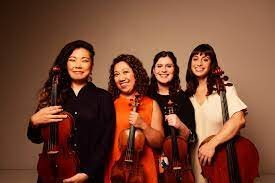
Hildegard von Bingen: Columba aspexit (arr. Alex Fortes); Eleanor Alberga: String Quartet No. 1; Komitas Vardapet: Armenian Folk Songs (arr. Sergei Aslamazian) - Yergink Ampel A (It’s Cloudy); Haprpan (Festive Song); Shoushigi (For Shoushing); Echmiadzni Bar (Dance from Echmiadznin); Kaqavik (The Partridge); Sibelius: String Quartet in D minor Op. 56, “Voces Intimae.” Aizuri Quartet (Emma Frucht and Miho Saegusa violins; Ayane Kozasa, viola; Karen Ouzounian, cello). Azica ACD-71359 

Having never heard of the Aizuri Quartet before receiving this disc for review, I was not quite sure what to expect. The program seemed to be a bit unusual, too, what with music from Hildegard, Komitas, and Sibelius – familiar names, but not ones I would have expected to find together on the same program – plus a quartet from a composer whose name was unfamiliar to me, Eleanor Alberga. Opening the booklet that came with the CD, I found these words of explanation from Aizuri’s cellist, Karen Ouzounian: “Earthdrawn Skies explores deep connections between humankind and the natural world through the distinct lenses of four composers forging personal relationships with the soil and the stars. These works by Hildegard von Bingen, Eleanor Alberga, Komitas Vardepet and Jean Sibelius are rooted in a sense of tradition and connection to the land, even as the composers seek something beyond their reach: an understanding of God, the physics of the cosmos, homeland, happiness. The music on this album draws from the earth as it reaches upward and outward. these composers share an impulse to understand the sky, the heavens, the larger things in life. This is music we have kept returning to as a quartet, as it speaks to us in deeply personal ways. We cherish playing this music together, and we hope it resonates as much with you as it does with us.”

The opening piece by Hildegard von Bingen (1098-1179) is an unusual choice for a string quartet in that rather than highlight the interplay among the four members, with the first and second violins swapping melodic lines in the upper registers while engaging in interplay with the darker tones of the viola and cello, weaving in and out of each other’s lines, the four players are bound tightly together. "The four of us have often talked about ‘singing through our instruments’ and how the quartet is one organism," remarks violinist Miho Saegusa. "Alex Fortes's arrangement of Hildegard's Columba aspexit presented us with a unique and challenging question, one we were excited to explore: how can we truly become one voice?" It’s an unusual sonority for a string quartet, but one that draws the listener in. What an effective way to begin an album!

Next on the docket is the three-movement String Quartet No. 1 by Eleanor Alberga (b.1949), a Jamaican-born composer who lives and works in the UK. From the very first measures of the first movement it is clearly a work that in tone and texture stands in contrast from the Bingen that preceded it. The pace is frantic, the mood more abstract. The overall pattern is the familiar fast-slow-fast, the engaging second movement (the highlight of the piece, designated Expressivo, with wonder and yearning) being followed by the more frenetic finale, with its sharper rhythms and pizzicato passages (it is designated Frantically driven yet playful). It sounds like one of those pieces that would be especially rewarding to see performed live, observing the interactions of the four players.


Then comes another shift in pace and mood with the five brief (none over three minutes) folk songs by the Armenian Komitas Vardapet (1869-1935), usually known simply as “Komitas,” an Armenian musicologist, composer, music teacher, choir director, priest (thus the “Vardapet,”), whose actual given name was Soghomon Gevorki Soghomonyan. He is considered the father of Armenian classical music. These folk songs are lively and charming, enjoyable to hear as well as to play. "The music of Komitas gave us a sense of our roots, our homes and lands from which we were displaced, the contours and nuances of our language, the warmth and sorrow and ebullience of our families, a link between those who perished and those who are living," writes Ouzounian of the album's link to her Armenian heritage.


The album closes with the “Voces Intimae” quartet by Sibelius. As popular as his symphonies have become, his string quartet has never really caught on to the same degree. Some years back I read a fascinating book that I highly recommend titled Indivisible by Four: A String Quartet in Pursuit of Harmony by Arnold Steinhardt, who was the first violinist of the famed Guarneri String Quartet. One of the tales from his account of his career with the group revolves around his repeated attempts to persuade the other members to add the Sibelius to the Guarneri’s repertoire. Surprisingly, it took many years before he was finally successful, as the other quartet members would not come to agreement that the Sibelius quartet was a worthy piece. My goodness! Violist Ayane Kokasa points out that “there are five movements instead of the traditional three or four. Each movement feels like a character piece, with the heart and soul of the work placed in three intimate and hushed chords tucked in the third movement. No matter how many times I listen to this piece, it feels new, like we are on the precipice of discovering something great.” It’s not one of those dramatic quartets that makes a memorable first impression; it’s a quartet that deserves and then rewards repeat listening. 

Azica Records deserves kudos for the liner notes that provide some insight into the music and musicians, the simple but compelling art that graces both cover and booklet, and the attractive sound quality. With Earthdrawn Skies, they have produced a CD that deserves and then rewards repeated listening.

Nov 30, 2023

Recent Releases No. 67 (CD Reviews)

by Karl Nehring

Tractus. Arvo Pärt: Littlemore Tractus; Greater Antiphons I-VII; Cantique des degrés; Sequentia; L’abbé Agathon;These Words…; Veni creator; Vater unser. Maria Listra, soprano; Estonian Philharmonic Chamber Choir; Tallinn Chamber Orchestra; Tönu Kaljuste, conductor. ECM New Series 2800 485 9166

Recorded in Tallinn’s Methodist Church last year, Tractus extends the line of Arvo Pärt albums on the ECM label that began with Tabula rasa in 1984, the recording which first brought Pärt’s music to widespread awareness. I was in graduate school back then, working weekends as a security guard at a factory. Late one night as I drove from the main plant to check on an off-site location while listening to classical music on WOSU-FM, they played music from that album, which featured not only classical violinist Gidon Kremer but also jazz pianist Keith Jarrett. I was transfixed by Pårt’s music, becoming an immediate fan. I purchased the CD that very week and went on to acquire dozens more over the next four decades – and have never been disappointed. This latest Pärt album, Tractus, features an emphasis on works for choir and chamber orchestra, although there are also compositions for the orchestra alone as well as one for soprano and orchestra. The texts (all of which are included in the CD booklet) are all based on scriptural, liturgical, or other traditional Christian texts. Although there are passages where the music exhibits some drama, it is for the most part reflective and inward-looking, very much in keeping with the spiritual focus of the texts. The sound quality is warm, spacious, and inviting. This is an album to treasure.

Lise Davidsen: Christmas from Norway. Adolphe Adam: O Helge natt (O Holy Night in Swedish); Humperdinck: Weihnachten; Franz Xaver Gruber/Josef Mohr: Silent Night; Gustaf Nordqvist/Edvard Evers: Jul, jul, strålande julDeilig er Jorden (trad. folk tune, lyrics by Bernhard Severin Ingemann); Mitt Herte Alltid Vanker (trad. folk tune, lyrics by Hans Adolph Brorson); Julvisa (No. 4 from Viisi joululaulua Op. 1 by Sibelius, lyrics by Zachris Topelius); Bach: Jesu Joy of Man’s Desiring (lyrics by Martin Janus); Reger: Maria Wiegenlied (lyrics by Martin Boelitz); Bach/Gounod: Ave Maria; Hugo Wolf: Schlafendes Jesuskind (lyrics by Eduard Mörike); The First Noël(trad.); John Francis Wade: O Come All Ye Faithful; Adam: O Holy Night. Lise Davidsen, soprano; Norwegian Soloists’ Choir (conductor, Simon Arlasjö); Norwegian National Opera Children’s Choir (conductor, Edle Stray-Pedersen); Norwegian Radio Orchestra; Christian Eggen, conductor. Decca 485 4358


“Christmas is how I got into music,” explains the Norwegian soprano Lise Davidsen (b. 1987), one of the foremost opera stars of our day, “we listened to all kinds of music: choral music, popular music, and the Norwegian songs I sing on this album.” She remembers Christmas services at her hometown church in Stokke: “I remember getting my first solo there, and when I was older, singing O Holy Night for the first time. I was still singing it there on Christmas Eve in my late twenties, well into my career. They were happy I kept going back but for me it was an essential part of the spirit of Christmas.” She concludes her liner booklet note by remarking, “For Scandinavians, Christmas is the white light we need in the middle of a long winter. Perhaps that’s why we embrace it. And we really do embrace it.” She opens and closes the album with O Holy Night, first in Swedish and then in English – reflecting the special place that song holds in her memory of Christmas. What sets this album apart from many other Christmas albums  -- beyond just the wondrous quality of Davidsen’s voice, that is – is the variety of music. This is not just your typical collection of popular carols. Moreover, the musical settings vary; some with orchestra, some with choir, some with children’s choir. Even if, like me, you already have a number of Christmas albums in your collection, you really ought to give this one serious consideration.

Miracle of Miracles: Music for Hanukkah. Trad., arr. Robert Applebaum: Oh Chanukah/Y'Mei Hachanukah; Trad., arr. Steve Barnett: S’vivon; Trad., arr. Mark Zuckerman: O, ir kleyne likhtelekh; Gerald Cohen: Chanukah Lights: Applebaum: Haneirot Halalu; Trad., arr.  Elliott Z. Levine): Al HaNisim; Trad., arr. Applebaum): Al Hanisim; Joshua Fishbein: Al Hanisim (For the Miracles); Daniel Tunkel: from Hallel Cantata - I. Hal’luyah! (Psalm 113)II. B’tzeit Yisrael (Psalm 114)III. Adonai Z’charanu (Psalm 115, vv. 12-18)VI. Hodu (Psalm 118, vv. 1-4); Trad., arr. Applebaum): Maoz Tzur; Levine: Lo V’Chayil; Vladimir Heyfetz (Arr. Zuckerman): Fayer, fayer; Samuel E. Goldfarb (arr. Applebaum): Funky Dreidl (I Had a Little Dreidl); Mikhl Gelbart (Arr. Zuckerman): I am a Little Dreydl (Ikh bin a kleyner Dreydl); Jonathan M. Miller: Biy’mey Mattityahu; Chaim Parchi (arr. Joshua Jacobson): Aleih Neiri; Stacy Garrop: Lo Yisa Goy. Chicago a cappella. Cedille CDR 9000022


Over the years I have accumulated a number of Christmas recordings – so many, in fact, that a few years ago I felt compelled to cull through them, decide which one I really wanted to keep, and take the rest in for trade. I took quite a few in go the store for trade, but still have more left than I will ever play over the holidays. Some of those Christmas CDs were sent to me for review over the years – but in all my years of being a reviewer (roughly 35, counting my time at both The $ensible Sound and now at Classical Candor), I was never sent one single Hanukkah CD for review until this one recently arrived in my mailbox. Miracle of miracles indeed! But receiving this disc after all that time made me stop and wonder why I had never been sent – or even really noticed, to be honest (of course, the fact that I am not Jewish is obviously a factor) any Hanukkah CDs before. Fortunately, in the liner booklet, Jonathan Miller, Chicago a cappella artistic director emeritus, at least partially answered my question: “Why, you might ask, aren’t there more albums of Hanukkah music like this? Finding the music is a big part of the challenge. It’s hard to locate works that meet all of our criteria: superb musical craftsmanship, a Hanukkah text, and a setting for a cappella mixed choir… Jewish choral music is a recent phenomenon, begun in earnest only about 200 years ago in Berlin, so there’s a simple quantity issue: we have much less repertoire to peruse than in other choral traditions. Given all of this, we are especially grateful for the composers and arrangers whose persistence and skill have given us the works found here.”

So what do we have here? Chicago a cappella is an ensemble of ten singers from among the Chicago area’s most accomplished classically trained choral singers and soloists. The group was originally founded in 1993 and has performed a wide variety of music, ranging from the Renaissance to the 21st century. Miracle of Miracles features a collection of songs from more than 25 years of the ensemble’s performances, arranged into a single program that replays the story of Hanukkah, from celebrations of the holiday itself through to its candles, miracles, religious observances, and traditional food and games. The music and the texts include a mix of both biblical and modern Hebrew, as well as Yiddish elements (and English) intertwined with American jazz and popular styles. The vocal styles and expressions represented on this album aim to capture fully the traditions of Hanukkah across the Diaspora and Jewish history. It’s a fascinating collection. One need not be Jewish to enjoy the skill and enthusiasm that these singers bring to these remarkable songs, such as the three versions of Al Hanisim or the energetic dreydl songs, perhaps the kinds of songs that might be most likely to strike a note of familiarity with some non-Jewish listeners. The liner notes include notes and texts for all of the compositions, and the engineering by Cedille’s audio wizard Bill Maylone is excellent as always, making this a fine production in every aspect, well worth a listen regardless of your faith or lack thereof.

Meet the Staff

Meet the Staff
John J. Puccio, Founder and Contributor

Understand, I'm just an everyday guy reacting to something I love. And I've been doing it for a very long time, my appreciation for classical music starting with the musical excerpts on the Big Jon and Sparkie radio show in the early Fifties and the purchase of my first recording, The 101 Strings Play the Classics, around 1956. In the late Sixties I began teaching high school English and Film Studies as well as becoming interested in hi-fi, my audio ambitions graduating me from a pair of AR-3 speakers to the Fulton J's recommended by The Stereophile's J. Gordon Holt. In the early Seventies, I began writing for a number of audio magazines, including Audio Excellence, Audio Forum, The Boston Audio Society Speaker, The American Record Guide, and from 1976 until 2008, The $ensible Sound, for which I served as Classical Music Editor.

Today, I'm retired from teaching and use a pair of bi-amped VMPS RM40s loudspeakers for my listening. In addition to writing for the Classical Candor blog, I served as the Movie Review Editor for the Web site Movie Metropolis (formerly DVDTown) from 1997-2013. Music and movies. Life couldn't be better.

Karl Nehring, Editor and Contributor

For nearly 30 years I was the editor of The $ensible Sound magazine and a regular contributor to both its equipment and recordings review pages. I would not presume to present myself as some sort of expert on music, but I have a deep love for and appreciation of many types of music, "classical" especially, and have listened to thousands of recordings over the years, many of which still line the walls of my listening room (and occasionally spill onto the furniture and floor, much to the chagrin of my long-suffering wife). I have always taken the approach as a reviewer that what I am trying to do is simply to point out to readers that I have come across a recording that I have found of interest, a recording that I think they might appreciate my having pointed out to them. I suppose that sounds a bit simple-minded, but I know I appreciate reading reviews by others that do the same for me — point out recordings that they think I might enjoy.

For readers who might be wondering about what kind of system I am using to do my listening, I should probably point out that I do a LOT of music listening and employ a variety of means to do so in a variety of environments, as I would imagine many music lovers also do. Starting at the more grandiose end of the scale, the system in which I do my most serious listening comprises Marantz CD 6007 and Onkyo CD 7030 CD players, NAD C 658 streaming preamp/DAC, Legacy Audio PowerBloc2 amplifier, and a pair of Legacy Audio Focus SE loudspeakers. I occasionally do some listening through pair of Sennheiser 560S headphones. I miss the excellent ELS Studio sound system in our 2016 Acura RDX (now my wife's daily driver) on which I had ripped more than a hundred favorite CDs to the hard drive, so now when driving my 2024 Honda CRV Sport L Hybrid, I stream music from my phone through its adequate but hardly outstanding factory system. For more casual listening at home when I am not in my listening room, I often stream music through a Roku Streambar Pro system (soundbar plus four surround speakers and a 10" sealed subwoofer) that has surprisingly nice sound for such a diminutive physical presence and reasonable price. Finally, at the least grandiose end of the scale, I have an Ultimate Ears Wonderboom II Bluetooth speaker and a pair of Google Pro Earbuds for those occasions where I am somewhere by myself without a sound system but in desperate need of a musical fix. I just can’t imagine life without music and I am humbly grateful for the technologies that enable us to enjoy it in so many wonderful ways.

William (Bill) Heck, Webmaster and Contributor

Among my early childhood memories are those of listening to my mother playing records (some even 78 rpm ones!) of both classical music and jazz tunes. I suppose that her love of music was transmitted genetically, and my interest was sustained by years of playing in rock bands – until I realized that this was no way to make a living. The interest in classical music was rekindled in grad school when the university FM station serving as background music for studying happened to play the Brahms First Symphony. As the work came to an end, it struck me forcibly that this was the most beautiful thing I had ever heard, and from that point on, I never looked back. This revelation was to the detriment of my studies, as I subsequently spent way too much time simply listening, but music has remained a significant part of my life. These days, although I still can tell a trumpet from a bassoon and a quarter note from a treble clef, I have to admit that I remain a nonexpert. But I do love music in general and classical music in particular, and I enjoy sharing both information and opinions about it.

The audiophile bug bit about the same time that I returned to classical music. I’ve gone through plenty of equipment, brands from Audio Research to Yamaha, and the best of it has opened new audio insights. Along the way, I reviewed components, and occasionally recordings, for The $ensible Sound magazine. Most recently I’ve moved to my “ultimate system” consisting of a BlueSound Node streamer, an ancient Toshiba multi-format disk player serving as a CD transport, Legacy Wavelet II DAC/preamp/crossover, dual Legacy PowerBloc2 amps, and Legacy Signature SE speakers (biamped), all connected with decently made, no-frills cables. With the arrival of CD and higher resolution streaming, that is now the source for most of my listening.

Ryan Ross, Contributor

I started listening to and studying classical music in earnest nearly three decades ago. This interest grew naturally out of my training as a pianist. I am now a musicologist by profession, specializing in British and other symphonic music of the 19th and 20th centuries. My scholarly work has been published in major music journals, as well as in other outlets. Current research focuses include twentieth-century symphonic historiography, and the music of Jean Sibelius, Ralph Vaughan Williams, and Malcolm Arnold.

I am honored to contribute writings to Classical Candor. In an age where the classical recording industry is being subjected to such profound pressures and changes, it is more important than ever for those of us steeped in this cultural tradition to continue to foster its love and exposure. I hope that my readers can find value, no matter how modest, in what I offer here.


Bryan Geyer, Technical Analyst

I initially embraced classical music in 1954 when I mistuned my car radio and heard the Heifetz recording of Mendelssohn's Violin Concerto. That inspired me to board the new "hi-fi" DIY bandwagon. In 1957 I joined one of the pioneer semiconductor makers and spent the next 32 years marketing transistors and microcircuits to military contractors. Home audio DIY projects remained a personal passion until 1989 when we created our own new photography equipment company. I later (2012) revived my interest in two channel audio when we "downsized" our life and determined that mini-monitors + paired subwoofers were a great way to mate fine music with the space constraints of condo living.

Visitors that view my technical papers on this site may wonder why they appear here, rather than on a site that features audio equipment reviews. My reason is that I tried the latter, and prefer to publish for people who actually want to listen to music; not to equipment. My focus is in describing what's technically beneficial to assure that the sound of the system will accurately replicate the source input signal (i. e. exhibit high accuracy) without inordinate cost and complexity. Conversely, most of the audiophiles of today strive to achieve sound that's euphonic, i.e. be personally satisfying. In essence, audiophiles seek sound that's consistent with their desire; the music is simply a test signal.

Mission Statement

It is the goal of Classical Candor to promote the enjoyment of classical music. Other forms of music come and go--minuets, waltzes, ragtime, blues, jazz, bebop, country-western, rock-'n'-roll, heavy metal, rap, and the rest--but classical music has been around for hundreds of years and will continue to be around for hundreds more. It's no accident that every major city in the world has one or more symphony orchestras.

When I was young, I heard it said that only intellectuals could appreciate classical music, that it required dedicated concentration to appreciate. Nonsense. I'm no intellectual, and I've always loved classical music. Anyone who's ever seen and enjoyed Disney's Fantasia or a Looney Tunes cartoon playing Rossini's William Tell Overture or Liszt's Hungarian Rhapsody No. 2 can attest to the power and joy of classical music, and that's just about everybody.

So, if Classical Candor can expand one's awareness of classical music and bring more joy to one's life, more power to it. It's done its job. --John J. Puccio

Contact Information

Readers with polite, courteous, helpful letters may send them to classicalcandor@gmail.com

Readers with impolite, discourteous, bitchy, whining, complaining, nasty, mean-spirited, unhelpful letters may send them to classicalcandor@recycle.bin.

"Their Master's Voice" by Michael Sowa

"Their Master's Voice" by Michael Sowa