Piano music by Couperin, Schumann, Glass, and Satie. Simone Dinnerstein, piano. Orange Mountain Music 0156.
By John J. Puccio and Karl W. Nehring
The music according to John:
As you probably know, American classical pianist Simone Dinnerstein loves to do theme albums. The titles alone give you the idea: An American Mosaic, A Character of Quiet, Bach: Strange Beauty, Mozart in Havana, Something Almost Being Said, Night, Bach Re-Invented, Broadway - Lafayette, and now Undersong. Of course, she has done more traditional albums as well, like Bach’s Goldberg Variations and Inventions and Sinfonias, and Beethoven’s Complete Works for Piano and Cello (with cellist Zuill Bailey). But lately, as her name and fame have grown, she has increasingly pursued theme albums.
Undersong is a term I was unfamiliar with, so I looked it up. The Free Dictionary calls it “an accompanying secondary melody”; or “a nuanced meaning.” Merriam-Webster says it’s “a subordinate melody or part; especially, a droning accompaniment or undertone. A refrain.” Ms. Dinnerstein apparently goes with “refrain.” As she says, “Couperin, Schumann, Glass, and Satie constantly revisit the same material, worrying at, shifting it to different harmonies and into different rhythmic shapes. Working with this music in the fall of 2020 was a constant reminder that in my afternoon walk in the Green-wood Cemetery, I was quite literally treading a familiar path every day, a path that nonetheless had changed almost imperceptibly every time I left the house.” Thus, we have the shifting, sometimes hidden texts of these musical pieces with refrains. The whole idea may seem a bit morose (starting with Ms. Dinnerstein’s black-and-white cover photo surrounded by tombstones and looking for all the world like Morticia Addams), but, then, the whole pandemic has been a pretty morose experience.
Nevertheless, whether or not you buy into the slightly murky spirit of the “undersong” business, you can’t deny that Ms. Dinnerstein’s handling of the material is thoughtful, emotional yet restrained, and unfailingly sensitive. Thus informed, we begin with Les Barricades Mysterieuses (“The Mysterious Barricades”) that the French Baroque composer Francois Couperin wrote in 1717. Like its title, the music is evocative, and Ms. Dinnerstein makes the most of it.
Next is an equally famous piece, Arabesque, Op. 18, written by Robert Schumann in 1839. The composer wrote it during a particularly stormy period of his life during which his future wife Clara’s father wanted no part of him as a son-in-law. The music reflects these turbulent yet tender times, and Ms. Dinnerstein adds her own affectionate touch and occasional barb.
Philip Glass comes after that with his solo piano work, Mad Rush (1979). Ms. Dinnerstein describes the music of the disc as the kind to get lost in, and that’s no better expressed than in the Glass piece. It’s kind of looking-glass music (pun intended) with ripples and reflections of all sorts. Ms. Dinnerstein’s gentle yet firm approach has us drifting through a kaleidoscope of musical colors.
Then we get more from Couperin, Tic Toc Choc, a whimsical representation of the rhythms of a clock. Given its eighteenth-century origins, the piece sounds surprisingly modern in Ms. Dinnerstein’s hands.
Then, there’s Gnossienne No. 3 by French composer Erik Satie (1888). “Gnossienne” was a word Satie invented, probably to remind listeners of “gnostic” or spiritual knowledge or maybe of “gnossus” from ancient Crete. Whatever, it is intensely mystical and contemplative.
The program’s penultimate work is the longest, Schumann’s Kreisleriana, a selection of eight movements for solo piano (1838). Schumann regarded it as his favorite work. Here, Ms. Dinnerstein lets her hair down, so to speak, pursuing the sometimes tempestuous, sometimes tranquil segments with equally warmhearted vigor.
Ms. Dinnerstein concludes the disc, appropriately, with a refrain: Couperin’s Les Barricades Redux.
Adam Abeshouse produced and engineered the album, which he recorded in Ms. Dinnerstein’s home in Brooklyn, NY in November 2020. The piano, recorded somewhat closely, sounds honeyed and mellow, with a warm, rich quality that greatly complements the music. Then, too, a mildly resonant acoustic also contributes to the disc’s pleasures.
JJP
The music according to Karl:
American pianist Simone Dinnerstein (b. 1972) first came to my attention and to the attention of many, many others, as it would soon turn out back in 2007 when her recording of Bach’s Goldberg Variations was released on the Telarc label. It was a splendid recording for which I wrote an enthusiastic review in The $ensible Sound. The album shot to the top of Billboard’s classical CD best-sellers list. I’d love to say that its success was in part attributable to my review, but I have every confidence that the good readers of Classical Candor are nowhere near so gullible as to believe such blatant blather. Fast-forward 15 years and I find myself once again reviewing a recording by Ms. Dinnerstein, who has been busy during the pandemic, as Undersong is her third made during this trying time. Isolation can have some compensations for those prepared to make the best of their particular talents and opportunities, and Ms. Dinnerstein has certainly used her talents and opportunities to produce another splendid recording. In her brief liner note, she writes that “all of the music on this album consists of musical forms that have a refrain. Glass, Schumann, Couperin, and Satie constantly revisit the same material in these pieces, shifting it to different harmonies and into different rhythmic shapes. Undersong is an archaic term for a song with a refrain, and to me it also suggests a hidden text. Glass, Schumann, Couperin and Satie all seem to be attempting to find what they want to say through repetition, as though their constant change and recycling will focus the ear and the mind. This is music to get lost in.” She goes on to compare that repetition to her daily afternoon walk through Green-wood Cemetery in Brooklyn, where she treads the same path day after day (the B&W cover photo features her posing there on the cemetery path).
Despite that talk of solitary cemetery strolls, the music she has chosen is not morose. The piece by Francois Couperin that opens and closes the album is ruminative, though. Indeed, it would seem that framing the album this way is evidence of a deft artistic touch, the pianist’s way of communicating that she intending her program to be understood as a framed musical composition that she has put together purposefully, beginning and ending a musical journey with something on her mind. Besides, Les Barricades Mysterieuses is an entrancing composition, well worth hearing played twice, ever so slightly slowly to finish the program. Between those opening and closing tunes, there is a varied program that spans the centuries. Following the opening Couperin, Schumann’s Arabesque seems somehow to sustain a similar feeling despite being dissimilar in style. The pace then picks up as Dinnerstein leans into the pulsing rhythms of Philip Glass’s Mad Rush. I know there are some who are wary of anything by Glass, but to my ears at least, his piano music represents some of the best of his output, and Mad Rush is an excellent piece that sounds perfectly placed in this program. After a brief bon-bon from Couperin, we then come to the longest composition, taking up more than half the time on the CD, Schumann’s Kreisleriana, which consists of eight sections. The music and the mood here are certainly different from the Glass, the Satie, or even the other Schumann, but I quibble. Others may find it more perfectly blended in than did I. My only other quibble is with the liner notes, which are quite brief. It would have been rewarding to have some more insight from Ms. Dinnerstein as to how she came to choose the particular composers and compositions and why she presented them in the order she chose for her program. Still, when you come down to it, this is a really nice release, with a well-played, well-recorded, and thoughtfully chosen program -- music to get lost in.
KWN
To listen to a brief excerpt from this album, click below:
By Karl W. Nehring
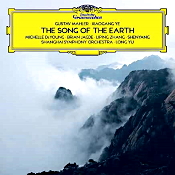
Gustav Mahler | Xiaogang Ye: The Song of the Earth. CD1 Mahler: Das Lied von der Erde (symphony for teneor, alto, and orchestra, text after Hans Bethge’s Die chinesischesche Flote); CD2 Xiaogang Ye: The Song of the Earth op. 47 (for soprano, baritone, and orchestra; text, Chinese poems of the Tang Dynasty). Michelle DeYoung, mezzo-soprano; Brian Jagde, tenor (Mahler); Liping Zhang, soprano; Shenyang, baritone (Xiaogang Ye); Long Yu, Shanghai Symphony Orchestra. Deutsche Grammophon 483 7452.
This release consists of two CDs. The first contains a performance of Gustav Mahler’s Das Lied von der Erde (“The Song of the Earth”), a work that should be familiar to most classical music lovers. The second contains a 21st century homage to and reimagining of Mahler’s opus by the Chinese composer Xiaogong Ye (b. 1955), who had been commissioned by conductor Long Yu to compose a new symphonic work based on the same poems that Mahler had used in creating Das Lied. But whereas Mahler created his German text based on Hans Bethge’s German translation of a French translation of Chinese poetry, Ye created his Chinese text based on those same Chinese poems. The liner notes include some observations by Yu about the similarities and differences between the two compositions. “Close comparisons are possible, with people able to see the double picture – how Europeans feel about love, pleasure, and death, and how the Chinese feel about the same things. In this project, you can hear that the last piece of the Mahler, Der Abscheid – ‘The Farewell’ – and the last piece in the Chinese work both purvey exactly the same emotion. [Though not through the same textures.] Mahler creates oil paintings, while Xiaogang Ye paints in watercolour. But the juxtaposition of these two pieces allows fruitful comparisons.”
As far as the performance on the Mahler disc goes, in all honesty I would have to say that it is satisfactory, but not one for which I could work up much enthusiasm. There are simply too many truly excellent versions available such as Klemperer on EMI, Oue on Reference Recordings, and Haitink on Philips, to name just a few from my personal pantheon (the Klemperer recording, with singers Fritz Wunderlich and Christa Ludwig, is one of the transcendent glories of recorded music – but I digress…) to keep me from making a strong recommendation for this one. In short, it is okay, but there are better versions to be had.
The main focus of interest for this release is the Chinese composition. Here we enter a different sound world from that of Mahler, based on different scales, a different language, and even several different instruments. Still, the overall feeling is not radically different, given that we are still listening to an essentially standard symphony orchestra, even though the language and some of the instrumentation might sound unfamiliar. The bottom line is that although this is not an essential recording, it is certainly an interesting recording. Mahler fans with a special fondness for Das Lied von der Erde might well gain additional appreciation for and insight into Mahler’s achievement by hearing this unique Chinese perspective on Mahler’s original source of inspiration. Moreover, one need not be a Mahler fan to enjoy this fascinating, colorful, at times exotic-sounding new composition by this relatively unknown (at least in the West) Chinese composer. A word of caution, however: for those new to the world of classical music, this well-engineered two-CD set could well be a gateway drug to mainline Mahler addiction.
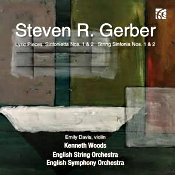
Gerber: Sinfonietta No. 1 (Piano Quintet, 1991) arr. Daron Hagen; String Sinfonia No. 1 (String Quartet No. 4, 1995) arr. Adrian Williams; Two Lyric Pieces for Violin and Strings (2005); String Sinfonia No. 2 (String Quartet No. 6, 2011) arr. Adrian Williams; Sinfonietta No. 2 (String Quartet No. 5, 2000) arr. Adrian Williams. Emily Davis, violin. Kenneth Woods, English String Orchestra, English Symphony Orchestra. Nimbus Alliance NI 6423.
As the liner notes point out, “most of the music on this recording consists of arrangements of chamber music pieces by Steven Gerber (1948-2015), commissioned by the Gerber Trust to help make performances of his music more accessible for chamber orchestras, smaller symphony orchestras and string orchestras. Taken together with Gerber’s beautiful Two Lyric Pieces for Violin and Strings, they provide a fascinating overview of Gerber’s development as a composer over most of the last two years of his working life.” That pretty well provides a succinct overview of this release, to which I would of course like to add a few thoughts and observations from my little listening enclave on this side of the pond.
For many music lovers, this is quite likely the first time they have ever heard of the late American composer Steven Gerber, nor are they likely familiar with any of his music. However, conductor Kenneth Woods, a Wisconsin native now living in the UK (who, by the way, wields a mean Fender Telecaster as well his conductor’s baton) has made it one of his personal and professional priorities to record works by lesser-known composers whose music he believes deserves wider exposure. This generously filled (73:07) disc is one of the fruits of his endeavors.
The program begins and ends with chamber pieces arranged for chamber orchestra, opening with Sinfonietta No. 1, an arrangement of Gerber’s Piano Quintet from 1991 and closing with Sinfonietta No. 2, an arrangement of his String Quartet No. 5 from 2000. The former is like a miniature symphony in four brief moments that total not much more than 15 minutes, the first three movements sounding somewhat spiky and playful, the fourth more dramatic. The latter, although in only two movements, is longer at just over 18 minutes. The first movement, marked Fantasy, is bold and dramatic, while the second movement consists of a remarkable set of theme and variations that highlight both Gerber’s ability to write interesting melodies and arranger Adrian Williams’s ability to bring them to colorful life.
Between the two Sinfoniettas we have as the centerpiece the only Gerber work on this CD that is performed in its original form, his Two Lyric Pieces for Violin and Strings, which as you might guess from the title are the pieces which tug most strongly at the heartstrings. Indeed, this is a composition so compelling that I was amazed never to have encountered it before. Violinist Emily Davis plays with heartfelt expression, but never cloyingly, with sensitive support from the strings of the English String Orchestra under the baton of Maestro Woods. What a wonderful musical discovery!
Preceding and following the Lyric Pieces are String Sinfonias Nos. 1 and 2, which are arrangements by Adrian Williams of Gerber’s String Quartets Nos. 4 and 6, respectively. These are more serious in tone than the other works on the program, more inwardly focused and intense. Evidently these were string quartets more along the lines of, say, Shostakovich rather than Haydn or Mozart. That is not to say the Sinfonias are difficult works, or especially prickly, it is simply that they are not as immediately engaging to to the ear as the other works on the program.
The overall sound quality is fine. Tonal balance leans a bit toward the warm side, but to my taste at least is a sound I prefer to overly bright and clinical. I can recall the days when the Nimbus label on a CD meant that it was recorded in “Ambisonic” sound, intended for multichannel playback, and often sounding distant and overly reverberant in two-channel systems. Those days are far behind us, thank goodness. For those looking for music off the beaten path but not too far out, Gerber is well worth an audition, especially the Two Lyric Pieces for Violin and Strings, a heretofore undiscovered gem.
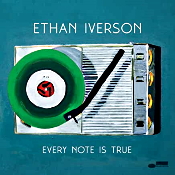
Every Note Is True. The More It Changes; The Eternal Verities; She Won’t Forget Me; For Ellen Raskin; Blue; Goodness Knows; Had I But Known; Merely Improbable; Praise Will Travel; At The Bells and Motley. Ethan Iverson, piano; Larry Grenadier, bass; Jack DeJohnette, drums. Blue Note B003473002.
Pianist Ethan Iverson first came to my attention as the pianist in the iconoclastic jazz trio The Bad Plus back around 2003 when I heaped praise on their major label debut album These Are the Vistas in my “More Jazz Than Not” column in The $ensible Sound. Could that really have been nearly 20 years ago? (I can imagine Iverson asking himself the same question from time to time…) I was less enamored of the group’s subsequent albums and did not think that much of it when I read about Iverson leaving the group in 2017. In 2018, I enjoyed an ECM album he recorded as part of a quartet with trumpeter Tom Harrell (Common Practice, ECM 2643), and somewhere over the past year or two I started following him on Twitter, where I discovered that in addition to his talents as a musician, Iverson has also blossomed into a writer, critic, interviewer, and blogger of note; I would strongly suggest those with an interest in jazz to check out his website at ethaniverson.com.
The moment I saw on Twitter that he was coming out with a new trio album on the venerable Blue note label with Larry Grenadier on bass and none other than drum grandmaster Jack DeJohnette, I immediately pre-ordered it and began counting the days before it would show up in my mailbox. The Blue Note “First Look” promotional video (https://www.youtube.com/watch?v=Aj8JCkxUQdU) ratcheted up my anticipation even higher. When it arrived, though, would it live up to my expectations?
In a word, indeed. I have always been a big fan of jazz piano trio albums, and this one is something special. The opening little vocal ditty, “The More It Changes,” with lyrics written by Iverson’s wife, the writer Sarah Deming, and performed by Iverson on the piano with vocals by Iverson, Deming, and a host of their friends (phoned in), is something I thought would wear on me after a few listens, but the more I listen, the more it touches me. Perfect for the pandemic, I guess. And then we get to the trio music. A few notes from Iverson, a flourish from DeJohnette, and then we are off, and right away there is a sense of a classical music vibe. There are echoes of Bach, but yet it is clearly jazz. As the program proceeds, the interplay among the three musicians is fascinating. None of them is showing off, but each of them is exhibiting mastery. The music just flows out of them. Gradually, the influence of baroque and classical gradually shifts until by the time we get to the final track, “At the Bells and Motley,” we are in blues territory.
Adding to the appeal of the album is the top-notch engineering. It was recorded by Andreas K. Meyer with the assistance of Shubham Mondal at the Clubhouse in Rhinebeck, NY, and is simply one of the finest-sounding trio recordings I have ever auditioned. I have argued before that jazz can be thought of as a form of chamber music; this album is a prime example and I recommend it with utmost enthusiasm.
The more it changes, the more it stays the same
We pass the ball to other ages, it’s how we play the game
You never sing alone when the rhythm catches you
The song goes on when the band goes home
And every note is true…
KWN
Also, Piano Concerto No. 4. Daniel Roth, organ; Jean-Francois Heisser, piano. Francois-Xavier Roth, Les Siecles. Harmonia Mundi 905348.
By John J. Puccio
Les Siecles (“The Centuries”) is a period-instrument orchestra founded by Francois-Xavier Roth in 2003. On the current disc, organist Daniel Roth plays an instrument built 1862. Pianist Jean-Francois Heisser plays a piano built in 1874. They perform the “Organ Symphony” of Camille Saint-Saens from 1886 and the Fourth Piano Concerto from 1875. The results are probably as close as we can get to something Saint-Saens’s audiences of the day might have heard.
A question arises, however, about why Harmonia Mundi held off for a decade or more in releasing these live recordings. They answer that question in the liner notes, saying “As partner of Les Siecles since 2017, Harmonia Mundi felt it was a must to reissue these fiery readings of two masterpieces in the great French Romantic tradition, for which Francois-Xavier Roth invited two eminent soloists.” So, basically, during the pandemic HM went into the Les Siecles archives and found two older live recordings they felt they should rerelease on their own label. The performances are certainly worthwhile, although I’m not convinced the live sound is up to Harmonia Mundi’s usual studio standards.
The first selection on the album is the Symphony No. 3 in C minor, “Organ,” Op. 78. Saint-Saëns called the work “a symphony with organ” and said "I gave everything to it I was able to give. What I have here accomplished, I will never achieve again." Apparently he knew what he was talking about because even though he lived for another thirty-five years, he never wrote another symphony, organ or otherwise.
Saint-Saens divided the work into two major parts, with two divisions in each part. It’s an odd arrangement, but it essentially works out to a conventional four-movement symphony. What’s more, although most people today know the work as the “Organ Symphony,” Saint-Saens himself labeled it Symphonie No. 3 "avec orgue" (with organ). In fact, the organ only plays a part in two of the four movements, the second and the last. But it makes enough of an impression for folks to remember it.
After an introductory first movement, the second-movement Adagio always reminds me of soft, warm waves flowing over and around one’s body on a tropical beach somewhere. Here’s where the organ makes its first entry, coming in with what should be huge, gentle, undulating washes of sound. Maestro Roth and his forces handle both movements pretty well, generating some interest in the otherwise rather bland Allegro and providing a gentle, poignant, comforting Adagio.
The two sections that comprise the finale can be fiery and exhilarating, if not a little bombastic, with the organ blazing the trail. Here, again, Maestro Roth, with his father, organist Daniel Roth, and Les Siecles do a fine job capturing the excitement of the score with a good forward thrust, a driving beat, and a wonderfully pulsating rhythm. When the organ enters in the final movement, it is as grand and imposing as we would expect it to be; it is also passionate and vibrant, pretty much dominating the orchestra, as it should. Overall, a good performance.
The second item on the agenda is the Concerto for Piano No. 4 in C minor, Op. 44. Although it is not the most popular of Saint-Saens’s five piano concertos (that honor probably goes to No. 2), it is surely one of his most-original, most-imaginative works. Featuring pianist Jean-Francois Heisser, one must first become accustomed to the deeper yet less-mellifluent sound of the period piano. Together with the stormy, close-up recording, the music makes a grand sweep across the stage. One clearly hears the elements of traditional Classicism as well as (for Saint-Saens, anyway) contemporary Romanticism in Heisser’s playing. It’s a lovely performance.
Artistic Director Jiri Heger and sound engineer Anne-Sophie Versneyen recorded the music live at the eglise Saint-Sulpice, Paris (symphony) in May 2010 and at the Opera-Comique, Paris in June 2009. The sound is typically “live”; that is, it’s precise, close-up, enormously dynamic, and a trifle edgy. Imaging seems kind of all over the place, with little dimensionality and a limited stereo spread. (For being so close, it’s not very wide.) The organ, though loud enough, doesn’t seem deep enough; and the piano appears much too close (the recording a little louder, too). On the plus side, we hear no extraneous noises from the audience, and the engineers mercifully edited out any applause. As these older recordings do not quite meet Harmonia Mundi’s usual studio standards, perhaps the company will consider re-recording the pieces themselves (with much the same performers but without the live audience).
JJP
To listen to a brief excerpt from this album, click below:
John J. Puccio, Founder and Contributor
Understand, I'm just an everyday guy reacting to something I love. And I've been doing it for a very long time, my appreciation for classical music starting with the musical excerpts on the Big Jon and Sparkie radio show in the early Fifties and the purchase of my first recording, The 101 Strings Play the Classics, around 1956. In the late Sixties I began teaching high school English and Film Studies as well as becoming interested in hi-fi, my audio ambitions graduating me from a pair of AR-3 speakers to the Fulton J's recommended by The Stereophile's J. Gordon Holt. In the early Seventies, I began writing for a number of audio magazines, including Audio Excellence, Audio Forum, The Boston Audio Society Speaker, The American Record Guide, and from 1976 until 2008, The $ensible Sound, for which I served as Classical Music Editor.
Today, I'm retired from teaching and use a pair of bi-amped VMPS RM40s loudspeakers for my listening. In addition to writing for the Classical Candor blog, I served as the Movie Review Editor for the Web site Movie Metropolis (formerly DVDTown) from 1997-2013. Music and movies. Life couldn't be better.
Karl Nehring, Editor and Contributor
For nearly 30 years I was the editor of The $ensible Sound magazine and a regular contributor to both its equipment and recordings review pages. I would not presume to present myself as some sort of expert on music, but I have a deep love for and appreciation of many types of music, "classical" especially, and have listened to thousands of recordings over the years, many of which still line the walls of my listening room (and occasionally spill onto the furniture and floor, much to the chagrin of my long-suffering wife). I have always taken the approach as a reviewer that what I am trying to do is simply to point out to readers that I have come across a recording that I have found of interest, a recording that I think they might appreciate my having pointed out to them. I suppose that sounds a bit simple-minded, but I know I appreciate reading reviews by others that do the same for me — point out recordings that they think I might enjoy.
For readers who might be wondering about what kind of system I am using to do my listening, I should probably point out that I do a LOT of music listening and employ a variety of means to do so in a variety of environments, as I would imagine many music lovers also do. Starting at the more grandiose end of the scale, the system in which I do my most serious listening comprises Marantz CD 6007 and Onkyo CD 7030 CD players, NAD C 658 streaming preamp/DAC, Legacy Audio PowerBloc2 amplifier, and a pair of Legacy Audio Focus SE loudspeakers. I occasionally do some listening through pair of Sennheiser 560S headphones. I miss the excellent ELS Studio sound system in our 2016 Acura RDX (now my wife's daily driver) on which I had ripped more than a hundred favorite CDs to the hard drive, so now when driving my 2024 Honda CRV Sport L Hybrid, I stream music from my phone through its adequate but hardly outstanding factory system. For more casual listening at home when I am not in my listening room, I often stream music through a Roku Streambar Pro system (soundbar plus four surround speakers and a 10" sealed subwoofer) that has surprisingly nice sound for such a diminutive physical presence and reasonable price. Finally, at the least grandiose end of the scale, I have an Ultimate Ears Wonderboom II Bluetooth speaker and a pair of Google Pro Earbuds for those occasions where I am somewhere by myself without a sound system but in desperate need of a musical fix. I just can’t imagine life without music and I am humbly grateful for the technologies that enable us to enjoy it in so many wonderful ways.
William (Bill) Heck, Webmaster and Contributor
Among my early childhood memories are those of listening to my mother playing records (some even 78 rpm ones!) of both classical music and jazz tunes. I suppose that her love of music was transmitted genetically, and my interest was sustained by years of playing in rock bands – until I realized that this was no way to make a living. The interest in classical music was rekindled in grad school when the university FM station serving as background music for studying happened to play the Brahms First Symphony. As the work came to an end, it struck me forcibly that this was the most beautiful thing I had ever heard, and from that point on, I never looked back. This revelation was to the detriment of my studies, as I subsequently spent way too much time simply listening, but music has remained a significant part of my life. These days, although I still can tell a trumpet from a bassoon and a quarter note from a treble clef, I have to admit that I remain a nonexpert. But I do love music in general and classical music in particular, and I enjoy sharing both information and opinions about it.
The audiophile bug bit about the same time that I returned to classical music. I’ve gone through plenty of equipment, brands from Audio Research to Yamaha, and the best of it has opened new audio insights. Along the way, I reviewed components, and occasionally recordings, for The $ensible Sound magazine. Most recently I’ve moved to my “ultimate system” consisting of a BlueSound Node streamer, an ancient Toshiba multi-format disk player serving as a CD transport, Legacy Wavelet II DAC/preamp/crossover, dual Legacy PowerBloc2 amps, and Legacy Signature SE speakers (biamped), all connected with decently made, no-frills cables. With the arrival of CD and higher resolution streaming, that is now the source for most of my listening.
Ryan Ross, Contributor
I started listening to and studying classical music in earnest nearly three decades ago. This interest grew naturally out of my training as a pianist. I am now a musicologist by profession, specializing in British and other symphonic music of the 19th and 20th centuries. My scholarly work has been published in major music journals, as well as in other outlets. Current research focuses include twentieth-century symphonic historiography, and the music of Jean Sibelius, Ralph Vaughan Williams, and Malcolm Arnold.
I am honored to contribute writings to Classical Candor. In an age where the classical recording industry is being subjected to such profound pressures and changes, it is more important than ever for those of us steeped in this cultural tradition to continue to foster its love and exposure. I hope that my readers can find value, no matter how modest, in what I offer here.
Bryan Geyer, Technical Analyst
I initially embraced classical music in 1954 when I mistuned my car radio and heard the Heifetz recording of Mendelssohn's Violin Concerto. That inspired me to board the new "hi-fi" DIY bandwagon. In 1957 I joined one of the pioneer semiconductor makers and spent the next 32 years marketing transistors and microcircuits to military contractors. Home audio DIY projects remained a personal passion until 1989 when we created our own new photography equipment company. I later (2012) revived my interest in two channel audio when we "downsized" our life and determined that mini-monitors + paired subwoofers were a great way to mate fine music with the space constraints of condo living.
Visitors that view my technical papers on this site may wonder why they appear here, rather than on a site that features audio equipment reviews. My reason is that I tried the latter, and prefer to publish for people who actually want to listen to music; not to equipment. My focus is in describing what's technically beneficial to assure that the sound of the system will accurately replicate the source input signal (i. e. exhibit high accuracy) without inordinate cost and complexity. Conversely, most of the audiophiles of today strive to achieve sound that's euphonic, i.e. be personally satisfying. In essence, audiophiles seek sound that's consistent with their desire; the music is simply a test signal.
Mission Statement
It is the goal of Classical Candor to promote the enjoyment of classical music. Other forms of music come and go--minuets, waltzes, ragtime, blues, jazz, bebop, country-western, rock-'n'-roll, heavy metal, rap, and the rest--but classical music has been around for hundreds of years and will continue to be around for hundreds more. It's no accident that every major city in the world has one or more symphony orchestras.
When I was young, I heard it said that only intellectuals could appreciate classical music, that it required dedicated concentration to appreciate. Nonsense. I'm no intellectual, and I've always loved classical music. Anyone who's ever seen and enjoyed Disney's Fantasia or a Looney Tunes cartoon playing Rossini's William Tell Overture or Liszt's Hungarian Rhapsody No. 2 can attest to the power and joy of classical music, and that's just about everybody.
So, if Classical Candor can expand one's awareness of classical music and bring more joy to one's life, more power to it. It's done its job. --John J. Puccio
Contact Information
Readers with polite, courteous, helpful letters may send them to classicalcandor@gmail.com
Readers with impolite, discourteous, bitchy, whining, complaining, nasty, mean-spirited, unhelpful letters may send them to classicalcandor@recycle.bin.


 As you probably know, American classical pianist Simone Dinnerstein loves to do theme albums. The titles alone give you the idea: An American Mosaic, A Character of Quiet, Bach: Strange Beauty, Mozart in Havana, Something Almost Being Said, Night, Bach Re-Invented, Broadway - Lafayette, and now Undersong. Of course, she has done more traditional albums as well, like Bach’s Goldberg Variations and Inventions and Sinfonias, and Beethoven’s Complete Works for Piano and Cello (with cellist Zuill Bailey). But lately, as her name and fame have grown, she has increasingly pursued theme albums.
 American pianist Simone Dinnerstein (b. 1972) first came to my attention and to the attention of many, many others, as it would soon turn out back in 2007 when her recording of Bach’s Goldberg Variations was released on the Telarc label. It was a splendid recording for which I wrote an enthusiastic review in The $ensible Sound. The album shot to the top of Billboard’s classical CD best-sellers list. I’d love to say that its success was in part attributable to my review, but I have every confidence that the good readers of Classical Candor are nowhere near so gullible as to believe such blatant blather. Fast-forward 15 years and I find myself once again reviewing a recording by Ms. Dinnerstein, who has been busy during the pandemic, as Undersong is her third made during this trying time. Isolation can have some compensations for those prepared to make the best of their particular talents and opportunities, and Ms. Dinnerstein has certainly used her talents and opportunities to produce another splendid recording. In her brief liner note, she writes that “all of the music on this album consists of musical forms that have a refrain. Glass, Schumann, Couperin, and Satie constantly revisit the same material in these pieces, shifting it to different harmonies and into different rhythmic shapes. Undersong is an archaic term for a song with a refrain, and to me it also suggests a hidden text. Glass, Schumann, Couperin and Satie all seem to be attempting to find what they want to say through repetition, as though their constant change and recycling will focus the ear and the mind. This is music to get lost in.” She goes on to compare that repetition to her daily afternoon walk through Green-wood Cemetery in Brooklyn, where she treads the same path day after day (the B&W cover photo features her posing there on the cemetery path).