Jordi Savall, Le Concert des Nations. Alia Vox AVSA9946 (3-disc set).
By John J. Puccio
The Spanish conductor, composer, and violist Jordi Savall (b. 1941) has been a leader in the fields of historically informed performances and period-instrument bands for a very long time, having formed Hesperion XX (now XXI) in 1974, La Capella Reial de Catalunya in 1987, and Le Concert des Nations in 1989. In his career he’s made over a hundred recordings (mostly for EMI, Astree, and more recently for his own label, Alia Vox) and appeared in just about every concert house everywhere in the world. While usually sticking with Baroque and early classical music, he has also branched out with music of the early Romantic Age, like these Beethoven symphonies. Here, with Symphonies Nos. 6-9, he follows his earlier set of Nos. 1-5 (2020).
Unlike some HIP conductors who take such an intensely academic approach to their music making that it tends to drain the life out of it or yet other conductors who seem committed to whipping through it so fast we don’t get time to appreciate it, Savall has always taken a different path. His style, though always well researched and enlightened, has also been unfailingly joyful and robust. Although his performances have not always sounded the most refined, they have always been delightful and heartfelt. And so it is with his Beethoven.
Of course, Savall isn’t the first one to record all of the Beethoven symphonies using period instruments, historically informed performance practices, accurately sized ensembles, technically correct bowing, and the composer’s own tempo markings. You’ll remember, Roger Norrington and his London Classical Players were among the first to attempt this feat back in the 1980’s. But not all HIP conductors succeed in making the music more enjoyable than those employing traditional interpretations using modern orchestras. Take, for instance, the matter of tempos. When Beethoven got older he embraced the newly patented metronome with a passion, perhaps to ensure that later generations would play his music the way he intended. Whatever, later generations were divided over the composer’s rather fast metronome markings, many critics suggesting that the metronome Beethoven used must have been faulty. Needless to say, as the nineteenth and early twentieth centuries wore on, conductors came to adopt their own tempos and pretty much ignored Beethoven’s. These days, thankfully, we have greater choice in such matters. Savall, for example, follows Beethoven’s markings pretty carefully and is within seconds of Norrington’s speeds in most movements. Yet Savall’s accounts couldn’t be more different from Norrington’s.
As the first disc in Savall’s set contains the Sixth Symphony “Pastorale,” it makes a good comparison. I have always felt it was the weakest of Norrington’s recordings because he followed Beethoven’s tempos so rigidly that it rather took away some of the gentle warmth of the music. Not so with Savall, whose quick tempos never sound fast and breathe new life into the score. Instead of sounding somewhat cold and sterile, as Norrington sounds to me in the Sixth, Savall’s version is far friendlier, more radiant, more alive. Indeed, I would count this recording among the best accounts of the “Pastorale” from anybody, HIP or traditional, and that includes my favorites from Bohm, Walter, Reiner, Jochum, Klemperer, and the rest. Savall's way with the “Arrival in the country” is full of good cheer; the “Scene at the brook” is tranquil and serene; the “Merry gathering of peasants” is sensibly spirited without appearing boisterous or rushed; the “Storm” is appropriately menacing: and the concluding “Shepherd's song” and “Happy feelings after the storm” are gentle, bucolic, and carefree, taken more effortlessly than most other period-instrument bands. Beethoven wanted us to picture the scenes of the “Pastorale” in our mind, and that’s exactly what Savall helps us do. Altogether, he makes a fine show of it, producing as good an interpretation as anyone’s and better than most.
Disc two gives us the Seventh and Eighth Symphonies. The Seventh, as you know, is the one that Beethoven himself said was one of his best pieces of work, the one whose second movement Allegretto became so popular that audiences would often demand it as an encore, and the one that Richard Wagner called the “apotheosis of the dance,” thanks to its bouncy, dance-like rhythms. It is a work that seems tailor-made for Maestro Savall, who generates thoroughly zesty results without sounding frenetic. His performance is much like the one I reviewed a short while back from von der Goltz and the Freiburg Baroque Orchestra, both of them conveying exuberance, spontaneity, and affection in equal measure.
Beethoven called No. 8 “my little Symphony in F,” and so audiences have referred to it for years. Compared to the more massive symphonies that precede and follow it, it really is somewhat small, being only about twenty-five to thirty minutes in length (although Savall gets through it in just under twenty-five minutes). It’s also one of the composer’s more seriously lighthearted works (with the exception of the final movement, at least), and the composer could never understand why it didn’t receive the same accolades as his longer symphonies did. I think it does get rather swallowed up by its surroundings. In any case, Savall provides the music with a healthy playfulness and vivacity, helping us to see it as a natural extension of and worthy successor to No 7.
The third and final disc in the set contains Beethoven’s crowning jewel, the Ninth Symphony. For me, this makes Savall’s account of the piece a tad disappointing because it’s the one symphony in the collection where the slightly faster-than-traditional speeds aren’t quite able to convey the full grandeur and opulence of the music. Remember when compact discs were first introduced, Sony and Philips, the co-developers of the CD, told us they designed it to hold about seventy-five minutes because they wanted the entire Ninth Symphony to fit on one disc. Well, Savall brings it in at just under sixty-three minutes, so there’s plenty of space to spare. Still, the recording makes a fascinating and worthwhile listening experience, and, overall, it’s better than most of the other historically informed, period-instrument interpretations of the work I’ve heard.
Savall opens the Ninth with a brawny vigor, where the timpani tend to dominate. The second movement, marked Molto vivace, is certainly that, very brisk and snappy. This seemed to me the most successful of the movements in its abundance of sparkle within a framework of elegant nobility. The third movement Adagio seemed a trifle brusque to me, too businesslike to be as moving as I’ve heard it. The final-movement Presto opens what has become one of the most-famous stretches of music in the whole of the classical world. Under Savall it appeared to me a trifle perfunctory; nevertheless, it provides a suitable introduction to the big choral number that follows. The soloists and chorus also serve the music well, although they are not as impressive as I’ve heard in some more-conventional performances.
The packaging is a fold-out Digipak sort of affair that’s about as easy to operate as an old road map. The booklet insert is over 270 pages long and written in practically every language known to Man. I found this document quite comprehensive and a welcome addition to the set. Just don’t try taking it out of the case; it’s a devil to put back in.
Producer and engineer Manuel Mohino recorded the symphonies at La Collegiale du Chateau de Cardona, Catalonia, Spain and the National Forum of Music, Wroclaw, Poland in 2020-21. Alia Vox chose to make it in hybrid SACD multichannel and stereo, depending on the equipment you use for playback. I listened in SACD two-channel stereo.
The sound (especially for Nos. 6, 7 and 9, recorded in Spain) is spacious, wide-ranging, smooth, dynamic, well balanced, and well defined. It is, in fact, about as good as one could want. The only minor caveat I found was that the soloists are recorded fairly closely. Nonetheless, the chorus doesn't shrill out on us. Compared to all the other period-instrument performances I’ve auditioned, the sound here is clearly the best, the most-realistic, so you really won’t do any better. No. 8, recorded separately from the others, is a tad more resonant and slightly less transparent than the others but still quite good.
JJP
To listen to a brief excerpt from this album, click below:
By Karl W. Nehring
Florence Price: Symphony No. 3 in C minor; The Mississippi River; Ethiopia’s Shadow in America. John Jeter, ORF Vienna Radio Symphony Radio Symphony Orchestra. Naxos 8.559879.
Florence Price: Symphonies Nos. 1 & 3. Yannick Nézet-Séguin, The Philadelphia Orchestra. Deutsche Grammophon B0034879-02.
The American composer Florence Beatrice Price (1887-1953) was born in Little Rock, Arkansas. As a child in the South, she was rejected by white teachers, so she received her first musical training from her mother. As the liner notes of the DG release explain, “because advanced training was largely unavailable to women of color in the South, 16-year-old Price was enrolled in the New England Conservatory in Boston, majoring in organ and piano performance (while following her mother’s advice to present herself as being of Mexican descent). [As an aside, watching the performance of some of our white GOP Senators during the confirmation hearings for Supreme Court nominee Ketanji Brown Jackson as I write these words leaves me more than a little angry and skeptical about racial
and political matters in 2022 America, I’m sorry to have to say but I just can’t in good conscience let it go unsaid…] At the NEC she was taught music theory by the institution’s director George Whitfield Chadwick, a leading figure of the so-called Second New England School of composers who had a special interest in African-American folk melodies and rhythms. He used a pentatonic melody resembling a spiritual in a symphony seven years before Dvorak’s “New World'' Symphony of 1893.”
Although what we have here are two recordings on different labels featuring performances of the same major work, Symphony No. 3 by, my intention is not at all to present this as any sort of competitive review. If anything, these CDs complement and even supplement each other. Other than the Symphony No. 3, of course, the two releases are completely different, the DG giving us Price’s Symphony No. 1 while the Naxos includes two of her orchestral suites. All of these works are well worth an audition, another way in which the releases complement more that they compete.
Let me first briefly discuss the music not in common between the two releases. In Symphony No. 1, you can hear echoes of Dvorak (and the influence of Chadwick, or at least I think that would be a reasonable guess), not that there’s anything wrong with that. In the third movement, however, rather than a traditional scherzo, Price treats us to a movement based on an African dance known as “Juba,” which involves syncopated rhythms and body slapping. Of course we do not get the latter from the orchestra, but there are some lively rhythms from the percussion section as the music moves along in lively fashion. Again, those who love the music of Dvorak (think, for example, of his Symphony No. 8, with its stretches of dance rhythms) will find much to love in this symphony. The two tone poems on the Naxos CD on the Naxos CD are also quite enjoyable. Although in The Mississippi River, Price works in quotations from several well-known spirituals and folk tunes, this is not a lighthearted romp; rather, it is a serious, thoughtful composition that bears repeated listening. Likewise, Ethiopia’s Shadow in America, one of the few compositions for which Price provided a written narrative, is colorfully scored and certainly enjoyable.
Symphony No. 3 (her Symphony No. 2, sadly enough, has been lost forever) sounds less overtly like Dvorak but still has that familiar idiomatic vibe. As the Naxos liner booklet explains, “a letter written before the symphony’s premiere offers one of the only first-hand accounts of Price’s compositional approach. ‘It is intended to be Negroid in character and expression,’ she wrote, but ‘no attempt has been made to project Negro music solely in the traditional manner.’ That is, she wanted to project aspects of her cultural heritage in a symphonic framework without making direct references to an existing body of folk songs and dances – a broad creative challenge broached by many composers around the world.” Like the 1st, it too has a Juba-themed third movement rather than a traditional scherzo. The end result is a remarkable symphony that is well deserving of not just one, but two excellent new recordings.
However, although both recordings are excellent, they vary significantly both musically and sonically. Nézet-Séguin takes a broader view of the first two movement than does Jeter, which is evident subjectively as you simply listen, with Nézet-Séguin seeming to draw things out and linger at times while Jeter moves things right along (although he never sounds actually hurried), and objectively as you note the timings: Nézet-Séguin 11:37 and 9:32 for the first two movements versus Jeter at 9:26 and 7:54. That is quite a difference in interpretation; to be honest, I am not sure which I prefer. I’ll just say that they are both enjoyable, and I will add that in the final two movements, the two conductors are within a few seconds of each other. Sonically, the DG release is clean, clear, and full-range, and the world-class Philadelphia Orchestra sounds large and in charge. However, you do not get a firm sense of the space in which the orchestra was recorded (Verizon Hall at the Kimmel Center for the Performing Arts in Philadelphia), which becomes evident when you listen to the Naxos release. The ORF Vienna Radio Symphony Orchestra was recorded in Studio 6 at the ORF Funkhaus in Vienna, and the recording gives you a sense of the space they were in, which at least for me, establishes a stronger bond with the orchestra. Although the RSO does not sound quite as large or opulent as the Philadelphia ensemble, they play this music with expressive power under the baton of Maestro Jeter, who has been an enthusiastic advocate for the music of Florence Price (he previously recorded her Symphonies Nos 1 and 4 with the Fort Smith Symphony for Naxos) .
Although it might sound like a reviewer copout, I really cannot pick one of these discs over the other. They really are complementary. Were some crazed wacko with an assault rifle to break into my home and force me to choose one or the other, I would probably pick the DG, because I would rather have the two symphonies; however, after he left with my Naxos disc in his backpack I would get on my computer and order a replacement copy of the Naxos, as both releases are musical delights that I simply could not live without, and as you might have guessed by now, I recommend them both with heartfelt enthusiasm. Just as we go to press, the DG recording has been awarded a Grammy for best classical recording of the year.
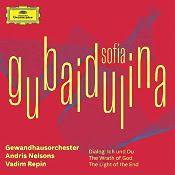
Gubaidulina: Dialog: Ich und Du; The Wrath of God; The Light of the End. Vadim Rapin, violin; Andris Nelsons, Gewandhausorchester Leipzig. Deutsche Grammophon 486 1457.
Ir is certainly quite a shift in both style and mood to go from the music of Florence Price to the music of Russian-born composer Sofia Gubaidulina (b. 1931), who has lived near Hamburg, Germany, for the past 30 years. While the music of Price is flowing and tuneful, the music of Gubaidulina is dense, dark, and at times almost explosive in its impact. However, there is another fascinating dimension to her music, as the liner notes explain: “Sofia Gubaidulina’s miuic exerts its fascination not least as the result of its profound spirituality. ‘Whenever I’m composing,’ the deeply religious nonagenerian admits, ‘I pray, no, I actually speak to God.’ Her works focus on our relationship with God and are private dialogues with the divine. This is also true of the three works that are all appearing here in world-premiere recordings.”
Some will no doubt recognize that Dialog: Ich und Du (Dialogue: I and You), which is the title of her Violin Concerto No. 3, is a reference to the philosopher Martin Buber’s book Ich und Du, which in its English translation, I and Thou, was quite influential in intellectual circles in the 1970s and beyond. The work was written for violinist Vadim Repin, who gave the world premiere in 2018. The performance on this recording is from the work’s German premiere in 2019. You can envision the work as a dialog between Repin’s violin, representing a human, and the full orchestra, representing the divine. There is dialogue, at times pleading, at times tender, until finally, at the end, the violin plays in hushed tones. (Submission? Gratitude? Ecstasy? Exhaustion?)
Next up is the powerful Wrath of God, which opens with a mighty blast from the brass section and builds up simple musical motifs to present an impressively powerful display of what a large orchestra can do when they are given the green light. Beyond its musical virtues, which are considerable, this is a great piece for showing off a good audio system.
The program closes with The Light of the End, which to these ears at least is vaguely reminiscent at times of the music of Sibelius, with its whirling and swirling strings and brooding brass, punctuated by tinkling percussion. It is an energetic work, crackling with energy. According to the notes. “It is based on a fundamental conflict that characterizes the physics of music, namely, the irreconcilability between the natural overtone row and tempered tuning… In Sofia Gubaidulina’s own words, the work encapsulates the ‘irreconcilability of nature and real life, in which nature is often neutralized. Sooner or later, this pain had to be manifested in some composition.’ The work’s title refers to the final section in which the dazzling sonorities of the cymbals afford a ray of hope.” Fear not: although that liner note description might make it sound crazed and unlistenable, the piece is not painful to hear. Energetic, yes, and at times filled with tension, but never to the point of unlistenability. There truly is light at the end – and along the journey.
In the end, these are three remarkable compositions both musically and sonically. They have been well played by the remarkable Gewandhaus musicians under the direction of Maestro Nelsons, with a passionate contribution from violin soloist Rapin, and well recorded by the engineers. If you have an interest in present-day orchestral music, this is a must-hear release. Outstanding!
KWN
Music of Johann Strauss II, Josef Strauss, Eduard Strauss, and others. Daniel Barenboim, Vienna Philharmonic. Sony 19439962512 (2-disc set).
By John J. Puccio
You doubtless know that Vienna’s New Year’s Concerts have been going on since 1941 when the Vienna Philharmonic began its annual custom of offering them, and things haven’t changed much since then. EMI, RCA, DG, Decca, and now Sony are among the many companies that have recorded the VPO’s concerts over the stereo years, and in keeping with the orchestra’s tradition of having no permanent music director, they invite a different conductor to perform the New Year’s duties each year. The New Year’s conductors in recent times have included some of the biggest names in the business, including Herbert von Karajan, Carlos Kleiber, Willi Boskovsky, Claudio Abbado, Lorin Maazel, Seiji Ozawa, Georges Pretre, Nikolaus Harnoncourt, Mariss Jansons, Franz Welser-Most, Zubin Mehta, Gustavo Dudamel, Riccardo Muti, Christian Thielemann, Andris Nelsons, and in 2022 the orchestra invited Daniel Barenboim to return.
Maestro Barenboim (b. 1942) is both a noted pianist and a conductor. He has been the leader of such prestigious ensembles as the Chicago Symphony, the Orchestre de Paris, La Scala, and the West–Eastern Divan Orchestra, and he is currently the music director of the Berlin State Opera and the Staatskapelle Berlin. He has been making music for quite a long time, and the recordings I’ve always admired most from him are the late Mozart symphonies and piano concertos with the English Chamber Orchestra on EMI. They have hardly been equalled, so we know what to expect from him.
Here’s the current set’s line-up of selections for 2022:
Disc One:
Josef Strauss: Phonix March
Johann Strauss II: Wings of the Phonix Waltz
Josef Strauss: Die Sinene Polka
Joseph Hellmesberger II: Little Advertiser Galop
Johann Strauss II: Morning Papers Waltz
Eduard Strauss: News in Brief Polka
Johann Strauss II: Overture to Die Fledermaus
Johann Strauss II: Champagne Polka
Carl Michael Ziehrer: Night Owls Waltz
Disc Two:
Johann Strauss II: Persian March
Johann Strauss II: A Thousand and One Nights Waltz
Eduard Strauss: Greeting to Prague Polka
Joseph Hellmesberger: Elves
Josef Strauss: Nymphs Polka
Josef Strauss: Harmony of the Spheres Waltz
Johann Strauss II: At the Hunt Polka
Johann Strauss II: The Beautiful Blue Danube Waltz
Johann Strauss II: Radetzky-March
The last time I heard Barenboim conduct a New Year’s Concert was in 2014, and his conducting seemed to me back then lively, sensible, a little sentimental, and perfectly enjoyable. This time, maybe not quite as much. I sensed a small lack of spark to the music, a minor want of sparkle and excitement. Yet, as I say, minor deficiencies, with most of the program going well. Perhaps we should call it maturity. Most conductors as they age tend to slow down, if only a tad, and we often count these latter performances as “mature.” So be it.
Still, there is much lyrical grace to the Strauss waltzes. The familiar Morning Papers waltz, for instance, demonstrates a lovely cadence, an almost stately refinement often missing from the piece. Other, less familiar material, like the Wings of the Phonix are given a gravitas that elevates them to more important status. The galops and polkas that Barenboim intersperses with the waltzes add a note of exhilarating contrast to the proceedings, and most of the time we hear no noticeable slowdown of the conductor’s enthusiasm for the subject matter. Then, too, he handles Die Fledermaus overture with delicacy as well as passion.
The second disc opens with the Persian March, which carries an unexpected dignity with it in addition to the usual martial airs. And so it goes. The Harmony of the Spheres comes off well, too, with a sweetly paced, uncommonly relaxed lilt. Naturally, we couldn’t have a New Year’s Concert without the traditional closing: The Blue Danube waltz and the Radetzky-March. Barenboim’s Danube, it seemed to me, flowed a little lugubriously but maybe we can chalk it up to global warming. And the audience continues to have a good time clapping in time to Radetzky. So all continues right with the world, despite everything we do to upset it.
Producer Friedemann Engelbrecht and engineer Rene Moller and Wolfgang Schiefermair recorded the music live for Teldec Studio Berlin at the Goldener Saal des Wiener Musikvereins, Vienna, Austria on January 1, 2022. This time, it doesn’t sound as though the engineers recorded the orchestra quite as closely as usual. There is a little distance involved, and a good deal of hall ambience, resonance, reverberation. This, of course, enhances the experience of being at the concert live. After all, most people will want the album as a memento of the live event, audience noise and all, not as an audiophile demo record. In this regard, the sound is fine and serves its purpose. It’s certainly dynamic enough.
JJP
To listen to a brief excerpt from this album, click below:
John J. Puccio, Founder and Contributor
Understand, I'm just an everyday guy reacting to something I love. And I've been doing it for a very long time, my appreciation for classical music starting with the musical excerpts on the Big Jon and Sparkie radio show in the early Fifties and the purchase of my first recording, The 101 Strings Play the Classics, around 1956. In the late Sixties I began teaching high school English and Film Studies as well as becoming interested in hi-fi, my audio ambitions graduating me from a pair of AR-3 speakers to the Fulton J's recommended by The Stereophile's J. Gordon Holt. In the early Seventies, I began writing for a number of audio magazines, including Audio Excellence, Audio Forum, The Boston Audio Society Speaker, The American Record Guide, and from 1976 until 2008, The $ensible Sound, for which I served as Classical Music Editor.
Today, I'm retired from teaching and use a pair of bi-amped VMPS RM40s loudspeakers for my listening. In addition to writing for the Classical Candor blog, I served as the Movie Review Editor for the Web site Movie Metropolis (formerly DVDTown) from 1997-2013. Music and movies. Life couldn't be better.
Karl Nehring, Editor and Contributor
For nearly 30 years I was the editor of The $ensible Sound magazine and a regular contributor to both its equipment and recordings review pages. I would not presume to present myself as some sort of expert on music, but I have a deep love for and appreciation of many types of music, "classical" especially, and have listened to thousands of recordings over the years, many of which still line the walls of my listening room (and occasionally spill onto the furniture and floor, much to the chagrin of my long-suffering wife). I have always taken the approach as a reviewer that what I am trying to do is simply to point out to readers that I have come across a recording that I have found of interest, a recording that I think they might appreciate my having pointed out to them. I suppose that sounds a bit simple-minded, but I know I appreciate reading reviews by others that do the same for me — point out recordings that they think I might enjoy.
For readers who might be wondering about what kind of system I am using to do my listening, I should probably point out that I do a LOT of music listening and employ a variety of means to do so in a variety of environments, as I would imagine many music lovers also do. Starting at the more grandiose end of the scale, the system in which I do my most serious listening comprises Marantz CD 6007 and Onkyo CD 7030 CD players, NAD C 658 streaming preamp/DAC, Legacy Audio PowerBloc2 amplifier, and a pair of Legacy Audio Focus SE loudspeakers. I occasionally do some listening through pair of Sennheiser 560S headphones. I miss the excellent ELS Studio sound system in our 2016 Acura RDX (now my wife's daily driver) on which I had ripped more than a hundred favorite CDs to the hard drive, so now when driving my 2024 Honda CRV Sport L Hybrid, I stream music from my phone through its adequate but hardly outstanding factory system. For more casual listening at home when I am not in my listening room, I often stream music through a Roku Streambar Pro system (soundbar plus four surround speakers and a 10" sealed subwoofer) that has surprisingly nice sound for such a diminutive physical presence and reasonable price. Finally, at the least grandiose end of the scale, I have an Ultimate Ears Wonderboom II Bluetooth speaker and a pair of Google Pro Earbuds for those occasions where I am somewhere by myself without a sound system but in desperate need of a musical fix. I just can’t imagine life without music and I am humbly grateful for the technologies that enable us to enjoy it in so many wonderful ways.
William (Bill) Heck, Webmaster and Contributor
Among my early childhood memories are those of listening to my mother playing records (some even 78 rpm ones!) of both classical music and jazz tunes. I suppose that her love of music was transmitted genetically, and my interest was sustained by years of playing in rock bands – until I realized that this was no way to make a living. The interest in classical music was rekindled in grad school when the university FM station serving as background music for studying happened to play the Brahms First Symphony. As the work came to an end, it struck me forcibly that this was the most beautiful thing I had ever heard, and from that point on, I never looked back. This revelation was to the detriment of my studies, as I subsequently spent way too much time simply listening, but music has remained a significant part of my life. These days, although I still can tell a trumpet from a bassoon and a quarter note from a treble clef, I have to admit that I remain a nonexpert. But I do love music in general and classical music in particular, and I enjoy sharing both information and opinions about it.
The audiophile bug bit about the same time that I returned to classical music. I’ve gone through plenty of equipment, brands from Audio Research to Yamaha, and the best of it has opened new audio insights. Along the way, I reviewed components, and occasionally recordings, for The $ensible Sound magazine. Most recently I’ve moved to my “ultimate system” consisting of a BlueSound Node streamer, an ancient Toshiba multi-format disk player serving as a CD transport, Legacy Wavelet II DAC/preamp/crossover, dual Legacy PowerBloc2 amps, and Legacy Signature SE speakers (biamped), all connected with decently made, no-frills cables. With the arrival of CD and higher resolution streaming, that is now the source for most of my listening.
Ryan Ross, Contributor
I started listening to and studying classical music in earnest nearly three decades ago. This interest grew naturally out of my training as a pianist. I am now a musicologist by profession, specializing in British and other symphonic music of the 19th and 20th centuries. My scholarly work has been published in major music journals, as well as in other outlets. Current research focuses include twentieth-century symphonic historiography, and the music of Jean Sibelius, Ralph Vaughan Williams, and Malcolm Arnold.
I am honored to contribute writings to Classical Candor. In an age where the classical recording industry is being subjected to such profound pressures and changes, it is more important than ever for those of us steeped in this cultural tradition to continue to foster its love and exposure. I hope that my readers can find value, no matter how modest, in what I offer here.
Bryan Geyer, Technical Analyst
I initially embraced classical music in 1954 when I mistuned my car radio and heard the Heifetz recording of Mendelssohn's Violin Concerto. That inspired me to board the new "hi-fi" DIY bandwagon. In 1957 I joined one of the pioneer semiconductor makers and spent the next 32 years marketing transistors and microcircuits to military contractors. Home audio DIY projects remained a personal passion until 1989 when we created our own new photography equipment company. I later (2012) revived my interest in two channel audio when we "downsized" our life and determined that mini-monitors + paired subwoofers were a great way to mate fine music with the space constraints of condo living.
Visitors that view my technical papers on this site may wonder why they appear here, rather than on a site that features audio equipment reviews. My reason is that I tried the latter, and prefer to publish for people who actually want to listen to music; not to equipment. My focus is in describing what's technically beneficial to assure that the sound of the system will accurately replicate the source input signal (i. e. exhibit high accuracy) without inordinate cost and complexity. Conversely, most of the audiophiles of today strive to achieve sound that's euphonic, i.e. be personally satisfying. In essence, audiophiles seek sound that's consistent with their desire; the music is simply a test signal.
Mission Statement
It is the goal of Classical Candor to promote the enjoyment of classical music. Other forms of music come and go--minuets, waltzes, ragtime, blues, jazz, bebop, country-western, rock-'n'-roll, heavy metal, rap, and the rest--but classical music has been around for hundreds of years and will continue to be around for hundreds more. It's no accident that every major city in the world has one or more symphony orchestras.
When I was young, I heard it said that only intellectuals could appreciate classical music, that it required dedicated concentration to appreciate. Nonsense. I'm no intellectual, and I've always loved classical music. Anyone who's ever seen and enjoyed Disney's Fantasia or a Looney Tunes cartoon playing Rossini's William Tell Overture or Liszt's Hungarian Rhapsody No. 2 can attest to the power and joy of classical music, and that's just about everybody.
So, if Classical Candor can expand one's awareness of classical music and bring more joy to one's life, more power to it. It's done its job. --John J. Puccio
Contact Information
Readers with polite, courteous, helpful letters may send them to classicalcandor@gmail.com
Readers with impolite, discourteous, bitchy, whining, complaining, nasty, mean-spirited, unhelpful letters may send them to classicalcandor@recycle.bin.


 The Spanish conductor, composer, and violist Jordi Savall (b. 1941) has been a leader in the fields of historically informed performances and period-instrument bands for a very long time, having formed Hesperion XX (now XXI) in 1974, La Capella Reial de Catalunya in 1987, and Le Concert des Nations in 1989. In his career he’s made over a hundred recordings (mostly for EMI, Astree, and more recently for his own label, Alia Vox) and appeared in just about every concert house everywhere in the world. While usually sticking with Baroque and early classical music, he has also branched out with music of the early Romantic Age, like these Beethoven symphonies. Here, with Symphonies Nos. 6-9, he follows his earlier set of Nos. 1-5 (2020).
 As the first disc in Savall’s set contains the Sixth Symphony “Pastorale,” it makes a good comparison. I have always felt it was the weakest of Norrington’s recordings because he followed Beethoven’s tempos so rigidly that it rather took away some of the gentle warmth of the music. Not so with Savall, whose quick tempos never sound fast and breathe new life into the score. Instead of sounding somewhat cold and sterile, as Norrington sounds to me in the Sixth, Savall’s version is far friendlier, more radiant, more alive. Indeed, I would count this recording among the best accounts of the “Pastorale” from anybody, HIP or traditional, and that includes my favorites from Bohm, Walter, Reiner, Jochum, Klemperer, and the rest. Savall's way with the “Arrival in the country” is full of good cheer; the “Scene at the brook” is tranquil and serene; the “Merry gathering of peasants” is sensibly spirited without appearing boisterous or rushed; the “Storm” is appropriately menacing: and the concluding “Shepherd's song” and “Happy feelings after the storm” are gentle, bucolic, and carefree, taken more effortlessly than most other period-instrument bands. Beethoven wanted us to picture the scenes of the “Pastorale” in our mind, and that’s exactly what Savall helps us do. Altogether, he makes a fine show of it, producing as good an interpretation as anyone’s and better than most.