

Also, Francesca da Rimini. Paavo Jarvi, Tonhalle
Orchester Zurich. Alpha 659.
By Bill Heck
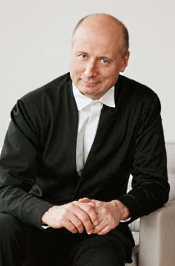
 I confess that, when it comes to performances led by Paavo
Jarvi, I may be a homer. We lived for eleven years in southwestern Ohio and had
season tickets for the Cincinnati Orchestra where Jarvi was the music director.
I cannot comment on what the band was like before Jarvi arrived, but it was
awfully good during his tenure, and his (their?) interpretations suited us
well. Thus it was that Paavo Jarvi’s countenance looking out from the cover of
this Alpha release grabbed my attention, and so here we are.
I confess that, when it comes to performances led by Paavo
Jarvi, I may be a homer. We lived for eleven years in southwestern Ohio and had
season tickets for the Cincinnati Orchestra where Jarvi was the music director.
I cannot comment on what the band was like before Jarvi arrived, but it was
awfully good during his tenure, and his (their?) interpretations suited us
well. Thus it was that Paavo Jarvi’s countenance looking out from the cover of
this Alpha release grabbed my attention, and so here we are.
While Jarvi was in Cincinnati, the orchestra recorded for Telarc. Many of the recordings in that series were conducted by the late Erich Kunzel, perhaps the most famous (notorious?) of those being the 1812 Overture – you know, the one with the booming canons that gave your subwoofer a true workout. However, the orchestra did record more “serious” repertoire under Jarvi, including Tchaikovsky’s Sixth Symphony. I found that performance good but not great, but it was a long time ago – how has his approach to Tchaikovsky’s music changed since then?
A few years ago, Jarvi left Cincinnati, subsequently assuming leadership of the Tonhalle Orchestra of Zurich. (No need to feel sorry for Cincinnati: the new music director, Louis Langree, is a very able replacement, and the newly renovated Music Hall sounds fabulous.) Among other projects, the Jarvi/Tonhalle partnership in Zurich has begun a cycle of the Tchaikovsky symphonies on the Alpha label, the Fifth being the first release.
As to the conception here, let me quote from Jarvi’s own description: “When I think of the Fifth Symphony, I think of vulnerability and hope. It looks directly into our soul….Unlike the Sixth, the Fifth still holds out hope for life.” This statement seems an apt description of what one hears on this very fine recording.
Usually, our reviews start with descriptions of the music, often stepping through the movements of a work pointing out highlights or idiosyncrasies of interpretation, with recorded sound mentioned last, almost as a footnote. In this case however, it's worth talking about the sound right up front because it contributes so greatly to the overall result. The major point is that I don’t recall ever hearing a recording that provides so much insight into the intricate inner voices of the orchestra. It is a commonplace that Tchaikovsky was a master of orchestral color, and in live performances, the attentive listener usually can pick out the various parts easily. In recordings, however, too often it is difficult to hear the inner details, particularly in loud, complex passages. Here, with what I suspect is a combination of some slight rearrangement of the players as well as careful miking of the orchestra, the brass and especially the woodwinds are more audible than usual. (Rearranging orchestral forces on the stage is not so unusual as some may think. There's nothing sacred about typical arrangements.) In whatever way the effect was produced, the result is revelatory.
I should add that the general quality of the recording is excellent, with very natural and uncompressed sound. Then too, the liner notes tell us that the recording was done live, but nary a distracting cough can be heard nor is post-performance applause audible. Audiences in Zurich must be exceedingly well-behaved.
Now, on to the performance. For many listeners, the touchstone recordings of the last two Tchaikovsky symphonies are the Mravinsky/Leningrad versions. For their time in 1960, the sound is quite good, but the interpretations are what make these recordings so special. In the case of the Fifth, the performance crackles with energy and passion, roaring through the piece at a blistering 42:08 and leaving the listener drained, or maybe overwhelmed. Jarvi’s approach is not quite so overtly passionate and it certainly is slower at 47:53, but that’s hardly surprising: everyone takes it slower than Mravinsky. (For a few comparisons, Gergiev is a leisurely 51:29, Honeck moves quickly at 46:06, and Neeme Jarvi is like son, like father at 47:24.)
 Tchaikovsky himself spoke of a “surrender to Fate” in
connection with this work. In keeping with the Fate motif, Jarvi’s opening is
quite slow and played very, very softly at first: we are stepping gingerly out
and peeking around the corner to see what Fate is up to. But things soon
accelerate and, while Jarvi and the Tonhalle do not quite throw off sparks like
the Leningrad group, they still bring plenty of feeling to the performance.
Despite the differences in timing, I heard Jarvi’s phrasing and approach as
fairly similar to Mravinsky’s – until the finale, where Mravinsky takes off at
an incredible, almost shocking pace. Jarvi gives the music plenty of energy,
but not like that – which is not necessarily a bad thing.
Tchaikovsky himself spoke of a “surrender to Fate” in
connection with this work. In keeping with the Fate motif, Jarvi’s opening is
quite slow and played very, very softly at first: we are stepping gingerly out
and peeking around the corner to see what Fate is up to. But things soon
accelerate and, while Jarvi and the Tonhalle do not quite throw off sparks like
the Leningrad group, they still bring plenty of feeling to the performance.
Despite the differences in timing, I heard Jarvi’s phrasing and approach as
fairly similar to Mravinsky’s – until the finale, where Mravinsky takes off at
an incredible, almost shocking pace. Jarvi gives the music plenty of energy,
but not like that – which is not necessarily a bad thing.
Independently of tempo, the fourth movement also is where interpretive differences among many performances are most obvious. The finale concludes a work that has vacillated between anxiety and hesitation on one hand and hope and determination on the other; the final movement supposedly represents “ultimate victory through strife.” The obvious reading thus comes down on the side of affirmation. But there is another reading, one that implies that the hope is superficial; that whistles past the graveyard; that swaggers along with false confidence, fearing that darkness and even despair lurk just underneath the surface. (Of course, there is no one correct view: surely a hallmark of great art is that it is open to multiple interpretations.) As the earlier quotation from Jarvi implies, this performance is in the former camp, emphasizing the positive and building a majestic soundscape for that view.
At this point in the review, it is common to call out a few illustrative details of the performance, either to praise some particularly felicitous phrasings or to pick some especially annoying nits. Frustratingly – for me, not so much for you – I found it difficult to carry out this duty. At the risk of sounding as though I am copping out completely, I found passage after passage nicely judged and well-played, with the Zurich forces producing music that seemed to flow naturally without calling attention to the conducting or playing. Indeed, it was only after several hearings that I became truly conscious of just how well-rehearsed and very much together the orchestra sounds: phrases start and stop precisely, accents are on the nose, with the musicians playing as one. Great playing like that does not call attention to itself, but instead keeps the attention on the music.
At this point, the astute reader will have noticed that I have yet to mention the second work on the disk, Francesca da Rimini. True, but let’s face it: the Fifth is the main attraction here. In brief, the Francesca is a solid, well-played performance – but I don’t find it as engaging or as powerful as its CD mate. Maybe it’s just me.
Heaven only knows how many commercial recordings of the Tchaikovsky Fifth have been released over the years. I recently found what purported to be a list of these recordings but gave up counting at 100 – and guessed that I was a quarter of the way through! Let’s just say that I own a few CDs of the Fifth, and I’ve heard more here and there – and with those in mind, I can recommend the Jarvi/Tonhalle recording as an excellent performance in excellent sound, well worth hearing even if you, too, have more recordings of the work than you really need.
BH
To listen to a brief excerpt from this album, click below:
By Bill Heck

While Jarvi was in Cincinnati, the orchestra recorded for Telarc. Many of the recordings in that series were conducted by the late Erich Kunzel, perhaps the most famous (notorious?) of those being the 1812 Overture – you know, the one with the booming canons that gave your subwoofer a true workout. However, the orchestra did record more “serious” repertoire under Jarvi, including Tchaikovsky’s Sixth Symphony. I found that performance good but not great, but it was a long time ago – how has his approach to Tchaikovsky’s music changed since then?
A few years ago, Jarvi left Cincinnati, subsequently assuming leadership of the Tonhalle Orchestra of Zurich. (No need to feel sorry for Cincinnati: the new music director, Louis Langree, is a very able replacement, and the newly renovated Music Hall sounds fabulous.) Among other projects, the Jarvi/Tonhalle partnership in Zurich has begun a cycle of the Tchaikovsky symphonies on the Alpha label, the Fifth being the first release.
As to the conception here, let me quote from Jarvi’s own description: “When I think of the Fifth Symphony, I think of vulnerability and hope. It looks directly into our soul….Unlike the Sixth, the Fifth still holds out hope for life.” This statement seems an apt description of what one hears on this very fine recording.
Usually, our reviews start with descriptions of the music, often stepping through the movements of a work pointing out highlights or idiosyncrasies of interpretation, with recorded sound mentioned last, almost as a footnote. In this case however, it's worth talking about the sound right up front because it contributes so greatly to the overall result. The major point is that I don’t recall ever hearing a recording that provides so much insight into the intricate inner voices of the orchestra. It is a commonplace that Tchaikovsky was a master of orchestral color, and in live performances, the attentive listener usually can pick out the various parts easily. In recordings, however, too often it is difficult to hear the inner details, particularly in loud, complex passages. Here, with what I suspect is a combination of some slight rearrangement of the players as well as careful miking of the orchestra, the brass and especially the woodwinds are more audible than usual. (Rearranging orchestral forces on the stage is not so unusual as some may think. There's nothing sacred about typical arrangements.) In whatever way the effect was produced, the result is revelatory.
I should add that the general quality of the recording is excellent, with very natural and uncompressed sound. Then too, the liner notes tell us that the recording was done live, but nary a distracting cough can be heard nor is post-performance applause audible. Audiences in Zurich must be exceedingly well-behaved.
Now, on to the performance. For many listeners, the touchstone recordings of the last two Tchaikovsky symphonies are the Mravinsky/Leningrad versions. For their time in 1960, the sound is quite good, but the interpretations are what make these recordings so special. In the case of the Fifth, the performance crackles with energy and passion, roaring through the piece at a blistering 42:08 and leaving the listener drained, or maybe overwhelmed. Jarvi’s approach is not quite so overtly passionate and it certainly is slower at 47:53, but that’s hardly surprising: everyone takes it slower than Mravinsky. (For a few comparisons, Gergiev is a leisurely 51:29, Honeck moves quickly at 46:06, and Neeme Jarvi is like son, like father at 47:24.)

Independently of tempo, the fourth movement also is where interpretive differences among many performances are most obvious. The finale concludes a work that has vacillated between anxiety and hesitation on one hand and hope and determination on the other; the final movement supposedly represents “ultimate victory through strife.” The obvious reading thus comes down on the side of affirmation. But there is another reading, one that implies that the hope is superficial; that whistles past the graveyard; that swaggers along with false confidence, fearing that darkness and even despair lurk just underneath the surface. (Of course, there is no one correct view: surely a hallmark of great art is that it is open to multiple interpretations.) As the earlier quotation from Jarvi implies, this performance is in the former camp, emphasizing the positive and building a majestic soundscape for that view.
At this point in the review, it is common to call out a few illustrative details of the performance, either to praise some particularly felicitous phrasings or to pick some especially annoying nits. Frustratingly – for me, not so much for you – I found it difficult to carry out this duty. At the risk of sounding as though I am copping out completely, I found passage after passage nicely judged and well-played, with the Zurich forces producing music that seemed to flow naturally without calling attention to the conducting or playing. Indeed, it was only after several hearings that I became truly conscious of just how well-rehearsed and very much together the orchestra sounds: phrases start and stop precisely, accents are on the nose, with the musicians playing as one. Great playing like that does not call attention to itself, but instead keeps the attention on the music.
At this point, the astute reader will have noticed that I have yet to mention the second work on the disk, Francesca da Rimini. True, but let’s face it: the Fifth is the main attraction here. In brief, the Francesca is a solid, well-played performance – but I don’t find it as engaging or as powerful as its CD mate. Maybe it’s just me.
Heaven only knows how many commercial recordings of the Tchaikovsky Fifth have been released over the years. I recently found what purported to be a list of these recordings but gave up counting at 100 – and guessed that I was a quarter of the way through! Let’s just say that I own a few CDs of the Fifth, and I’ve heard more here and there – and with those in mind, I can recommend the Jarvi/Tonhalle recording as an excellent performance in excellent sound, well worth hearing even if you, too, have more recordings of the work than you really need.
BH
To listen to a brief excerpt from this album, click below:


